Brandon Arkin, elder law attorney, Solkoff Legal, P.A.Brandon ArkinSolkoff Legal, P.A.

Delray Beach · Palm Beach County

Estate Planning in Delray Beach: Wills, Trusts and Incapacity

Estate planning is how you write down who decides, who inherits, and what should happen if you cannot speak for yourself. Brandon Arkin, at Solkoff Legal, P.A. in Delray Beach, prepares wills, trusts, and incapacity documents for families in Palm Beach County and across South Florida. This page is education. It is not legal advice, and it does not promise a tax result or a particular inheritance.
Grandparents with their granddaughter, smiling in the sunlight
Grandparents smiling outdoors with their grandchildren

Who is this Medicaid planning page for?

Most people who call are planning ahead, updating documents after a move to South Florida, or helping a parent who has asked them to sort out the folder. Financial advisors and care managers sometimes send clients here first for the basics.

The same office also helps with Florida Medicaid long-term care planning and the other work described under how I help. Estate planning on this site means the documents you sign in advance.

An older couple and their adult son together on a sunny porch with palm trees

Families planning ahead

You live in Delray Beach, Boca Raton, Boynton Beach or elsewhere in Palm Beach County, or your parents do. Nothing is on fire. You want instructions your children can actually follow, written while everyone can still sit at the table and disagree out loud. That is the calmest version of this work, and the one with the most options.

Couples

You're deciding who speaks for each of you, what the surviving spouse needs to stay in the house, and what should happen for children from this marriage or an earlier one. A plan for two people is not two copies of the same form.

Florida adds its own rules. If an owner dies leaving a spouse or a minor child, the Florida Constitution limits how the homestead can be left by will (Fla. Stat. 732.4015). A useful meeting names the differences instead of hoping they never matter.

Adult children helping a parent

A parent has asked you to "get the papers in order," or you've noticed the will in the drawer is from another state and another decade. You can help gather names and account lists. You can't sign for a parent who is still able to decide, and you shouldn't be the only one who knows what they wanted.

The parent should meet with the lawyer directly, at least part of the time without family in the room. That protects the documents later.

Papers that no longer match the life

A move to South Florida, a divorce, a death, a new grandchild, a house you sold or a child with a disability can leave an old will or beneficiary form describing a life you no longer live. Updating is ordinary maintenance, like servicing a car. It is not a sign that something has gone wrong.

Why should families plan now?

The reason is practical. Illness and long-term care rarely arrive on a day you picked, and the people you love shouldn’t have to guess at your wishes. Planning now is quieter than planning from a hospital hallway. It is not a prediction that something bad is about to happen.

Someone may need to act while you are still living

Estate planning isn't only about what happens after a death. If you can't pay a bill, talk to the bank or tell a doctor what you want, someone else has to. A Florida durable power of attorney (for money and property) and a designation of health care surrogate (for medical decisions) are how you choose that person while you still can.

Without them, your family may have to ask a court to appoint a guardian, which is a public, supervised and often slow process. You can also sign a preneed guardian declaration that names who you'd want if a court ever had to appoint one. It is signed in front of two witnesses, can be filed with the clerk of court, and creates a presumption in favor of the person you named (Fla. Stat. 744.3045).

Clarity is a kindness

A written plan lets a spouse or an adult child follow instructions instead of reconstructing a conversation everyone remembers differently. The documents should be readable by the people who will use them, with names spelled out, alternates named, and a short note on where the originals are kept. A binder no one can interpret isn't a plan.

Florida life makes old documents stale

Many Palm Beach County families arrive with wills signed in another state, or with nothing signed since the children were small. Florida generally honors a will that was valid where it was signed (Fla. Stat. 732.502). Out-of-state powers of attorney and health care documents can be harder to use at a Florida bank or hospital, and they may not reflect Florida homestead rules.

The people, the house and the accounts have changed, too. A review asks whether the documents still say what you mean. It doesn't assume you need to start over.

Long-term care often sits in the same folder

Families who come in for a will sometimes realize a parent may need care soon, or that no one could sign a Medicaid application if that day came. Estate planning and Medicaid planning are related. A power of attorney without Medicaid-planning powers, or a trust written without long-term care in mind, can limit options later. They aren't the same meeting, and neither one promises a particular result.

Parents walking with their child on a bike along a sunny park path

Florida estate planning documents, in plain English

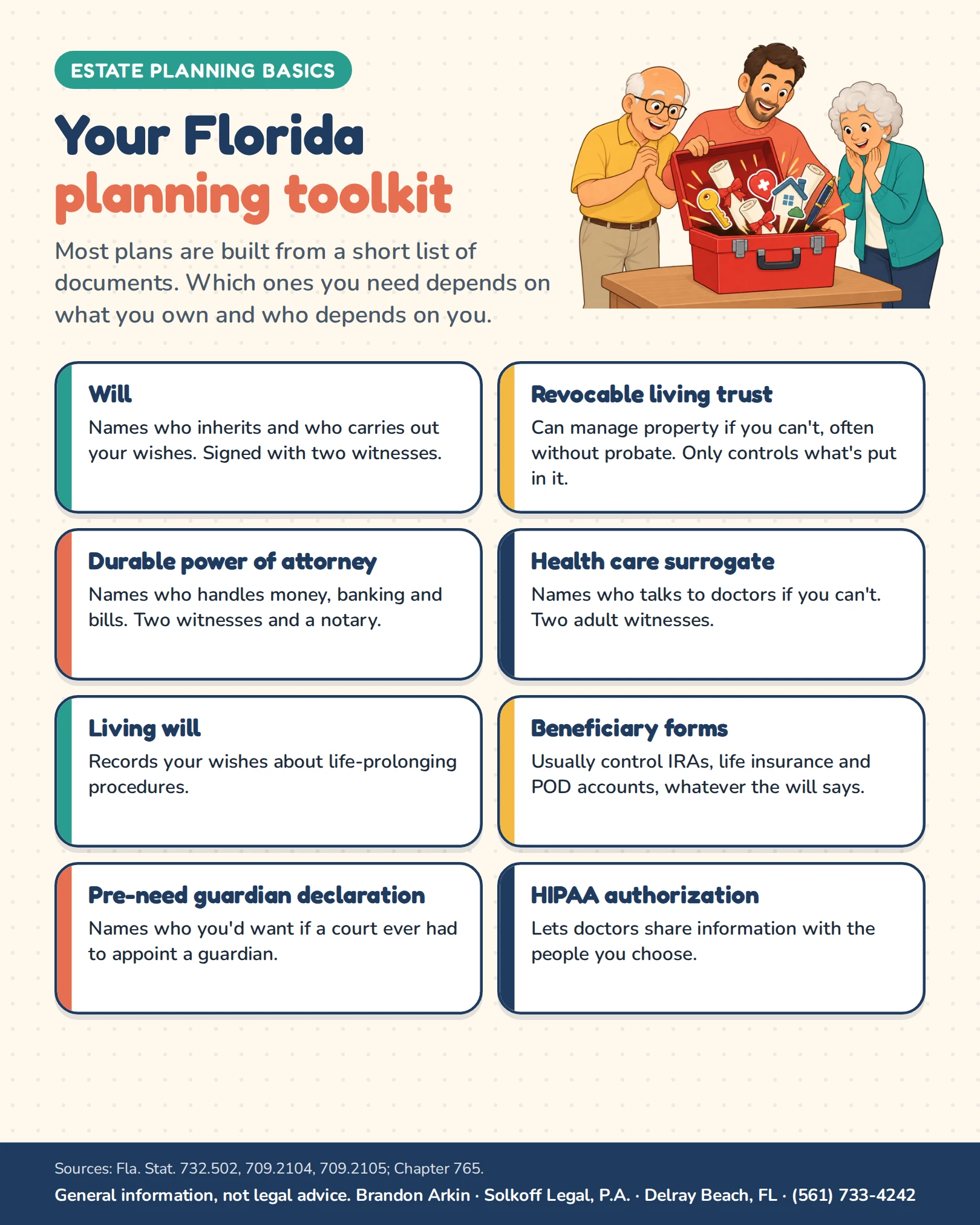
Most plans are built from a short list of documents. Which ones you need depends on what you own, who depends on you, and whether long-term care is already part of the picture. The descriptions below are for orientation. They aren’t forms to copy or a signing checklist for the kitchen table.

Florida estate planning documents explained: will, revocable living trust, durable power of attorney, health care surrogate, living will, beneficiary forms, preneed guardian declaration, and health-information sharing.

Last will and testament

A will names who receives the property that passes under it, and who you choose (the personal representative) to carry out those instructions. A Florida will must be in writing, signed at the end, and signed in front of two witnesses who also sign in front of you and each other (Fla. Stat. 732.502).

A will doesn't control everything. Retirement accounts, life insurance and anything with a beneficiary form follow that form, and jointly owned property may pass by how the title is written. Property that does pass under a will usually goes through probate, the court process for settling an estate. For general education: Florida has summary administration, a shorter process available when the probate estate, not counting property exempt from creditors, is $150,000 or less (raised from $75,000 effective July 1, 2026) or the person died more than two years ago, and formal administration for other estates (Fla. Stat. 735.201). This site does not list probate as a practice area. A will covers what is left. It isn't a complete map of every account unless the rest of the map is checked at the same time.

Florida revocable living trust

A revocable living trust is a document you can change or cancel while you're able to make decisions. You usually serve as your own trustee. The trust can hold property during your life, name a successor trustee to manage it if you can't, and say who receives it later, often without a probate case for the property inside it.

It is a tool, not a requirement for every Palm Beach County family. It only controls property actually placed in it, by retitling accounts, deeding the house to the trust, or naming the trust as a beneficiary. A trust that is signed and then left empty doesn't do the job people imagine.

A revocable trust is not a Medicaid strategy by itself. Because you can take the money back, Florida Medicaid generally treats what's inside as yours. For people with a disability, a special needs trust is a different tool: it can hold money for someone who receives SSI or Medicaid without automatically counting against them. One funded with the person's own money (a "(d)(4)(A)" trust, for someone under 65) must pay Medicaid back at death (42 U.S.C. 1396p(d)(4)(A)). A trust funded by parents or grandparents is generally written differently, and the details matter. This page doesn't treat any trust as a tax shelter or a reason to retitle a house based on an article.

Florida durable power of attorney

A durable power of attorney names an agent who can handle banking, bills, real estate, taxes and similar matters for you. "Durable" means the document says the authority continues even if you later become incapacitated (Fla. Stat. 709.2104). In Florida it must be signed by you and two witnesses and acknowledged before a notary (Fla. Stat. 709.2105).

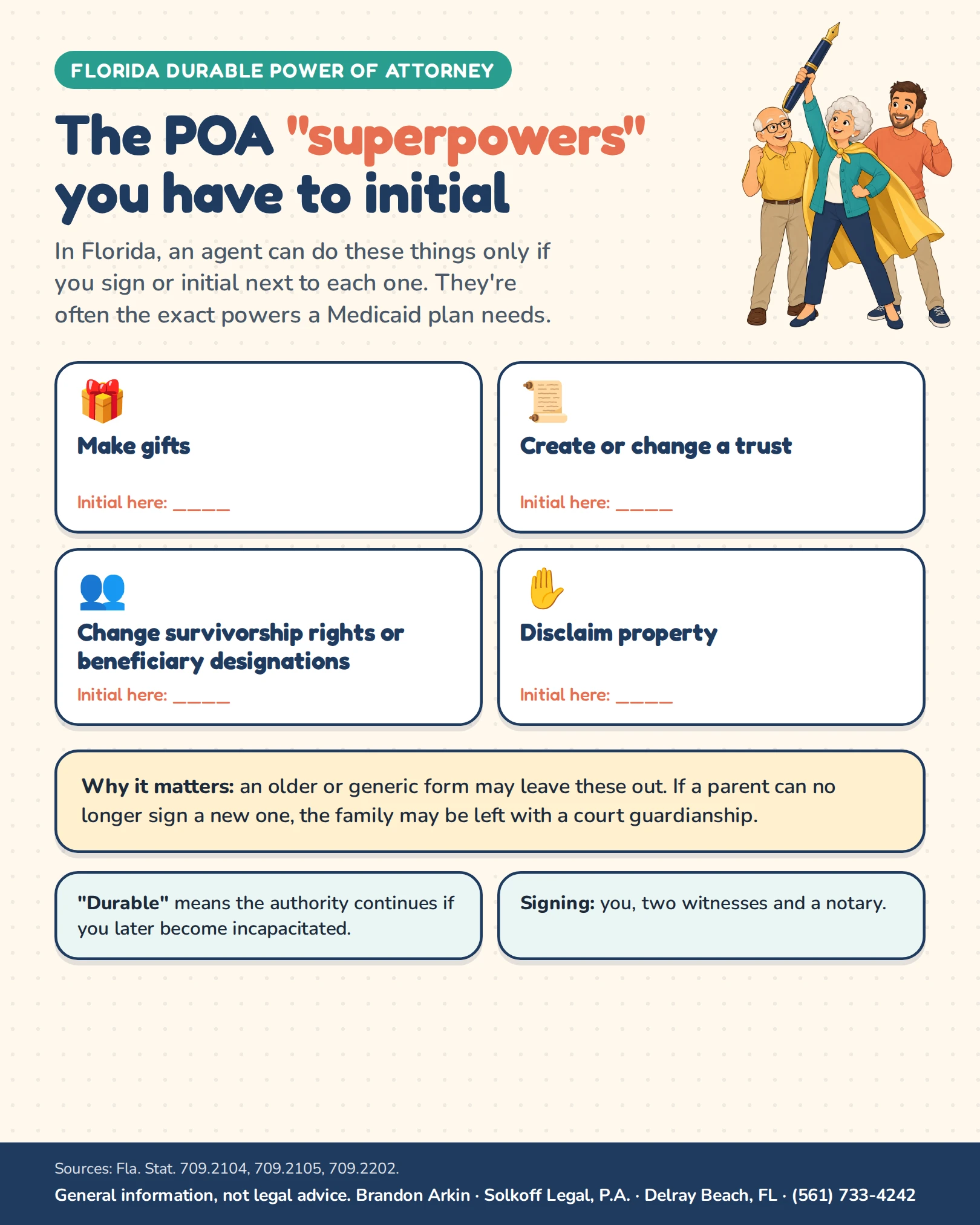
Some powers, sometimes called "superpowers," only work if you sign or initial next to each one: making gifts, creating or changing a trust, creating or changing survivorship rights or beneficiary designations, and disclaiming property (Fla. Stat. 709.2202). Those are often the exact powers a Medicaid plan or a special needs plan needs.

Banks read the wording closely, and vague or very old documents are sometimes refused. A person who no longer understands the document generally can't sign a new one. That's the practical reason to sign while it's easy, not a reason to give someone blanket control you don't intend.

Florida power of attorney powers that work only if initialed: making gifts, creating or changing a trust, changing survivorship rights or beneficiary designations, and disclaiming property (Fla. Stat. 709.2202).

Health care surrogate and living will in Florida

Under Chapter 765 of the Florida Statutes, families commonly sign two medical documents:

  • A designation of health care surrogate names the person who can talk with doctors and make medical decisions if you can't. You sign it in front of two adult witnesses. The surrogate can't be one of them, and at least one witness must not be your spouse or a blood relative. You can name an alternate, and the surrogate should get a copy (Fla. Stat. 765.202).
  • A living will records your wishes about life-prolonging procedures if you have a terminal condition or an end-stage condition, or are in a persistent vegetative state. It is also signed in front of two witnesses, at least one of whom is not your spouse or a blood relative (Fla. Stat. 765.302).

These are separate from the financial power of attorney, and most plans include both. Naming a surrogate doesn't take away your right to decide while you still can. It answers the question of who the hospital calls when you can't answer.

Beneficiary forms, checked with the will

The beneficiary form on file with a retirement plan, IRA, annuity or life insurance company usually controls that asset, no matter what the will says. The same goes for "payable on death" and "transfer on death" bank and brokerage accounts. An old form can name a former spouse, a parent who has died, or a child you meant to treat the same as the others.

Leaving an account outright to a family member who receives SSI or Medicaid can affect their benefits. A special needs trust is often named instead. Reviewing these forms is part of signing the plan, not an optional extra. Bring the forms and read them against the will.

Planning for a family member with a disability

Special needs trusts in Florida: what families should know

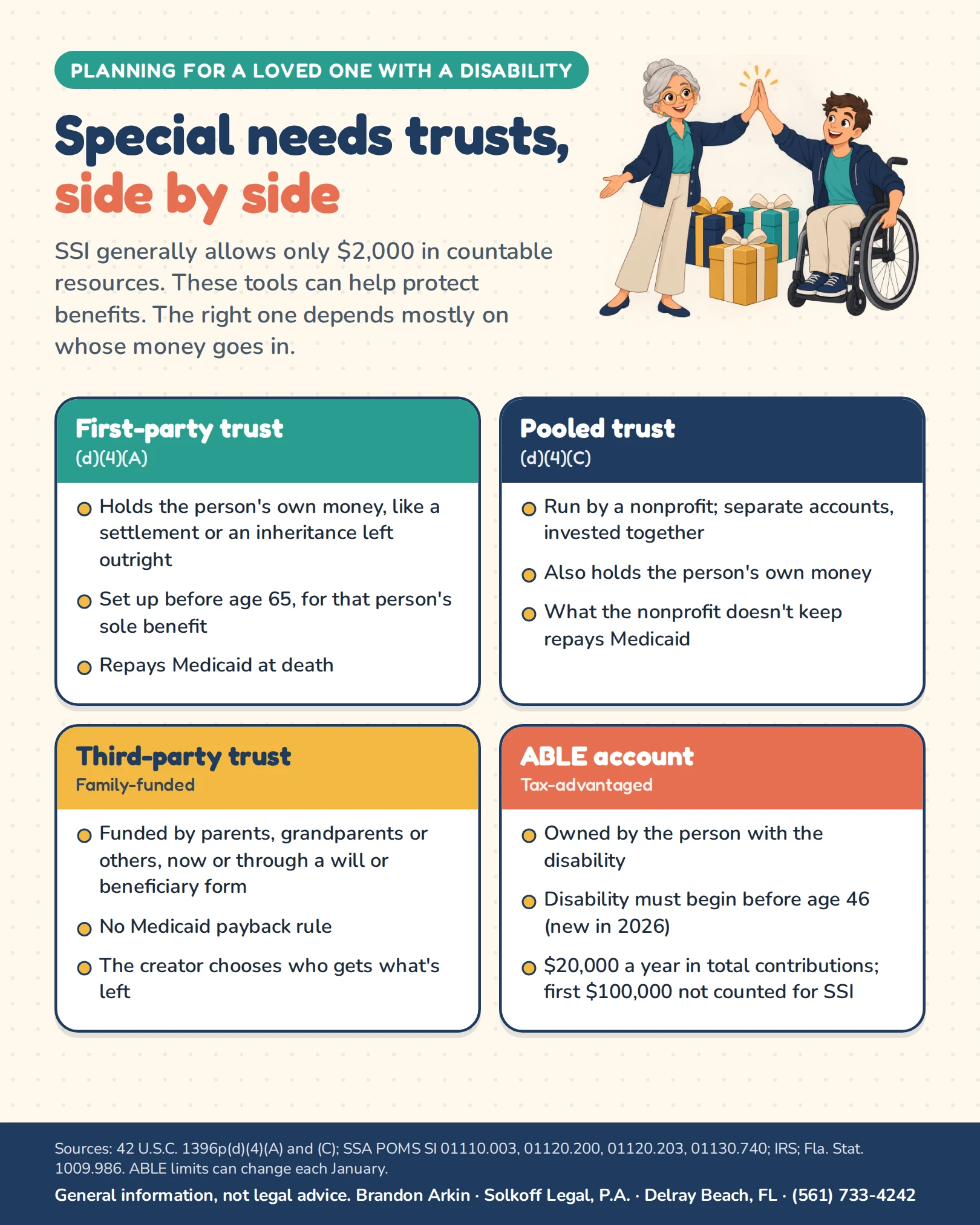
A special needs trust holds money for a person with a disability without that money automatically counting against needs-based benefits such as Supplemental Security Income (SSI) and Medicaid. SSI generally allows only $2,000 in countable resources for one person (SSA POMS SI 01110.003), so an inheritance left outright can end benefits that took years to obtain.

There are three main kinds of special needs trust. Which one fits depends mostly on whose money goes into it.

Side-by-side comparison of first-party (d)(4)(A), pooled (d)(4)(C), and third-party special needs trusts and ABLE accounts, including the 2026 ABLE age-46 rule, $20,000 annual contribution limit, and $100,000 SSI disregard.

First-party special needs trust, (d)(4)(A)

A first-party trust holds the disabled person's own money, such as a personal injury settlement, back benefits or an inheritance that was left to them outright. Federal law protects it from being counted for Medicaid if three conditions are met (42 U.S.C. 1396p(d)(4)(A)):

  • The person was under 65 when the trust was established.
  • The trust is for that person's sole benefit.
  • At death, the trust repays the state for Medicaid benefits it paid.

Since December 13, 2016, the person can set up the trust themselves. A parent, grandparent, legal guardian or court can also do it (SSA POMS SI 01120.203).

Pooled trust, (d)(4)(C)

A pooled trust is run by a nonprofit association. Each beneficiary has a separate account, but the money is invested together. Like a first-party trust, it holds the disabled person's own funds. Whatever the nonprofit doesn't keep at the person's death goes to repay Medicaid (42 U.S.C. 1396p(d)(4)(C)).

SSA applies no age limit to the pooled trust exception, but money moved into a pooled trust for someone 65 or older may still be treated as a transfer (SSA POMS SI 01120.203). Pooled trusts can suit smaller amounts, or families with no trusted person to serve as trustee.

Third-party special needs trust

A third-party trust is funded with someone else's money: a parent, a grandparent or another relative, during their life or through a will, a revocable trust or a beneficiary designation. Because it never held the beneficiary's own assets, it isn't subject to the (d)(4) payback rule, and the person who sets it up can choose who receives what's left (SSA POMS SI 01120.200).

How the trustee pays for things still matters. SSA counts some payments as income, and cash given directly to the beneficiary can reduce benefits. This is the trust most parents in Palm Beach County mean when they ask how to leave money to an adult child with a disability.

ABLE accounts, and the 2026 change

An ABLE account is a tax-advantaged savings account owned by the person with the disability. In Florida it is offered through the state's ABLE program (Fla. Stat. 1009.986). For 2026, total contributions from everyone combined are generally limited to $20,000 a year (IRS).

Starting January 1, 2026, eligibility expanded to people whose disability or blindness began before age 46, up from 26 (SSA POMS SI 01130.740). For SSI, the first $100,000 in the account isn't counted as a resource. At death, the state may claim what's left for Medicaid paid after the account was opened (26 U.S.C. 529A(f)). An ABLE account often works alongside a special needs trust rather than replacing one.

Beneficiary forms, inheritances and benefits

For SSI, an inheritance is generally counted as unearned income in the month it is received (20 CFR 416.1123). Whatever is left the next month counts as a resource. A single life insurance payout, IRA or "payable on death" account that names a disabled adult child directly can push them over the $2,000 limit and affect Medicaid as well.

The fix is usually upstream. Name the third-party special needs trust, not the person, on beneficiary forms, and check that the will and any revocable trust do the same. Ask grandparents and other relatives to do the same, because their forms are often the ones nobody checks. If money does arrive outright, a first-party or pooled trust may still be an option, but it carries the Medicaid payback.

A hypothetical example

A Boca Raton couple might have three adult children, one of whom receives SSI and Medicaid because of a disability that began at 30. Their wills split everything three ways, and their life insurance names all three children directly. A planning conversation might look at:

  • a third-party special needs trust for that child's share;
  • updated beneficiary forms that name the trust;
  • whether the child, now eligible under the age-46 rule, should open an ABLE account for everyday expenses.

The right mix would depend on the family's facts and on how the trustee is likely to use the money.

Read how special needs planning connects to Medicaid

How does estate planning connect to Medicaid?

A will and a power of attorney are elder-law documents when the question is also “who can act if Mom needs care in Palm Beach County.” Read the Florida Medicaid long-term care guide if that is the question that brought you here. The home page lists the three areas of this site — elder law, Medicaid planning, and estate planning — under how I help.

Who can sign if care is needed

If a parent can't sign, the agent under a valid Florida durable power of attorney is often the one who can talk to the bank, gather records, file a Medicaid application through ACCESS Florida, or set up a Qualified Income Trust. If the document doesn't include the specific initialed powers Florida requires for gifts, trusts and beneficiary changes, some planning steps may not be available. Without valid authority, a Florida Medicaid application can stall while the family looks for another way to act.

That's a reason to coordinate estate planning with long-term care planning. It isn't a reason to sign a power of attorney nobody has read.

How the house and accounts are titled

The name on a deed, and what a trust says about income and principal, can matter later when someone asks about long-term care coverage. A Lady Bird deed (enhanced life estate deed) keeps full ownership and control with the owner during life and passes the home to named people at death. Florida Medicaid treats it like other real property the owner holds, so the homestead exclusion can still apply (ESS Policy Manual, 1640.0613.01). Adding a child to a deed or an account, by contrast, may count as a transfer.

Bring the documents you already have. Don't retitle a house, add a child to an account, or move assets into a trust because an article said those steps "work with Medicaid." The Medicaid guide on this site explains how the 60-month look-back can turn an unplanned transfer into a delay. The two conversations belong together, but neither is a script.

What this meeting is, and is not

The work described here is the paperwork you sign while you can still choose: wills, trusts, powers of attorney, health care directives and preneed guardian declarations, for families whose questions often include elder law and long-term care.

On taxes: Florida has no state estate tax or inheritance tax (Florida Department of Revenue). In 2026 the federal estate and gift tax basic exclusion is $15,000,000 per person, and the annual gift exclusion is $19,000 per recipient (IRS). A gift under the IRS annual exclusion can still count as a transfer under Florida Medicaid's look-back. That's general information, not a promise about taxes or about who will inherit a particular dollar. Court work after a death, and guardianship cases, are not practice areas on this site.

How working together typically goes

The order is: a consultation, then your goals, then draft documents, then a signing. You’ll see drafts ahead of time, not for the first time on the day you’re asked to sign.

  1. 1

    Consultation

    How do you talk to aging parents about money? is about who you want to protect, who you trust to decide, and what is already signed. A rough list of the house, accounts, and life insurance is enough. Exact balances can come later. If a parent’s care is already on your mind, say so at the start.

  2. 2

    Goals

    Before anything is drafted, the meeting names the choices in plain language:

    • Who manages money if you can't.
    • Who speaks to doctors.
    • What a spouse needs to stay in the house.
    • What you want for children, grandchildren or anyone else you support.
    • Whether anyone who receives, or may need, SSI or Medicaid needs a special needs trust.
    • Where an old document no longer fits.

    Goals come before forms.

  3. 3

    Documents

    Drafts are written so you can read them, not only so a lawyer can file them. You should be able to point to the sentence that names your decision-maker and the sentence that says who receives the house.

    If a revocable trust is part of the plan, the conversation includes what has to be retitled into it, what should stay outside it, and which beneficiary forms should be updated to match.

  4. 4

    Signing

    Florida documents have specific signing rules. A will needs two witnesses. A durable power of attorney needs two witnesses and a notary. A health care surrogate designation needs two adult witnesses, at least one of whom is not your spouse or a blood relative. Signing at a kitchen table without those formalities can leave you with documents a bank or a hospital won't accept.

    The signing meeting is part of the work. Afterward you should know where the originals are kept, and which people need a copy of the power of attorney or the health care surrogate designation.

Put your instructions in writing while everyone can still choose

Call or request a consultation. Bring whatever is already signed, even if it is incomplete. Solkoff Legal, P.A. · (561) 733-4242 · 2605 West Atlantic Avenue, Suite A-103, Delray Beach, FL 33445. A call or an email does not by itself create an attorney-client relationship.

Solkoff Legal, P.A. · (561) 733-4242

CallRequest consultation