For hospital social workers and case managers
Hospital discharge to a nursing home with Medicaid pending in Florida
By Brandon Arkin, elder law attorney, Solkoff Legal, P.A.

By Brandon Arkin, elder law attorney, Solkoff Legal, P.A.
Updated November 5, 2026
Medicare SNF coverage: the 3-midnight rule and the day-21 cliff
Original Medicare covers skilled nursing facility care only after a medically necessary inpatient stay of at least 3 consecutive days. The day of admission counts, the day of discharge doesn't, and time in the ER or in observation before the inpatient order doesn't count (Medicare.gov; CMS). The patient generally must enter the SNF within 30 days of discharge and need daily skilled care. Medicare Advantage plans and some ACO arrangements may waive the 3-day requirement, so check the plan.
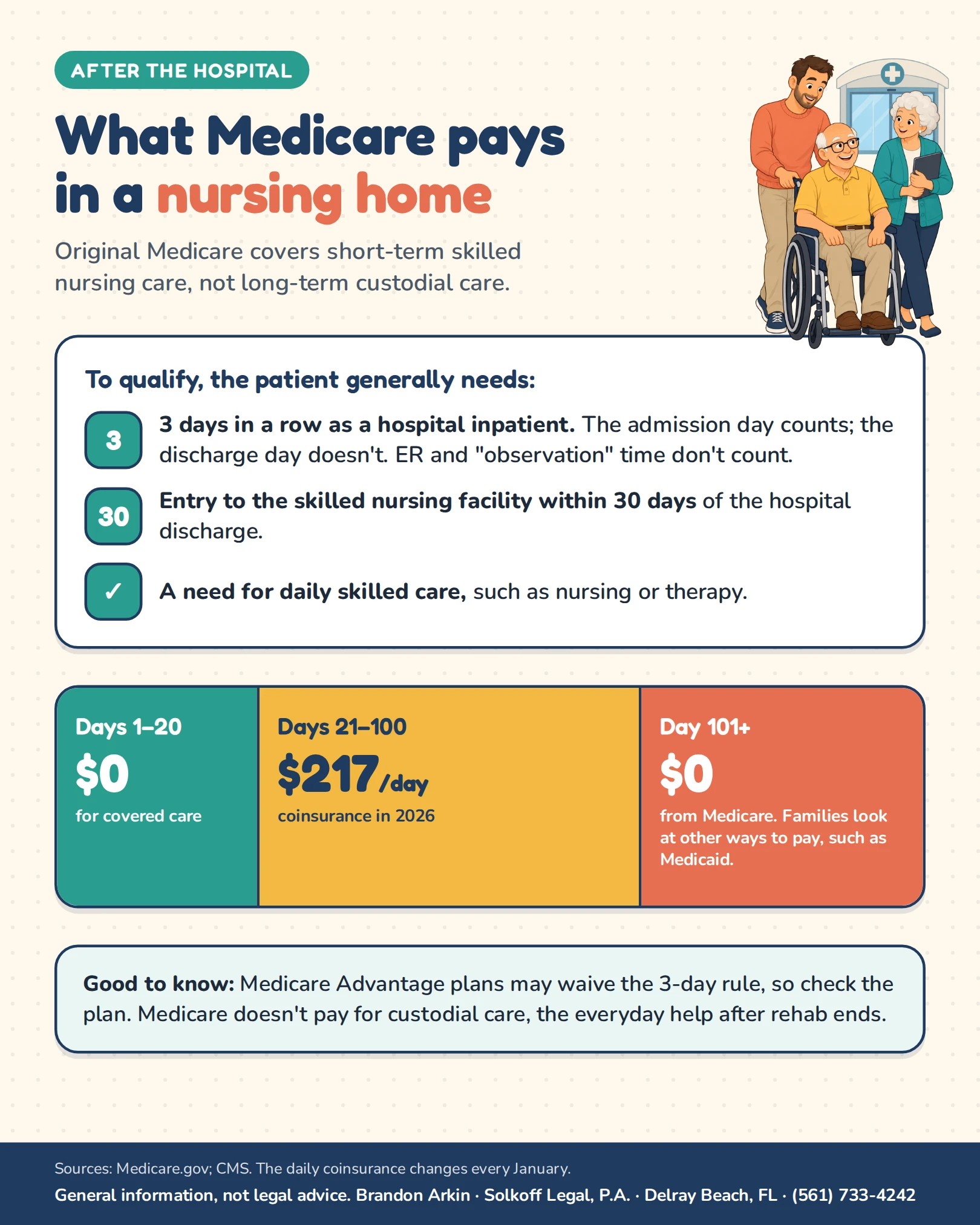
| Benefit period, 2026 | Patient pays under Original Medicare |
|---|---|
| SNF days 1–20 | $0 |
| SNF days 21–100 | Up to $217 per day |
| SNF day 101 and on | All costs |
| Inpatient hospital deductible | $1,736 |
Source: CMS 2026 Medicare costs.
The family should hear this early: "up to 100 days" is a ceiling, not a promise. Coverage ends when skilled need ends, and many patients are discharged from Medicare-covered care well before day 100. Day 21 is when private-pay pressure usually begins, unless a Medigap policy covers the coinsurance.
Observation status and the MOON
A patient in outpatient observation is not an inpatient, however long they stay, and those days don't count toward the 3-day rule. Under the NOTICE Act, hospitals must give the Medicare Outpatient Observation Notice (MOON, CMS-10611) to Medicare beneficiaries, including Medicare Advantage enrollees, who receive more than 24 hours of observation services. It must be delivered no later than 36 hours after observation begins, or at release if sooner, with an oral explanation and a signature acknowledging receipt (CMS). When a family learns at discharge that the SNF stay won't be covered, the MOON is usually the first document they ask about.
Discharge to a nursing home with Medicaid pending
When Medicare won't cover the stay, or will end soon, the long-term plan is often Florida's Institutional Care Program (ICP) Medicaid. Nursing home residents receive it through a Statewide Medicaid Managed Care long-term care plan after CARES confirms nursing facility level of care (s. 409.979). The waitlist in that statute applies to home and community-based services, not to nursing facility residents. Whether a facility will accept a "Medicaid pending" admission is its own decision, and many will ask what the payer source and application timeline are.
July 2026 Florida figures from DCF Appendix A-9:
- Countable asset limit for the applicant: $2,000.
- Income cap: $2,982 per month (see the section on QITs below).
- Personal needs allowance: $160 per month.
- Community spouse resource allowance: up to $162,660.
- Minimum monthly maintenance needs allowance: $2,705, with a cap (CSMIA) of $4,067.
- Home equity limit: $752,000.
- Transfer penalty divisor: $10,645 per month of penalty for gifts within the 60-month look-back.
A married patient whose spouse stays home is the most common case where planning changes the result. The rules protect the community spouse's assets and income only to the extent the application is set up to use them.
No retroactive Medicaid for adults 21 and over
Since February 1, 2019, Florida has given no retroactive Medicaid coverage to non-pregnant adults 21 and older. Coverage can start no earlier than the first day of the month in which the application is received (AHCA; s. 409.904(12)(b)). Children and pregnant women still have up to 90 days of retroactive coverage.
In practice, the month the application is filed matters. An application filed on the 30th can cover that whole month, but one filed on the 1st of the next month can't, even if the patient was eligible all along. Applications can be filed while verifications are still being gathered. Waiting for a "complete" file can cost a month of private pay.
QIT urgency when income is over $2,982
If the patient's gross monthly income is over $2,982, even by a dollar, Florida ICP eligibility requires a qualified income trust (a "Miller trust"). The trust must be irrevocable and hold only the patient's income, and DCF sends it to legal counsel for review. The excess income must actually be deposited into the trust account in the month it is received. Income isn't excluded until it is placed in the trust (DCF ESS manual; DCF policy guidance). Combined with the lack of retroactive coverage, a month without a funded QIT can be a month without coverage. Signing the trust and opening the account usually needs the patient, if they have capacity, or someone with financial authority, such as an agent under a durable power of attorney or a guardian.
Patients with no POA or health care surrogate
If an incapacitated patient has no surrogate or guardian, s. 765.401 sets the order of proxies: a guardian, then the spouse, an adult child (or a majority of reasonably available adult children), a parent, an adult sibling (or a majority), an adult relative who has shown special care and concern, and a close friend. Last on the list is a licensed clinical social worker or a graduate of a court-approved guardianship program, selected by the provider's bioethics committee and not employed by the provider. A proxy decides based on what the patient would have wanted. A decision to withhold or withdraw life-prolonging procedures needs clear and convincing evidence of the patient's wishes or, if they are unknown, of the patient's best interest.
Under s. 765.205, a surrogate may apply for public benefits and authorize admission, discharge or transfer, and s. 765.401(3) makes those duties apply to proxies. A proxy, however, has no authority over the patient's money. If a QIT must be funded, or property sold or retitled, and no valid durable power of attorney exists, guardianship, including emergency temporary guardianship, may be the only path. That takes time, so flag it early.
Where the Baker Act and Marchman Act end
These statutes are not discharge tools for dementia. For Baker Act purposes, "mental illness" excludes conditions manifested only by dementia or traumatic brain injury (s. 394.455), and involuntary examination under s. 394.463 requires mental illness plus refusal or inability to consent and a risk of harm or self-neglect. The Marchman Act (s. 397.675) addresses substance abuse impairment. For a patient with dementia who can't decide where to live, the usual tools are a surrogate, a proxy or a guardianship.
Discharge-planning checklist: long-term care with Medicaid pending
Print this checklist
Questions discharge planners ask
Will Medicare cover the nursing home if the patient was in observation?
Under Original Medicare, generally not. SNF coverage requires a medically necessary inpatient stay of at least 3 consecutive days, counting the admission day but not the discharge day, and outpatient observation time doesn't count toward those days. A patient who spent two nights in observation and one as an inpatient has one qualifying day. Medicare Advantage plans and some ACO programs may waive the 3-day rule, so check the plan's terms. If the stay won't be covered, the family needs to know right away so that private pay, Medicaid timing and any QIT can be addressed before the discharge.
Can Florida Medicaid pay for nursing home days before the application?
Not for most older adults. Since February 1, 2019, Florida has given no retroactive coverage to non-pregnant adults 21 and older, so ICP coverage can begin no earlier than the first day of the month in which the application is received. Children and pregnant women still have up to 90 days of retroactive coverage. Because of that, the date the application is filed matters a great deal. Filing before month-end, even with verifications still to come, can protect a full month. Eligibility still depends on the asset, income and level-of-care rules.
What if the patient's income is just over the Medicaid limit?
In 2026, if gross monthly income is over $2,982, Florida ICP eligibility requires a qualified income trust. Being over by a few dollars counts the same as being over by a thousand. The trust must be irrevocable and hold only the patient's income, and the excess must be deposited into the trust account in the month it is received, because DCF doesn't exclude income until it is in the trust. Someone with legal authority has to sign the trust and manage the account: the patient, an agent under a durable power of attorney, or a guardian. A health care proxy doesn't have that authority.
Solkoff Legal, P.A. does not pay referral fees or give anything of value for a recommendation, consistent with Florida Bar Rules 4-7.17 and 4-7.18. Client information is shared only with the client's consent, and records are requested only as the client directs.
If a client or patient is facing one of these questions, Brandon Arkin at Solkoff Legal, P.A. can be reached at (561) 733-4242.
Talk through the next step
Bring your questions, a list of accounts and any papers a hospital, nursing home or Medicaid office has sent you. Call the Delray Beach office or request a consultation, and I can look at where things stand and what may come next. A phone call or an email does not by itself create an attorney-client relationship.
Solkoff Legal, P.A. · (561) 733-4242