
For seniors and couples
Aging in Place in Florida: Paying for Home Care and Planning Ahead
By Brandon Arkin, elder law attorney, Solkoff Legal, P.A.
By Brandon Arkin, elder law attorney, Solkoff Legal, P.A.
Updated November 2026
What "aging in place" means
Aging in place means staying in your own home, safely and comfortably, as your needs change. For many people it's the goal. It can also take planning.
Home care comes in two kinds. Skilled care is medical care from a nurse or therapist, like wound care or physical therapy. Custodial care is help with daily life, like bathing, dressing, meals and getting around. Most people who need long-term help at home need custodial care, and that's the kind that's hardest to pay for.
What Medicare covers at home
Medicare is the federal health insurance program for people 65 and older. It covers home health care only in limited cases. Your doctor must certify that you're homebound, which means leaving home is hard without help, and that you need part-time or intermittent skilled care. Medicare defines "intermittent" as skilled nursing needed fewer than 7 days a week, or daily for less than 8 hours a day for up to 21 days (Medicare).
A home health aide can help with bathing or dressing, but only while you're also getting skilled care. Medicare doesn't pay for 24-hour care at home or for custodial care alone (Medicare.gov).
So Medicare may help after a hospital stay or surgery. It usually won't pay for a long-term aide.
Medicaid home and community services
Medicaid is the joint federal-state program for people with limited income and assets. In Florida, long-term care at home is provided through the Statewide Medicaid Managed Care Long-Term Care program, called SMMC LTC. You must be 65 or older (or 18 or older with a disability), meet Medicaid's financial rules, and be found by the state's CARES program to need nursing home level of care (Elder Affairs).
Covered home services include personal care, homemaker help, home-delivered meals, adult day health care, respite care for family caregivers, a personal emergency response system, and home accessibility adaptations like grab bars (AHCA). Each person gets services based on need, not all of them.
There's a catch: home and community services have a waitlist. People are released by a priority score based on frailty, not by time on the list (Fla. Stat. 409.979). To be screened, call your local Aging and Disability Resource Center through the Elder Helpline at 1-800-963-5337. Get screened early and ask to be rescreened if your health changes.
The 2026 Florida limits for long-term care Medicaid include a $2,982 monthly income cap and a $2,000 asset limit for a single person (DCF Appendix A-9). Your home is usually not counted while you live there, up to $752,000 in equity, and with no cap when a spouse lives there. Income over the cap may be handled with a special trust. Medicaid myths and Medicaid planning explain more.
State programs and private options
Florida's Department of Elder Affairs runs programs for people 60 and older that aren't Medicaid. Community Care for the Elderly (CCE) offers in-home services to frail elders based on an assessment (Elder Affairs). Home Care for the Elderly (HCE) supports elders living with family, with a basic subsidy of $160 a month and possible extra help for supplies, ramps and home modifications (Elder Affairs). Funding is limited, and the ADRC handles intake.
Private options include paying a home care agency, hiring a caregiver directly, long-term care insurance, and veterans' benefits. If you served in wartime, see VA Aid and Attendance.
Many families also pay a relative to help. That can affect Medicaid unless it's done with a written agreement. Getting paid to care for a parent covers this.
Reverse mortgages and Medicaid
A reverse mortgage lets you borrow against your home's value without monthly loan payments. The most common type, the Home Equity Conversion Mortgage (HECM), is for homeowners 62 and older who live in the home as their main residence. You must meet with a HUD-approved counselor first (HUD). You still have to pay property taxes, homeowners insurance and upkeep (CFPB).
How it interacts with Medicaid:
- Loan money generally isn't income when you receive it. But money you keep past the month you receive it counts as an asset (SSA POMS SI 01120.220). Florida Medicaid follows the same treatment.
- The loan generally becomes due if you're away from home for more than 12 consecutive months in a hospital, nursing home or assisted living facility and no co-borrower lives there (CFPB). A spouse who isn't on the loan may or may not be able to stay.
A reverse mortgage can fund home care for a while. It can also use up equity you or a spouse may need later. Talk it over with a HUD counselor and an elder law attorney before you sign.
Making your home safer
Small changes may help you stay home longer: grab bars, a walk-in shower, better lighting, removing loose rugs, a ramp, a raised toilet seat and a medical alert device.
Paying for these can come from savings, HCE special subsidies, or SMMC LTC home accessibility adaptations, which cover changes like grab bars but not major work like roof repairs or new carpeting (AHCA). If you're planning for Medicaid, paying for home repairs and modifications with your own money is often allowed, because you're spending on yourself and your home. Get advice first if the amounts are large.
Who decides if you can't
Staying home is easier with someone you trust ready to step in. Without signed papers, your family may need a guardianship, a court process to appoint someone to make decisions for you.
Four documents keep the choice in your hands:
- A durable power of attorney, naming an agent for money matters (Fla. Stat. 709.2105).
- A health care surrogate designation, naming someone for medical decisions (Fla. Stat. 765.202).
- A living will, stating your wishes about life-prolonging care.
- A preneed guardian designation, naming who should serve if a guardianship is ever needed (Fla. Stat. 744.3045).
If you have none of these, Florida law lists family members who may make health decisions as a "proxy", starting with a guardian, then a spouse, then adult children (Fla. Stat. 765.401). For money matters, there is no similar list.
Tell the people you name what you want, especially whether you'd rather stay home even if it carries some risk. Choosing who will decide for you and estate planning go deeper.
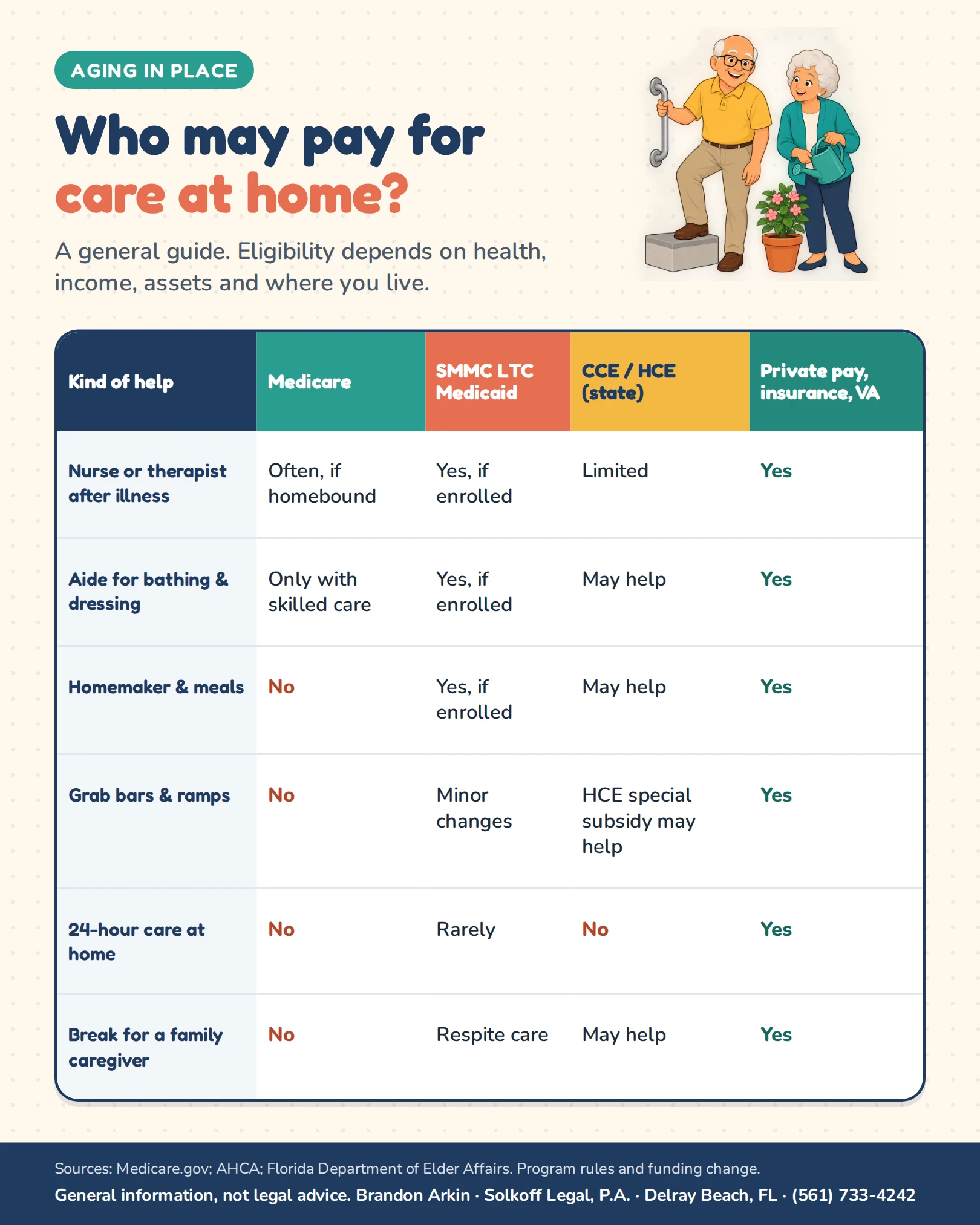
Decision table: who may pay for which care at home
A general guide. Eligibility depends on your health, income, assets and where you live.
| Kind of help | Medicare | SMMC LTC Medicaid | CCE / HCE (state) | Private pay, insurance, VA |
|---|---|---|---|---|
| Nurse or therapist after illness | Often, if homebound | Yes, if enrolled | Limited | Yes |
| Aide for bathing and dressing | Only with skilled care | Yes, if enrolled | May help | Yes |
| Homemaker and meals | No | Yes, if enrolled | May help | Yes |
| Grab bars and ramps | No | Minor changes | HCE special subsidy may help | Yes |
| 24-hour care at home | No | Rarely | No | Yes |
| Break for a family caregiver | No | Respite care | May help | Yes |
Does Medicare pay for a home health aide in Florida?
Only in limited cases. Medicare may pay for part-time home health aide help, like bathing or dressing, but only if you're homebound and also getting skilled care such as nursing or therapy. It doesn't pay for 24-hour care or for an aide when custodial help is all you need. Many people learn this after a hospital stay, when skilled care ends and the aide stops. Long-term help at home is usually paid privately, by long-term care insurance, by VA benefits for some veterans, or through Florida's SMMC LTC Medicaid program.
Is there a waitlist for Medicaid home care in Florida?
Yes. Home and community-based services under Florida's SMMC LTC program have a statewide waitlist. After a phone screening by your local Aging and Disability Resource Center, you get a priority score based on frailty. Releases are made by score, not by how long you've waited, so a change in your health may move you up if you ask to be rescreened. Some groups, such as certain nursing home residents moving home, may qualify for priority enrollment. Call the Elder Helpline at 1-800-963-5337 to start the screening.
Will a reverse mortgage stop me from getting Medicaid?
Not by itself. Under the SSI-based rules Florida generally uses, reverse mortgage loan money isn't income in the month you receive it. Money you keep into the next month counts as an asset, though, and too much can put you over the $2,000 limit. The loan also generally comes due if you're in a health care facility for more than 12 consecutive months with no co-borrower at home. Whether a reverse mortgage fits your plan depends on your health, your spouse's situation and your other assets. Talk with a HUD counselor and an elder law attorney before signing.
If your family is facing one of these questions, you can reach Brandon Arkin at Solkoff Legal, P.A. at (561) 733-4242.
Talk through the next step
Bring your questions, a list of accounts and any papers a hospital, nursing home or Medicaid office has sent you. Call the Delray Beach office or request a consultation, and I can look at where things stand and what may come next. A phone call or an email does not by itself create an attorney-client relationship.
Solkoff Legal, P.A. · (561) 733-4242