For seniors and couples
Helping Your Grandchildren Without Hurting Your Own Plan
By Brandon Arkin, elder law attorney, Solkoff Legal, P.A. · Updated November 2026

By Brandon Arkin, elder law attorney, Solkoff Legal, P.A.
Updated November 2026
Imagine a couple in Boca Raton with four grandchildren. They'd like to help with college, maybe a first car, and they've heard they can give $19,000 a year to each grandchild "tax-free." That's true for federal gift tax. But if one of them needs nursing home care in the next five years, those same gifts could delay Medicaid.
Helping grandchildren is one of the joys of having saved well. This guide explains the two different rulebooks, the most common ways grandparents give, and how to match the gift to your own plan.
Two rulebooks: the IRS and Medicaid
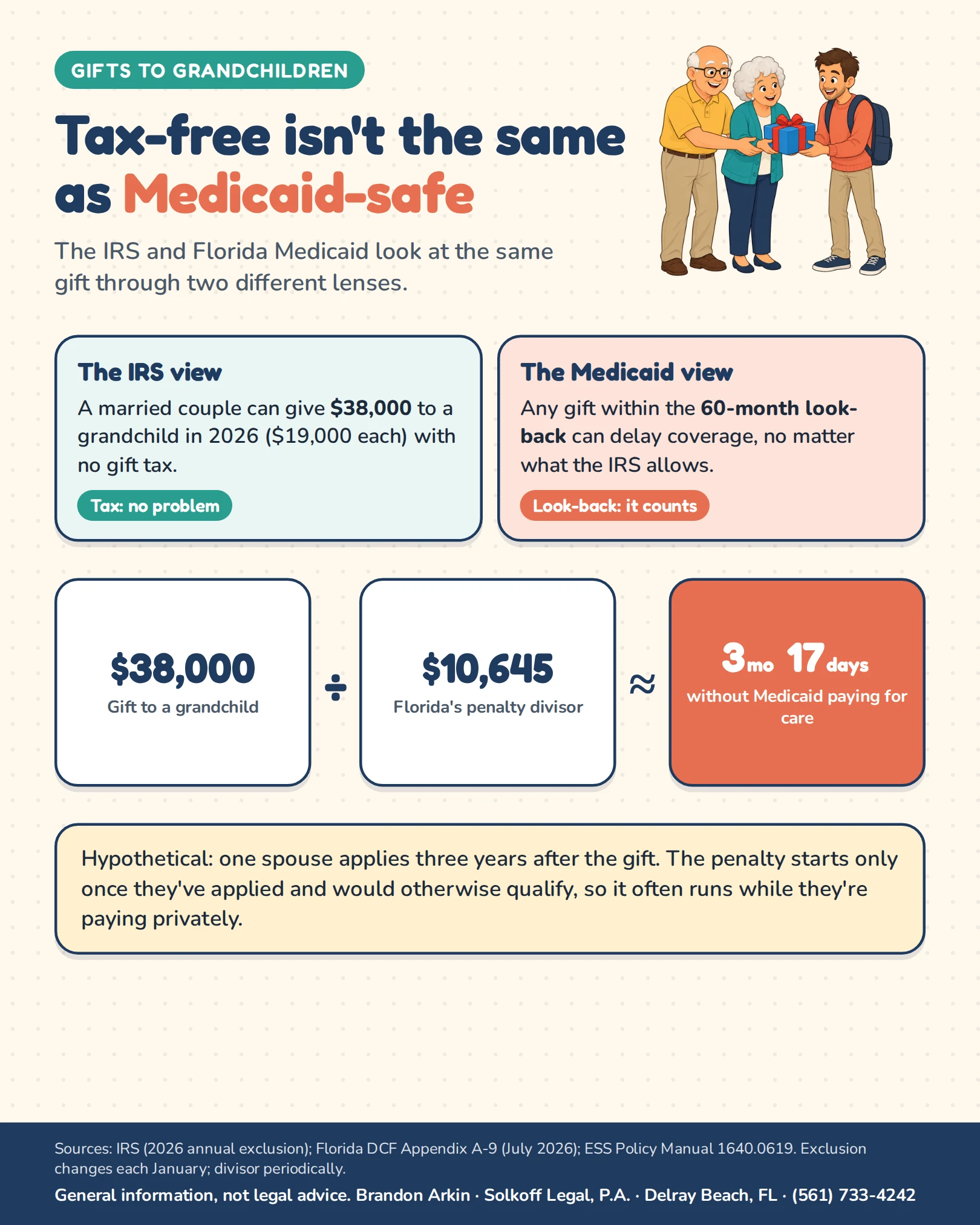
The IRS rule. In 2026, you can give up to $19,000 to any one person without using any of your lifetime gift and estate tax exemption. A married couple can give $38,000 per grandchild (IRS). Tuition paid directly to a school and medical bills paid directly to a provider aren't counted at all. Even above $19,000, most families owe no gift tax, because the lifetime exemption is $15,000,000 per person in 2026 (IRS). A larger gift usually just means filing a gift tax return.
The Medicaid rule. Florida Medicaid has no annual gift allowance. When you apply for Medicaid to pay for nursing home care or long-term care at home, DCF reviews every transfer in the 60 months before you apply (ESS Policy Manual 1640.0608). It presumes a gift was made to qualify for Medicaid unless you show otherwise (ESS Policy Manual 1640.0606). Tuition paid directly to a college is still a gift for Medicaid purposes.
So a gift can be completely fine with the IRS and still cause a Medicaid problem. The Medicaid myths article covers this mix-up.
What a gift could cost you later
DCF turns gifts into a waiting period. It divides the total given away by the state's average monthly private nursing home cost, $10,645 in 2026 (DCF Appendix A-9). The result is the number of months Medicaid won't pay for long-term care (ESS Policy Manual 1640.0618).
For example, if a couple gives $38,000 to a grandchild and one of them applies for Medicaid three years later, the penalty would be about 3 months and 17 days. The penalty clock doesn't start when the gift is made. It starts once you've applied and would otherwise qualify (ESS Policy Manual 1640.0619). So you're likely to be in a nursing home, paying privately, while the penalty runs.
If the gift is fully returned, the penalty is removed (ESS Policy Manual 1640.0620). But a grandchild may have already spent it on tuition.
The practical question is simple: if you gave this money away and needed care in the next five years, could you still pay for that care? If the answer is yes, a gift may fit your plan. If you aren't sure, talk it through first. The Medicaid planning page explains the look-back in more detail.
529 college savings plans
A 529 plan is a tax-advantaged account for education costs. Grandparents like them because the money grows tax-free for qualified expenses. Federal law also lets you spread one large contribution over five years for gift tax purposes, so one person could put in up to $95,000 at once without using lifetime exemption (26 U.S.C. 529(c)(2)(B)). You make that choice on a gift tax return.
For Medicaid, ownership matters. DCF's general rule is that anyone with the legal ability to dispose of an asset is treated as its owner (ESS Policy Manual 1640.0300). Most 529 plans let the account owner take the money back. So a 529 in your name is likely to count as your asset. If you change the owner to your child to qualify, DCF may treat that as a gift. A 529 owned by the grandchild's parent, which you contribute to, is a gift when you make it.
UTMA accounts and trusts
UTMA accounts. Under Florida's Uniform Transfers to Minors Act, you give money to a custodian (often a parent) who manages it for the grandchild. The gift can't be taken back. The grandchild usually gets the money outright at 21. You can choose 25, but if the gift is irrevocable, the grandchild can still demand the money at 21 (Fla. Stat. 710.123). That's simple, but you have no say in how a 21-year-old spends it.
Trusts for grandchildren. A trust lets you set the rules: money for education, a first home or a wedding, with a trustee you trust making the calls. Gifts into a trust during your lifetime are still gifts for Medicaid. Gifts through your will or revocable trust after you die aren't covered by the Medicaid look-back. For many grandparents, the safest generous plan is a modest gift now and a larger share at death. The estate planning page explains the basic tools.
A grandchild with a disability
If a grandchild has a disability and receives, or may someday need, Supplemental Security Income (SSI) or Medicaid, a gift or inheritance left to them directly can cost them those benefits. Two tools help.
A third-party special needs trust holds your gift for the grandchild without counting as theirs. You can name it in your will, trust or beneficiary forms. Ask your children to do the same.
An ABLE account is a tax-advantaged account the grandchild owns. In 2026, total contributions from everyone combined are generally limited to $20,000 a year. The disability must have started before age 46 (IRS). At the grandchild's death, the state may claim what's left for Medicaid it paid (26 U.S.C. 529A(f)), so many families use both tools. The special needs planning article covers both in more detail.
Ways to help a grandchild: a quick comparison
| Way to help | Federal gift tax (2026) | Medicaid look-back | Who controls the money |
|---|---|---|---|
| Cash gift | No tax up to $19,000 per grandchild; return needed above that (IRS) | Counts as a gift for 60 months | The grandchild or parent |
| Tuition paid directly to a school | Not counted for gift tax | Still counts as a gift | The school |
| 529 plan in your name | Gift when funded; 5-year election available | Likely counted as your asset | You, as owner |
| UTMA account | Gift when funded | Counts as a gift | Custodian, then the grandchild at 21 |
| Lifetime trust | Gift when funded | Counts as a gift | Your trustee, under your rules |
| Gift in your will or revocable trust | Part of your estate | Not a transfer during life | Your executor or trustee |
| Special needs trust or ABLE account | Gift when funded | Counts as a gift if funded during life | Trustee, or the grandchild (ABLE) |
The table is a starting point, not a rule for your family. How a gift is treated depends on the documents and the dates.
Questions grandparents ask about gifts
If I give $19,000 to each grandchild, does that count against Medicaid?
It can. The $19,000 figure is an IRS gift tax rule for 2026 (IRS). Florida Medicaid has no annual allowance. DCF reviews transfers made in the 60 months before you apply for long-term care Medicaid and presumes they were made to qualify (ESS Policy Manual 1640.0606 and 1640.0608). In 2026, each $10,645 given away generally means about one month without long-term care coverage, once you've applied and otherwise qualify.
Does a 529 plan I own count as my asset for Medicaid?
It likely does. DCF treats anyone with the legal ability to dispose of an asset as its owner (ESS Policy Manual 1640.0300), and most 529 plans let the account owner withdraw the money. Moving ownership to your child or grandchild within five years of applying may be treated as a gift. If you want to help with college and keep Medicaid planning options open, it's worth reviewing ownership before you open or fund an account.
How can I leave money to a grandchild with a disability?
Usually through a third-party special needs trust rather than directly, so the money doesn't count against SSI or Medicaid. You can name the trust in your will, revocable trust or beneficiary forms. An ABLE account can also help with everyday costs. In 2026, total contributions are generally limited to $20,000 a year, for people whose disability began before age 46 (IRS). The special needs article explains the options.
If your family is facing one of these questions, you can reach Brandon Arkin at Solkoff Legal, P.A. at (561) 733-4242.
Related reading
Talk through the next step
Bring your questions, a list of accounts and any papers a hospital, nursing home or Medicaid office has sent you. Call the Delray Beach office or request a consultation, and I can look at where things stand and what may come next. A phone call or an email does not by itself create an attorney-client relationship.
Solkoff Legal, P.A. · (561) 733-4242