
For life, annuity and long-term care insurance agents
How Does Florida Medicaid Treat Annuities, Life Insurance and LTC Policies?
By Brandon Arkin, elder law attorney, Solkoff Legal, P.A. · Updated November 2026

By Brandon Arkin, elder law attorney, Solkoff Legal, P.A.
Updated November 2026
A product that fits a healthy 70-year-old can cause a Medicaid problem for an 82-year-old whose spouse was just diagnosed with dementia. Florida Medicaid long-term care rules look at insurance and annuities their own way: cash surrender value, whether a contract can be revoked or sold, who the remainder beneficiary is, and whether money moved during the 60-month look-back. Here are those rules with 2026 figures, Florida's annuity best-interest law, and the red flags to watch for.
Life insurance cash value and the $2,500 face-value rule
Florida counts a life insurance policy only to the extent of its cash surrender value. If the total face value of all policies on one person is $2,500 or less, none of the cash value counts. Over $2,500, the cash value of every policy on that person counts, not just the excess. Term and burial insurance with no cash value are excluded entirely. The exclusion applies to each person separately (ESS Policy Manual, 1640.0554).
A single applicant's asset limit is $2,000 in 2026 (DCF Appendix A-9), so a widow with an old $25,000 whole life policy holding $14,000 of cash value may be over the limit on that policy alone. Florida lets a person adjust holdings, such as by reducing face value. Each spouse may also set aside up to $2,500 in identifiable burial funds, and an irrevocable prepaid funeral contract isn't counted (ESS Policy Manual, 1640.0509 and 1640.0514). For a married couple, cash value counts toward combined assets, and the at-home spouse may keep up to the $162,660 Community Spouse Resource Allowance.
Transferring a policy to a child for nothing in return can be a look-back transfer.
Annuities after the Deficit Reduction Act of 2005
Federal law treats buying an annuity as a transfer for less than fair market value unless the state is named remainder beneficiary: first, or second after a community spouse or a minor or disabled child (42 U.S.C. 1396p(c)(1)(F)). An applicant's annuity also counts as an asset unless it's a qualifying IRA-type annuity, or it is irrevocable and nonassignable, actuarially sound under Social Security Administration tables, and pays in equal amounts with no deferral or balloon (42 U.S.C. 1396p(c)(1)(G)).
Florida applies these rules to annuity transactions on or after November 1, 2007 within the look-back (ESS Policy Manual, 1640.0609.03; DCF Appendix A-34):
- Revocable: the cancellation value counts as an asset.
- Assignable: the secondary-market value counts.
- Not actuarially sound, not paying equal monthly amounts, or not naming the State of Florida, Agency for Health Care Administration (AHCA) correctly: transfer-of-assets rules apply.
- Compliant: not an asset, and each payment counts as unearned income.
Applicants must disclose every annuity interest (42 U.S.C. 1396p(e)). A community spouse's annuity bought in the look-back must name AHCA first (after a minor or disabled child, if any) and be actuarially sound.
Payments count toward the $2,982 monthly income cap. A compliant annuity can push an applicant over it, requiring a Qualified Income Trust (Miller trust), and raises the monthly share of cost after the $160 personal needs allowance.
Florida's annuity best-interest rule
Florida's suitability law applies to any sale or recommendation of an annuity, not only to seniors. The agent must act in the consumer's best interest without putting the agent's or insurer's financial interest first, through obligations of care, disclosure, conflict management and documentation (Fla. Stat. 627.4554(2), (5)).
The consumer profile includes age, intended use, time horizon, liquidity needs and existing assets. For a client who may need care within five years, a long surrender period may conflict with each. For a replacement, the agent must weigh new surrender charges, lost benefits and any other exchange in the preceding 60 months.
For consumers 65 or older, a surrender or deferred sales charge may not exceed 10 percent of the amount withdrawn and must end after the 10th policy year or 10 years after each premium, whichever is later. Some contracts are exempt (Fla. Stat. 627.4554(9)).
Traditional and hybrid LTC policies, and the Florida Partnership
Florida's Long-Term Care Insurance Partnership Program is active, run by AHCA with the Office of Insurance Regulation and DCF (Fla. Stat. 409.9102; AHCA). When a Partnership policyholder applies for long-term care Medicaid, DCF disregards countable assets equal to the benefits paid, for as long as Medicaid coverage lasts, and that amount is protected from estate recovery. DCF's example: $61,000 of assets, less $60,000 of benefits paid, leaves $1,000 countable (ESS Policy Manual, 1640.0594).
A Partnership policy must be tax-qualified, effective on or after January 1, 2007, and keep age-based inflation protection: annual compound before 61, annual inflation coverage from 61 to 75. Cash surrender values, premium returns and death benefits don't count toward the disregard, and status can be lost if coverage changes (Fla. Admin. Code R. 69O-157.201). Florida honors policies from reciprocal states (Florida DFS LTC guide).
A hybrid life and LTC policy's cash value falls under the $2,500 face-value rule, and whether a hybrid form is Partnership-approved depends on the form, so ask the carrier. DCF treats LTC benefits paid directly to a nursing home as a third-party source billed before Medicaid; benefits paid to the insured follow the income rules (ESS Policy Manual, 1640.0594).
Selling an annuity during the look-back
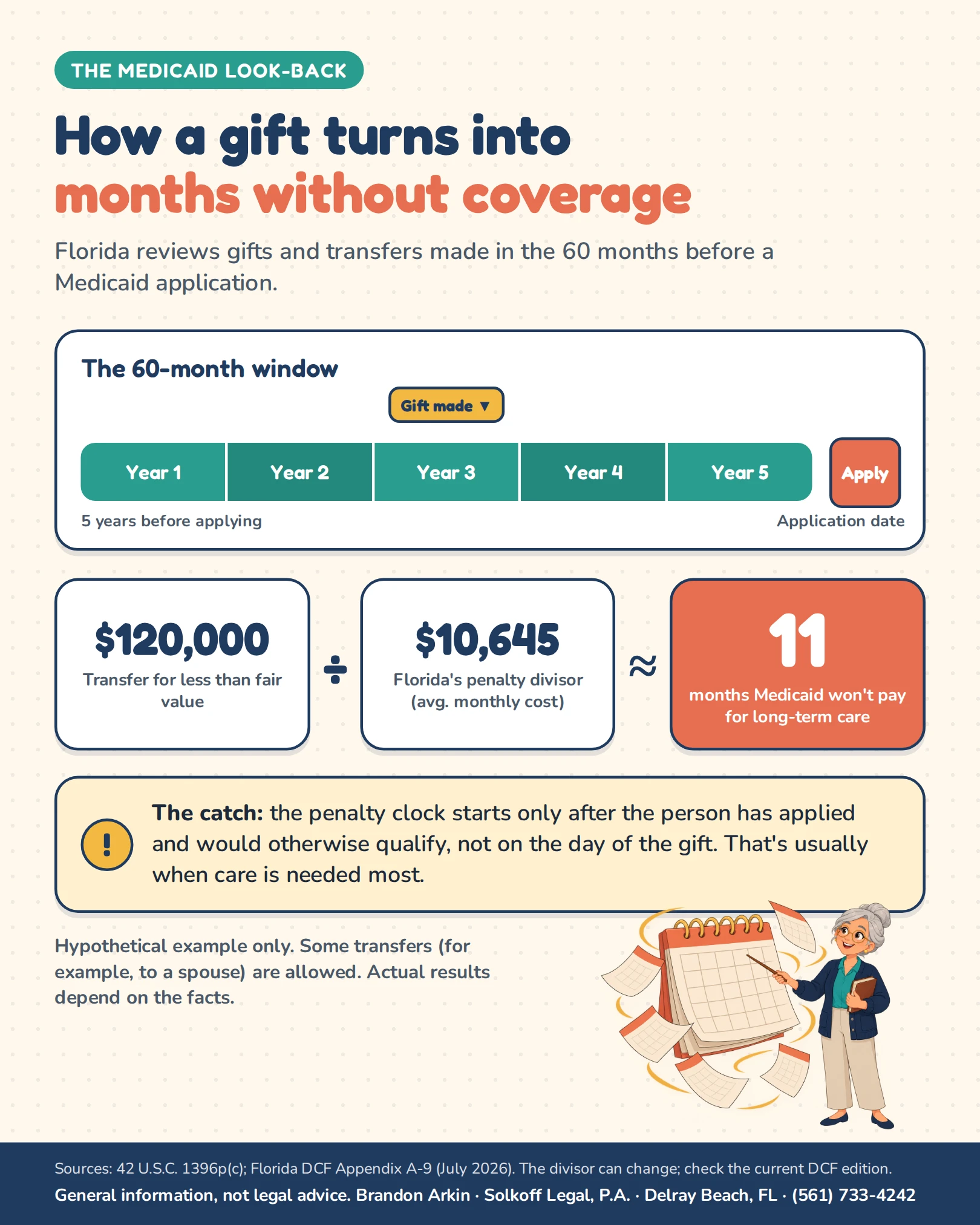
The look-back covers the 60 months before a long-term care Medicaid application (42 U.S.C. 1396p(c)). In Florida, buying an annuity, adding premium, taking elective withdrawals, changing the payout or annuitizing an older contract can all bring it under review (DCF Appendix A-34).
Hypothetically, a widowed Boca Raton client, 84, moves $120,000 from CDs into an immediate annuity with a 10-year period certain and her children as beneficiaries. The term runs past her life expectancy under SSA tables, and AHCA isn't named. If she needs nursing home care within five years, DCF may treat the purchase as a transfer: $120,000 divided by $10,645 is about 11 months without Medicaid coverage, starting only once she has applied and would otherwise qualify.
A married couple can see a different result. If the community spouse's annuity names AHCA correctly and is actuarially sound, transfer rules don't apply, and the payments are the at-home spouse's own income (DCF Appendix A-34). That income affects the spousal income allowance, which can raise the at-home spouse's income toward $2,705 a month, up to a 2026 maximum of $4,067. Make the product decision and the Medicaid plan together.
How Florida Medicaid may treat common products
| Product | General Florida Medicaid treatment (2026) |
|---|---|
| Term or burial insurance, no cash value | Not counted |
| Cash value life insurance, total face $2,500 or less per person | Cash value not counted |
| Cash value life insurance, total face over $2,500 | All cash surrender value counts |
| Irrevocable prepaid funeral contract | Not counted |
| Revocable annuity | Cancellation value counts |
| Assignable annuity | Secondary-market value counts |
| Noncompliant irrevocable annuity bought in the look-back | Transfer; penalty is the amount divided by $10,645 |
| Compliant annuity | Not an asset; payments count toward the $2,982 cap |
| LTC Partnership policy | Assets disregarded equal to benefits paid |
Sources: ESS Policy Manual 1640.0509, 1640.0554, 1640.0594 and 1640.0609.03; DCF Appendix A-9. DCF updates figures in January and July. Treatment depends on the contract and the facts.
Red flags before a sale, surrender or replacement
Two or more of these often mean the family should talk with an elder law attorney before signing. Tick the ones you see. Nothing is saved.
When to bring in an elder law attorney
The most useful time is before money moves: a large premium, a surrender, a 1035 exchange or an ownership change for a client who may need care within five years. Suspected exploitation is different. Florida requires any person who suspects a vulnerable adult is being exploited to report it to the Florida Abuse Hotline at 1-800-962-2873 (Fla. Stat. 415.1034).
Coordination works best with the client's written consent; without it, details can't be shared either way. Solkoff Legal, P.A. does not pay referral fees or give anything of value for a recommendation. Florida Bar rules don't allow a lawyer to give anything of value for a recommendation (Rule 4-7.17(b)). The family is always free to choose its own lawyer and its own agent.
Questions agents ask
Does Florida Medicaid count the cash value of life insurance?
Sometimes. Florida counts life insurance only to the extent of its cash surrender value, and only if the total face value of all policies on that person is over $2,500 (ESS Policy Manual, 1640.0554). At $2,500 or less, no cash value counts. Over $2,500, all of it counts, not just the excess. Term and burial policies with no cash value are excluded. With a $2,000 asset limit for a single applicant in 2026, even a modest whole life policy can affect eligibility, though the client may be able to reduce the face value.
What makes an annuity Medicaid-compliant in Florida?
For an applicant, the annuity must be irrevocable and nonassignable. It must be actuarially sound under Social Security Administration tables, and pay principal and interest in equal monthly amounts with no balloon or deferred payments. It must also name the State of Florida, AHCA, as remainder beneficiary: first, or right after a spouse, minor child or disabled child (ESS Policy Manual, 1640.0609.03; 42 U.S.C. 1396p(c)(1)(F)–(G)). A compliant annuity isn't counted as an asset. Its payments count as income, which can affect the $2,982 income cap and the monthly share of cost.
Is the Florida Long-Term Care Partnership program still available?
Yes. Florida's Partnership program is authorized by Fla. Stat. 409.9102 and run by AHCA with OIR and DCF. If a Partnership policyholder later applies for long-term care Medicaid, DCF disregards countable assets equal to the benefits paid, and that amount is protected from estate recovery (ESS Policy Manual, 1640.0594). A qualifying policy must be tax-qualified, effective on or after January 1, 2007, and carry age-based inflation protection. It doesn't guarantee eligibility, because the income and other rules still apply.
If a client or patient is facing one of these questions, Brandon Arkin at Solkoff Legal, P.A. can be reached at (561) 733-4242.
Talk through the next step
Bring your questions, a list of accounts and any papers a hospital, nursing home or Medicaid office has sent you. Call the Delray Beach office or request a consultation, and I can look at where things stand and what may come next. A phone call or an email does not by itself create an attorney-client relationship.
Solkoff Legal, P.A. · (561) 733-4242