For home care professionals
Florida Home Care Agencies: How Clients Pay for Care, and Who Can Sign
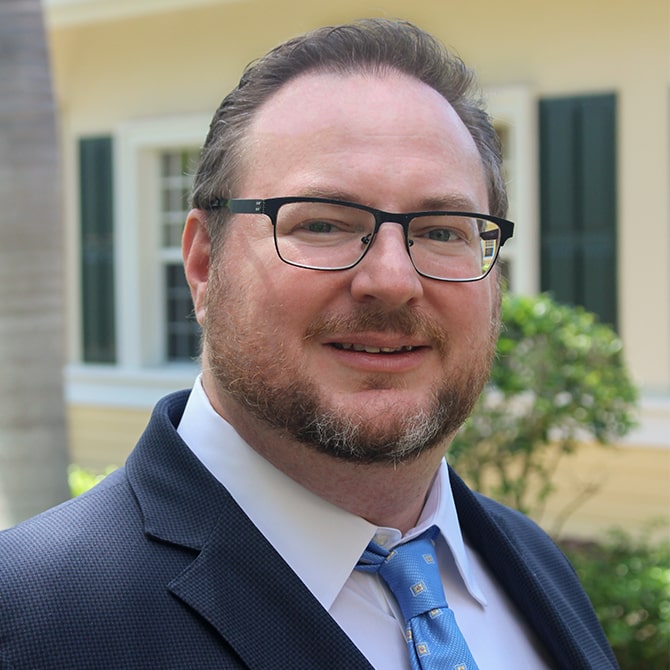
By Brandon Arkin, elder law attorney, Solkoff Legal, P.A. · Updated November 2026

By Brandon Arkin, elder law attorney, Solkoff Legal, P.A.
Updated November 2026
Your intake coordinator often hears the real story first. A daughter asks how long her mother's savings will last at 12 hours a day. A son wants to sign the service agreement but isn't sure he can. A husband says Medicare will cover it, and it won't. This guide covers the Florida rules behind those moments, so your team can set accurate expectations and recognize when a family may need an elder law attorney.
Who pays for care at home in Florida?
Medicare home health is a skilled benefit for a homebound patient who needs part-time or intermittent skilled nursing or therapy. Aide services are covered only alongside that skilled care, usually up to 8 hours a day combined and 28 hours a week, or up to 35 hours a week for a short time (Medicare.gov). Medicare does not pay for 24-hour care at home, for homemaker services unrelated to the care plan, or for personal care when that is the only care needed.
Private pay covers most companion, homemaker and personal care hours, from income, savings, long-term care insurance or, for some veterans, VA pension.
Medicaid home and community-based care runs through the Statewide Medicaid Managed Care Long-Term Care program (SMMC LTC). Plan benefits include personal care, home-delivered meals, respite, adult day care, intermittent and skilled nursing, and case management (Fla. Stat. 409.98). A person must be 65 or older (or 18 or older with a disability), be found by the state's CARES unit to need nursing-facility level of care, and meet the financial limits (Fla. Stat. 409.979). In 2026, those include a $2,000 asset limit for a single applicant and a $2,982 monthly income cap. Income over the cap usually means a Qualified Income Trust, or Miller trust (DCF Appendix A-9).
The SMMC LTC waitlist and priority scores
Unlike nursing home Medicaid, SMMC LTC home care depends on available funding. The Department of Elder Affairs keeps a statewide pre-enrollment list. The local Aging and Disability Resource Center screens each person with a frailty-based tool that produces a priority score. People are released by score; placement date only breaks ties (Fla. Stat. 409.979(3)). In Palm Beach County, screening starts with the Area Agency on Aging Palm Beach/Treasure Coast Helpline at 1-866-684-5885.
What your staff can tell families:
- People with a low priority score aren't notified of placement,.
- A fall, a hospital stay or a family caregiver who can no longer help may justify a new assessment.
- Missing a rescreening or ignoring contact attempts can mean removal and starting over. An alternate contact on file helps.
- Some people skip the list, including a nursing home resident of at least 60 consecutive days who wants to return home (Fla. Stat. 409.979(3)(f)).
Release is only an offer to begin the eligibility process. Asset or income problems can still stall enrollment after a long wait.
Why families shouldn't pay relatives informally
Many clients combine agency hours with care from a relative, and parents often want to "pay them back." Informal payments create three problems.
First, Medicaid. If the parent later applies, DCF reviews the look-back period (the 60 months before applying) for gifts, and unwritten payments to family can look like gifts. DCF weighs the fair market value, frequency and duration of the services (ESS Policy Manual, 1640.0609.01 and 1640.0614.04). An uncompensated transfer causes a penalty period: the amount divided by $10,645, in months without coverage (DCF Appendix A-9).
Second, payments for care are generally taxable income to the relative. Third, if the relative is also the agent under the power of attorney, paying themselves raises loyalty questions. Florida agents must act for the principal's sole benefit, avoid conflicts and keep records (Fla. Stat. 709.2114).
The written alternative is a personal care agreement: signed before care starts, listing duties and hours, paying local market rates as care is given, and backed by care logs. Medicaid recipients in SMMC LTC may also be able to direct their own care and hire a relative, subject to Level 2 background screening (Fla. Stat. 409.221).
VA Aid and Attendance for home care
Aid and Attendance is an amount added to VA pension for a wartime veteran or surviving spouse who needs help with daily activities such as bathing, feeding and dressing, or meets other criteria (VA). The payment is generally the gap between countable income and the Maximum Annual Pension Rate (MAPR). Effective December 1, 2025, the veteran MAPR with Aid and Attendance is $29,093 a year with no dependents and $34,488 with one dependent. The net worth limit is $163,699 through November 30, 2026 (VA pension rates).
VA treats payments to an in-home attendant for help with daily activities as deductible medical expenses, which can lower countable income, if payments match the hours of care. The attendant normally has to be a licensed health care provider (or an aide supervised by one), but not when the person needs Aid and Attendance or is housebound, or a qualifying clinician certifies the need in writing (38 C.F.R. 3.278). Invoices showing hours, dates and services help document the claim.
VA has its own 36-month look-back for asset transfers, with a penalty of up to five years (38 C.F.R. 3.276). VA and Medicaid rules differ, so a move that helps one can hurt the other.
Who can sign the service agreement?
The client signs if able to understand the agreement. If not, check the paperwork before accepting a family member's signature.
An agent under a Florida durable power of attorney may exercise only the authority the document specifically grants. Catch-all language such as "do all acts I could do" grants no authority by itself (Fla. Stat. 709.2201(1)). Look for powers over contracts, banking and payment of bills. Gifts and creating trusts require separate initialed grants (Fla. Stat. 709.2202).
A health care surrogate makes health care decisions during incapacity and may apply for Medicare and Medicaid (Fla. Stat. 765.205). The statute doesn't give the surrogate power to sign financial contracts or pay bills from the client's money. The payment agreement usually needs the client, an agent or a court-appointed guardian.
A relative with no document can't sign for the client. If nobody has authority and the client can't sign, the family may want to speak with an elder law attorney.
Exploitation, neglect and your duty to report
Florida's mandatory reporting law covers "any person" who knows or has reasonable cause to suspect that a vulnerable adult is being abused, neglected or exploited. It specifically lists nurses, health professionals and professional adult care staff. The report goes immediately to the central abuse hotline (Fla. Stat. 415.1034): the Florida Abuse Hotline, 1-800-962-2873. A vulnerable adult is someone whose self-care or self-protection is impaired by disability or the infirmities of aging (Fla. Stat. 415.102).
Warning signs aides may see:
- Bills unpaid or service cut off, even though the client has income.
- A new "friend" or relative who controls mail, the phone or visits.
- Missing checks, jewelry or cash, or the client signing papers they don't understand.
- Missing medications, poor hygiene, weight loss or untreated injuries.
Staff report; the state investigates. Planning documents can still be updated only while the client has capacity.
Nurse registry or home health agency: why it matters
Both are licensed by the Agency for Health Care Administration (AHCA) under Chapter 400, Part III (Fla. Stat. 400.462). (Part IV covers hospices.) A home health agency must carry at least $250,000 per claim in malpractice and liability insurance, and one providing skilled care must also be accredited (Fla. Stat. 400.471).
A nurse registry needs its own license and refers nurses, CNAs, aides, companions and homemakers who are independent contractors, not registry employees. At contract signing, the registry must tell the family that the caregiver is an independent contractor and that the registry may not monitor, supervise, manage or train that caregiver (Fla. Stat. 400.506(6)). It can matter for VA claims, which ask whether an aide is supervised by a licensed provider.
Companion and homemaker providers that offer no hands-on personal care must register with AHCA and include the registration number in their advertising (Fla. Stat. 400.509). Families can check any license on FloridaHealthFinder.
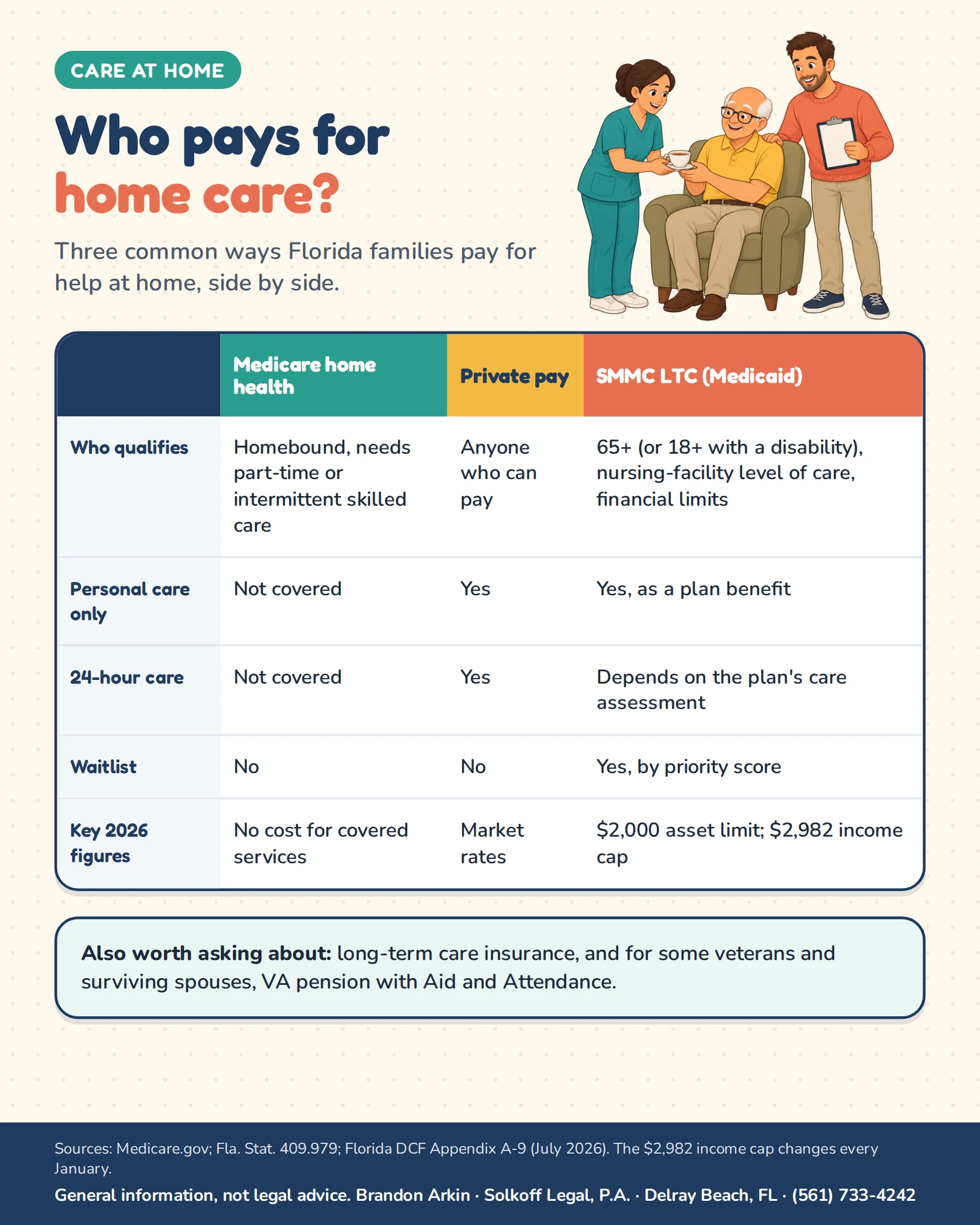
Paying for care at home: a quick comparison
| Medicare home health | Private pay | SMMC LTC (Medicaid) | |
|---|---|---|---|
| Who qualifies | Homebound, needs part-time or intermittent skilled care (Medicare.gov) | Anyone who can pay | 65+ (or 18+ with disability), nursing-facility level of care, financial limits (Fla. Stat. 409.979) |
| Personal care only | Not covered | Yes | Yes, as a plan benefit |
| 24-hour care | Not covered | Yes | Depends on plan care assessment |
| Waitlist | No | No | Yes, by priority score |
| Key 2026 figures | No cost for covered services | Market rates | $2,000 asset limit; $2,982 income cap (DCF A-9) |
Intake checklist for home care staff
Tick boxes work on this device only. Nothing is saved or sent.
Questions home care agencies ask
Can a health care surrogate sign our private-pay service agreement?
Usually not on the payment side. A Florida health care surrogate has authority to make health care decisions during incapacity, give informed consent and apply for public benefits like Medicare and Medicaid (Fla. Stat. 765.205). The statute doesn't grant power to sign financial contracts or pay from the client's accounts. A surrogate may approve a care plan, but the payment agreement is generally signed by the client, an agent under a durable power of attorney with specific authority, or a guardian. If no one has that authority, the family may want legal advice.
Does being on the SMMC LTC waitlist mean Medicaid will pay soon?
No, not necessarily. Florida releases people from the pre-enrollment list by frailty-based priority score, and only when funding allows, not by how long they have waited (Fla. Stat. 409.979). Release is only an offer to begin the eligibility process, and the person must still meet the 2026 financial rules, including the $2,000 asset limit and $2,982 income cap (DCF Appendix A-9). Families should plan to private pay in the meantime and ask for rescreening after a significant change.
Can VA Aid and Attendance help pay for our services?
It may. Aid and Attendance is an added pension amount for qualifying wartime veterans and surviving spouses who need help with daily activities. Effective December 1, 2025, the veteran MAPR with Aid and Attendance is $29,093 a year with no dependents (VA pension rates). Home care payments can count as deductible medical expenses that lower countable income, if payments match hours of care (38 C.F.R. 3.278). Eligibility also depends on net worth and a 36-month transfer look-back, so results vary by family.
Solkoff Legal, P.A. does not pay referral fees or give anything of value for a recommendation. Florida Bar rules don't allow a lawyer to give anything of value to a person for recommending the lawyer's services (Rule 4-7.17(b)). Client information is shared only with the client's consent. For health information, that usually means the patient's written authorization (45 C.F.R. 164.508).
If a client or patient is facing one of these questions, Brandon Arkin at Solkoff Legal, P.A. can be reached at (561) 733-4242.
Talk through the next step
Bring your questions, a list of accounts and any papers a hospital, nursing home or Medicaid office has sent you. Call the Delray Beach office or request a consultation, and I can look at where things stand and what may come next. A phone call or an email does not by itself create an attorney-client relationship.
Solkoff Legal, P.A. · (561) 733-4242