For seniors and couples
Remarrying Later in Life: Protecting Your New Spouse and Your Children
By Brandon Arkin, elder law attorney, Solkoff Legal, P.A. · Updated November 2026
By Brandon Arkin, elder law attorney, Solkoff Legal, P.A.
Updated November 2026
Finding love again later in life is a gift. It also changes your estate plan, sometimes in ways you didn't choose. Florida gives a surviving spouse automatic rights that can override a will. Many people want to provide for a new husband or wife and still leave the family home and savings to their children. Both goals are possible. It just takes planning, ideally before the wedding.
What Florida gives a surviving spouse
Unless you both agree otherwise in writing, Florida law protects a surviving spouse in several ways:
- The elective share. Your spouse can choose to take 30% of your "elective estate" instead of what your will leaves them (Fla. Stat. 732.2065). The elective estate is broad. Beyond your probate estate, it can include revocable trusts, payable-on-death and joint accounts, retirement accounts, life insurance cash value and certain gifts made in the year before death (Fla. Stat. 732.2035). Generally, the spouse must file the election within 6 months after receiving notice of the probate, and no later than 2 years after the death (Fla. Stat. 732.2135).
- The "pretermitted spouse" share. If you marry after signing your will and the will doesn't provide for your new spouse, they may receive what they'd get with no will at all. Exceptions apply if a prenuptial or postnuptial agreement covers it, or the will shows you meant to leave them out (Fla. Stat. 732.301).
- Homestead rights, explained next.
The family home: Florida's homestead rules
Florida's Constitution limits how you can leave your homestead, meaning the home you live in. If you're survived by a spouse or a minor child, you can't freely leave it by will. With no minor children, you may leave it to your spouse (Fla. Stat. 732.4015).
If you try to leave the home to your children instead, the law usually steps in. Your spouse gets a "life estate," the right to live in or use the home for life, and your children get the home after your spouse dies. Within 6 months of your death, your spouse can choose instead to own half of the home outright, with your children owning the other half (Fla. Stat. 732.401).
Picture a hypothetical. A widower in Boynton Beach marries again at 72, and his will leaves the house to his two daughters. When he dies, his wife, who is 66, may have the right to live there for the rest of her life. His daughters may wait decades. Meanwhile everyone is sharing a house that nobody fully controls. This often leads to hard feelings, and it can usually be avoided with planning.
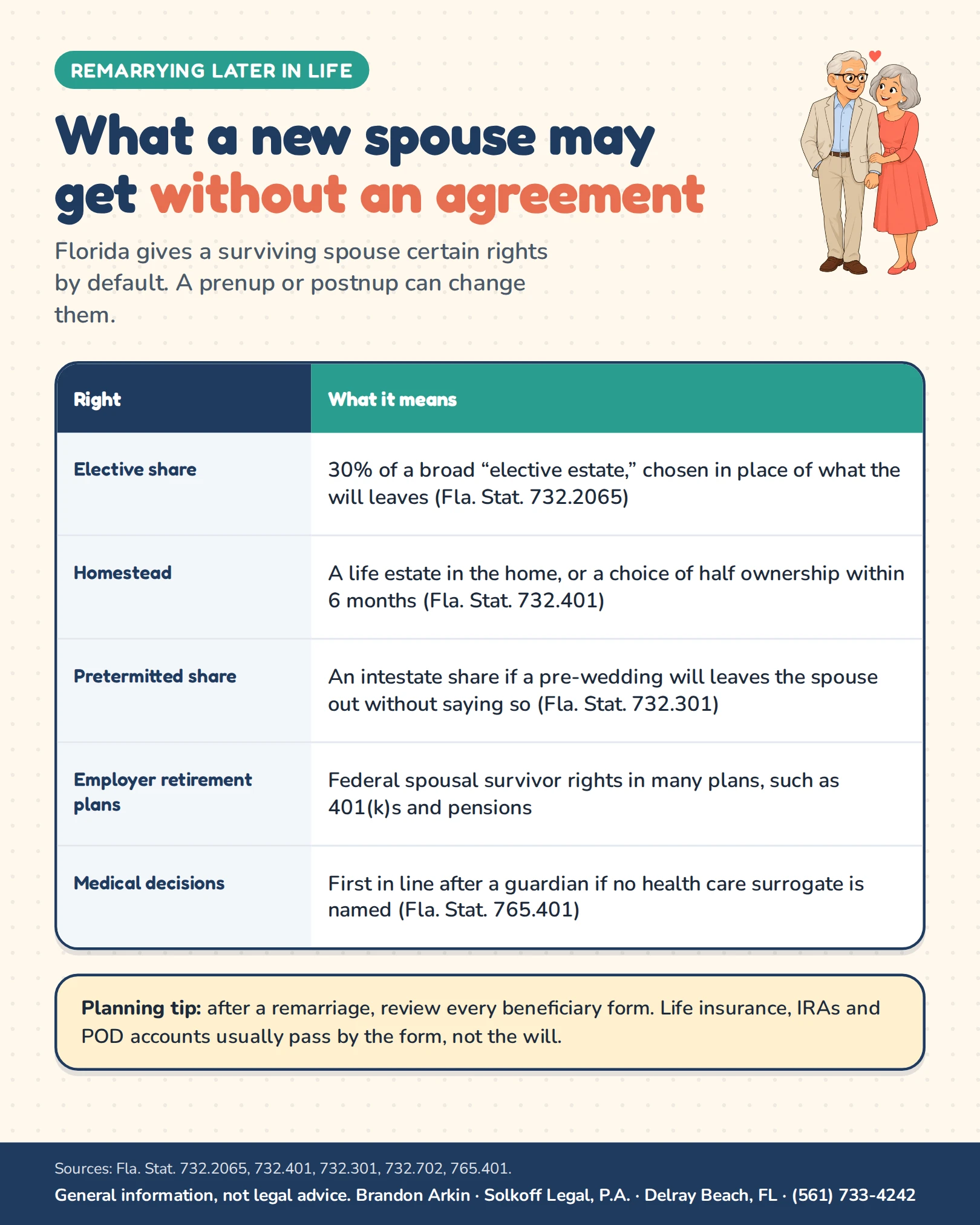
What a surviving spouse may receive without an agreement
| Right | What it means |
|---|---|
| Elective share | 30% of a broad "elective estate," chosen in place of what the will leaves (Fla. Stat. 732.2065) |
| Homestead | A life estate in the home, or a choice of half ownership within 6 months (Fla. Stat. 732.401) |
| Pretermitted share | An intestate share if a pre-wedding will leaves the spouse out without saying so (Fla. Stat. 732.301) |
| Employer retirement plans | Federal spousal survivor rights in many plans, such as 401(k)s and pensions |
| Medical decisions | First in line after a guardian if no surrogate is named (Fla. Stat. 765.401) |
Prenuptial and postnuptial agreements
A prenuptial agreement ("prenup") is signed before the wedding, and a postnuptial agreement after. For older couples, they're less about divorce and more about inheritance. Each spouse can waive the elective share, homestead rights, the pretermitted share and other spousal rights, in whole or in part. A Florida resident must sign the waiver before two witnesses (Fla. Stat. 732.702).
The disclosure rule depends on timing:
- Before the wedding, the law doesn't require financial disclosure for the waiver of rights at death.
- After the wedding, each spouse must make a "fair disclosure" of their estate to the other, or the waiver may not hold up (Fla. Stat. 732.702(2)).
Even before the wedding, sharing a summary of your assets is wise. In a divorce case, a premarital agreement can be challenged if it was unconscionable and signed without fair disclosure (Fla. Stat. 61.079). Each of you should have your own lawyer. A good agreement doesn't have to cut anyone out. Many promise the new spouse a set amount, a home for a period of time or life insurance, in exchange for waiving the rest.
Beneficiary forms and retirement accounts
Life insurance, IRAs, annuities and payable-on-death accounts usually pass by beneficiary form, not by your will. After a remarriage, review every form.
If your previous marriage ended in divorce, Florida generally voids a beneficiary designation naming your former spouse that was made before the divorce, with exceptions, including where federal law controls (Fla. Stat. 732.703). Don't rely on that. Update the forms yourself.
Employer plans such as 401(k)s and pensions follow federal law, which gives a spouse survivor rights in many plans. A prenup alone doesn't waive them, because the person signing isn't a spouse yet (Treas. Reg. 1.401(a)-20, Q&A-28-20)). If you've agreed your children will inherit a 401(k), your new spouse usually needs to sign the plan's own waiver after the wedding.
Trusts that care for everyone
A trust can do what a will often can't: take care of your spouse now and your children later. For example, a trust might pay your spouse income for life, or let them stay in the home, then pass what's left to your children. Choosing the trustee matters. Asking a stepparent and stepchildren to manage money together can strain relationships, so some couples choose a neutral trustee or a professional. Your trust and agreement need to work together so that the trust doesn't trigger an elective share claim.
Other things remarriage can change
- Social Security. If you're a widow or widower, remarrying at 60 or older (50 or older if you have a disability) doesn't stop survivor benefits on your late spouse's record (Social Security Administration).
- Medicaid. If one of you later needs nursing home care, Medicaid counts both spouses' assets, whoever owns them and regardless of state laws on dividing marital property (42 U.S.C. 1396r-5(c)(2)). In 2026, the healthy spouse may keep up to $162,660. A prenup doesn't change that count. See Medicaid planning.
- Medical decisions. If you have no health care surrogate, your spouse comes before your children (Fla. Stat. 765.401). Name the person you want.
Before and after the wedding
Tick the items as you finish them. Nothing is saved.
Common questions
Can I leave my Florida house to my children if I remarry?
Not by will alone, in most cases. If you're survived by a spouse, Florida limits how your homestead can be left (Fla. Stat. 732.4015). Your spouse usually receives a life estate, or may choose half ownership, with your children receiving the rest (Fla. Stat. 732.401). Your spouse can waive those rights in a written agreement signed before two witnesses (Fla. Stat. 732.702).
How much does a surviving spouse get under Florida's elective share?
30% of the "elective estate" (Fla. Stat. 732.2065). It includes much more than the probate estate: revocable trusts, joint and payable-on-death accounts, retirement accounts and some recent gifts (Fla. Stat. 732.2035). The right can be waived in a prenuptial or postnuptial agreement.
Does a prenup protect my 401(k) for my children?
Not by itself. Under federal rules, consent in an agreement signed before marriage doesn't waive a spouse's survivor rights in plans covered by those rules (Treas. Reg. 1.401(a)-20, Q&A-28-20)). Your prenup can require your spouse to sign the plan's waiver after the wedding. Make sure that step actually happens.
If your family is facing one of these questions, you can reach Brandon Arkin at Solkoff Legal, P.A. at (561) 733-4242.
Talk through the next step
Bring your questions, a list of accounts and any papers a hospital, nursing home or Medicaid office has sent you. Call the Delray Beach office or request a consultation, and I can look at where things stand and what may come next. A phone call or an email does not by itself create an attorney-client relationship.
Solkoff Legal, P.A. · (561) 733-4242