Palm Beach County Caregiver and Long-Term Care Resources
When a parent or spouse needs more care, families usually face several problems in the same month: finding a nursing home or assisted living facility, paying for it, applying for Florida Medicaid, and spotting the scams that target older adults. This page is a starting shelf for those jobs.
Start with the facility finder if you need to compare Florida nursing homes or assisted living facilities (ALFs). Use the legal and government sections when you need a phone number, a residents’ rights statute, or the ACCESS Florida application (filed online through MyACCESS). The community, technology, and health sections cover caregiver support in Palm Beach County and beyond.
Every link below goes to a public agency, a nonprofit, or a published source. The guides on this site explain elder law, Florida Medicaid planning, and estate planning in plain language.
Educational only. This is not legal advice, not medical advice, and not a facility placement service. Contacting the office does not create an attorney-client relationship.
On this site
Where does our family stand?
Ten plain-English questions for adult children and for seniors, covering documents, money, health, and who would step in if something happened. Your answers and your result stay in your browser on this device. Nothing is saved or sent. It is education, not a legal opinion.
A printable guide for talking with an aging parent about money and care: how to open the topic without a fight, what to ask, and which papers to find, such as a will, a durable power of attorney, a health care surrogate designation, deeds, and recent bank and insurance statements.
Florida’s Agency for Health Care Administration (AHCA), the state agency that licenses nursing homes and assisted living facilities, publishes its search and comparison tools on FloridaHealthFinder. There is no single public link that reliably opens a Medicaid-only list for every facility type, so this page does not pretend to embed one. Instead, choose a facility type and a county below. The page then gives you the right official tool and the steps to follow inside it. This is a guide to the state’s tools. It is not a live Medicaid database, and it does not copy or pull data from the state site. A quick example: a family in Boynton Beach whose mother is leaving the hospital might choose “Nursing home / SNF” and “Palm Beach,” open the state facility search, and then call three facilities on the list to ask about a Medicaid bed.
Your notes for the official search
Palm Beach County
Nursing home / SNF. Type the county into Florida’s own tool. These buttons open that tool in a new tab. They do not run a Medicaid search from this site.
Open the nursing home facility search (Advanced Search is on the same FloridaHealthFinder site if you need more filters). Enter Palm Beach County. This page cannot apply those filters for you.
2
Open a facility profile. Look for Medicaid and for the payment forms the facility says it accepts. The profile is the facility’s information on the state site. It is not a live bed count.
3
Call the facility. Ask whether a Medicaid bed is available now, whether the facility accepts “Medicaid pending” admissions (a resident whose application has not yet been approved), and what the admissions office needs from the family. Availability changes daily, and this website cannot see it.
4
Use the Nursing Home Guide when you want the state’s quality comparison. A score is not the same thing as a Medicaid bed, and it is not a recommendation from this office.
5
If your county is not in the short list, choose it inside the AHCA tool. “Other Florida county” only means this page did not pre-fill a South Florida county name.
What to confirm for a nursing home
Open the facility profile and look for Medicaid and for the payment forms the facility reports it accepts. Then ask the facility whether a Medicaid bed is available.
Keep two steps separate in your mind. The facility decides whether it has a bed. The State of Florida decides Medicaid eligibility: a CARES assessment looks at whether nursing-facility care is medically needed, and the Department of Children and Families (DCF) reviews income and assets, including gifts made in the 60-month look-back period (the five years before the application that Medicaid reviews for transfers). A profile and a quality rating are not a reservation, and they are not a statement from this office.
Optional, and separate from Florida Medicaid: Medicare Care Compare (opens in a new tab) is the federal Medicare tool. It can add context. It is not a Florida Medicaid bed list.
Printable checklist
Questions to ask on a nursing home tour
A tour shows you the lobby. The questions below help you learn how the building works on an ordinary Tuesday night. Print the list, or tick the boxes on your screen as you go. Your ticks stay on this device. They are not saved or sent anywhere.
Ask the same questions at every facility so you can compare answers side by side. Ask for written copies of anything important, such as the admission agreement, the bed-hold policy and the list of extra charges.
Print this checklist
Medicaid and payment
Is the facility certified for Medicaid, and is a Medicaid bed available now?
Do you accept residents who are “Medicaid pending” (applied but not yet approved), and what do you expect the family to pay while the application is pending?
If my parent starts as private pay or under Medicare and later qualifies for Medicaid, will they keep the same room?
Which charges are outside the daily rate, and can I see the price list in writing?
What is your bed-hold policy if my parent goes to the hospital?
Which SMMC Long-Term Care plans do you contract with?
Several of these questions have legal anchors. Florida law says a Medicaid-certified nursing home may not transfer or discharge a resident solely because their source of payment changes. Any admission document that tries to waive that right is void (Fla. Stat. §400.022(1)(p)).
Federal rules say a facility may not require a third-party guarantee of payment as a condition of admission (42 C.F.R. §483.15(a)). It may ask someone with legal access to the resident’s money to pay from the resident’s own funds. Federal rules also bar a facility from asking for a promise that the resident will not apply for Medicaid.
For a hospital stay, Florida law requires the facility to tell a Medicaid resident how long their bed will be held, which is up to 15 days while Medicaid pays for it (§400.022(1)(u)).
Staffing and daily care
How many certified nursing assistants (CNAs) and nurses work each shift, including nights and weekends?
How often do you use agency or temporary staff?
Will my parent usually see the same aides from day to day?
How long have the director of nursing and the administrator been here?
How quickly do staff answer a call light, and how do you check?
Who is the physician, and how often do they see residents?
How are falls, wounds, weight loss and medication changes reported to the family?
Florida sets minimum staffing for nursing homes. It requires a weekly average of at least 3.6 hours of direct care per resident per day, including at least 2.0 hours from certified nursing assistants and 1.0 hour from licensed nurses (Fla. Stat. §400.23(3)(b)). These are minimums, not targets. Asking how the building staffs above them is fair.
Care-plan meetings
When is the first care-plan meeting, and who attends?
Can family join by phone or video?
How often are care plans reviewed, and can we request a meeting when something changes?
Who is our day-to-day contact: a social worker, a unit manager or someone else?
Under federal rules, a written care plan must be developed within 7 days after the resident’s comprehensive assessment. It is prepared by a team that includes the physician, a nurse and a nurse aide, with the resident and their representative taking part to the extent practicable (42 C.F.R. §483.21). Florida law also gives residents the right to take part in planning their medical treatment (§400.022(1)(j)).
Transfer and discharge rights
Under what circumstances have you discharged residents in the past year?
How would you notify us, and who would receive the notice?
Who helps us if we disagree with a discharge?
Federal rules list the limited reasons a facility may transfer or discharge a resident against their wishes. They include needs the facility cannot meet, improved health, danger to others’ safety or health, nonpayment after reasonable notice, and closure.
The facility must usually give written notice at least 30 days ahead, with shorter notice allowed in emergencies and some other situations. The notice must state the reason, the appeal rights, and contact details for the State Long-Term Care Ombudsman, and a copy goes to the Ombudsman (42 C.F.R. §483.15(c)). Florida law sets the same 30-day standard (§400.022(1)(p)).
The Long-Term Care Ombudsman Program is free and confidential, at 1-888-831-0404 (Ombudsman).
The arbitration clause in the admission papers
Does the admission packet include an arbitration agreement?
Is it a separate document, or a clause inside the main agreement?
Will you admit my parent if we do not sign it?
How many days do we have to cancel it after signing?
An arbitration agreement means a dispute would go to a private arbitrator instead of a court. Under federal rules, a nursing home may not require one as a condition of admission or of continued care, and it must tell you that in writing. The agreement must give you 30 calendar days after signing to cancel it (42 C.F.R. §483.70(m)).
Many families take the admission packet home and read it before signing. If something in it is unclear, that is a good time to ask a lawyer.
Your notes (stay on this device)
Statutes, rights, and where to report
Florida residents’ rights and where to report
These are primary sources and official help lines. A statute is the text of the law. It is not a memo about your parent’s building, and it is not a substitute for advice about your facts.
Two numbers are worth saving now. If you suspect abuse, neglect, or financial exploitation of an older adult, including a scam that is draining a parent’s accounts, the Florida Abuse Hotline takes reports at 1-800-962-2873. If someone is in immediate danger, call 911 first. For a problem with care inside a licensed facility, AHCA’s complaint line is 1-888-419-3456.
What are the warning signs of elder scams and financial exploitation?
Financial exploitation means someone takes or misuses an older person’s money or property. It can be a stranger running a scam or someone the person trusts. Florida treats exploitation of an elderly person or disabled adult as a crime (Fla. Stat. §825.103).
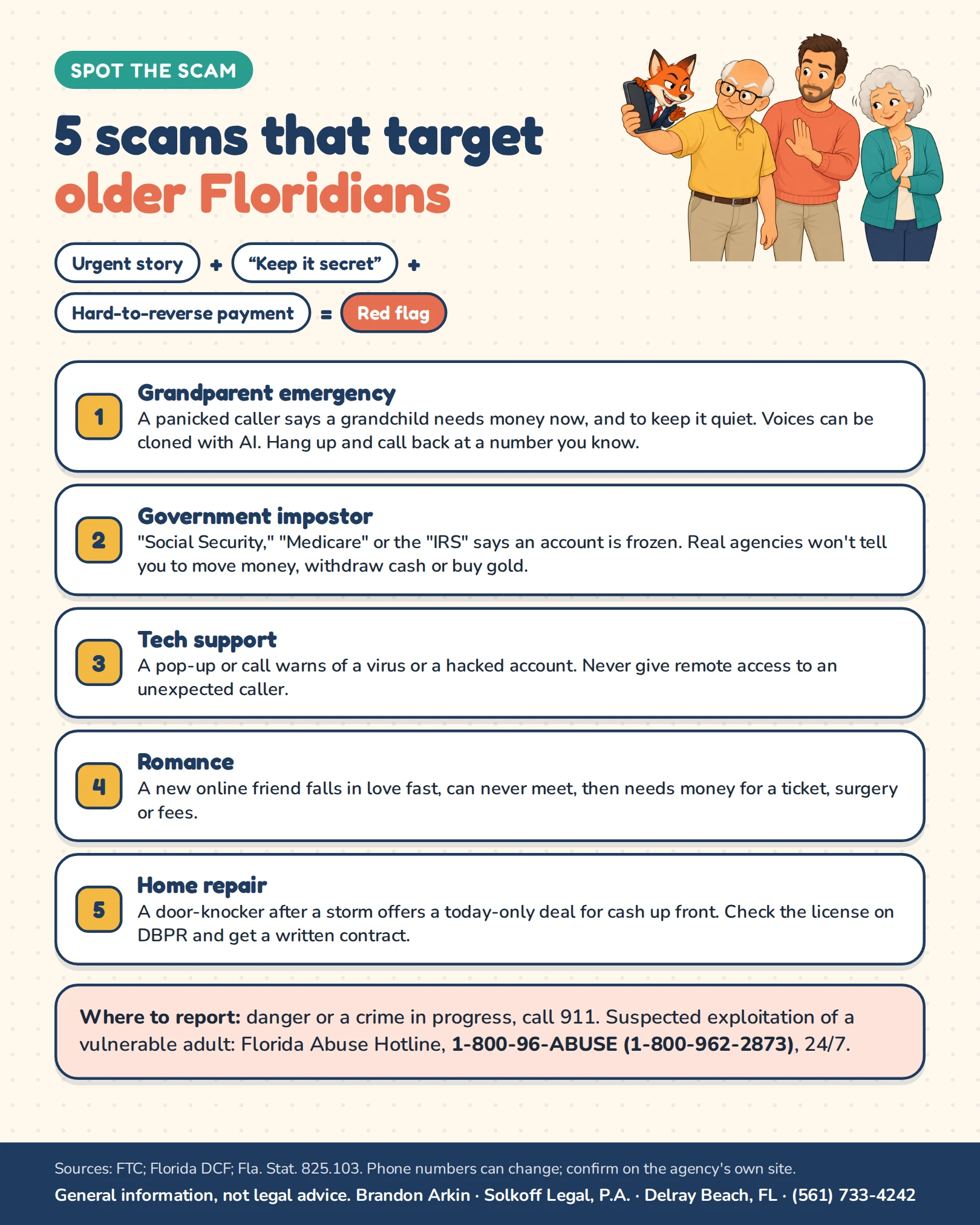
Most scams follow the same pattern: an urgent story, a demand for secrecy, and a payment method that is hard to reverse. The cards below describe five common schemes, the signs that a parent may already be affected, and where to report.
Grandparent or family emergency
A caller, often sounding panicked, claims to be a grandchild in jail, in the hospital or stranded overseas, and asks for money right away. They usually ask the grandparent to keep it quiet. The FTC warns that scammers can now clone a relative’s voice with AI. Hang up and call the family member back at a number you already know.
Government impostor
Someone claims to be from Social Security, Medicare, the IRS, the FTC or law enforcement. They say an account is frozen or a crime is tied to the person’s name. The FTC says it will never threaten you, tell you to move money to “protect it,” or ask you to withdraw cash or buy gold and hand it over. Anyone asking for that is running a scam.
Tech support
A pop-up, email or phone call warns that a computer has a virus or that a bank account has been hacked, and tells the person to call a number or let someone connect remotely. According to the FTC, real tech companies do not contact people this way. Never give remote access to an unexpected caller.
Romance
A new online friend moves the conversation off the dating site, professes love quickly, and always has a reason they cannot meet in person: they work overseas or are deployed, for example. Then come the requests for money for a plane ticket, surgery or customs fees. The FTC says this pattern is the core of a romance scam.
Contractor and home repair
Someone knocks on the door, often after a storm, offers a deal that is good only today, and wants cash or a large deposit up front. The work is never done, is done badly, or comes with costly financing tied to the house (FTC). In Florida, you can check a contractor’s license on the DBPR license search, and it is wise to get a written contract before paying.
Signs a parent may be exploited
Large or unusual withdrawals, wire transfers, or purchases of gift cards, gold or cryptocurrency
New “best friends,” caregivers or romantic partners who discourage contact with family
Unpaid bills, shut-off notices or an empty refrigerator despite enough income
Changes to a will, deed, power of attorney or account beneficiaries that the parent cannot explain
New names added to bank accounts or credit cards
Secrecy, fear or anxiety about money or phone calls
Missing checks, statements or valuables
Mail about loans, sweepstakes or lottery “winnings”
One sign alone does not prove exploitation. A pattern is worth a calm conversation and a closer look at statements.
A durable power of attorney (a document that names someone to handle finances, governed in Florida by Chapter 709), signed while the parent can still decide, often makes it easier for a trusted person to step in and protect accounts.
Where to report
Emergency or a crime in progress: call 911.
Florida Abuse Hotline and Adult Protective Services: report suspected abuse, neglect or exploitation of a vulnerable adult, 24 hours a day, at 1-800-96-ABUSE (1-800-962-2873), or online ([DCF](https://www.myflfamilies.com/services/abuse/adult-protective-services/how-report-adult-abuse)). The Hotline takes the report, and Adult Protective Services, part of DCF, investigates under Chapter 415, Florida Statutes ([DCF APS](https://www.myflfamilies.com/services/abuse/adult-protective-services)).
Local police or sheriff: file a report for theft or fraud, and keep the report number for banks and insurers.
Federal Trade Commission: report scams at [ReportFraud.ftc.gov](https://reportfraud.ftc.gov/) or 1-877-FTC-HELP (1-877-382-4357), and report identity theft at [IdentityTheft.gov](https://www.identitytheft.gov/) ([FTC](https://www.ftc.gov/foia/frequently-asked-questions)).
FBI Internet Crime Complaint Center (IC3): report online fraud at [ic3.gov](https://www.ic3.gov/CrimeInfo/ElderFraud).
National Elder Fraud Hotline (U.S. Department of Justice): help with reporting for people 60 and older, at 1-833-FRAUD-11 (1-833-372-8311), Monday through Friday, 10 a.m. to 6 p.m. Eastern ([DOJ](https://www.justice.gov/stopelderfraud)).
Florida Attorney General Fraud Hotline: 1-866-9-NO-SCAM (1-866-966-7226) ([Florida Attorney General](https://www.myfloridalegal.com/overview/frequently-asked-questions)).
The bank or card company: call the number on the back of the card right away and ask about stopping or recalling a payment.
Scammers also impersonate fraud hotlines. The DOJ warns that callers have falsely claimed to be from the National Elder Fraud Hotline. If someone calls you, hang up and dial the official number yourself. Write down dates, amounts, names and phone numbers, and keep receipts, emails and texts (IC3).
A hypothetical: a son in Boynton Beach sees three $2,000 gift-card purchases on his mother’s statement. She explains that a “Medicare agent” told her that her benefits would stop. He might call her bank first, then the Florida Abuse Hotline, and file a report at ReportFraud.ftc.gov. Later, the family might talk about whether a durable power of attorney is in place.
Applications, counseling, and assessments are different desks, and families lose weeks calling the wrong one.
- SHINE answers Medicare questions.
- CARES looks at the level of care someone needs.
- DCF, through the ACCESS Florida application on MyACCESS, decides financial eligibility for most Medicaid long-term care.
- The local Area Agency on Aging, which also serves as the Aging and Disability Resource Center (ADRC), screens people for SMMC LTC and can help a Palm Beach County family find the right front door.
For example, a daughter in Delray Beach whose father needs help at home might call the ADRC for an SMMC LTC screening, call SHINE about his Medicare plan, and file a Medicaid application through MyACCESS. Each step is separate.
How do you apply for Florida Medicaid long-term care?
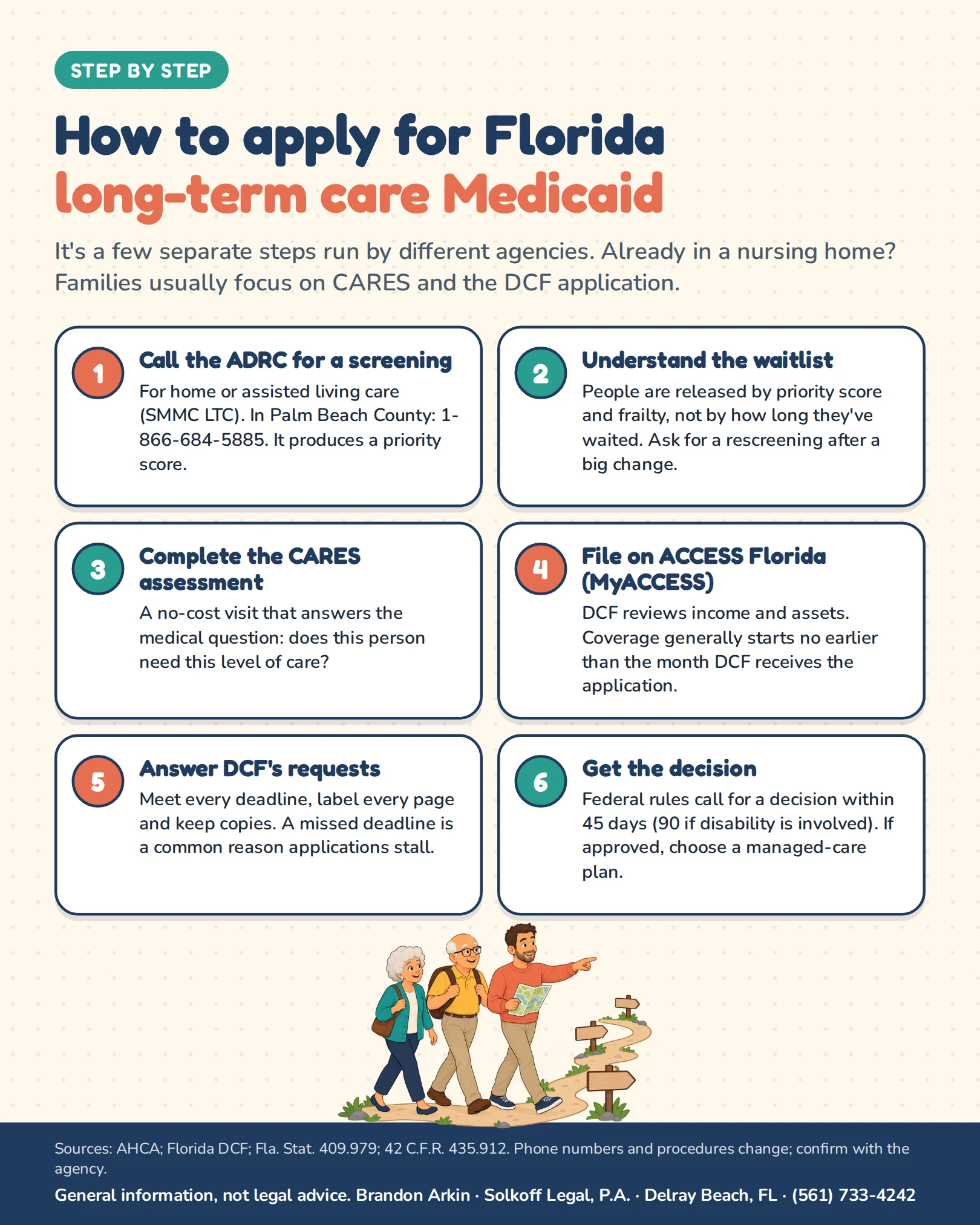
Florida Medicaid long-term care is not one form. It is a few separate steps, run by different agencies:
a screening or medical assessment, which looks at the care the person needs;
a financial application to the Department of Children and Families (DCF), which looks at income and assets;
a managed-care plan, which delivers the services once someone is enrolled.
The order depends on where the person lives now. Someone at home or in assisted living who wants services through the Statewide Medicaid Managed Care Long-Term Care program (SMMC LTC) usually starts with a phone screening. Someone already in a nursing home who needs nursing-home Medicaid, called the Institutional Care Program (ICP), usually focuses on the CARES assessment and the DCF application.
The steps below explain each stage in plain English. They are general education. What applies to your family depends on the facts.
Call the ADRC for an SMMC LTC screening
For care at home or in assisted living, the first step into SMMC LTC is a screening by an Aging and Disability Resource Center (ADRC), according to AHCA.
In Palm Beach County, the ADRC is the Area Agency on Aging of Palm Beach/Treasure Coast. Its helpline is 1-866-684-5885, Monday through Friday, 8 a.m. to 5 p.m., and it serves Palm Beach, Martin, St. Lucie, Indian River and Okeechobee counties. From anywhere in Florida, the statewide Elder Helpline at 1-800-963-5337 (1-800-96-ELDER) can connect you to the right ADRC.
The screening is done by phone with the person or a caregiver and takes about 45 minutes to an hour. It produces a priority score.
Understand the waitlist and priority score
After the screening, the Department of Elder Affairs sends a written notice of the person’s priority rank. People with a high priority rank are placed on the SMMC LTC waitlist. People with a low rank are given information about other community resources.
AHCA explains that people are released from the waitlist each month based on priority score and frailty level, not on how long they have waited. If something big changes, ask the ADRC for a rescreening. Examples of a big change include a fall or hospital stay, a move, losing a caregiver or spouse, or damage to the home.
Complete the CARES assessment
CARES stands for Comprehensive Assessment and Review for Long-Term Care Services. AHCA says CARES must assess anyone who asks Medicaid to pay for nursing-facility care or for home and community-based services through SMMC LTC.
A nurse or assessor usually visits the person where they live, and there is no charge. A physician or registered nurse then reviews the file and decides the level of care. CARES answers the medical question only: does this person need this level of care? Money is a separate step.
File the ACCESS Florida application on MyACCESS
DCF decides financial eligibility for most Medicaid long-term care. If someone already receives SSI, Social Security may decide instead, according to DCF. Most families apply online through the MyACCESS portal. DCF says the online application takes most people about 30 minutes, and you can sign it electronically.
You can also apply at a DCF office or a community partner, or mail a paper application to the Office of Economic Self Sufficiency Mail Center, P.O. Box 1770, Ocala, FL 34478-1770 (DCF).
Timing matters. For adults 21 and older, Florida Medicaid generally starts no earlier than the first day of the month DCF receives the application (AHCA). Florida no longer offers three months of retroactive coverage to most adults.
Documents families often gather
Photo ID and Social Security card for the applicant (and spouse, if married)
Proof of age and of citizenship or immigration status
Medicare card and any other health insurance cards
Income proof: Social Security award letter, pension, annuity, VA and other income notices
Recent statements for every bank, brokerage and retirement account
Life insurance policies with cash values, and any prepaid funeral or burial contracts
Deeds, plus records of any home or property sold or transferred
Records of gifts or transfers in the 60-month look-back period
Trust documents, if any
Durable power of attorney, health care surrogate designation, or guardianship papers for the person signing on the applicant’s behalf
DCF tells you in a written notice exactly what it needs, and it sets a deadline. Upload the documents to your MyACCESS account, or mail, fax or drop them off. Write the ACCESS or case number, the applicant’s name and date of birth, and a phone number on every page (DCF).
The look-back period is the 60 months before the application that Medicaid reviews for gifts and transfers made for less than fair value (42 U.S.C. §1396p(c)). A transfer in that window may delay eligibility.
Answer DCF’s requests and keep records
DCF reviews each application and decides whether it needs an interview. If it does, it sends a pending notice, either to your MyACCESS account or by mail, depending on the contact preference you chose. Signing up for email alerts on MyACCESS usually gets these notices to you faster.
After you upload documents, allow about three days for your account to show that DCF received them. Keep a copy of everything you send, along with the date. A missed deadline is one of the common reasons an application stalls.
What happens after DCF decides
Federal rules require a Medicaid decision within 45 days, or within 90 days when eligibility depends on a disability decision (42 C.F.R. §435.912).
If the application is approved, DCF mails a Medicaid card, and AHCA sends Choice Counseling information so the person can choose a managed-care plan. If any part is denied, the notice explains why. DCF sends it by mail and posts it in your online account (DCF). Read it closely, because notices can carry deadlines for asking questions or requesting a hearing.
Approval is often not the last step. A nursing home resident may still owe part of their monthly income to the facility, and the plan must still arrange the services.
A hypothetical: a daughter in Boca Raton notices that her 84-year-old father can no longer manage at home alone. She might call the Area Agency on Aging helpline for an SMMC LTC screening. She would then gather his bank statements and Social Security letter while waiting for the CARES visit, and file the ACCESS Florida application on MyACCESS as soon as the family understands where he stands.
If he moved to a nursing home first, the family might shift its focus to CARES and the ICP application. Every family’s order of steps can differ.
If the family’s question is how income, savings, the home or past gifts fit the Medicaid rules, call Solkoff Legal, P.A. at (561) 733-4242 before you file.
Dates to know · confirm before you go
Palm Beach County caregiver events
Upcoming community dates for South Florida families, followed by calendars that stay up all year. These are other organizations’ events. This office does not run them. Confirm the time and address on the host’s page, because dates change. Alzheimer’s Association 24/7 Helpline: 800-272-3900. Area Agency on Aging of Palm Beach/Treasure Coast: 866-684-5885.
A monitor, an app, or a medical alert can supplement a human check-in. It does not replace one. If a tool watches, records, or shares someone’s location or health information, talk about consent and who can see that information before you turn it on. A parent who still makes their own decisions gets a say. If a parent can no longer decide, the person named in a Florida durable power of attorney or health care surrogate designation may need to be part of that choice, depending on what the document allows.
For families
For adult children who are helping, or keeping an eye on a parent, from another house or another state.
Public articles on food, movement, hearing, company, and caregiver breaks. They are not medical advice, and they are not a promise about who will or will not develop dementia. Nothing here is a statement about a legal result. Bring health questions to a physician who knows the person.
Two eating patterns come up again and again in this research: the Mediterranean diet and the MIND diet, a blend of Mediterranean and DASH eating aimed at brain health. The articles describe what studies have looked at. They do not promise a result.
A 2023 randomized trial called ACHIEVE (Lin and the ACHIEVE Collaborative Research Group, The Lancet) compared a hearing intervention, which included hearing aids and audiologist counseling, with a health-education program in 977 older adults with hearing loss. In the full study group, the hearing intervention did not change cognitive decline over three years compared with the education group. In a pre-specified subgroup of 238 people drawn from the Atherosclerosis Risk in Communities (ARIC) study, who were at higher risk, the hearing intervention was associated with about 48 percent slower cognitive decline over those three years. The subgroup result belongs to people already at higher risk in that study. It is not a promise for every person who gets a hearing aid.
A 2011 paper in Archives of Neurology followed 639 adults in the Baltimore Longitudinal Study of Aging for a median of about 12 years and reported an association between hearing loss and a later dementia diagnosis: the more severe the hearing loss at the start, the higher the risk. An association is not proof that treating hearing loss changes that risk for a particular person. Questions about hearing aids belong with an audiologist or a physician.
Respite care means a short break for the person doing the care, while someone else steps in for a few hours or a few days. These pages explain the idea. They do not place anyone in a program. In Palm Beach County, the Area Agency on Aging helpline and Alzheimer’s Community Care, both listed above, are places to ask what is available locally.
Buttons and cards on this page open other organizations’ websites in a new tab. Brandon Arkin and Solkoff Legal, P.A. do not control those sites, their forms, or their information. A link is not an endorsement of every page on that site. Phone numbers, filters, and program rules change. Confirm what you read with the agency itself.
The county and city you type into the facility finder stay in your browser. They are not saved or sent by this website. This page is educational. It is not legal advice, and it does not create an attorney-client relationship.
Call Solkoff Legal, P.A.
When the question is about your family’s facts, call (561) 733-4242 or request a consultation. For the longer guides on this site, start with Medicaid planning or estate planning.