
For seniors and couples
Who should be your power of attorney in Florida? Choosing who will decide for you
By Brandon Arkin, elder law attorney, Solkoff Legal, P.A.

By Brandon Arkin, elder law attorney, Solkoff Legal, P.A.
Updated November 5, 2026
Four roles, four decisions
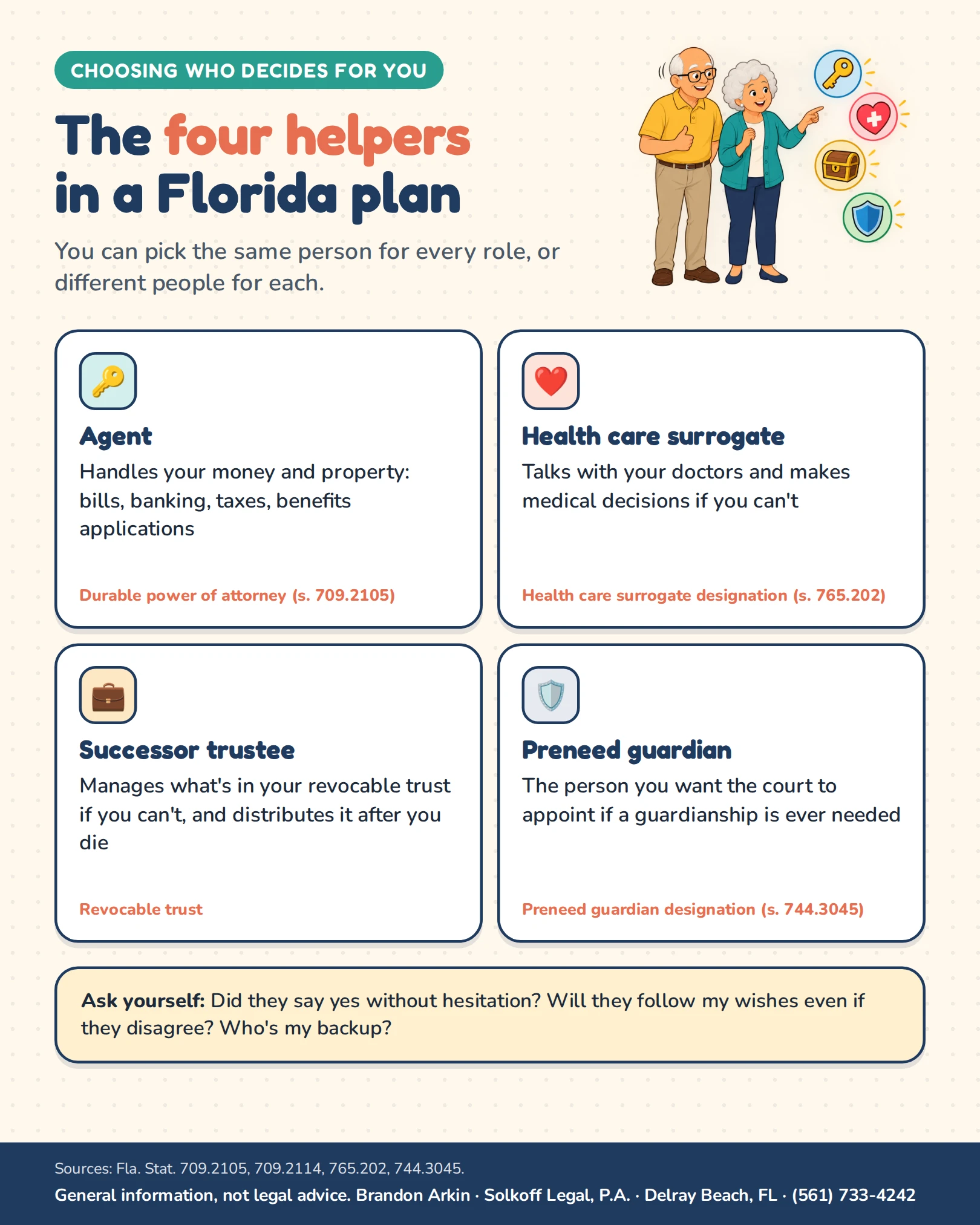
Florida planning usually names up to four helpers. You can pick the same person for every role, or different people for each. The article on the five documents every Florida adult should have explains the documents themselves. This one is about who goes in them.
| Role | What they do | Document |
|---|---|---|
| Agent | Handles your money and property: bills, banking, taxes, benefits applications | Durable power of attorney (s. 709.2105) |
| Health care surrogate | Talks with your doctors and makes medical decisions if you can't | Health care surrogate designation (s. 765.202) |
| Successor trustee | Manages what's in your revocable trust if you can't, and distributes it after you die | Revocable trust |
| Preneed guardian | The person you want the court to appoint if a guardianship is ever needed | Preneed guardian designation (s. 744.3045) |
What makes a good agent
Your agent under a power of attorney will have real control over your money. In Florida, the agent must be an adult (18 or older) or a bank or trust company with trust powers in Florida (s. 709.2105). The law makes your agent a fiduciary, which means they must act in good faith and loyally for your benefit, and keep records of every transaction (s. 709.2114).
Look for someone who:
- is honest with money, including their own;
- is organized and will keep receipts;
- gets along well enough with the rest of the family to share information;
- will follow your wishes even when they'd choose differently; and
- is available. They don't have to live in Florida, but banks and doctors tend to move faster when someone can show up.
Love isn't the test. The child you're closest to may not be the one who handles paperwork well. Many people choose one child for health care and another for money, and that's fine.
Choosing your health care surrogate
Your health care surrogate may one day have to make hard decisions in a hospital hallway. Choose someone who knows your values, can stay calm, and will carry out your wishes even if other relatives push back. Talk with them now about what you would and wouldn't want. A living will puts your end-of-life wishes in writing, and your surrogate can point to it.
The designation must be signed in front of two adult witnesses, and at least one of them can't be your spouse or a blood relative. The person you name can't be a witness, and they should get a copy (s. 765.202).
Trustee and preneed guardian
If you have a revocable trust, the successor trustee steps in when you can't manage it, and then settles the trust after your death. While you are alive and the trust is still revocable, the trustee's duties are owed to you alone (s. 736.0603). It often makes sense for the successor trustee and your agent to be the same person, or at least people who work well together.
A preneed guardian designation is a backup plan for your backup plan. If a court ever has to appoint a guardian for you, it generally must appoint the person you named, as long as they qualify, unless that would be against your best interests (s. 744.312). You sign it in front of two witnesses, and you can file it with the clerk of court (s. 744.3045). A guardian who lives outside Florida must be a close relative, such as a child, sibling, niece or nephew (s. 744.309).
Always name a backup
People get sick, move away or simply say no. For each role, name at least one successor.
- Successor agents. Under Florida law, a successor agent has the same powers as the first agent but can act only after the earlier agent resigns, dies, becomes incapacitated, isn't qualified or declines to serve (s. 709.2111).
- Co-agents. You can name two people to serve at once. Unless your document says otherwise, each can act alone. That can be convenient, or it can lead to two people pulling in different directions. Think hard before choosing co-agents who don't get along.
- Alternate surrogate. Your health care surrogate designation can name an alternate who steps in if your first choice isn't willing, able or reasonably available (s. 765.202).
If you are married and name your spouse, know that filing for divorce generally ends a spouse's authority as your agent (s. 709.2109), and a divorce generally revokes a spouse's designation as your health care surrogate (s. 765.104), unless your documents say otherwise. Your backups matter even more then.
The powers that need your initials
Some powers are so significant that Florida requires you to sign or initial next to each one separately. These include making gifts, creating or changing a trust, changing beneficiary designations and changing rights of survivorship on accounts (s. 709.2202). These powers can matter a lot for Medicaid planning, and they are also the ones a dishonest agent could misuse. Initial them only for someone you trust completely.
The whole document has to be signed with two witnesses and a notary. Because the power of attorney is effective as soon as you sign it (s. 709.2108), choose your agent as if they could act tomorrow.
Red flags, and how scams target this choice
Be careful if someone:
- pressures you to sign a power of attorney or change your documents quickly;
- chooses the lawyer, comes to the meeting, or insists on staying in the room;
- has recently entered your life and wants to "help with the finances";
- discourages you from talking to your children, friends or your own lawyer; or
- asks you to keep the arrangement secret.
Scammers know that being named as an agent can unlock bank accounts. A new online "friend" or romantic interest who asks for money, gift cards or wire transfers is a classic warning sign, and the FTC advises never sending money to someone you haven't met in person. In Florida, an agent, trustee or guardian who breaches their fiduciary duty to take an older person's property may be committing the crime of exploitation (s. 825.103).
You can revoke a power of attorney at any time while you have capacity, by signing a written revocation or a new power of attorney (s. 709.2110). Signing a new one doesn't automatically cancel the old one, so say so in writing and tell the old agent and your bank. If you are worried about exploitation now, call the Florida Abuse Hotline at 1-800-962-2873.
Questions to ask before you name someone
Go through this list for each person you're considering. Print it and write your answers in the margin.
Print this list
Questions seniors ask
Can I name two of my children to serve together as my agents?
Yes. Florida allows co-agents, and unless your power of attorney says otherwise, each one can act on their own. That can help when one child lives nearby and another lives out of state. It can also cause trouble if they disagree, because each can act without the other. Some people name one child as agent and the other as successor instead, or require the co-agents to act together for large transactions. Whatever you choose, tell both children why, and put your wishes in writing so nobody has to guess.
Does my agent or surrogate have to live in Florida?
No. Florida doesn't require an agent under a power of attorney or a health care surrogate to live in the state. An agent must be at least 18, or a bank or trust company with trust powers in Florida. Distance matters in practice, though. Hospitals, banks and care facilities often need someone who can respond quickly or show up in person. Guardianship has a stricter rule: a guardian who lives outside Florida must be a close relative, such as a child, sibling, niece or nephew. Naming a nearby backup is often a sensible step.
What if I change my mind about who I picked?
While you have capacity, you can change your choice. To revoke a Florida power of attorney, sign a written revocation or a new power of attorney that says it revokes the old one. Signing a new document alone doesn't automatically cancel an earlier one. Give notice to your old agent and to your bank and other institutions. You can change a health care surrogate designation by signing a new one, by a signed and dated writing, or even by telling someone you're revoking it. Make sure your doctors and family know about the change.
If your family is facing one of these questions, you can reach Brandon Arkin at Solkoff Legal, P.A. at (561) 733-4242.
Talk through the next step
Bring your questions, a list of accounts and any papers a hospital, nursing home or Medicaid office has sent you. Call the Delray Beach office or request a consultation, and I can look at where things stand and what may come next. A phone call or an email does not by itself create an attorney-client relationship.
Solkoff Legal, P.A. · (561) 733-4242