For geriatric and aging life care managers
Florida Medicaid Long-Term Care for Care Managers: Waitlists, CARES, QITs and the First 10 Days
By Brandon Arkin, elder law attorney, Solkoff Legal, P.A.

By Brandon Arkin, elder law attorney, Solkoff Legal, P.A.
Updated November 2026
Two doors: ICP and SMMC LTC
Florida pays for long-term care through two doors, and your client's setting decides which one applies.
The Institutional Care Program (ICP) is the Medicaid eligibility category for a person who needs nursing facility care. The Department of Children and Families (DCF) decides financial eligibility. Once the person is approved, care is delivered through a Statewide Medicaid Managed Care Long-Term Care (SMMC LTC) plan, which is a managed care plan that pays the nursing home (Florida DCF).
SMMC LTC also covers assisted living and home and community-based services (HCBS), meaning care at home or in an assisted living facility (ALF), for people 65 or older, or 18 or older with a disability (AHCA).
The practical difference: nursing facility coverage has no waitlist, while HCBS, including ALF, does.
DCF's 2026 ICP figures include a $2,982 monthly income cap, a $2,000 asset limit for a single applicant, a community spouse resource allowance (CSRA) of up to $162,660 and a $752,000 home equity limit (DCF Appendix A-9).
CARES and the level of care
Medical eligibility runs separately from financial eligibility. CARES (Comprehensive Assessment and Review for Long-Term Care Services) is the Department of Elder Affairs (DOEA) program deciding whether a person needs nursing facility level of care. The assessment is required for anyone seeking Medicaid nursing facility care or SMMC LTC home and community-based services (AHCA; Fla. Stat. 409.985).
The assessment is usually in person and free, and a physician or registered nurse decides the level of care. The process starts with AHCA Form 5000-3008, the Medical Certification for Medicaid Long-Term Care Services, which the treating physician completes (AHCA Form 3008 instructions).
Common delays are an incomplete 3008 or a physician's office unfamiliar with the form. Your notes on activities of daily living (ADLs), such as bathing, dressing and toileting, and on cognition often give the clearest picture of need.
The waitlist and priority scoring
Under Fla. Stat. 409.979, DOEA keeps a statewide pre-enrollment list for HCBS. Aging and Disability Resource Center (ADRC) staff screen applicants with a frailty-based tool that assigns a priority score. Ties go to the earliest placement date, and people are rescreened yearly or after a significant change.
Screening is a 45- to 60-minute phone call, followed by a written notice of rank with fair hearing rights (AHCA screening). Releases happen monthly by score and frailty, not by time on the list (AHCA waitlist release).
In practice:
- A fall, hospitalization, new dementia behaviors or caregiver loss is a reason to request rescreening.
- If DOEA can't reach the person, it sends a letter, and a response is due within 30 calendar days or the person is removed. Keep contact details current.
- Section 409.979(3)(f) allows priority enrollment for certain groups, including nursing facility residents of at least 60 consecutive days who want to move home, and Adult Protective Services high-risk referrals placed in an ALF.
For Palm Beach County clients, the ADRC helpline is 1-866-684-5885 (AAA of Palm Beach/Treasure Coast).
Medicaid-pending placement
"Medicaid pending" means the person is in a nursing home and an ICP application has been filed but not yet approved. Several rules shape the timing.
Florida no longer offers retroactive coverage for most adults 21 and older. Since February 1, 2019, eligibility generally begins on the first day of the month DCF receives the application (AHCA). Filing on the 30th rather than the 1st of next month may save a month of private pay.
Federal rules give the agency up to 45 days to decide, or 90 days when a disability determination is needed (42 CFR 435.912). Verification requests are the usual source of delay.
A nursing home may not require a third-party guarantee of payment as a condition of admission (42 CFR 483.15(a)). Read any "responsible party" language before a family member signs.
ALF placement works differently. Medicaid pays for ALF services only through an SMMC LTC plan, which usually means release from the waitlist first. Families should plan for a possible long private-pay period.
QIT timing and patient responsibility
If gross monthly income is above $2,982, the applicant generally needs a Qualified Income Trust (QIT), a trust that receives income above the cap. DCF's guidance sets out the mechanics (DCF QIT sheet):
- It needs a written agreement and its own bank account.
- Income must be deposited in the same month it is received. A missed or short deposit can make that month ineligible for long-term care payment, and deposits can't be made up for a past month.
- The trust holds income only, never assets.
Timing is the trap: a trust signed late in the month may miss that month's deposit.
Patient responsibility, the resident's monthly share of cost, is generally gross income minus the $160 personal needs allowance, minus any allowance for a community spouse or dependents, minus allowable uncovered medical costs such as health insurance premiums. Income inside and outside the QIT both count.
Hypothetical: a single resident has $3,300 in monthly gross income and a $150 supplemental premium. The QIT must receive at least the $318 above the cap each month. Patient responsibility would be about $3,300 − $160 − $150 \= $2,990.
When transfers need legal review first
DCF reviews transfers made in the 60 months before the application, called the look-back period. A gift or transfer for less than fair value can trigger a penalty period. That penalty is roughly the uncompensated value divided by $10,645, giving months of ineligibility (DCF Appendix A-9).
Red flags worth pausing on:
- Plans to put the house in the children's names or retitle accounts.
- Cash gifts, or payments to a child "for all the help" with no written care agreement.
- An agent writing checks to himself or herself.
- An annuity pitched by a salesperson as "Medicaid planning".
Transfers between spouses and properly structured care agreements may be permitted, depending on the facts. The difference is often in the paperwork and the order of steps, so an elder law attorney should review the plan before money moves.
POA, surrogate and guardianship gaps
A Florida durable power of attorney (POA) must be signed by the principal and two subscribing witnesses, and acknowledged before a notary (Fla. Stat. 709.2105). Certain powers, including creating or amending a trust and making gifts, can be used only if the principal signed or initialed next to each one (Fla. Stat. 709.2202). Without them, the agent may be unable to set up a QIT. A POA signed on or after October 1, 2011 can't be "springing", meaning effective only on incapacity; it is generally exercisable when signed (Fla. Stat. 709.2108).
A health care surrogate designation must be signed in front of two adult witnesses. The named surrogate can't be one of them, and at least one witness can't be the principal's spouse or blood relative (Fla. Stat. 765.202).
If the client still has capacity, signing these documents may avoid a guardianship, a court process to appoint a decision-maker for an incapacitated person. A client can also sign a preneed guardian designation, a written statement naming who should serve if a guardianship is ever needed. It is signed in front of two witnesses present at the same time, may be filed with the clerk, and creates a rebuttable presumption that the named person serves (Fla. Stat. 744.3045).
How I work with care managers
I share client information only with the client's or authorized agent's written consent.
Solkoff Legal, P.A. does not pay referral fees or give anything of value for a recommendation. Florida Bar Rule 4-7.17(b) generally prohibits a lawyer from giving anything of value to a person for recommending the lawyer's services (Rules Regulating The Florida Bar; Florida Bar ethics alert).
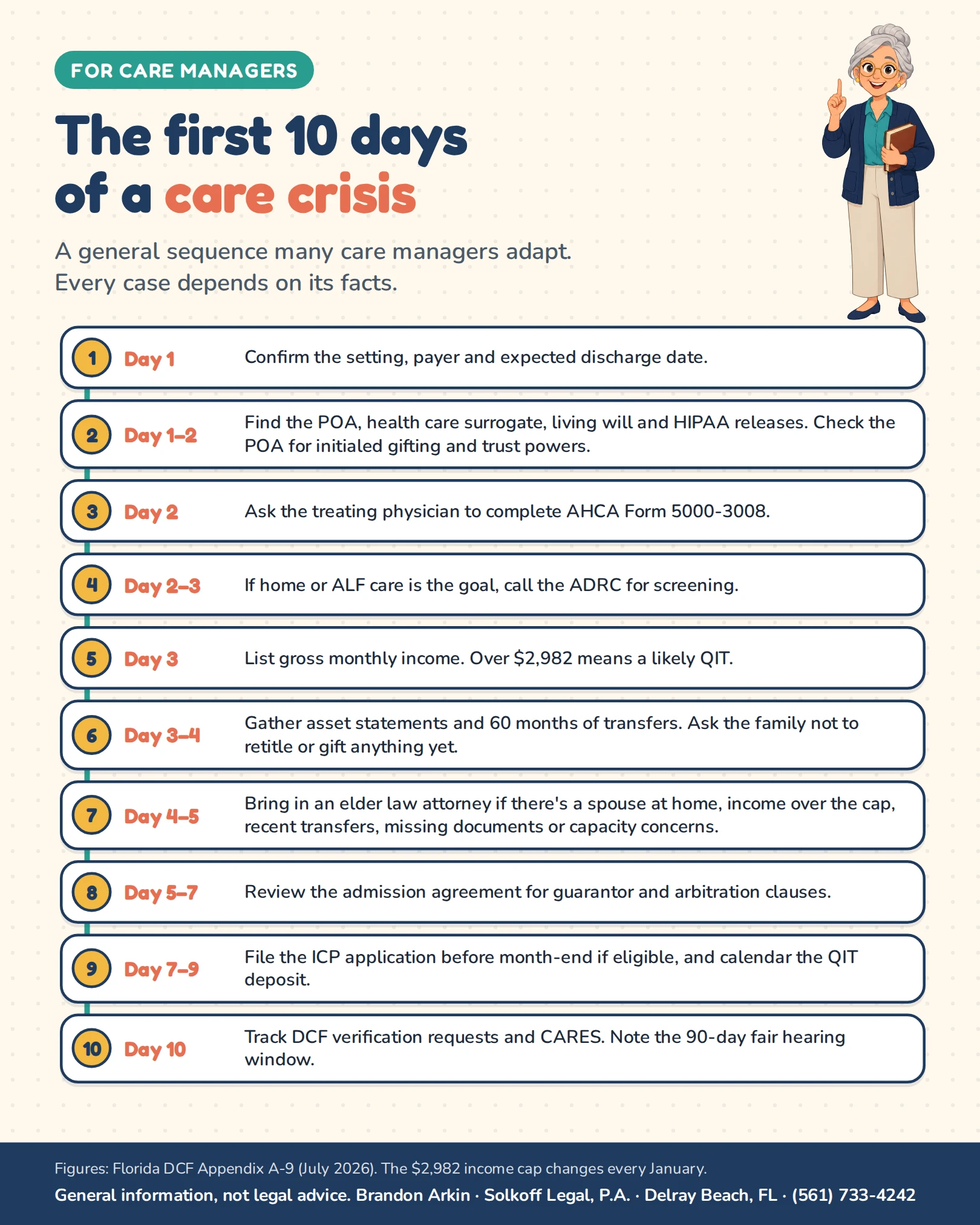
The first 10 days of a crisis: a timeline checklist
A general sequence many care managers adapt. Every case depends on its facts.
- Day 1: Confirm the setting, payer and expected discharge date.
- Day 1–2: Locate the POA, health care surrogate and living will. Check the POA for initialed gifting and trust powers.
- Day 2: Ask the treating physician to complete AHCA Form 5000-3008.
- Day 2–3: If home or ALF care is the goal, call the ADRC for screening.
- Day 3: List gross monthly income. Over $2,982 means a likely QIT.
- Day 3–4: Gather asset statements and 60 months of transfers. Ask the family not to retitle or gift anything yet.
- Day 4–5: Bring in an elder law attorney if there is a spouse at home, income over the cap, recent transfers, missing documents or capacity concerns.
- Day 5–7: Review the admission agreement for guarantor and arbitration clauses.
- Day 7–9: File the ICP application before month-end if eligible, and calendar the QIT deposit.
- Day 10: Track DCF verification requests and CARES. Note the 90-day fair hearing window.
Is there a waitlist for Medicaid nursing home care in Florida?
Generally no. The statewide pre-enrollment list in Fla. Stat. 409.979 applies to home and community-based services under SMMC LTC, which include assisted living and in-home care. A person who meets the nursing facility level of care through CARES and the financial rules for the Institutional Care Program can usually be approved without waiting for a release. The main timing factors are the date DCF receives the application, verification requests, and getting any required QIT funded in the right month. For home or ALF care, the priority score from the ADRC screening drives release, so updating the screening after a significant change may matter.
What happens if a QIT deposit is missed?
The month with a missed or short deposit may be ineligible for long-term care payment. DCF's guidance says income must be deposited in the month it is received and that deposits can't be made for a past month, so a late deposit usually can't fix the earlier month. The resident or family may owe the facility privately for that month. Care managers can help by confirming the deposit date each month and checking that the trustee moves at least the amount above $2,982. When a deposit has been missed, it is worth speaking with the eligibility worker and an elder law attorney promptly about the effect on the case.
When should a care manager suggest an elder law attorney?
Usually before money moves or documents are signed. Triggers include a spouse living at home, income above the $2,982 cap, transfers or gifts in the last 60 months, a POA without initialed gifting or trust powers, no health care surrogate, a family plan to retitle the home, an annuity pitch, a denial notice, or doubts about the client's capacity. An attorney can review the facts, explain options and help avoid penalties or a guardianship that might have been preventable. The decision to hire a lawyer, and which lawyer, always belongs to the client or the client's authorized agent.
If a client or patient is facing one of these questions, Brandon Arkin at Solkoff Legal, P.A. can be reached at (561) 733-4242.
Talk through the next step
Bring your questions, a list of accounts and any papers a hospital, nursing home or Medicaid office has sent you. Call the Delray Beach office or request a consultation, and I can look at where things stand and what may come next. A phone call or an email does not by itself create an attorney-client relationship.
Solkoff Legal, P.A. · (561) 733-4242