
For seniors and couples
One spouse in a nursing home in Florida: what happens to the other spouse
By Brandon Arkin, elder law attorney, Solkoff Legal, P.A. | {date}
By Brandon Arkin, elder law attorney, Solkoff Legal, P.A. | {date}
You won't be left with nothing
Many couples worry that if one of them needs a nursing home, the other will have to spend everything. Federal and Florida law were written to prevent that. They let the spouse at home keep a share of the savings, part of the income, and usually the home. The amounts are set each year. The figures below are Florida's 2026 numbers from DCF Appendix A-9.
Two terms come up again and again. The "institutionalized spouse" is the one who needs nursing home or Medicaid long-term care. The "community spouse" is the one who stays at home.
Savings: the spousal share
When you apply, Florida adds up the countable assets of both spouses, no matter whose name they're in. Countable assets are things like bank accounts, CDs and investments. The home, one car and some other items usually don't count.
From that total, the community spouse may keep up to $162,660 in 2026. This is called the Community Spouse Resource Allowance (CSRA). The spouse who needs care may keep $2,000. Anything above those amounts generally has to be spent on care or other allowable things, or protected through planning that fits your facts.
Some assets need a closer look. Retirement accounts may be treated as income or as an asset depending on whether payments are being made, and life insurance may count by its cash value. A spouse's IRA that is not paying out regularly may count toward the couple's total (DCF passage 1640.0505.05). Make a list of every account and policy before you apply, so nothing surprises you later.
Federal law allows transfers between spouses without penalty, so moving assets into the at-home spouse's name is generally allowed (42 U.S.C. 1396r-5(f)). After approval, assets owned only by the community spouse are no longer counted for the spouse in care (DCF passage 1640.0315).
A hypothetical: a couple in Boca Raton has $250,000 in countable savings. The wife at home may keep $162,660 and the husband in care $2,000, which leaves $85,340 to spend down or plan around.
The home
Your home is generally not counted while your spouse lives there. Florida's home equity limit of $752,000 generally doesn't apply while a spouse lives in the home (42 U.S.C. 1396p(f)(2)). After the spouse in care dies, Florida's Medicaid estate recovery claim is not enforced while a spouse survives (Fla. Stat. 409.9101). Some couples also look at a Lady Bird deed, but whether one fits depends on your plan.
Income: what the at-home spouse keeps
The community spouse's own income, such as their Social Security or pension, generally isn't counted toward the other spouse's eligibility (42 U.S.C. 1396r-5(b)(1)). Income is usually treated as belonging to the spouse whose name is on the check.
If the at-home spouse's income is low, part of the other spouse's income may be shifted to them. The Minimum Monthly Maintenance Needs Allowance (MMMNA) is $2,705 a month in 2026. With high housing costs, the Community Spouse Monthly Income Allowance (CSMIA) can reach up to $4,067. The spouse in care keeps a $160 personal needs allowance, and most of the rest of their income goes to the nursing home.
A hypothetical: a wife at home receives $1,200 a month in Social Security. Her husband in care may be able to send her about $1,505 a month to bring her to $2,705, and possibly more if her shelter costs are high.
If the spouse needing care has gross income over $2,982 a month, a Qualified Income Trust may be needed. The Medicaid planning page explains how one works.
The "income-first" rule and asking for more
Sometimes $162,660 isn't enough to generate the income the at-home spouse needs. Federal law lets either spouse ask, at a fair hearing, for a larger asset allowance (42 U.S.C. 1396r-5(e)(2)(C)), and Florida policy follows this (DCF passage 1640.0314.01). Under the "income-first" rule, the state first counts the income the spouse in care could send home before allowing more savings (42 U.S.C. 1396r-5(d)(6)). Because of that rule, a larger allowance is possible but not common.
When the at-home spouse won't contribute
Federal law and Florida policy include a process sometimes called "spousal refusal." If the community spouse refuses to make their assets available, the spouse in care may assign their right to support to the state on DCF Form CF-ES 2504 (DCF passages 1640.0314.03 and 1640.0314.04; 42 U.S.C. 1396r-5(c)(3)). DCF then doesn't deny eligibility because of the withheld assets if the spouse in care would otherwise qualify and has no other way to pay.
There are tradeoffs. The assignment lets the state pursue support from the at-home spouse. DCF says its staff won't suggest the option, and it is meant for situations that already exist, such as spouses who are separated or a second marriage with separate finances. Whether it fits a family is a decision to make with an elder law attorney.
Update the at-home spouse's plan too
Couples often have wills that leave everything to each other. If the at-home spouse dies first, that inheritance could go to the spouse in care and affect their Medicaid. Many couples review their wills, powers of attorney and beneficiary forms when one spouse's health changes. The estate planning page and the five documents every family should find are good places to start.
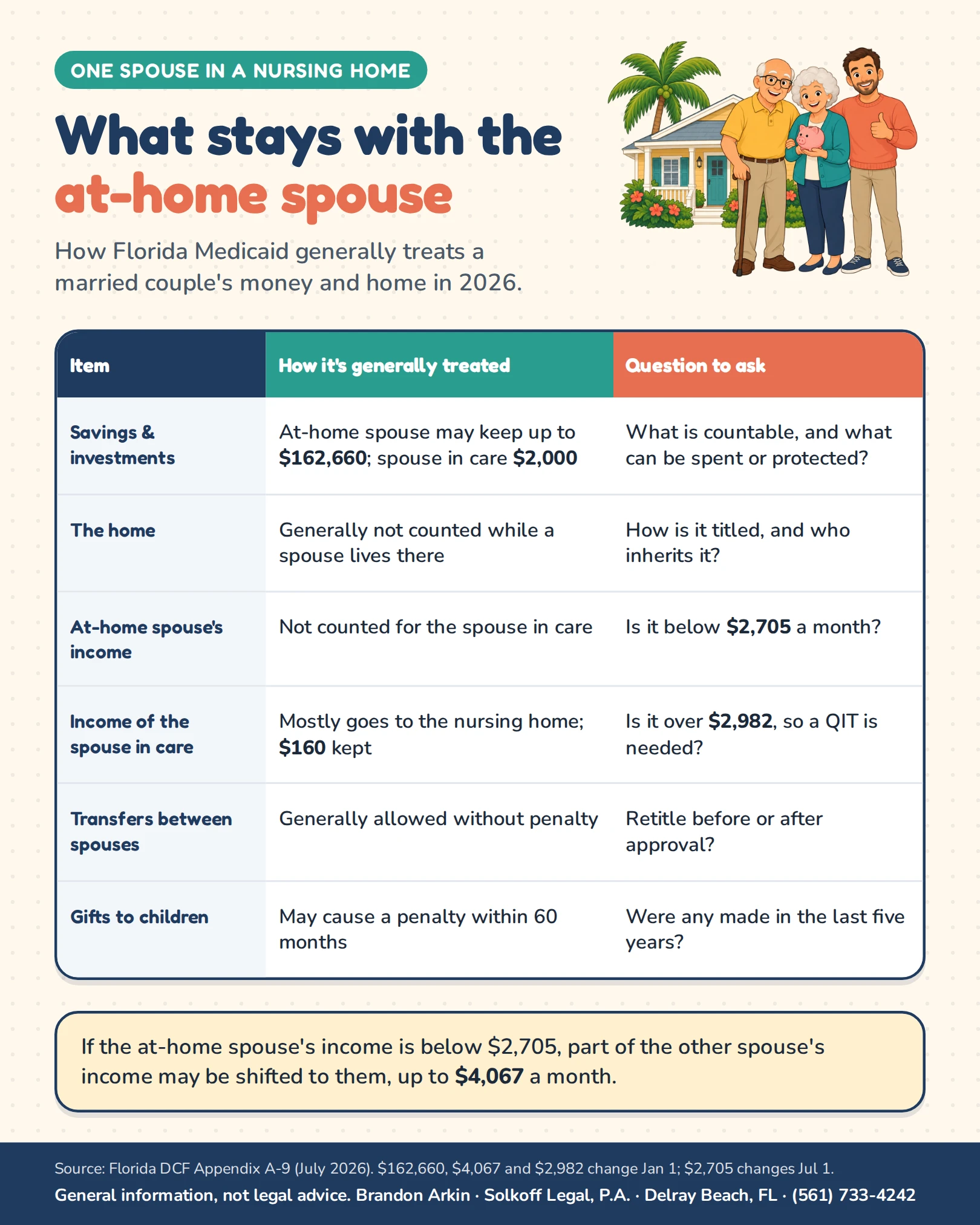
What stays with the at-home spouse: a quick table
| Item | How Florida Medicaid generally treats it in 2026 | Question to ask |
|---|---|---|
| Savings and investments | At-home spouse may keep up to $162,660; spouse in care $2,000 | What is countable, and what can be spent or protected? |
| The home | Generally not counted while a spouse lives there | How is it titled, and who inherits it? |
| At-home spouse's income | Not counted for the spouse in care | Is it below $2,705 a month? |
| Income of the spouse in care | Mostly goes to the nursing home; $160 kept | Is it over $2,982, so that a QIT is needed? |
| Transfers between spouses | Generally allowed without penalty | Should assets be retitled before or after approval? |
| Gifts to children | May cause a penalty within 60 months | Were any made in the last five years? |
Will I lose the house if my husband goes into a nursing home?
Usually not while you live there. Florida Medicaid generally doesn't count the home while a spouse lives in it, and the $752,000 home equity limit generally doesn't apply then (42 U.S.C. 1396p(f)(2)). Florida's estate recovery claim also isn't enforced while a spouse survives (Fla. Stat. 409.9101). What happens later depends on how the home is titled and on both of your estate plans, so it's worth reviewing them with an elder law attorney.
Do we have to spend all our savings before Medicaid helps?
No. In 2026, the at-home spouse may generally keep up to $162,660 in countable assets, and the spouse in care may keep $2,000 (DCF Appendix A-9). The home, one car and certain other items usually aren't counted. Savings above those amounts generally must be spent on care or other allowable items, or protected through planning that fits your facts. Gifts to children can cause a penalty, so avoid moving money before getting advice. An elder law attorney can review what's countable in your situation.
Is my income counted if my wife needs Medicaid?
Generally no. Federal law says the at-home spouse's income isn't counted toward the other spouse's eligibility (42 U.S.C. 1396r-5(b)(1)), and income usually belongs to whoever's name is on the check. If your own income is below $2,705 a month in 2026, part of your wife's income may be sent to you, up to $4,067 when housing costs are high. Her remaining income generally goes toward her care, after a $160 personal needs allowance.
If your family is facing one of these questions, you can reach Brandon Arkin at Solkoff Legal, P.A. at (561) 733-4242.
Talk through the next step
Bring your questions, a list of accounts and any papers a hospital, nursing home or Medicaid office has sent you. Call the Delray Beach office or request a consultation, and I can look at where things stand and what may come next. A phone call or an email does not by itself create an attorney-client relationship.
Solkoff Legal, P.A. · (561) 733-4242