
For bankers and trust officers
Elder financial exploitation in Florida: what bankers and trust officers need to know
By Brandon Arkin, elder law attorney, Solkoff Legal, P.A. | {date}

By Brandon Arkin, elder law attorney, Solkoff Legal, P.A. | {date}
Where banking meets elder law
Branch staff and trust officers often see an elder law problem before a family does. An agent arrives with a power of attorney. A daughter wants to be added to her father's account. A customer who has banked with you for 30 years starts wiring money to someone she met online.
Accepting a Florida power of attorney
A Florida power of attorney must be signed by the principal and two subscribing witnesses and acknowledged before a notary (Fla. Stat. 709.2105). Banking authority is granted by stating "authority to conduct banking transactions as provided in section 709.2208(1), Florida Statutes," and investment authority by the matching reference to 709.2208(2) (Fla. Stat. 709.2208).
Under Fla. Stat. 709.2119, you may rely in good faith on a power of attorney that appears to be properly executed. You may ask the agent for an affidavit stating the principal's domicile, that the principal is not deceased, that the power of attorney has not been revoked, terminated or suspended, and, for a successor agent, why the earlier agents are not serving. The statute includes a sample affidavit. You may also ask for an English translation, an opinion of counsel (stating your reason in writing), or, for a remotely notarized document, the notary's electronic journal.
The four-day rule and lawful refusals
Fla. Stat. 709.2120 requires a third person to accept or reject a power of attorney within a reasonable time. For a financial institution or broker-dealer handling banking or investment transactions the document expressly grants, four days, excluding Saturdays, Sundays and legal holidays, is presumed reasonable. You may refuse if you would not otherwise do business with the principal, you know the authority has ended, the agent won't provide a requested affidavit, translation or opinion, you believe in good faith the document is invalid or the agent lacks authority, or you or someone else has reported the agent to adult protective services. Except for the first reason, a rejection must be in writing and state the reason. A wrongful rejection may lead to a court order and liability for damages, including attorney fees and costs.
Signs of elder financial exploitation
Common warning signs include sudden changes in spending, withdrawals or wires; a new "friend," caregiver or relative who does the talking and won't leave the customer alone; a customer who seems confused, frightened or coached; new joint owners, payees or beneficiaries added quickly; requests to close CDs early or cash out annuities with no clear reason; gift cards, cryptocurrency kiosks or wires to people the customer has never met; an agent using the principal's money for the agent's own bills; and missing statements or a sudden change of address. Any one sign may be innocent; together they may give reasonable cause to suspect exploitation.
Florida's reporting duty and the Senior Safe Act
Under Fla. Stat. 415.1034, any person who knows or has reasonable cause to suspect that a vulnerable adult has been or is being abused, neglected or exploited must report it immediately to the central abuse hotline. The statute expressly lists bank, savings and loan and credit union officers, trustees and employees, along with dealers, investment advisers and associated persons under Chapter 517. The duty belongs to the individual, so internal escalation doesn't replace the hotline call.
At the federal level, the Senior Safe Act (12 U.S.C. 3423) gives immunity to trained supervisory, compliance and legal staff, and to covered financial institutions, when they disclose suspected exploitation of someone 65 or older to a covered agency in good faith and with reasonable care. The immunity depends on training that covers how to identify and report exploitation and how to protect customer privacy. Keep records of that training.
Delaying a transaction: Florida 415.10341 and FINRA 2165
Fla. Stat. 415.10341 allows a financial institution that has reported suspected exploitation of a "specified adult," meaning someone 65 or older or a vulnerable adult, to delay a disbursement or transaction if it promptly starts an internal review. Within 3 business days, it must give written notice and the reason to all parties authorized on the account and any trusted contact, leaving out anyone suspected of the exploitation. The delay ends after 15 business days and may be extended by up to 30 more business days if the review supports it. A court may shorten or extend it. Keep the required record for 5 years. An institution acting in good faith and with reasonable care is immune from liability for the delay.
Broker-dealers have a parallel rule. FINRA Rule 4512 requires a reasonable effort to get the name and contact information of a trusted contact person, 18 or older, for each non-institutional account, with written disclosure that the firm may contact that person. FINRA Rule 2165 allows a temporary hold on a disbursement or securities transaction in a specified adult's account for up to 15 business days, a further 10 business days, and 30 more if the matter has been reported to a state regulator, agency or court. Notice to the trusted contact and authorized parties is due within 2 business days.
Joint account, POA or convenience account
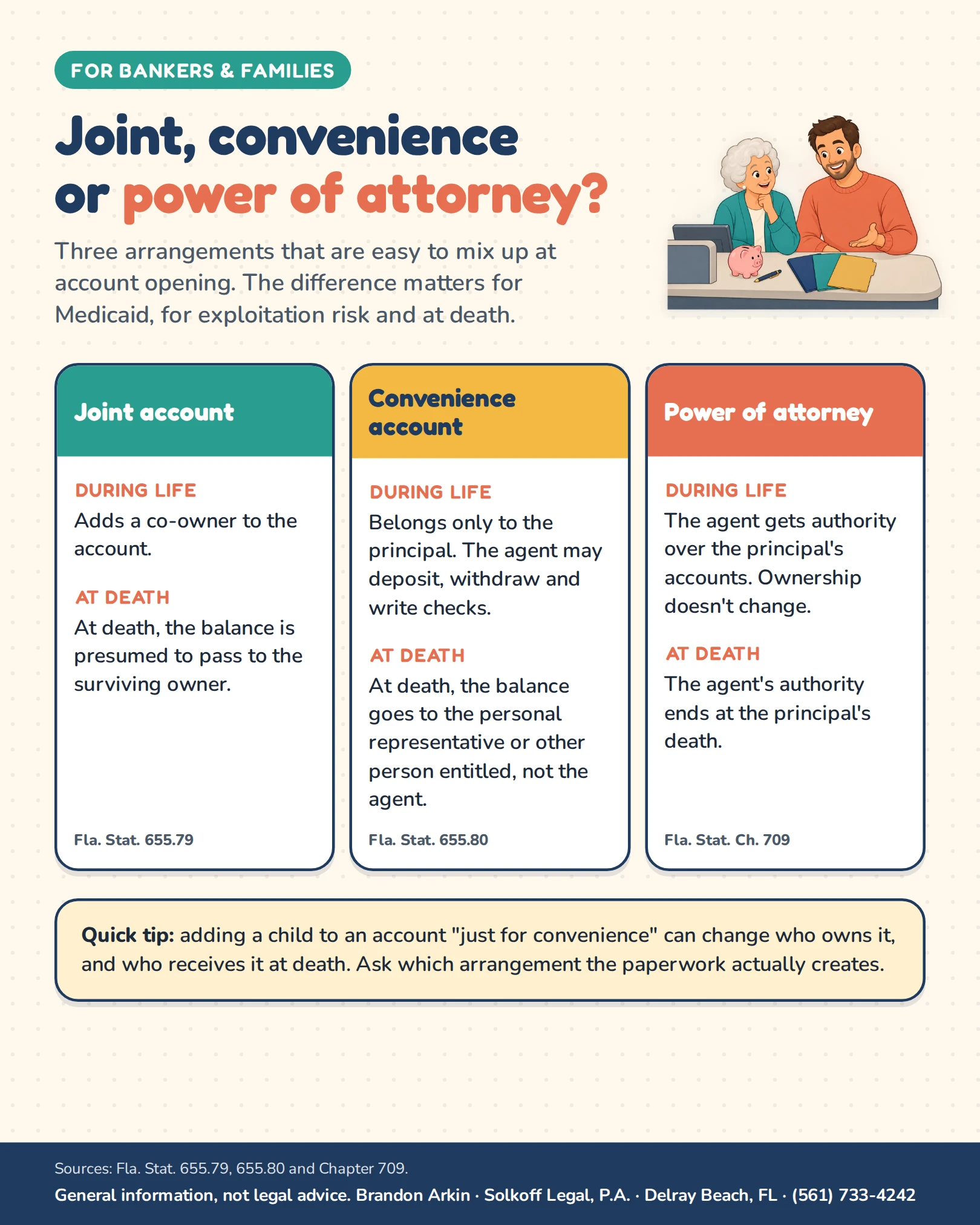
These three arrangements are often confused at account opening, and the difference matters for Medicaid, for exploitation risk and at death. A joint deposit account is presumed to pass to the surviving owner (Fla. Stat. 655.79). A convenience account under Fla. Stat. 655.80 belongs only to the principal. The agent may deposit, withdraw and write checks, only the principal can change the designations, and at death the balance is paid to the personal representative or other person entitled, not to the agent. A power of attorney gives an agent authority over the principal's accounts without changing ownership.
| Arrangement | Who owns the funds | Helper's authority | At the owner's death |
|---|---|---|---|
| Joint account (655.79) | Each owner has present access | Full, as a co-owner | Presumed to pass to the survivor |
| Convenience account (655.80) | The principal only | Deposit, withdraw, write checks | Paid to the personal representative or other person entitled |
| Power of attorney (Ch. 709) | The principal | As granted in the document | Agent's authority ends |
| Payable-on-death | The owner | None during life | Paid to the named beneficiary |
For Medicaid, DCF presumes all funds in a joint account belong to the applicant if the applicant has unrestricted access (passage 1640.0302.01). Adding a child as a joint owner "for convenience" may not protect anything.
Special needs and pooled trust accounts
A first-party special needs trust under 42 U.S.C. 1396p(d)(4)(A) holds the beneficiary's own money, must be set up before the beneficiary turns 65, and must repay Medicaid at death. A pooled trust under (d)(4)(C) is run by a nonprofit that keeps a separate sub-account for each beneficiary, and funding at 65 or older may be treated as a transfer (POMS SI 01120.203). A third-party trust funded by family has no payback requirement (POMS SI 01120.200). For trust officers, the practical points are to title the account in the trustee's name for the trust, use the trust's own tax identification number when one is required, and keep distributions for the beneficiary's sole benefit, checking with the drafting attorney before giving the beneficiary direct access.
Qualified Income Trust accounts
A Qualified Income Trust (QIT), sometimes called a Miller trust, lets a person whose gross income is over $2,982 a month qualify for Florida long-term care Medicaid. DCF's QIT information sheet and ESS passage 1840.0110 describe the rules. The trust must be irrevocable, hold only the person's income, and name the State as remainder beneficiary up to the Medicaid paid. Income must be deposited in the month it's received, and no deposit can be made for a past or future month (Appendix A-22.1). If the account holds assets or someone else's money, DCF may not treat it as a QIT.
Working with the family's elder law attorney
When a power of attorney is rejected, a QIT deposit is missed or a hold is placed, a short call between the bank's legal or compliance team and the family's attorney can often resolve things inside the statutory deadlines. Share account information only as your privacy rules and the customer's authorization allow. Solkoff Legal, P.A. does not pay referral fees or give anything of value for a recommendation, which is consistent with Rule 4-7.17(b) of the Rules Regulating The Florida Bar.
QIT account setup checklist
Use this checklist when a family or trustee opens a Qualified Income Trust account. It reflects DCF's published QIT guidance. The trust document itself controls, so confirm details with the drafting attorney.
Get a copy of the signed QIT agreement and confirm it names the trustee and is irrevocable.
Title the account in the trustee's name for the trust, as the document directs, separate from every other account.
Open it with a small deposit from the person's income, not from savings or another person's money.
Set up a recurring monthly transfer of the income to be deposited, timed to land in the same month the income arrives.
Avoid debit cards and overdraft links to the person's personal account unless the attorney approves them.
Set up monthly statements.
Note that money leaving the QIT generally goes toward the patient responsibility and allowed deductions, and that payments made directly to the person count as their income.
At death, provide the statement covering the date of death so the trustee can pay the remainder to AHCA, as DCF's guidance describes.
How long does a Florida bank have to accept a power of attorney?
A reasonable time, which Fla. Stat. 709.2120 presumes to be four days, excluding Saturdays, Sundays and legal holidays, for a financial institution or broker-dealer handling banking or investment transactions that the document expressly grants. During that time you may ask for the agent's affidavit, a translation or an opinion of counsel under 709.2119. A rejection must generally be in writing with the reason, unless the reason is that you would not otherwise do business with the principal. Wrongful rejection can lead to a court order and liability for damages, including attorney fees.
Can a Florida bank hold a transaction it thinks is exploitation?
Yes, within limits. Under Fla. Stat. 415.10341, a financial institution that has reported suspected exploitation of a person 65 or older, or a vulnerable adult, may delay a disbursement or transaction if it promptly starts an internal review. Written notice must go to authorized parties and any trusted contact, other than a suspected exploiter, within 3 business days. The delay lasts up to 15 business days and may be extended by up to 30 more if the review supports it, and a court can change it. Broker-dealers follow FINRA Rule 2165.
What is the difference between a joint account and a convenience account?
Ownership. In a joint deposit account, each owner has present access, and the balance is presumed to pass to the survivor at death (Fla. Stat. 655.79). In a convenience account under Fla. Stat. 655.80, the funds belong only to the principal. The agent can deposit, withdraw and write checks but has no ownership, and at death the balance goes to the principal's estate or the person entitled. For an older customer who only wants help paying bills, a convenience account or a power of attorney may fit better, but the right choice depends on the customer's goals.
If a client or patient is facing one of these questions, Brandon Arkin at Solkoff Legal, P.A. can be reached at (561) 733-4242.
Talk through the next step
Bring your questions, a list of accounts and any papers a hospital, nursing home or Medicaid office has sent you. Call the Delray Beach office or request a consultation, and I can look at where things stand and what may come next. A phone call or an email does not by itself create an attorney-client relationship.
Solkoff Legal, P.A. · (561) 733-4242