Planning basics
5 Legal Documents Every Florida Adult Needs, and How Each One Is Signed
By Brandon Arkin, elder law attorney, Solkoff Legal, P.A. · Updated November 2026
At 18, a child becomes a legal adult. From then on, parents no longer automatically get medical updates or access to accounts. The same gap opens for anyone, at any age, after a stroke or a car accident. If no one has written authority, the family may have to ask a court for it.
Five documents close most of that gap. Florida sets specific signing rules for each. A document that looks complete but was signed the wrong way can be refused exactly when it's needed. This guide covers what each document does and how it's signed, so you can check what your family already has.
Durable power of attorney
Signing rule: Two witnesses and a notary
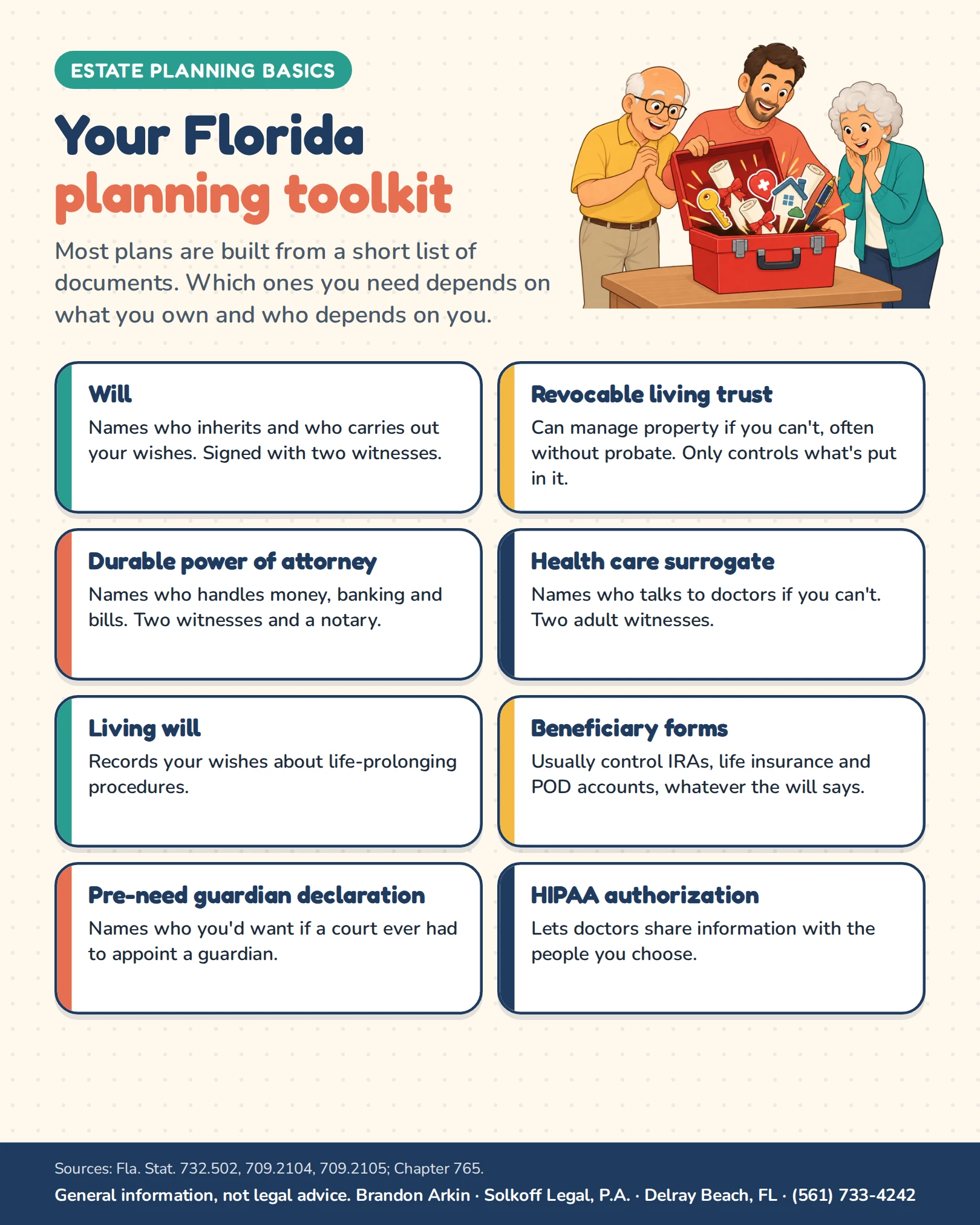
A durable power of attorney names an agent to handle money and property: paying bills, talking to the bank, filing taxes, dealing with Social Security. "Durable" means it keeps working if you lose capacity. That's the moment it matters most.
Florida requires the principal to sign in front of two witnesses and a notary (Fla. Stat. 709.2105). Some powers, such as making gifts, creating or changing trusts, or changing beneficiaries, only work if the principal separately initials or signs next to each one (Fla. Stat. 709.2202). For an older adult who may later need Medicaid planning, those initialed powers can matter a great deal.
Florida also doesn't allow "springing" powers of attorney that take effect only after incapacity, if signed on or after October 1, 2011 (Fla. Stat. 709.2108). The document works as soon as it's signed, so the choice of agent matters. The guide for agents covers what the job involves once you're named.
Designation of health care surrogate
Signing rule: Two adult witnesses
A health care surrogate makes medical decisions when you can't, and can talk with doctors and review records. You sign the designation in front of two adult witnesses. The person you name can't be one of them, and at least one witness must be someone other than your spouse or a blood relative (Fla. Stat. 765.202).
You can name an alternate in case your first choice isn't available. You can also let the surrogate act right away, before any finding that you lack capacity. Many families find that helpful for appointments and hospital stays. Give the surrogate an exact copy.
Without a designation, Florida law sets an order of who may decide: a guardian, then a spouse, then a majority of adult children who are reasonably available, and so on (Fla. Stat. 765.401). A designation lets you pick the person yourself.
Living will
Signing rule: Two witnesses, one not a spouse or blood relative
A living will states your wishes about life-prolonging procedures if you have a terminal condition or an end-stage condition, or are in a persistent vegetative state. It's signed in front of two witnesses, and at least one of them can't be your spouse or a blood relative (Fla. Stat. 765.302).
The living will and the surrogate designation work as a pair. The living will records what you want, and the surrogate is the person who speaks for you. Families often say the hardest part isn't the paperwork. It's the conversation. A living will spares a spouse or child from guessing in an ICU waiting room.
HIPAA authorization
Signing rule: Signed and dated by you, naming who may receive information
Federal privacy rules limit what doctors, hospitals and insurers can share. A HIPAA authorization lets named people receive your health information. It must describe the information, name who may receive it, and include an expiration date or event and your signature (45 C.F.R. 164.508).
It's useful for people who need to stay informed without making decisions, such as a second child, an adult grandchild who coordinates appointments, or a care manager. It's also the document many parents of college students ask about. Some families fold this language into the surrogate designation. A separate form is easier to hand to a billing office.
A will or a revocable trust
Signing rule: Will: signed at the end, with two witnesses
A will says who receives your property at death and who serves as personal representative. Florida requires it to be signed at the end in front of two witnesses, who also sign (Fla. Stat. 732.502). A self-proving affidavit, signed before a notary, can spare witnesses from being tracked down later (Fla. Stat. 732.503). Assets that pass under a will usually go through probate.
A revocable living trust can hold property during life and pass it at death without probate. A trust only controls what's actually put into it, though. A house still titled in your own name stays outside the trust. Florida requires the trust's dispositive provisions to be signed with the same formalities as a will (Fla. Stat. 736.0403). Which one fits depends on property, family and goals. Estate planning walks through the choice.
Also in the toolkit: beneficiary forms
IRAs, 401(k)s, life insurance, annuities and payable-on-death bank accounts usually pass to whoever is named on the form, whatever the will says. An old form naming an ex-spouse or a late parent can undo a careful plan. Review every form after a marriage, divorce, death or birth. Naming a person with a disability outright can affect their benefits. The special needs guide explains why.
Also in the toolkit: pre-need guardian declaration
If a court ever has to appoint a guardian, a pre-need declaration tells it whom you would want. It's a written declaration signed in front of two witnesses who are present at the same time. It can name an alternate and can be filed with the clerk of court (Fla. Stat. 744.3045). Your choice is presumed to be the right one unless someone shows otherwise. Good powers of attorney and surrogate designations often make a guardianship unnecessary. This document is a backstop.
Moved to Florida with documents from another state?
Florida generally honors a will that was valid where it was signed (Fla. Stat. 732.502). An out-of-state power of attorney is also valid here if it was valid where signed. A bank, however, may ask for a lawyer's opinion at your expense, and it may refuse the document if no opinion is given (Fla. Stat. 709.2106). That's one reason new residents often re-sign their documents under Florida law. The moving to Florida guide covers the rest of the move.
Your five-document checklist
Gather what you have and tick each line. This checklist works on screen and on paper. Nothing you tick is saved or sent anywhere.
Tick boxes stay on this device. Nothing is saved or sent.
Common questions
Does my 18-year-old need these documents?
Many families decide yes. At 18 a child is a legal adult, and parents no longer have automatic authority to receive medical information or handle money for them. If a young adult is hospitalized or away at school, a health care surrogate designation and a HIPAA authorization let a parent speak with doctors. A durable power of attorney lets a parent help with banking or a lease. Without them, a family may need to ask a court for authority in an emergency. A will is often less pressing at 18. That depends on what the young adult owns.
What happens in Florida if someone has no health care surrogate?
Florida law supplies a list. If there's no surrogate designation and no court-appointed guardian, providers generally look first to a spouse, then to a majority of the adult children who are reasonably available, then to parents, adult siblings and others, in order (Fla. Stat. 765.401). That can work in a close family. It can be slow or contested when children disagree, live far away, or when a partner isn't legally a spouse. A designation lets the person choose for themselves and name an alternate.
Is a revocable trust better than a will in Florida?
Neither is better for everyone. A will is simpler to set up, but assets passing under it usually go through probate. A revocable trust can avoid probate for whatever has been placed in it, and it can provide management if you become ill. It only works if the house and accounts are actually retitled into it. People with a trust usually still sign a short "pour-over" will as a safety net. Florida has no state estate tax (Florida Department of Revenue), so the choice usually turns on probate, privacy and management, not tax.
If your family is facing one of these questions, you can reach Brandon Arkin at Solkoff Legal, P.A. at (561) 733-4242.
Talk through the next step
Bring your questions, a list of accounts and any papers a hospital, nursing home or Medicaid office has sent you. Call the Delray Beach office or request a consultation, and I can look at where things stand and what may come next. A phone call or an email does not by itself create an attorney-client relationship.
Solkoff Legal, P.A. · (561) 733-4242