
Resources · Your home
Lady Bird deed in Florida: what it does, what it doesn't, and when to be careful
By Brandon Arkin, elder law attorney, Solkoff Legal, P.A. · Updated November 2026
What a Lady Bird deed is
A Lady Bird deed is the common name for an enhanced life estate deed, sometimes called a life estate deed with powers. You sign a new deed to your home that keeps a life estate for yourself and names one or more people, called remainder beneficiaries, to receive the home when you die.
What makes it "enhanced" is what you keep. Florida's Department of Children and Families (DCF) describes the owner of an enhanced life estate as having the same rights as complete ownership, including the right to sell without the remainder beneficiaries' consent (ESS Policy Manual 1640.0305.03). In practice, you can usually live in the home, rent it, sell it, mortgage it or sign a new deed naming different people, all without asking the beneficiaries. They have no say while you're alive.
A regular life estate deed is different. Once you sign one, the remainder beneficiaries already own part of the home, and you generally need their signatures to sell or mortgage it. That difference matters a great deal for Medicaid, as explained below.
How it can avoid probate
When the owner dies, the home passes to the remainder beneficiaries under the deed itself, without going through probate. The beneficiaries usually record a death certificate and related papers in the county records. Our guide to Florida probate explains what probate involves and why many families try to keep the home out of it.
The deed covers only the property it describes. Bank accounts, cars and other property still need their own plan, such as a will, a revocable trust or beneficiary designations.
How Florida Medicaid treats it
Two DCF rules matter here.
First, signing the deed isn't a transfer. DCF's policy says that when someone keeps a life estate using a Lady Bird deed or life estate with powers, "no transfer has occurred," because the person keeps full ownership powers and the property changes hands only at death (ESS Policy Manual 1640.0613.01). Signing one therefore doesn't, by itself, start a penalty under the 60-month look-back. By contrast, a regular life estate deed is treated as a transfer of the remainder value, and a deed giving the home outright to children is a transfer of its full value.
Second, the home is counted the same way as any other home you own. It may be excluded if it qualifies as your homestead, including when you're away from the home but intend to return (1640.0305.03). For 2026, Florida's home equity limit for an applicant is $752,000 (DCF Appendix A-9). That limit generally doesn't apply while a spouse lives in the home. Our Medicaid planning page explains the asset rules more broadly.
So a Lady Bird deed doesn't make a home "Medicaid-proof" during life. Its Medicaid value usually shows up after death.
Estate recovery and homestead
When someone received Medicaid at 55 or older, Florida may seek repayment from their estate. Florida's statute says that recovery is done by filing a claim against the estate of the deceased Medicaid recipient as provided in the probate code (Fla. Stat. 409.9101). A home that passes to beneficiaries under a Lady Bird deed passes outside probate, so it generally isn't part of the estate that claim is filed against. The same statute also says the claim can't be enforced against property that is exempt from creditors, which can include protected homestead.
Recovery rules can change, and the result depends on how the deed is written and what else is in the estate. This is a point to confirm with an attorney before relying on it.
Property taxes, lenders and title insurance
Homestead exemption. Florida law says a person whose right to live in a home comes from an instrument granting a beneficial interest for life is entitled to the homestead property tax exemption if they otherwise qualify (Fla. Stat. 196.041). In practice, the exemption usually continues after a Lady Bird deed. It's still wise to confirm with the county property appraiser when the new deed is recorded.
Mortgages. Most mortgages have a "due-on-sale" clause. Federal law bars lenders from enforcing it for certain transfers, including a transfer to a relative resulting from the borrower's death, and a transfer where the borrower's spouse or children become an owner (12 U.S.C. 1701j-3(d)). Even so, it's sensible to tell the lender, and to check the deed with your lawyer before refinancing.
Title insurance. When you later sell, or your beneficiaries sell after your death, the title company will review the deed. Some ask for extra documents, such as a death certificate or proof that homestead restrictions don't apply. Clear drafting and a careful legal description make this easier.
Income tax. Because the owner keeps a life estate with full powers, the beneficiaries generally receive a basis equal to the home's value at death (26 U.S.C. 1014), which can reduce capital gains tax if they sell. A deed to children during life usually doesn't have that benefit.
Risks and limits
Spouses and minor children. Florida's Constitution limits how homestead can pass when the owner is survived by a spouse or a minor child, and requires the spouse to join in many transfers (Art. X, s. 4(c), Fla. Const.). Because a Lady Bird deed lets the owner take the home back, those homestead rules may still apply at death. A Fourth District case in 2026 involved this exact clash after a remarriage; our law updates page summarizes it, and our guide on remarrying later in life explains why it's worth revisiting the deed. A beneficiary dies first. Name alternates, or say what happens to that share. A beneficiary has a disability. Leaving the home outright to someone on SSI or Medicaid may affect their benefits. See our special needs planning guide. Several beneficiaries. After your death, they own the home together and must agree to sell it. Incapacity. The deed doesn't let anyone else manage the home for you. You still need a durable power of attorney that covers real property. Not every property fits. Co-op apartments, property held in a trust, and homes owned with someone else need a separate look.
Lady Bird deed or revocable trust?
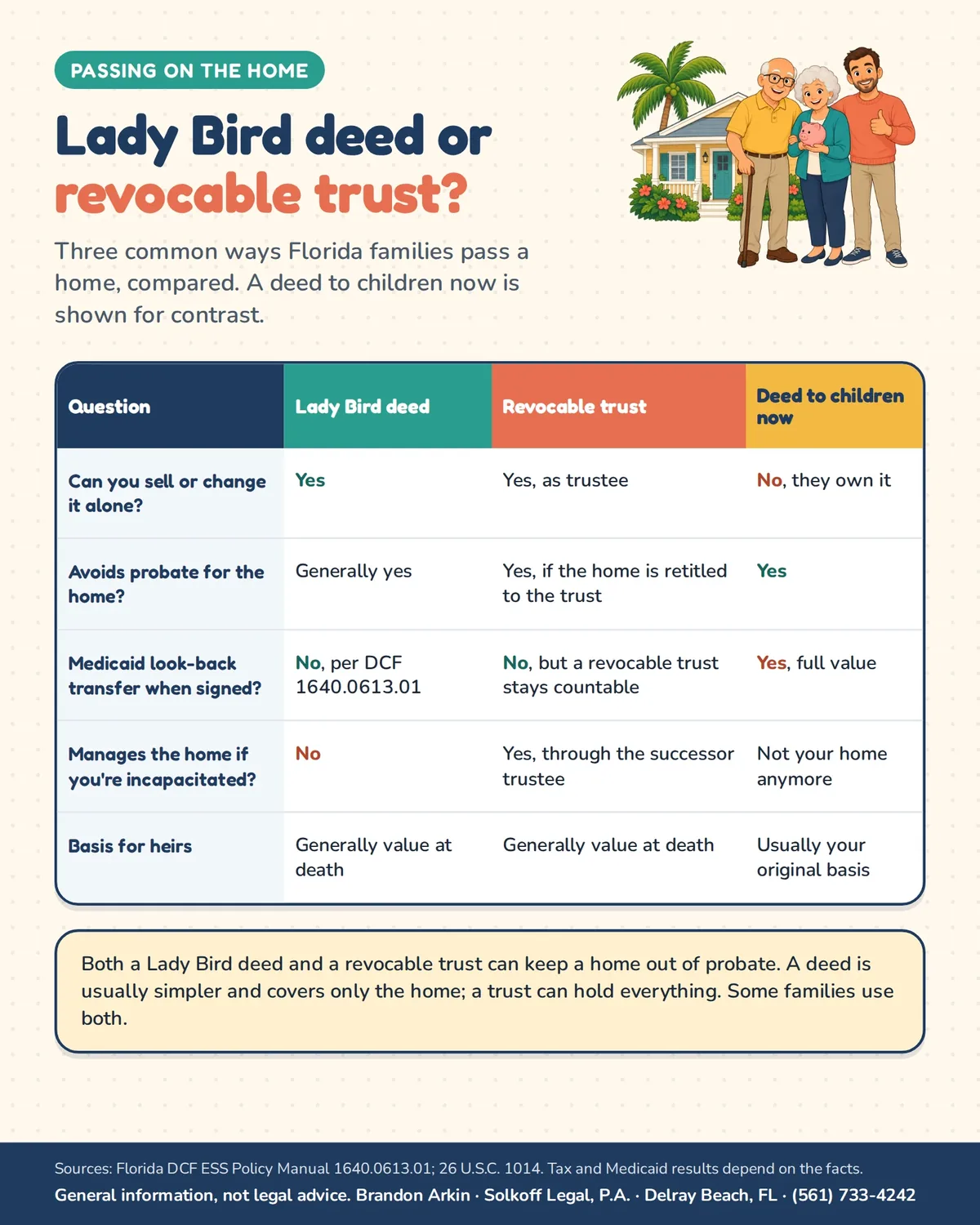
Both can keep a home out of probate. A Lady Bird deed is usually simpler and cheaper, and it covers only the home. A revocable trust can hold everything, can name a successor trustee to manage property if you become incapacitated, and can hold a share for a beneficiary over time instead of handing it over outright. Some families use both. Our estate planning page explains the trust side.
Comparing three ways to pass a home
| Question | Lady Bird deed | Revocable trust | Deed to children now |
|---|---|---|---|
| Can you sell or change it alone? | Yes | Yes, as trustee | No, they own it |
| Avoids probate for the home? | Generally yes | Yes, if the home is retitled to the trust | Yes |
| Medicaid look-back transfer when signed? | No, per DCF 1640.0613.01 | No, a revocable trust stays countable | Yes, full value |
| Manages the home if you're incapacitated? | No | Yes, through the successor trustee | Not your home anymore |
| Basis for heirs | Generally value at death | Generally value at death | Usually your original basis |
Question
Can you sell or change it alone?
Lady Bird deed
Yes
Revocable trust
Yes, as trustee
Deed to children now
No, they own it
Question
Avoids probate for the home?
Lady Bird deed
Generally yes
Revocable trust
Yes, if the home is retitled to the trust
Deed to children now
Yes
Question
Medicaid look-back transfer when signed?
Lady Bird deed
No, per DCF 1640.0613.01
Revocable trust
No, a revocable trust stays countable
Deed to children now
Yes, full value
Question
Manages the home if you're incapacitated?
Lady Bird deed
No
Revocable trust
Yes, through the successor trustee
Deed to children now
Not your home anymore
Question
Basis for heirs
Lady Bird deed
Generally value at death
Revocable trust
Generally value at death
Deed to children now
Usually your original basis
Tick boxes stay on this device. Nothing is saved or sent.
Common questions
Can I still sell my house after signing a Lady Bird deed?
Generally yes. The owner of an enhanced life estate keeps the same rights as complete ownership, including the right to sell without the remainder beneficiaries' consent, as DCF describes it (ESS Policy Manual 1640.0305.03). You can usually also mortgage the home or sign a new deed naming different people. The title company handling a sale will review the deed. If you're married, Florida's homestead rules may still require your spouse to sign. A regular life estate deed works differently, because the beneficiaries' signatures are generally needed.
Does a Lady Bird deed protect my home from Medicaid?
Partly, and mostly after death. DCF says signing one isn't a transfer, so it doesn't start a look-back penalty (ESS Policy Manual 1640.0613.01). During life, the home is counted like any other home: it may be excluded as homestead, subject to the 2026 equity limit of $752,000. After death, Florida's estate recovery works through a probate claim (Fla. Stat. 409.9101), and a home passing under the deed generally passes outside probate. Your facts matter, so confirm with an attorney.
Will I lose my homestead exemption?
Usually not. Florida law says a person whose right to live in the home comes from an instrument granting them a beneficial interest for life is entitled to the homestead property tax exemption, as long as they otherwise qualify (Fla. Stat. 196.041). A Lady Bird deed keeps that kind of life interest for you. Still, it's wise to contact your county property appraiser after the deed is recorded to confirm the exemption carries over, and to keep a copy of the recorded deed.
If your family is facing one of these questions, you can reach Brandon Arkin at Solkoff Legal, P.A. at (561) 733-4242.
Talk through the next step
Bring your questions, a list of accounts and any papers a hospital, nursing home or Medicaid office has sent you. Call the Delray Beach office or request a consultation, and I can look at where things stand and what may come next. A phone call or an email does not by itself create an attorney-client relationship.
Solkoff Legal, P.A. · (561) 733-4242