For veterans, surviving spouses and their families
VA Aid and Attendance in Florida: A Plain-English Guide
By Brandon Arkin, elder law attorney, Solkoff Legal, P.A. · Updated November 2026

What Aid and Attendance is
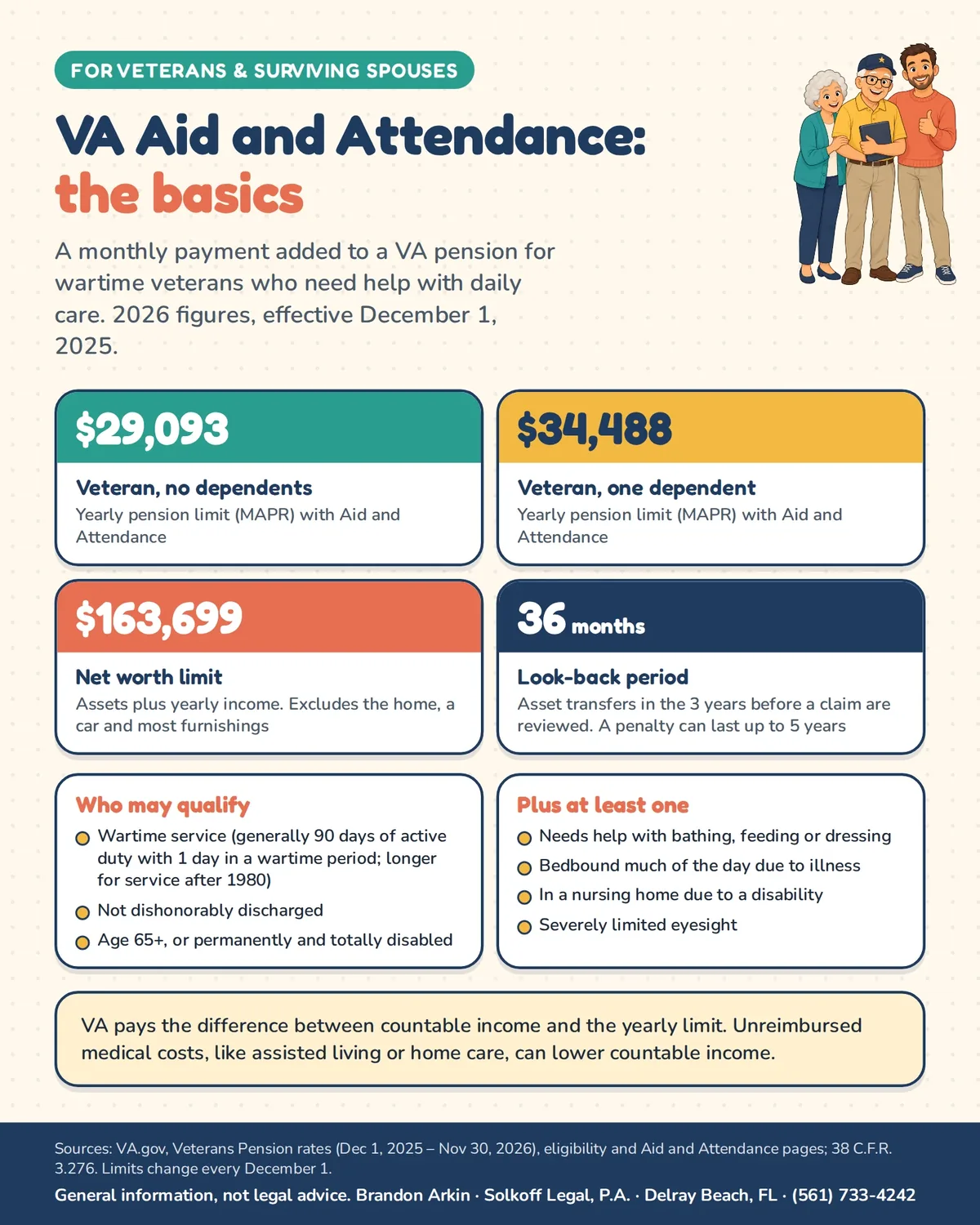
"Aid and Attendance" isn't a separate program. It's an extra amount added to a VA pension for a veteran or surviving spouse who needs help from another person with daily life (VA).
The pension is a needs-based monthly payment for wartime veterans and survivors. Unlike VA disability compensation, it doesn't require a service-connected injury.
A smaller increase, Housebound, is for someone mostly confined to home by a permanent disability. You can receive one or the other, not both.
Who may qualify
For service, a veteran generally must not have a dishonorable discharge and must meet one of these (VA):
Started active duty before September 8, 1980, and served at least 90 days, with at least one day during a wartime period. Started active duty after September 7, 1980, and generally served at least 24 months or the full period called to duty, with at least one day during wartime.
The wartime periods include World War II (December 7, 1941 through December 31, 1946), the Korean conflict (June 27, 1950 through January 31, 1955), the Vietnam era (August 5, 1964 through May 7, 1975, or from November 1, 1955 for those who served in Vietnam), and the Gulf War (August 2, 1990 to a date not yet set) (38 CFR 3.2).
The veteran must also be 65 or older, or have a permanent and total disability, or be a nursing home patient, or receive Social Security disability or SSI (VA). A surviving spouse who hasn't remarried may qualify on the veteran's service (VA).
For the Aid and Attendance increase, VA looks for at least one of the following (VA):
Needing another person's help with bathing, feeding or dressing. Staying in bed much of the day because of illness. Being a nursing home patient because of lost mental or physical abilities. Very limited eyesight.
How VA counts income and net worth
Congress sets a yearly cap called the Maximum Annual Pension Rate (MAPR). VA pays the difference between the MAPR and your "income for VA purposes."
Unreimbursed medical expenses, such as home care aides, assisted living care, nursing home bills and health insurance premiums, can lower countable income (38 CFR 3.278). Only the part above 5% of the base MAPR counts, meaning the MAPR without the Aid and Attendance increase (38 CFR 3.272(g)).
VA also has a net worth limit. For December 1, 2025 through November 30, 2026, it's $163,699 (VA). Net worth means countable assets plus yearly income, after deductible medical expenses. It includes a spouse's assets. Your home, car and most household belongings aren't counted (VA).
Here's a hypothetical. A single veteran, 88, lives in assisted living in Boynton Beach. Their income is $2,400 a month ($28,800 a year), and the facility charges $5,500 a month for care VA accepts as a medical expense. Those costs exceed their income, so countable income may be zero. In that case, the pension could be up to the full $29,093 a year, about $2,424 a month. VA's review decides.
The 3-year look-back
VA reviews assets given away or sold for less than they were worth in the 36 months before it receives the pension claim (38 CFR 3.276). A transfer causes a problem only if keeping the asset would have put net worth over the limit.
If it would have, VA sets a penalty period of up to 5 years with no pension. The length is the amount transferred divided by a monthly penalty rate. That rate is the one-dependent Aid and Attendance MAPR in effect on the claim date, divided by 12. For claims under the current rates, that's $2,874 a month ($34,488 ÷ 12).
A penalty may be reduced or erased if the asset is returned within set time limits. Transfers to a trust for a veteran's child whom VA rates unable to self-support, and transfers caused by fraud or unfair sales of financial products, aren't penalized.
How it fits with Florida Medicaid
VA pension and Florida Medicaid have different rules, and families often need both.
Income. Florida Medicaid counts a VA pension as income. It excludes the Aid and Attendance and Housebound amounts, and any part paid for unreimbursed medical expenses (DCF ESS Policy Manual, 1840.0906.02). Nursing home Medicaid. When a veteran or surviving spouse with no dependents is in a Medicaid nursing home and Medicaid is paying, VA reduces the pension to $90 a month or less. Florida doesn't count that $90 as income or add it to the resident's share of cost (DCF ESS 1840.0906.02). Applying. DCF's manual says Medicaid applicants and recipients must apply for the improved VA pension (DCF ESS 1840.0906.02). Different look-backs. VA looks back 36 months. Florida Medicaid looks back 60 months and uses its own penalty divisor of $10,645 (DCF Appendix A-9). A move that helps with one program can hurt with the other.
Medicaid planning explains the Florida side.
How to apply, and who can help
You can apply online, by mail or at a VA regional office. Aid and Attendance requires a medical examination report on VA Form 21-2680. A nursing home resident also needs VA Form 21-0779, which the facility completes (VA). Have the DD-214 discharge papers, income records and a list of care costs ready.
Free help is available from county veteran service officers and veterans service organizations.
Accredited attorneys and agents generally may charge fees only for work done after VA issues an initial decision on the claim, not for preparing the first application (38 CFR 14.636(c)). Be wary of anyone charging to file a first claim or selling an annuity to "qualify" for VA.
Brandon Arkin is an Accredited Veterans Benefit Attorney, accredited by the U.S. Department of Veterans Affairs. That credential is listed so families can see it. It isn't a promise that anyone qualifies.
See also My parent needs help: the first 30 days and the family quiz.
2026 Aid and Attendance rates
| Situation | Maximum yearly rate, Dec 1, 2025 – Nov 30, 2026 |
|---|---|
| Veteran with no dependents, needing Aid and Attendance | $29,093 |
| Veteran with one dependent, needing Aid and Attendance | $34,488 |
| Two veterans married to each other, both needing Aid and Attendance | $46,143 |
| Surviving spouse alone, needing Aid and Attendance | $18,697 |
| Net worth limit | $163,699 |
Situation
Veteran with no dependents, needing Aid and Attendance
Maximum yearly rate, Dec 1, 2025 – Nov 30, 2026
$29,093
Situation
Veteran with one dependent, needing Aid and Attendance
Maximum yearly rate, Dec 1, 2025 – Nov 30, 2026
$34,488
Situation
Two veterans married to each other, both needing Aid and Attendance
Maximum yearly rate, Dec 1, 2025 – Nov 30, 2026
$46,143
Situation
Surviving spouse alone, needing Aid and Attendance
Maximum yearly rate, Dec 1, 2025 – Nov 30, 2026
$18,697
Situation
Net worth limit
Maximum yearly rate, Dec 1, 2025 – Nov 30, 2026
$163,699
Sources: Federal Register COLA notice, Feb. 17, 2026; VA pension rates.
Eligibility checklist
Tick what applies. It's a starting point, not an eligibility decision. Nothing is saved.
Tick boxes stay on this device. Nothing is saved or sent.
Common questions
Can a surviving spouse get Aid and Attendance in Florida?
Often, yes. A surviving spouse who hasn't remarried may qualify for Survivors Pension based on the late veteran's wartime service, as long as the veteran's discharge wasn't dishonorable. The spouse must meet the same type of income and net worth tests, and Aid and Attendance is added if the spouse needs help with daily activities or is in a nursing home. For December 1, 2025 through November 30, 2026, the maximum yearly rate for a surviving spouse alone with Aid and Attendance is $18,697. Care costs can lower countable income, so the actual payment depends on the spouse's income and medical expenses.
Does VA Aid and Attendance count as income for Florida Medicaid?
Partly. Florida's Medicaid manual counts the VA pension as income but excludes the Aid and Attendance and Housebound amounts and any part paid for unreimbursed medical expenses. For a veteran or surviving spouse with no dependents in a Medicaid nursing home, VA generally reduces the pension to $90 a month or less. Florida doesn't count that amount as income or add it to the resident's share of cost. The rules for assisted living and home care differ, and the two programs have different look-back periods, 36 months for VA and 60 months for Medicaid. Planning for both together usually avoids surprises.
Is there a penalty for giving money away before applying for VA pension?
There can be. VA reviews gifts and below-value sales made in the 36 months before it receives the claim. If keeping the asset would have put net worth over the $163,699 limit, VA may set a penalty period of up to 5 years with no pension. The length is the amount transferred divided by the monthly penalty rate, currently $2,874. Returning the asset within VA's time limits can reduce or end the penalty. Florida Medicaid has its own 60-month look-back, so a transfer made with VA in mind can also delay Medicaid. Talk it through before moving money.
If your family is facing one of these questions, you can reach Brandon Arkin at Solkoff Legal, P.A. at (561) 733-4242.
Talk through the next step
Bring your questions, a list of accounts and any papers a hospital, nursing home or Medicaid office has sent you. Call the Delray Beach office or request a consultation, and I can look at where things stand and what may come next. A phone call or an email does not by itself create an attorney-client relationship.
Solkoff Legal, P.A. · (561) 733-4242