

Brandon Arkin, elder law attorney, Solkoff Legal, P.A.Brandon ArkinSolkoff Legal, P.A.

Myth busting

Florida Medicaid Myths Families Hear, and a Clearer Picture of Each

What people say about selling the house, spending down, gifts, Medicare, divorce, the kids' money and wills, set against what Florida's rules say in 2026.

By Brandon Arkin, elder law attorney, Solkoff Legal, P.A. · Updated November 2026

Illustration of a friendly teacher popping thought bubbles with a magnifying glass in a classroom.

Medicaid rumors spread fastest in a crisis: in a hospital hallway, at a support group, or from a neighbor whose situation sounded just like yours. Some of them hold a piece of truth. Acting on them without checking can cost a family months of coverage or money it didn't need to spend.

Below are eight myths I hear often. Each one is followed by a clearer picture of the general rule, using Florida's 2026 figures. These are general corrections, not instructions for your situation. A deed, a beneficiary form or a pension can change the answer completely.

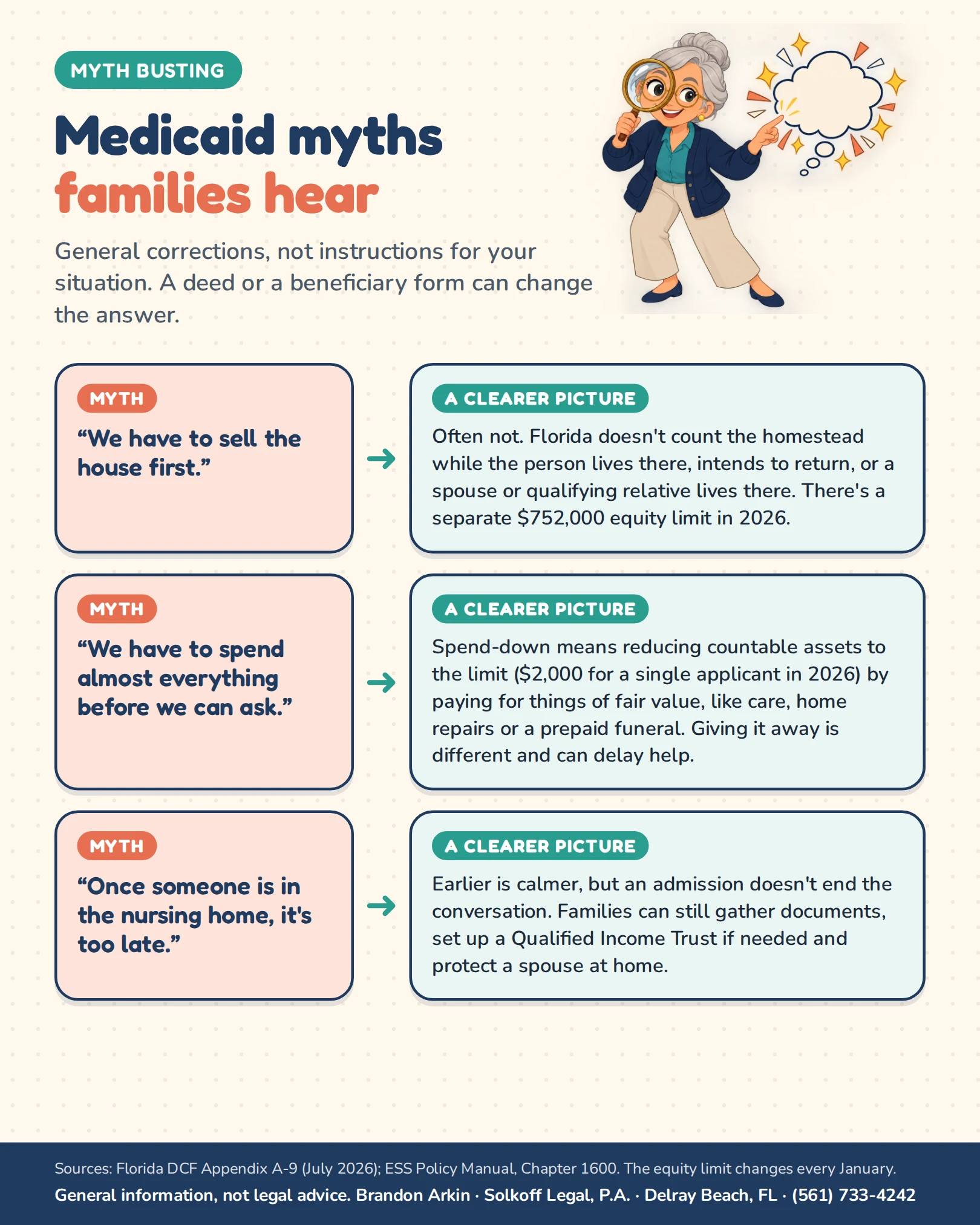
Infographic titled "Medicaid myths families hear" showing three myths (selling the house first, spending almost everything, and it being too late after a nursing home admission), each with a short clearer picture. Brandon Arkin, Solkoff Legal, P.A., Delray Beach.

Myth

"We have to sell the house first."

A clearer picture

Often not. Florida doesn't count the homestead (the person's principal home) as an asset while the person lives there, intends to return, or has a spouse or qualifying relative living there. A separate home equity limit of $752,000 applies in 2026 for long-term care coverage. It doesn't apply when a spouse, a child under 21, or a blind or disabled child lives in the home (DCF Appendix A-9; ESS Policy Manual, Chapter 1600).

Selling the house can actually make things harder. It turns an excluded asset into countable cash. Keeping the home exempt during life is one question. What happens to it later is another. The Lady Bird deed guide covers one option families ask about.

Myth

"We have to spend almost everything before we can ask."

A clearer picture

Spend-down means reducing countable assets to the limit by paying for things of fair value. In 2026 the limit is $2,000 for a single applicant (DCF Appendix A-9). Paying for care, home repairs, a car or a prepaid funeral is different from giving money away.

Married couples have more room. The spouse at home may keep up to $162,660 in countable assets in 2026, plus the home and one car. The guide for married couples explains how that works. Asking early costs nothing. Spending everything first can waste money the law would have let the family keep.

Myth

"Mom can give each of us $19,000 a year. That's the legal limit."

A clearer picture

That limit is a federal gift tax rule, not a Medicaid rule. In 2026, a person can generally give up to $19,000 per recipient without filing a gift tax return (IRS). Florida Medicaid has no annual exclusion. Any gift or transfer for less than fair value in the 60 months before a long-term care application is reviewed, whatever the amount (42 U.S.C. 1396p(c)).

The penalty is the amount given divided by $10,645, which gives the number of months Medicaid won't pay for care (DCF Appendix A-9). As a hypothetical, $19,000 to each of three children is $57,000, or roughly five months. The grandchildren gifts guide looks at gifting in more detail.

Myth

"Medicare will pay for the nursing home."

A clearer picture

Only for a short time, and only for skilled care. After a medically necessary inpatient hospital stay of at least three days in a row, Medicare may cover up to 100 days of skilled nursing facility care in a benefit period. In 2026 the patient pays $217 a day for days 21 through 100 (Medicare.gov). Time "under observation" doesn't count toward the three days.

Medicare doesn't pay for long-term custodial care, meaning help with bathing, dressing and eating. That's where private pay, long-term care insurance or Medicaid comes in. The first 30 days guide compares the two programs side by side.

Myth

"They'll have to divorce so one of them can qualify."

A clearer picture

Divorce is rarely necessary for Medicaid, and it carries real costs. Federal and Florida rules already protect the spouse at home: a share of the savings, the home, and in some cases part of the other spouse's income (42 U.S.C. 1396r-5). Transfers between spouses are generally allowed without penalty while they are married.

A divorce ends those spousal protections. It can also affect inheritance, health insurance, survivor benefits and the ability to make decisions for each other. Florida's transfer rules apply whenever someone gives up an asset without fair compensation (ESS Policy Manual, 1640.0606), so an uneven split could be examined. Before anyone files papers, look at what the spousal rules already allow.

Myth

"If Mom runs out of money, the kids have to pay the nursing home."

A clearer picture

Not because they're her children. Florida has no filial responsibility law that makes adult children pay a parent's care costs. Federal rules also bar a Medicaid- or Medicare-certified nursing home from requiring a third-party guarantee of payment as a condition of admission (42 C.F.R. 483.15(a)(3)).

Children can create their own liability, though. They might sign an agreement personally instead of as their parent's agent, or receive gifts that cause a Medicaid penalty. The paying for care guide explains what signing as the "responsible party" can mean.

Myth

"Once someone is in the nursing home, it's too late."

A clearer picture

Earlier is calmer, but an admission doesn't end the conversation. Families can still gather documents, set up a Qualified Income Trust if income is over $2,982 a month (DCF QIT information sheet), and protect a spouse at home. They can also see which lawful steps remain.

What usually makes the week harder is trying every rumor first (a new deed, a large gift, a closed account) and only then asking what the rules say. Crisis planning and advance planning are different conversations, and neither comes with a guaranteed result.

Myth

"Mom has a will, so her money is protected from Medicaid."

A clearer picture

A will says who inherits at death. It has no effect on whether someone qualifies for Medicaid while living. After death, Florida can file a claim against the estate of a Medicaid recipient for benefits paid after age 55. The state doesn't enforce that claim while a spouse, a child under 21, or a blind or disabled child survives, and it can't enforce it against protected homestead (Fla. Stat. 409.9101).

A will can still matter. If it leaves everything outright to a spouse who is on Medicaid, the inheritance could affect that spouse's eligibility. A trust created inside a will is treated differently from one a person sets up for themselves (42 U.S.C. 1396p(d)(2)(A)). See estate planning.

Before you act on something you heard

Use this table when a relative, a neighbor or a facility suggests a quick fix. Print it, or tick the questions you've asked on screen. Nothing is saved.

  • What you heard

    "Sell the house."

    Ask this first

    Does a spouse or relative live there? Does your parent intend to return?

    Why it matters

    The home is often excluded. Cash from a sale isn't.

  • What you heard

    "Put the house in the kids' names."

    Ask this first

    Was it deeded in the last 60 months, or would it be now?

    Why it matters

    A deed to children can be a transfer with a penalty.

  • What you heard

    "Give it away a little at a time."

    Ask this first

    Will anyone apply for long-term care in the next five years?

    Why it matters

    Medicaid has no $19,000 safe harbor.

  • What you heard

    "Spend it all first."

    Ask this first

    Is there a spouse at home? What counts?

    Why it matters

    Up to $162,660 may stay with a spouse in 2026.

  • What you heard

    "Medicare will cover it."

    Ask this first

    Is this skilled care after a three-day inpatient stay?

    Why it matters

    Custodial care isn't covered.

  • What you heard

    "Get a divorce."

    Ask this first

    What do the spousal protections already allow?

    Why it matters

    Divorce ends those protections and affects much more.

  • What you heard

    "Sign here as responsible party."

    Ask this first

    Am I signing as Mom's agent, or personally?

    Why it matters

    Personal signatures can create personal liability.

  • What you heard

    "It's too late now."

    Ask this first

    Is income over $2,982? Is there a spouse? What has been signed?

    Why it matters

    Lawful steps often remain after admission.

Tick boxes stay on this device. Nothing is saved or sent.

Common questions

Will Florida Medicaid take my parent's house after they die?

Not automatically, and often not at all. Florida can file a claim against a Medicaid recipient's estate for benefits paid after age 55. The claim isn't enforced while a spouse, a child under 21, or a blind or disabled child survives. It also can't be enforced against property that Florida law exempts from creditors, which generally includes protected homestead passing to certain heirs (Fla. Stat. 409.9101). Whether a home is protected homestead depends on who inherits it and how it's titled, so check before you assume either way.

Do adult children in Florida have to pay a parent's nursing home bill?

Not just because they're the parent's children. Florida has no filial responsibility law requiring adult children to pay a parent's care costs. Federal rules also bar certified nursing homes from requiring a third-party guarantee of payment as a condition of admission (42 C.F.R. 483.15(a)(3)). Liability can still arise if a child signs an agreement personally, misuses a parent's funds, or receives transfers that leave a bill unpaid. When signing for a parent, sign as their agent, using their funds.

Is the $19,000 annual gift limit safe for Medicaid?

No. The $19,000 figure is the 2026 federal gift tax annual exclusion. It decides whether a gift tax return is needed, not whether Medicaid will penalize a gift. Florida Medicaid reviews any transfer for less than fair value in the 60 months before a long-term care application (42 U.S.C. 1396p(c)). The penalty is the amount divided by $10,645, the number Florida uses in 2026 (DCF Appendix A-9). Some transfers, such as gifts to a spouse, are allowed.

If your family is facing one of these questions, you can reach Brandon Arkin at Solkoff Legal, P.A. at (561) 733-4242.

Talk through the next step

Bring your questions, a list of accounts and any papers a hospital, nursing home or Medicaid office has sent you. Call the Delray Beach office or request a consultation, and I can look at where things stand and what may come next. A phone call or an email does not by itself create an attorney-client relationship.

Solkoff Legal, P.A. · (561) 733-4242

CallRequest consultation