Family decisions
Taking the Car Keys: When an Older Parent Should Stop Driving in Florida
By Brandon Arkin, elder law attorney, Solkoff Legal, P.A. · Updated November 2026
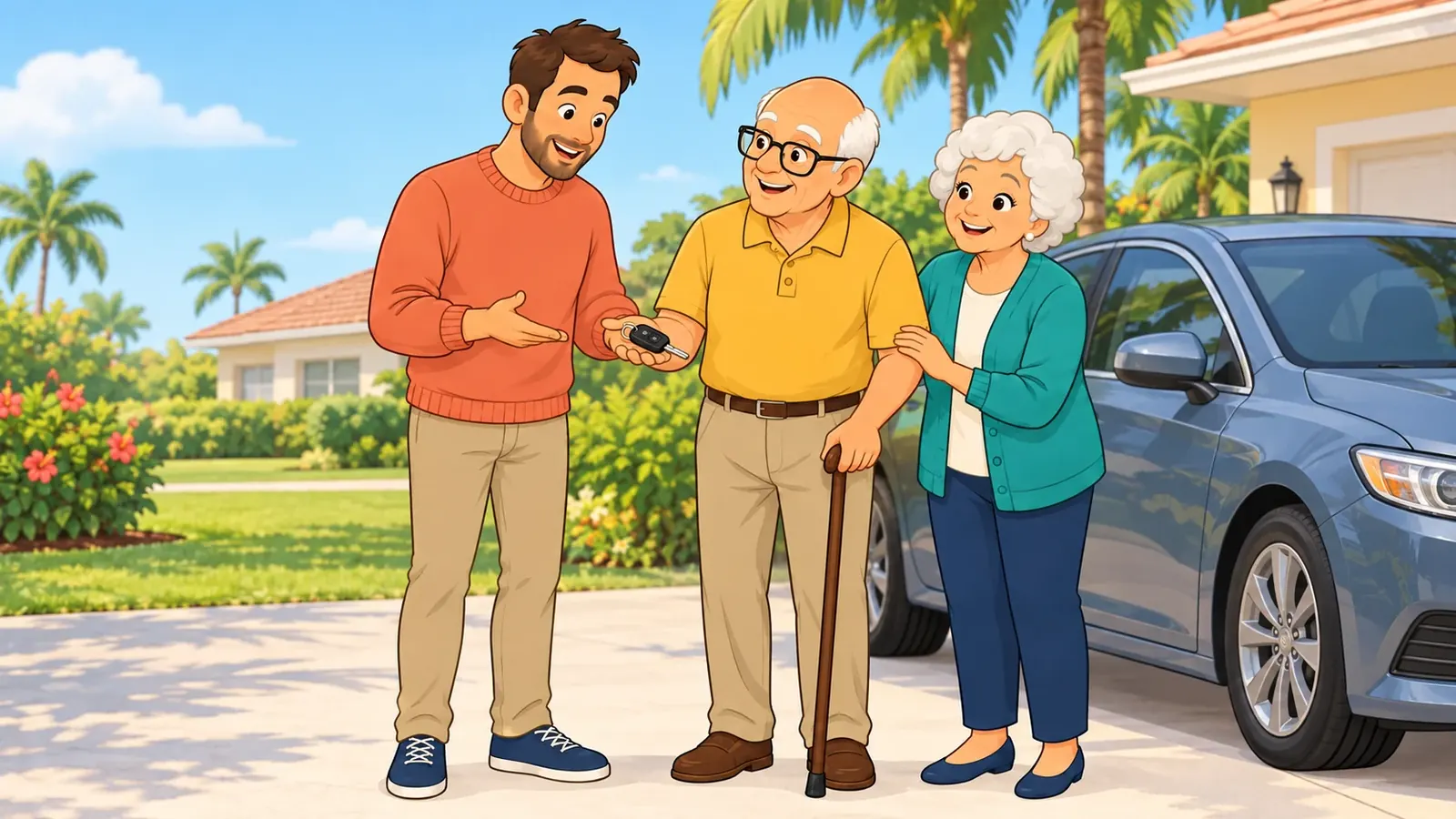
Florida has no age at which a driver must stop; the question is whether a medical condition or a pattern of near-misses now makes driving unsafe, and FLHSMV says reports must be based on medical conditions, "not the age of the driver" (FLHSMV medical review). If a doctor's advice and a family conversation don't settle it, anyone may send the state a confidential written report, and the state can then require a medical review or a new driving test (Fla. Stat. 322.126; Fla. Stat. 322.221).
Last checked: The license rules are from the 2026 Florida Statutes. Palm Tran fares and the Connection ADA / Connection Plus split (effective January 18, 2026) are as posted by Palm Tran in November 2026. Palm Tran says fares are set by the County Commission "and may change at any time," so check palmtran.org before you rely on a number. Form numbers are FLHSMV's as of November 2026.
Families put this conversation off because it feels like taking away independence. Waiting until after a crash leaves fewer choices. Treat it as a plan: notice, talk, involve the doctor, arrange rides, and use the state process only if you must.
Warning signs worth writing down
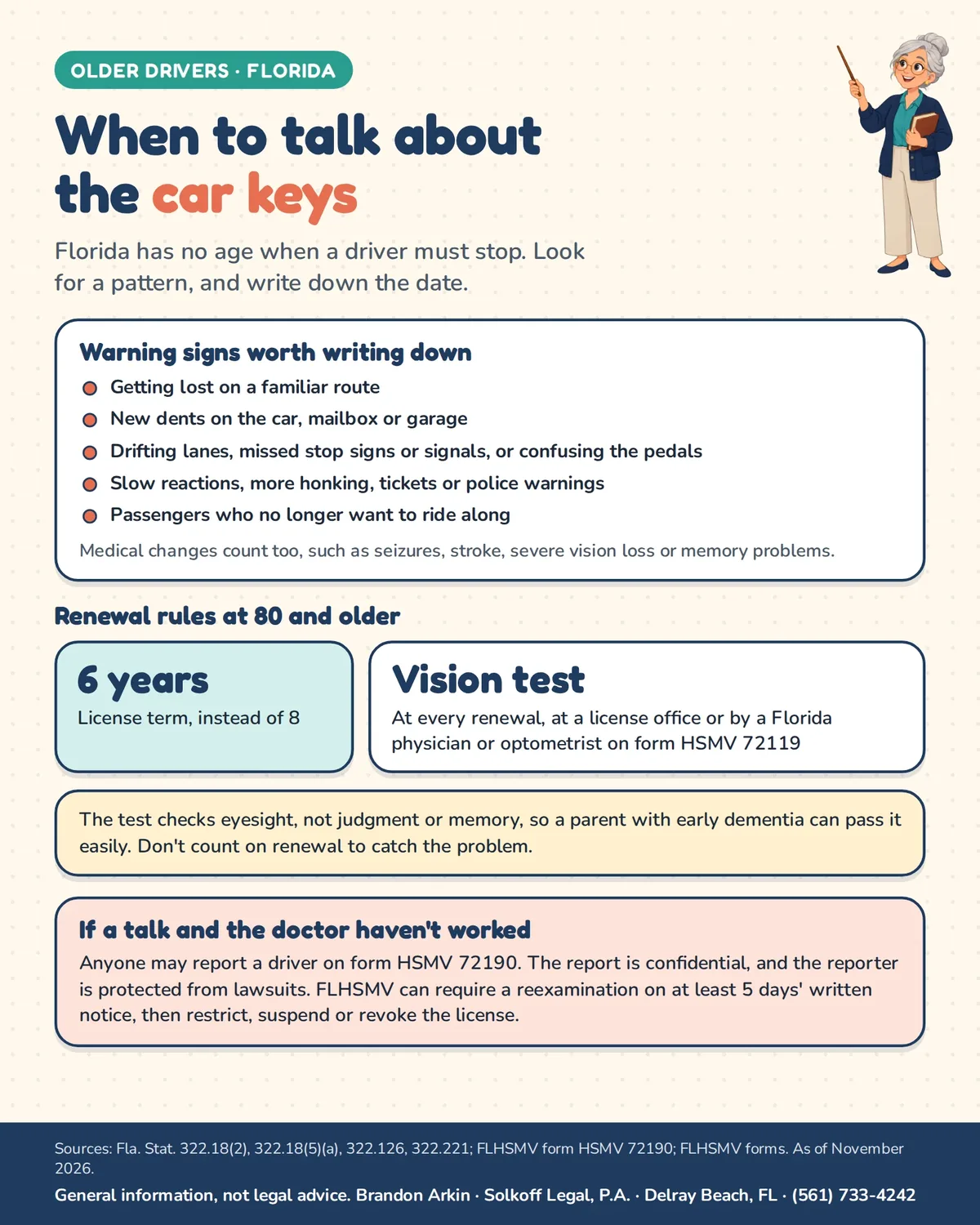
A pattern matters more than one scrape. Note the date when you see:
getting lost on a familiar route new dents on the car, mailbox or garage drifting lanes, missed stop signs or signals, or confusing the pedals slow reactions, more honking, tickets or police warnings passengers who no longer want to ride along
Medical changes count too. FLHSMV's report form lists seizures, stroke, loss of consciousness, uncontrolled diabetes, severe vision loss, sleep disorders and dementia or memory problems (HSMV 72190). A parent will push back harder on "you always" than on "on October 12 you drove past our street twice," so use the log below.
How to start the conversation
Talk early and privately. Pick one or two people your parent trusts, not the whole family. Use specifics from the log, and ask rather than accuse: "What happened with the side mirror?" Talk about safety, not age. Florida doesn't tie driving to a birthday. Have the ride plan ready. "Here's how you'll still get to the Tuesday card game" lands better than "you're done." Offer steps in between: daytime only, no highways, local trips. That buys safe time for some drivers and shows the problem for others. Bring in the doctor. Many parents accept from a physician what they won't hear from a child. A doctor can also refer your parent for a formal driving evaluation with an occupational therapist trained in driver rehabilitation.
Example (hypothetical): A father, 82, in Boynton Beach has two fender-benders in four months and gets lost coming home from his cardiologist. His daughter keeps a log for six weeks and asks his doctor to raise driving. The doctor orders a driving evaluation. Meanwhile she sets him up with the Palm Tran half fare and a standing ride to appointments, and he agrees to stop night driving and accept the evaluation result.
Florida's renewal rules at 80 and older
As of November 2026, a driver who is at least 80 gets a license that expires 6 years later, not 8, and must pass a vision test at each renewal. The test is at a license office or, for an online or mail renewal, by a Florida physician or optometrist on the state's form (Fla. Stat. 322.18).
The test checks eyesight, not judgment or memory, so a parent with early dementia can pass it easily. An examiner can order a reexamination if a person's "appearance or actions" raise serious doubt (Fla. Stat. 322.221), but don't count on renewal to catch the problem.
Reporting a driver to FLHSMV, step by step
When a talk and the doctor haven't worked, "any physician, person, or agency" may report a driver whose medical condition may make driving unsafe. The report is confidential, and the reporter is protected from lawsuits (Fla. Stat. 322.126; FLHSMV medical review). As of November 2026:
Use form HSMV 72190 (English or Spanish). Give the driver's full name, date of birth, address and license number, tick the conditions and describe what you saw. FLHSMV says missing details invalidate the form (Report an unsafe driver). Sign it. Your name and signature are required to investigate, but the report stays confidential. Mail or fax it to the Bureau of Motorist Compliance, Medical Review Program, Neil Kirkman Building, MS 86, Tallahassee, FL 32399-0500, fax (850) 617-3944, phone (850) 617-3814 (HSMV 72190). What follows. On good cause, FLHSMV may require a reexamination on at least 5 days' written notice and send medical reports to its medical advisory board. It then may let the driver keep the license, or restrict, suspend or revoke it (Fla. Stat. 322.221).
The doctor's records usually decide the outcome, so pair a report with a medical visit.
Getting around Palm Beach County without a car
The ride plan is what makes stopping workable. As of November 2026:
Palm Tran buses. Riders 65+ with a driver license or Florida ID pay $1 a ride, $3.50 a day or $55 for 31 days (Palm Tran reduced fares). Palm Tran Connection (door-to-door). Riders must apply and be approved. Since January 18, 2026, Connection ADA covers trips within ¾ mile of a bus route, and Connection Plus covers trips outside it for riders who qualify under the Transportation Disadvantaged program (Palm Tran Connection; Connection Plus). The fare is $4.00 one way, or $3.50 for income-qualified riders (Connection fares). Call (561) 649-9838 or (877) 870-9849 to apply (Palm Tran FAQs). Tri-Rail. Riders 65+ get discounted tickets with a Medicare card, driver license or other ID showing their birth date (Tri-Rail tariff policy). Everything else. Family schedules, rides from a house of worship, a ride-hailing app on a relative's account, or a paid companion-driver. The Area Agency on Aging (1-866-684-5885) knows local senior ride programs.
The money once spent on insurance, gas and repairs can pay for a lot of rides.
When dementia is part of the picture
Our dementia planning guide covers the basics. Beyond that:
Judgment fades before skill. A parent may handle a familiar route but not a detour. They may also forget yesterday's near-miss, so the log matters more. Agreements don't hold. "Only to the store" depends on memory. Families often end up removing the car, keeping the keys, or asking the doctor for a written "do not drive" note. Sign documents while capacity allows. A durable power of attorney that covers selling or retitling the car and changing insurance avoids a guardianship over a vehicle. See what a POA agent can do. Check whose name is on the title. Under Florida's dangerous instrumentality doctrine, the owner of a car can be held liable when someone they lend it to causes a crash. A natural-person owner who lends a car is liable up to $100,000 per person and $300,000 per incident for bodily injury and $50,000 for property damage, plus up to $500,000 more in economic damages if the borrower is uninsured or underinsured (Fla. Stat. 324.021(9)(b)3). If the car is in your name and your parent drives it, that exposure is yours.
The paperwork once your parent stops
Get a Florida ID card at a driver license office. Palm Tran's half fare needs a license or state ID (Palm Tran reduced fares). Decide about the car. Florida Medicaid generally excludes one vehicle, but giving a car away can count as a transfer. See which assets Medicaid doesn't count. Keep insurance until the title changes, then cancel or adjust it.
Tool: the driving sign log
Fill this in on your own device over a few weeks. Nothing is saved or sent. Bring it to the doctor and the family talk.
| Sign | Date seen | What happened | Who saw it |
|---|---|---|---|
| Got lost on a familiar route | |||
| New dent, scrape or damage | |||
| Missed a stop sign or signal | |||
| Drifted lanes or hit a curb | |||
| Confused gas and brake | |||
| Ticket, warning or crash | |||
| New medication or diagnosis | |||
| Passenger felt unsafe | |||
| Other |
Sign
Got lost on a familiar route
Date seen
What happened
Who saw it
Sign
New dent, scrape or damage
Date seen
What happened
Who saw it
Sign
Missed a stop sign or signal
Date seen
What happened
Who saw it
Sign
Drifted lanes or hit a curb
Date seen
What happened
Who saw it
Sign
Confused gas and brake
Date seen
What happened
Who saw it
Sign
Ticket, warning or crash
Date seen
What happened
Who saw it
Sign
New medication or diagnosis
Date seen
What happened
Who saw it
Sign
Passenger felt unsafe
Date seen
What happened
Who saw it
Sign
Other
Date seen
What happened
Who saw it
Tick boxes stay on this device. Nothing is saved or sent.
Common questions
At what age does Florida make you stop driving?
None. As of November 2026, Florida doesn't end a license at any age. Drivers 80 and older renew every 6 years instead of 8 and must pass a vision test at each renewal (Fla. Stat. 322.18). FLHSMV says medical reports must be based on conditions or symptoms that affect driving, "not the age of the driver" (FLHSMV medical review). So the real question is whether your parent can still drive safely, not how old they are.
Will my parent find out I reported them?
The report is confidential under Florida law, and no civil or criminal action can be brought against the person who sends it (Fla. Stat. 322.126). The form still requires your name and signature so the state can investigate (HSMV 72190). In practice, your parent may guess who raised it, especially if you've already talked about driving. Many families decide that's acceptable, or ask the doctor to make the report instead.
What happens after a medical report is filed?
FLHSMV reviews it. If there's good cause, the department can require a reexamination with at least 5 days' written notice, and it can ask for medical reports for its medical advisory board (Fla. Stat. 322.221). Afterward it may let the driver keep the license, add restrictions, suspend it or revoke it. A driver who doesn't respond to a reexamination notice faces consequences under the same section. The doctor's records usually carry the most weight, so get the physician involved early.
Can I just take the keys or sell my parent's car?
The car belongs to your parent, so selling it or changing the title takes your parent's signature or an agent acting under a valid durable power of attorney that covers it. Hiding the keys may feel easier, but it can damage trust and doesn't change the license. If dementia is involved and your parent can no longer agree, talk with the doctor and look at what the POA allows. If there's no POA, an attorney can explain the options. Have the ride plan ready either way.
If your family is facing one of these questions, you can reach Brandon Arkin at Solkoff Legal, P.A. at (561) 733-4242.
Related on this site
Talk through the next step
Bring your questions, a list of accounts and any papers a hospital, nursing home or Medicaid office has sent you. Call the Delray Beach office or request a consultation, and I can look at where things stand and what may come next. A phone call or an email does not by itself create an attorney-client relationship.
Solkoff Legal, P.A. · (561) 733-4242