Resources · Medicaid
Does Medicaid pay for assisted living in Florida? What it covers, what it doesn't, and the waitlist
By Brandon Arkin, elder law attorney, Solkoff Legal, P.A. · Updated November 2026

Florida Medicaid may pay for services in an assisted living facility, such as help with bathing, dressing and medications, through the Statewide Medicaid Managed Care Long-Term Care (SMMC LTC) program, but it does not pay for room and board. Enrollment usually requires release from a statewide waitlist, so most families pay privately for a period, sometimes with help from Florida's Optional State Supplementation (OSS) program.
What Medicaid pays for in an ALF
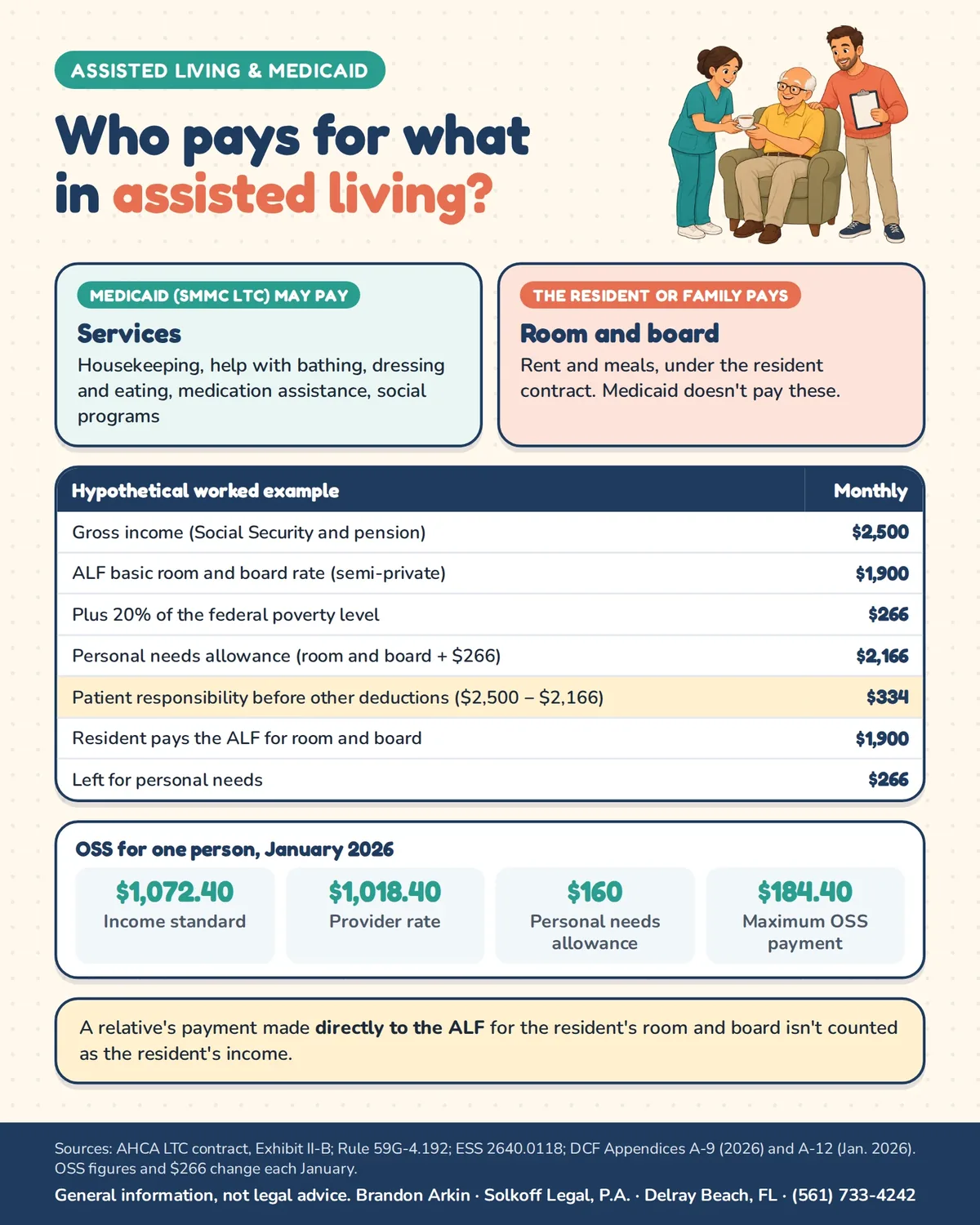
An assisted living facility (ALF) is a licensed residence providing housing, meals and help with daily activities. Under SMMC LTC, the person's managed care plan pays the ALF for "assisted living services." AHCA describes them as housekeeping, help with bathing, dressing and eating, medication assistance and social programs (AHCA).
What Medicaid doesn't pay is room and board, meaning the rent and meals. AHCA's coverage policy lists room and board payments to ALFs as excluded. The plan's contract with each ALF says the plan's payment is full payment for the long-term care services, while "enrollees remain responsible for the separate ALF room and board costs" in their resident contract (AHCA LTC contract, Exhibit II-B).
Who may qualify
To receive SMMC LTC in an ALF, a person generally must (DCF):
be 65 or older, or 18 or older with a disability; be found by CARES, the state's medical assessment program, to need nursing home level of care; meet the financial rules: gross income of $2,982 a month or less, or a Qualified Income Trust (Miller trust) for income above that, and countable assets of $2,000 or less for a single person (DCF Appendix A-9); be released from the waitlist and enrolled in an LTC plan.
The person also needs an ALF that contracts with the plan and has a Medicaid-designated bed. Plans must let the person choose among network facilities with an available Medicaid bed (AHCA LTC contract, Exhibit II-B). Not every ALF participates.
The waitlist
Nursing home Medicaid has no waitlist. Home and community-based services, including ALF, do. Under Fla. Stat. 409.979, the Department of Elder Affairs keeps a statewide list. Aging and Disability Resource Center (ADRC) staff do a phone screening that produces a frailty-based priority score. Releases happen monthly by score, not by time on the list (AHCA).
Practical points:
Get screened early, even before a move. Call the Elder Helpline at 1-800-963-5337, or in Palm Beach County the ADRC at 1-866-684-5885. Ask for a rescreen after a fall, hospitalization or decline. The score is what moves people up. Answer every letter. If DOEA can't reach the person, it sends a letter, and missing the 30-day response window can mean removal from the list.
The statute also allows priority enrollment, without waiting, for some groups. These include nursing facility residents of at least 60 consecutive days who want to move to the community, and Adult Protective Services high-risk referrals temporarily placed in an ALF (409.979(3)(f)).
The "Medicaid pending" myth in assisted living
In a nursing home, families often hear "we'll admit Mom Medicaid pending." Coverage can begin back to the first day of the month DCF received the application, once she qualifies.
Assisted living usually doesn't work that way. DCF's manual says home and community-based coverage "cannot begin prior to the date the individual is enrolled in the waiver" (ESS 0640.0502). And Florida no longer provides most adults with retroactive months (AHCA). Until the waitlist releases the person and a plan enrolls them, the ALF's full bill is generally private pay.
If an ALF tells you a parent can move in "Medicaid pending," ask three questions in writing:
Is my parent already enrolled in an LTC plan? If not, who pays until enrollment? Does the facility have a Medicaid-designated bed with that plan? What happens if the waitlist release takes months?
How the money works once enrolled
DCF figures patient responsibility, the person's monthly share of the cost of care, by subtracting allowances from gross income. In an ALF, the personal needs allowance (PNA) isn't the $160 used in nursing homes. It's the ALF's basic monthly rate for three meals a day and a semi-private room, plus 20% of the federal poverty level (ESS 2640.0118). The 20% figure is $266 for one person in 2026 (DCF Appendix A-9). The person keeps enough for room and board plus a little more; income above that goes toward services.
Optional State Supplementation (OSS)
OSS is a separate, state-funded cash program run by DCF. It helps low-income residents pay an ALF, adult family-care home or similar setting (Fla. Stat. 409.212). It isn't Medicaid, so the SMMC LTC waitlist doesn't apply. It is also small.
DCF's January 2026 standards for one person in an OSS-enrolled facility are (DCF Appendix A-12):
income standard: $1,072.40; provider rate: $1,018.40; personal needs allowance: $160; maximum OSS payment: $184.40; asset limit: $2,000.
DCF figures the payment by subtracting the $160 PNA from countable income and paying the gap up to the recognized cost of care (ESS 2640.0131.04). OSS starts no earlier than the month of application (ESS 0640.0503). Applications go through MyACCESS. To find facilities that accept OSS, use the Florida Health Finder ALF tool.
OSS mostly helps people whose income is near the SSI level.
When family helps pay
Many ALF stays are funded partly by children. How the help is given matters.
For OSS residents, Florida law allows voluntary third-party supplementation under conditions. The money must be paid to the facility, not the resident. It can't be a condition of proper care. And it can't exceed four times the OSS provider rate, which is $4,073.60 a month at the 2026 rate. DCF doesn't count it as income for OSS, though it may reduce an SSI check (Fla. Stat. 409.212(4)–(5)).
For SMMC LTC residents, family often pays for extras the plan doesn't cover, such as a private room. Plans must offer a choice of private or semi-private rooms as available (AHCA LTC contract, Exhibit II-B). DCF doesn't count a relative's payments made directly to the ALF for the resident's room and board as the resident's income. Keep the payments going straight to the facility, not through the resident's own account, and get advice before setting up a regular arrangement.
If a family member provides care and is paid for it, a written care agreement matters. Getting paid to care for a parent covers that.
Worked example (hypothetical)
| Line | Monthly amount |
|---|---|
| Gross income (Social Security and pension) | $2,500 |
| ALF basic room and board rate (semi-private) | $1,900 |
| Plus 20% of the federal poverty level | $266 |
| Personal needs allowance (room and board + $266) | $2,166 |
| Patient responsibility before other deductions ($2,500 − $2,166) | $334 |
| Resident pays the ALF for room and board | $1,900 |
| Left for personal needs | $266 |
Line
Gross income (Social Security and pension)
Monthly amount
$2,500
Line
ALF basic room and board rate (semi-private)
Monthly amount
$1,900
Line
Plus 20% of the federal poverty level
Monthly amount
$266
Line
Personal needs allowance (room and board + $266)
Monthly amount
$2,166
Line
Patient responsibility before other deductions ($2,500 − $2,166)
Monthly amount
$334
Line
Resident pays the ALF for room and board
Monthly amount
$1,900
Line
Left for personal needs
Monthly amount
$266
Other deductions, such as a supplemental insurance premium, can lower patient responsibility. The actual figure is in DCF's notice.
Cost-planning worksheet
Fill in monthly figures to see the private-pay gap while you wait for a waitlist release. Nothing is saved.
Tick boxes stay on this device. Nothing is saved or sent.
Common questions
Does Florida Medicaid pay for assisted living room and board?
No. Florida Medicaid, through the SMMC LTC program, may pay an assisted living facility for services such as help with bathing, dressing, eating and medications, but not for room and board. AHCA's coverage policy lists room and board payments to ALFs as excluded, and the plan's contract with each ALF says residents remain responsible for room and board under their resident contract. DCF accounts for this by letting an ALF resident keep income equal to the facility's basic room and board rate plus 20% of the federal poverty level, $266 for one person in 2026, before figuring patient responsibility.
Can my parent move into assisted living "Medicaid pending"?
Usually not in the way it works in a nursing home. DCF's manual says home and community-based coverage can't begin before the person is enrolled in the waiver, and enrollment generally requires release from the statewide waitlist. Florida also no longer gives most adults retroactive months. Until a plan enrolls your parent, the full ALF bill is generally private pay. If an ALF uses the phrase "Medicaid pending," ask whether your parent is already enrolled in an LTC plan, whether the facility has a Medicaid bed with that plan, and who pays while you wait.
How long is the Florida Medicaid waitlist for assisted living?
There's no fixed wait, because releases go by priority score, not by time on the list. ADRC staff screen by phone and assign a frailty-based score. DOEA releases people monthly as funding allows, starting with the highest scores. A person with a low score may not be placed on the list at all and is referred to other resources. Rescreening after a significant change in health can raise the score. Certain groups, including some nursing home residents of 60 days or more who want to move to the community, may qualify for priority enrollment without waiting.
What is OSS, and how much does it pay in 2026?
Optional State Supplementation is a state cash program run by DCF that helps low-income residents of ALFs and adult family-care homes. It isn't Medicaid, so the SMMC LTC waitlist doesn't apply. DCF's January 2026 standards for one person are an income standard of $1,072.40, a provider rate of $1,018.40, a $160 personal needs allowance, a maximum payment of $184.40 a month, and a $2,000 asset limit. The facility must be OSS-enrolled. Family may add voluntary payments made directly to the facility, up to four times the provider rate, under Fla. Stat. 409.212.
If your family is facing one of these questions, you can reach Brandon Arkin at Solkoff Legal, P.A. at (561) 733-4242.
Related on this site
Talk through the next step
Bring your questions, a list of accounts and any papers a hospital, nursing home or Medicaid office has sent you. Call the Delray Beach office or request a consultation, and I can look at where things stand and what may come next. A phone call or an email does not by itself create an attorney-client relationship.
Solkoff Legal, P.A. · (561) 733-4242