Resources · Medicaid
What happens after you apply for Medicaid in Florida: notices, deadlines and next steps
By Brandon Arkin, elder law attorney, Solkoff Legal, P.A. · Updated November 2026

After you apply for long-term care Medicaid in Florida, DCF usually sends a pending notice listing the papers it still needs, generally due 10 calendar days later, then approves or denies the application, typically within 30 days, or up to 90 days if a disability decision is needed. If approved, coverage generally starts the first day of the month DCF received the application; if denied, you generally have 90 days to ask for a fair hearing.
The pending notice and the 10-day clock
Within days, DCF usually posts a pending notice in the applicant's MyACCESS account, the state's online benefits portal.
DCF's manual requires the notice to include three things: a written list of the missing items, the due date, and what happens if the items aren't returned (ESS 0640.0401). The due date is generally:
10 calendar days after the interview, or after the pending notice if there's no interview; 30 calendar days when medical information is needed; the next business day if the due date falls on a weekend or holiday.
DCF's policy is to extend the due date at the applicant's request. Ask before it passes and note who you spoke with.
Common requests include bank statements, proof of income, life insurance values, deeds, trust documents and explanations of large withdrawals. Because DCF can review 60 months of transfers, requests for older statements are normal. Uploads can take about three days to show in the case (DCF).
Interviews and the CARES assessment
DCF holds an interview when the applicant asks for one, when eligibility is questionable, or when a disability decision is needed. Interviews are usually by phone (ESS 0640.0105–0640.0106).
For nursing home Medicaid (the Institutional Care Program, or ICP), DCF also needs a medical decision that the person needs nursing home level of care. That comes from CARES (Comprehensive Assessment and Review for Long-Term Care Services), a Department of Elder Affairs program. DCF's manual says DCF should request the CARES decision within two days of receiving the application, and CARES should decide within 12 days of the request (ESS 0640.0400). The physician's AHCA Form 5000-3008 often holds this step up, so ask the doctor's office early.
How long the decision takes
Federal rules set outside limits of 45 days, or 90 with a disability determination (42 CFR 435.912). DCF's standard is tighter: by the 30th day once everything is in (ESS 0640.0400).
Two more DCF rules:
If the papers aren't returned by day 30, DCF generally denies the application then. But if the papers come in between day 30 and day 60, DCF's policy is to approve as soon as possible without a new application, as long as the case is decided by day 60 (ESS 0640.0401). For an ICP case where the person meets every rule except placement, or the facility is waiting for certification, the applicant can ask DCF to hold the application up to 30 more days (ESS 0640.0400).
Changes, such as a move or an inheritance, must be reported within 10 calendar days (ESS 0640.0110).
The approval notice and patient responsibility
The approval comes as a Notice of Case Action stating the program, the start date and the patient responsibility, meaning the monthly share of income paid toward care.
Coverage generally starts on the first day of the month DCF received the application, regardless of when the decision is made. ICP can't begin before the date of placement in the facility. Home and community-based coverage can't begin before the person is enrolled in the waiver program (ESS 0640.0502). DCF assigns a 12-month review period (ESS 0640.0500).
Patient responsibility is figured from gross income. For a nursing home resident, DCF subtracts the $160 personal needs allowance, any allowance for a spouse at home or dependents, and allowable uncovered medical expenses such as a supplemental insurance premium. What's left goes to the facility (ESS 2640.0117–2640.0118).
Hypothetical: a widowed nursing home resident has $2,600 a month in gross income and pays $140 a month for a supplemental policy. Patient responsibility would be about $2,600 − $160 − $140 = $2,300.
If income is over $2,982 a month, a Qualified Income Trust (Miller trust) generally must be funded every month. Income in the trust still counts toward patient responsibility (DCF).
After approval, the person gets a Medicaid card and is enrolled in a Statewide Medicaid Managed Care plan, with choice counseling from AHCA (DCF). Check the income and deductions on the notice line by line.
The denial notice and your options
A denial notice should state the reason. Common reasons include:
Missing papers. Assets over the $2,000 limit for a single applicant. Income over $2,982 with no properly funded Miller trust. A transfer penalty from gifts in the 60-month look-back. CARES finding that nursing home level of care isn't met.
There are usually three paths, and the right one depends on the facts:
Send the missing papers. If they reach DCF by day 60, the application may still be approved without starting over. Reapply. This is often faster when the problem has been fixed, such as assets now under the limit. But a new application generally sets a new, later start month. Ask for a fair hearing. This is the route when you think DCF got it wrong and the original filing month matters.
An elder law attorney can help weigh which path protects more months of coverage.
The fair hearing
A fair hearing is an informal hearing before a hearing officer from DCF's Office of Appeal Hearings. Deadline: the applicant or an authorized representative must request it within 90 calendar days. The 90 days begin the day after the date on the written notice, or the date it was mailed if that's later (Fla. Admin. Code R. 65-2.046).
Requests go to the DCF Office of Appeal Hearings, 2415 North Monroe Street, Suite 400-I, Tallahassee, FL 32303-4190; by phone at (850) 488-1429; or by email to appeal.hearings@myflfamilies.com (AHCA). The notice of hearing is generally sent at least 14 days before the hearing, and evidence is due 7 days before it (DCF Appeal Hearings FAQ).
Continuing benefits: this applies when existing Medicaid is reduced or ended. A hearing request filed within 10 days after the notice was mailed or handed over generally keeps benefits at the current level until the hearing decision. If DCF's action is upheld, DCF may seek repayment of the extra benefits (Fla. Admin. Code R. 65-2.048).
Medicaid pending in a nursing home
Federal rules bar a certified nursing home from requiring a third-party guarantee of payment or a promise not to apply for Medicaid (42 CFR 483.15(a)). Florida law bars discharge solely because the payment source changes (Fla. Stat. 400.022(1)(p)).
Facilities usually ask for the expected patient responsibility each month, and failing to send DCF the papers it needs may be treated as nonpayment (42 CFR 483.15(c)). Nursing home admission covers the admission papers in detail.
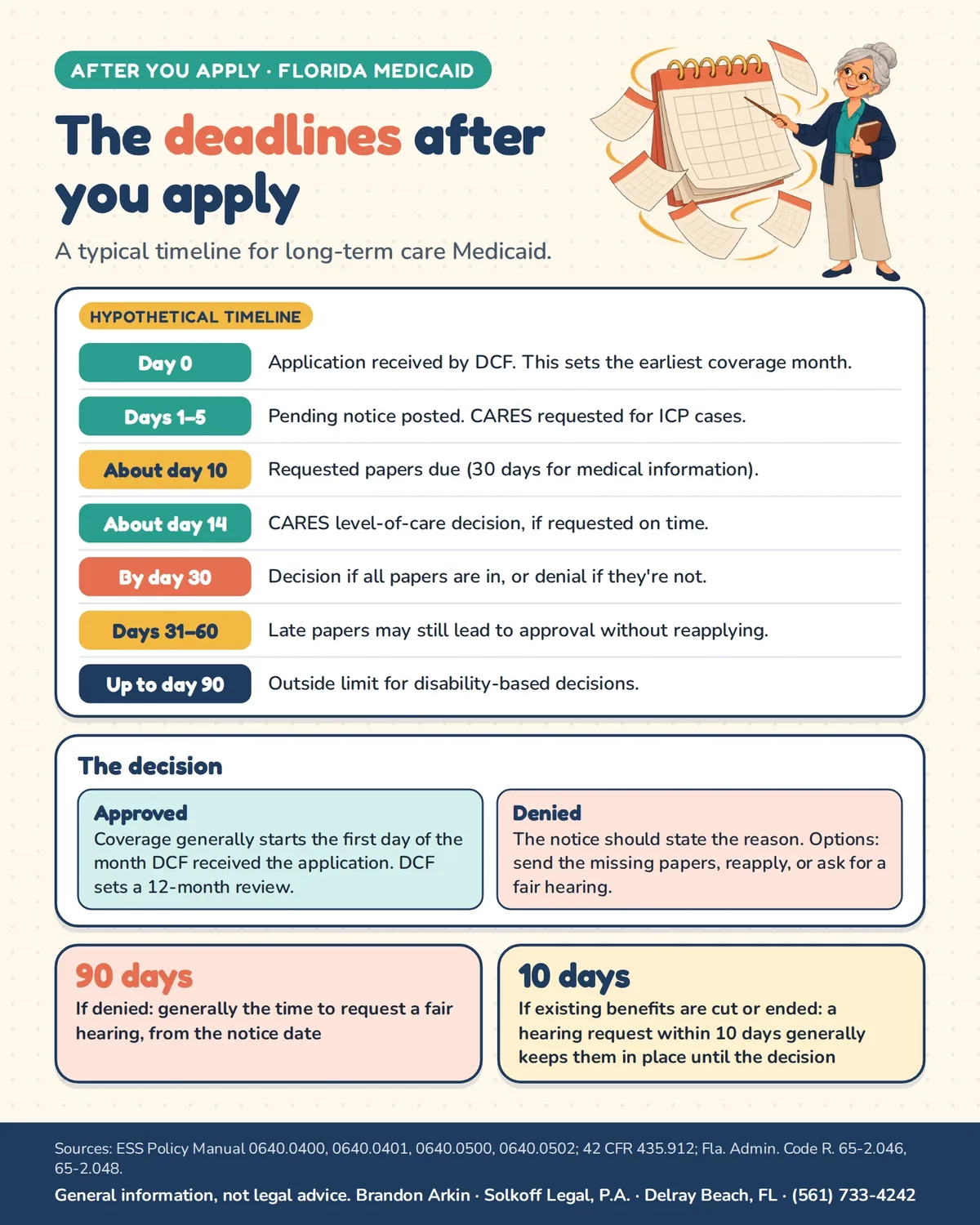
A typical timeline (hypothetical)
| When | What usually happens |
|---|---|
| Day 0 | Application received by DCF. This sets the earliest coverage month. |
| Days 1–5 | Pending notice posted. CARES requested for ICP cases. |
| About day 10 | Requested papers due (30 days for medical information). |
| About day 14 | CARES level-of-care decision, if requested on time. |
| By day 30 | Decision if all papers are in, or denial if they're not. |
| Days 31–60 | Late papers may still lead to approval without reapplying. |
| Up to day 90 | Outside limit for disability-based decisions. |
When
Day 0
What usually happens
Application received by DCF. This sets the earliest coverage month.
When
Days 1–5
What usually happens
Pending notice posted. CARES requested for ICP cases.
When
About day 10
What usually happens
Requested papers due (30 days for medical information).
When
About day 14
What usually happens
CARES level-of-care decision, if requested on time.
When
By day 30
What usually happens
Decision if all papers are in, or denial if they're not.
When
Days 31–60
What usually happens
Late papers may still lead to approval without reapplying.
When
Up to day 90
What usually happens
Outside limit for disability-based decisions.
Deadline tracker
Print this and fill it in as notices arrive. Nothing is saved.
Tick boxes stay on this device. Nothing is saved or sent.
Common questions
How long does DCF take to approve Medicaid for a nursing home in Florida?
DCF's policy is to decide by the 30th day after the application when all papers and the CARES level-of-care decision are in, and within 90 days when a disability decision is needed. Federal rules set outside limits of 45 and 90 days. Timing mostly depends on how quickly requested papers come back. If papers arrive after day 30 but by day 60, DCF's policy is to approve without a new application. Coverage generally reaches back to the first day of the application month, not just the approval date.
What if I can't get the documents DCF asked for in 10 days?
Ask for more time before the due date. DCF's manual says to extend the due date at the applicant's request and to help applicants get missing verifications. Call or message through MyACCESS, note who you spoke with, and upload what you have. If the application is denied on day 30 for missing papers, getting them to DCF by day 60 may still lead to approval without reapplying. That can save a month or more of coverage.
How long do I have to appeal a Florida Medicaid denial?
Generally 90 calendar days. Under Florida's rule, the 90 days begin the day after the date on the written notice, or the mailing date if the notice was mailed later. Requests go to the DCF Office of Appeal Hearings by mail, by phone at (850) 488-1429 or by email at appeal.hearings@myflfamilies.com. If existing benefits are being reduced or ended, a request within 10 days of the notice generally keeps them at the current level until the decision, though repayment may be sought if DCF wins. Whether to appeal or reapply depends on the facts.
Does Medicaid pay for the months before approval?
It may cover the months between the application and the approval. Coverage generally starts the first day of the month DCF received the application, regardless of when the decision is made, if the person was eligible in that month. Nursing home coverage can't start before the date of placement. Florida no longer offers most adults age 21 and older three months of retroactive coverage before the application month. So filing before month-end often matters.
If your family is facing one of these questions, you can reach Brandon Arkin at Solkoff Legal, P.A. at (561) 733-4242.
Related on this site
Talk through the next step
Bring your questions, a list of accounts and any papers a hospital, nursing home or Medicaid office has sent you. Call the Delray Beach office or request a consultation, and I can look at where things stand and what may come next. A phone call or an email does not by itself create an attorney-client relationship.
Solkoff Legal, P.A. · (561) 733-4242