Resources guide
Caregiver Burnout: Where to Get Help in Palm Beach County
By Brandon Arkin, elder law attorney, Solkoff Legal, P.A. · Updated November 2026
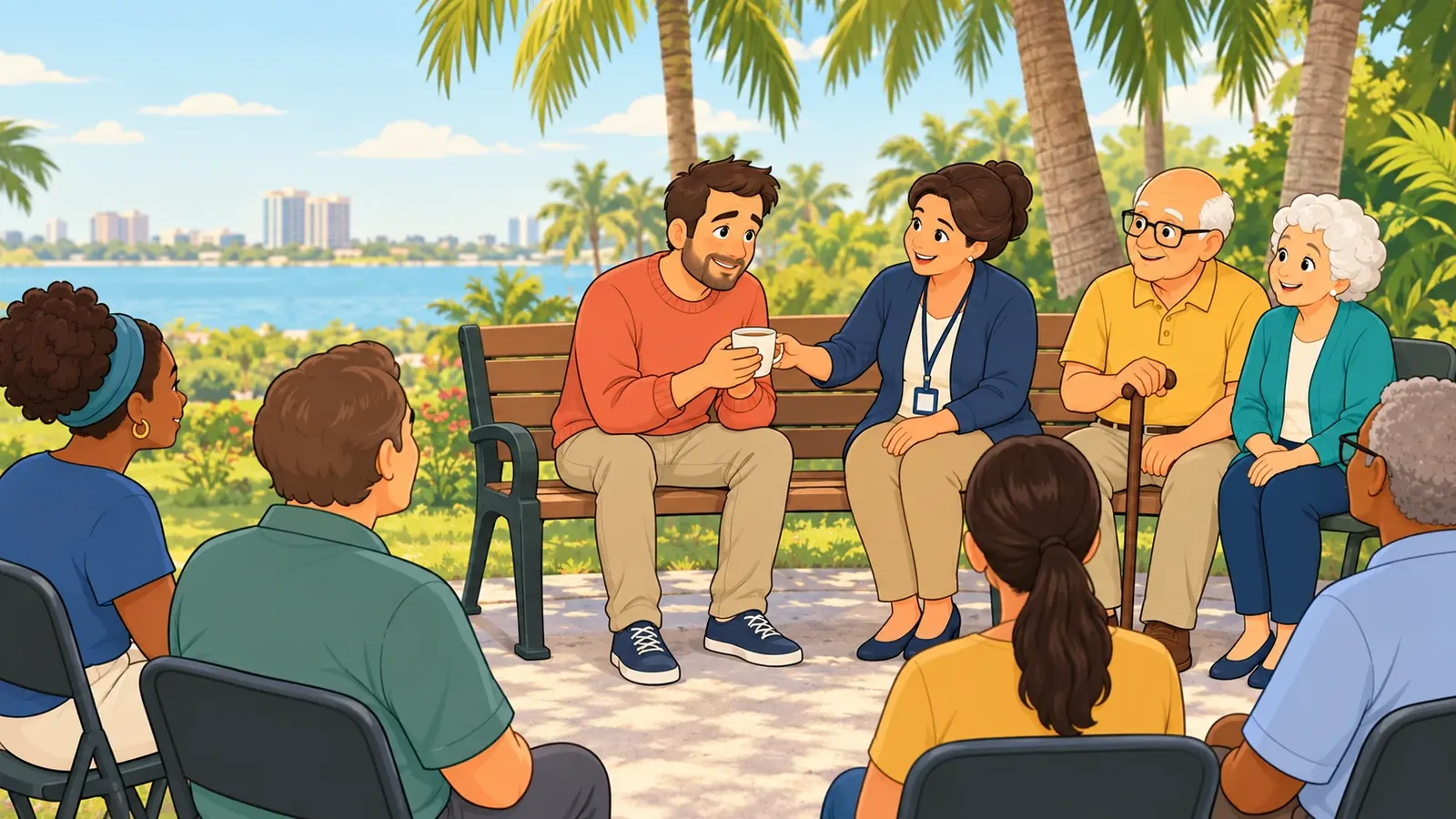
In Palm Beach County, the place to start for caregiver help is the Area Agency on Aging of Palm Beach/Treasure Coast Helpline at 1-866-684-5885. It connects caregivers to support groups, training, respite and in-home services. If you work, federal FMLA leave may give you up to 12 weeks of unpaid, job-protected leave to care for a parent. Starting with 2026 returns, the dependent care credit can be worth up to $1,500 a year.
Last checked: The tax figures are for tax year 2026, and those returns are filed in 2027. The IRS may adjust the credit thresholds for 2027. The FMLA rules and the local phone numbers were checked in November 2026. Support group and memory cafe schedules change, so call ahead.
Consider a hypothetical daughter in Wellington who works full time and moved her father in after his Parkinson's diagnosis. Eighteen months later she sleeps five hours a night. She has dropped her own doctor's appointments and snaps at her kids. She tells her brother in Atlanta, "I'm fine." She isn't, and nothing about her situation is unusual. This guide covers what she can do this month: recognize the signs, find people who understand, protect her job, and use the tax rules that apply to her.
Signs of caregiver burnout
The National Institute on Aging lists these signs of caregiver stress (NIA):
feeling exhausted, overwhelmed or anxious getting angry or impatient easily feeling lonely or cut off trouble sleeping sadness or loss of interest in things you used to enjoy frequent headaches or pain no time to exercise or eat well skipping your own personal care misusing alcohol or medication
NIA notes that caregivers face a higher risk of physical and mental health problems. It recommends learning your own warning signs and acting before you are completely overwhelmed (NIA).
If you are having thoughts of harming yourself or the person you care for, call or text 988, or dial 2-1-1 in Palm Beach County (211 Palm Beach/Treasure Coast). If you are worried that care at home is becoming unsafe, the Florida Abuse Hotline is 1-800-962-2873. It also takes calls about neglect, and you can ask it for help (Florida DCF).
People to talk to in Palm Beach County
The AAA Helpline (1-866-684-5885). This is the county's Aging and Disability Resource Center. Staff help caregivers find services and enroll in programs, in English, Spanish and Creole (AAA PB/TC). The agency also runs Powerful Tools for Caregivers, a workshop on managing stress and emotions (AAA PB/TC Healthy Aging). Alzheimer's Community Care (561-683-2700). This nonprofit serves Palm Beach, Martin and St. Lucie counties. It offers a 24-hour assistance line, Family Navigators and caregiver support groups at low or no cost (Palm Beach United Way; Florida Attorney General). Alzheimer's Association, Southeast Florida (1-800-272-3900). It runs a 24-hour helpline and free caregiver support groups across the area (211 Palm Beach/Treasure Coast). Memory cafes. These are social hours for a person with dementia and the caregiver together. For example, the Palm Beach County Library System's Lantana Road Branch hosts one with Alzheimer's Community Care (Palm Beach County Library System). Trustbridge offers memory cafes and caregiver workshops as well (Trustbridge).
Support groups won't solve the workload, but caregivers often find out there what is actually available.
Getting real breaks
A real break means someone else covers the care for a set block of time. That can be a few hours at an adult day center, a volunteer for an evening, or a short facility stay. Our respite care guide explains each program in Palm Beach County and how to apply, including Medicaid, VA, the Alzheimer's Disease Initiative and RELIEF.
Federal caregiver money flows through the Area Agency on Aging. The National Family Caregiver Support Program covers adult family members caring for someone 60 or older. Its services include information, help getting access to services, individual counseling, support groups and training, respite, and limited supplemental services (Florida Department of Elder Affairs). Most of these programs have waiting lists, and screening is how you get on them (Okeechobee County Senior Services). Call before you reach a crisis.
Protecting your job: FMLA
The federal Family and Medical Leave Act gives eligible employees up to 12 workweeks of unpaid, job-protected leave in a 12-month period to care for a parent with a serious health condition. Your employer must keep your group health coverage going while you're on leave (U.S. Department of Labor).
You're eligible if all of these apply (U.S. Department of Labor):
your employer is covered: a private employer with 50 or more employees, or any public agency or school you have worked there at least 12 months you have at least 1,250 hours in the past 12 months your worksite has at least 50 employees within 75 miles
You can take the leave intermittently or on a reduced schedule when medically necessary, even a few hours at a time, for things like doctor visits (U.S. Department of Labor).
There are two limits. FMLA doesn't cover parents-in-law (29 CFR 825.122(c)). And Florida has no general family leave law for private employers. Its state law covers career service state employees, who can get up to 6 months of unpaid family medical leave (Fla. Stat. 110.221). Check your employer's handbook for any paid leave.
Tax help for caregivers in 2026
Dependent care credit. If you pay someone to care for a parent so you can work, you may qualify. The parent must be physically or mentally unable to care for themselves and must live with you more than half the year (IRS Topic 602). Starting in 2026, the credit runs from 50% down to 20% of up to $3,000 in expenses for one person, or $6,000 for two or more, depending on income (IRS). You can't pay your spouse or your own dependent and claim the credit for it (IRS Tax Withholding Estimator).
Dependent care FSA. For 2026, the employer exclusion is $7,500. You can't use the same expenses for both the FSA and the credit (IRS).
Head of household. An unmarried caregiver who can claim a parent as a dependent may file as head of household. The parent doesn't have to live with you, as long as you pay more than half the cost of the parent's main home, which can include a rest home (IRS).
Paid help and sharing the load
When unpaid help and programs aren't enough, families usually hire a licensed home care agency or a registry aide. Our home care agencies page explains the license types.
If a family member has become the full-time caregiver, a written personal services agreement can pay that person fairly and document the arrangement for a future Medicaid application. See paying a family caregiver and our personal services contract guide.
Burnout also comes from being the only person who can act. Once a durable power of attorney and a health care surrogate designation are in place, a sibling can call the bank or the doctor's office without you (five documents guide). For long-term costs, Medicaid planning and VA Aid and Attendance may fund care at home or in a facility.
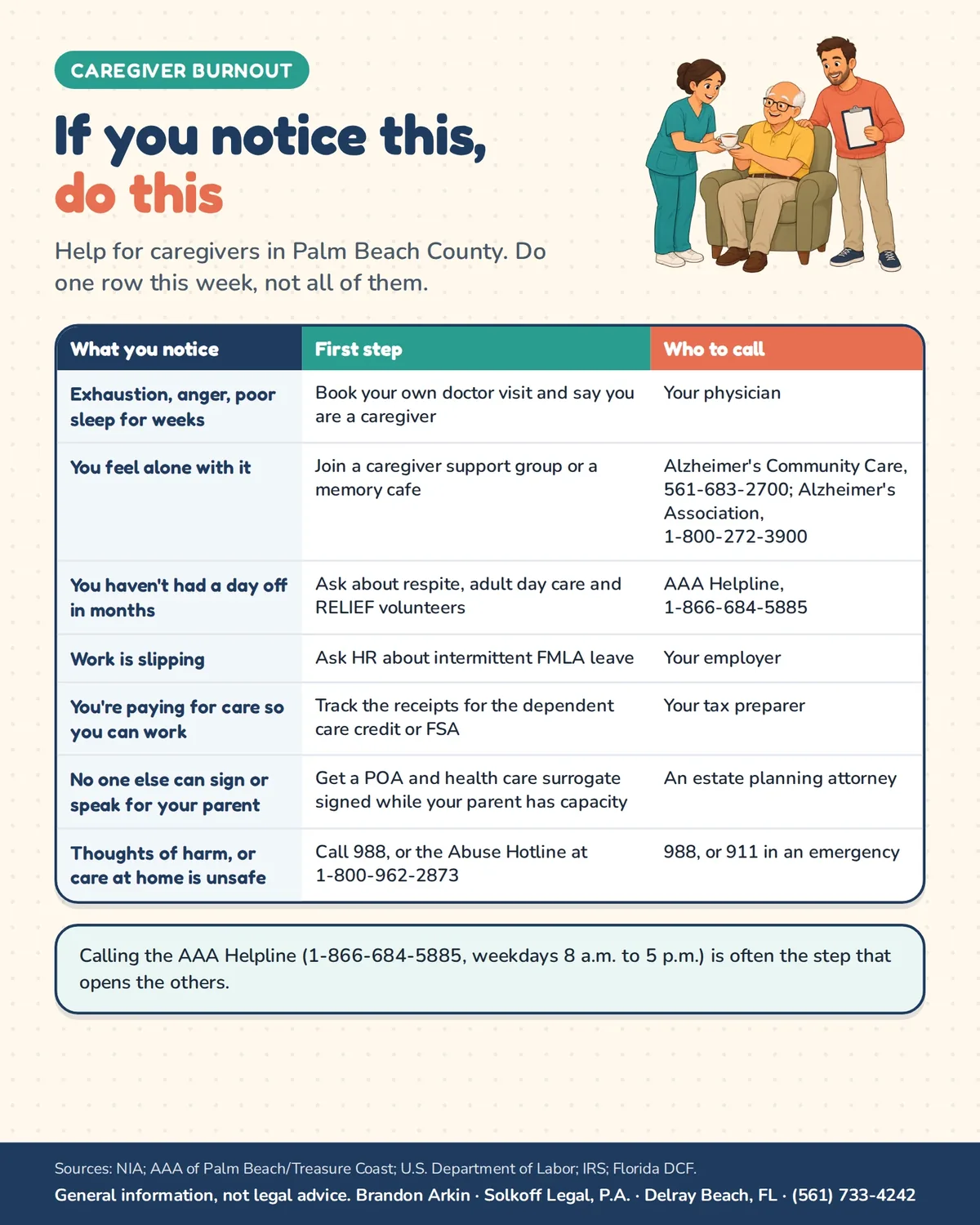
If you notice this, do this
| What you notice | First step | Who to call |
|---|---|---|
| Exhaustion, anger, poor sleep for weeks | Book your own doctor visit and say you are a caregiver (NIA) | Your physician |
| You feel alone with it | Join a caregiver support group or a memory cafe | Alzheimer's Community Care, 561-683-2700; Alzheimer's Association, 1-800-272-3900 |
| You haven't had a day off in months | Ask about respite, adult day care and RELIEF volunteers (respite guide) | AAA Helpline, 1-866-684-5885 |
| Work is slipping | Ask HR about intermittent FMLA leave (DOL) | Your employer |
| You're paying for care so you can work | Track the receipts for the dependent care credit or FSA (IRS) | Your tax preparer |
| No one else can sign or speak for your parent | Get a POA and health care surrogate signed while your parent has capacity (five documents) | An estate planning attorney |
| Thoughts of harm, or care at home is unsafe | Call 988, or the Abuse Hotline at 1-800-962-2873 (DCF) | 988, or 911 in an emergency |
What you notice
Exhaustion, anger, poor sleep for weeks
First step
Book your own doctor visit and say you are a caregiver (NIA)
Who to call
Your physician
What you notice
You feel alone with it
First step
Join a caregiver support group or a memory cafe
Who to call
Alzheimer's Community Care, 561-683-2700; Alzheimer's Association, 1-800-272-3900
What you notice
You haven't had a day off in months
First step
Ask about respite, adult day care and RELIEF volunteers (respite guide)
Who to call
AAA Helpline, 1-866-684-5885
What you notice
Work is slipping
First step
Ask HR about intermittent FMLA leave (DOL)
Who to call
Your employer
What you notice
You're paying for care so you can work
First step
Track the receipts for the dependent care credit or FSA (IRS)
Who to call
Your tax preparer
What you notice
No one else can sign or speak for your parent
First step
Get a POA and health care surrogate signed while your parent has capacity (five documents)
Who to call
An estate planning attorney
What you notice
Thoughts of harm, or care at home is unsafe
First step
Call 988, or the Abuse Hotline at 1-800-962-2873 (DCF)
Who to call
988, or 911 in an emergency
Tick boxes stay on this device. Nothing is saved or sent.
Common questions
Where can I get caregiver burnout help in Palm Beach County?
Start with the Area Agency on Aging Helpline at 1-866-684-5885, weekdays from 8 a.m. to 5 p.m. (AAA PB/TC). For dementia caregiving, Alzheimer's Community Care (561-683-2700) offers Family Navigators, support groups and a 24-hour line (Palm Beach United Way).
Can I take FMLA leave to care for my mother-in-law?
No. FMLA's definition of "parent" excludes parents-in-law (29 CFR 825.122(c)), and Florida doesn't have its own family leave law for private employers. Your employer's own policies may still allow it.
Is there a tax credit for caring for an elderly parent?
Yes, if you pay for care so you can work and your parent is unable to care for themselves and lives with you more than half the year (IRS Topic 602). For 2026, the credit can be up to $1,500 for one person (IRS).
Can I be paid for caring for my parent?
Often, yes. You can be paid through a written personal services agreement, and in some cases through Medicaid's long-term care program. See paying a family caregiver.
If your family is facing one of these questions, you can reach Brandon Arkin at Solkoff Legal, P.A. at (561) 733-4242.
Related on this site
Talk through the next step
Bring your questions, a list of accounts and any papers a hospital, nursing home or Medicaid office has sent you. Call the Delray Beach office or request a consultation, and I can look at where things stand and what may come next. A phone call or an email does not by itself create an attorney-client relationship.
Solkoff Legal, P.A. · (561) 733-4242