
Paying family caregivers
Personal Services Contracts and Florida Medicaid: How DCF Values Family Care
By Brandon Arkin, elder law attorney, Solkoff Legal, P.A. · Updated November 2026

A personal services contract is a written agreement in which a parent pays a relative or another person a fair market rate for care and help going forward. When it's documented properly, Florida Medicaid treats the payments as fair compensation instead of gifts. DCF values the services by their local fair market value, frequency and duration. It asks for the agreement or a statement describing them, and payments for care given before any agreement are at high risk of being treated as gifts within the 60-month look-back (ESS Policy Manual 1640.0614.01 and 1640.0614.04).
Families usually start with the basics in getting paid as a family caregiver: put it in writing, pay a fair rate, and keep a log. This page is for the next questions. How does DCF actually put a number on care from a daughter or nephew? Is a lump sum ever sensible? What does a contract need to say so it holds up to review? And what tax paperwork comes with it?
How DCF values the services
DCF's manual gives three ways to value care received in exchange for money, depending on what the agreement says (ESS 1640.0614.04):
For a set period: DCF uses the time the care was actually given. "As needed" or for an interim period: the caregiver's statement must give the expected frequency and the basis for that expectation. For life: DCF multiplies the yearly fair market value by the life expectancy factor for the person's age at their last birthday, using the table in Appendix A-14.
The manual adds that contacting "an outside source in the same locality" will usually be needed to set the value. The case record must also say how the value was set. In practice, a contract is stronger when it already contains that evidence, such as written rate quotes from two or three local home care agencies for the same tasks.
What counts as a service, and what doesn't
Services that usually have a market price include:
transportation and escorting to appointments medication set-up meal preparation laundry bill paying and insurance paperwork coordinating doctors and home care staff supervision for someone with dementia
Companionship is real but hard to price as a job.
Expect the most questions in a nursing home. The facility already provides personal care, meals, laundry and nursing, so a contract paying a relative for the same tasks invites the question of what the relative is adding. Advocacy, outside appointments, managing finances and care coordination are easier to explain. In assisted living, the line depends on what the facility's own contract covers. Read it before drafting.
Why payments must look forward
Because DCF measures compensation by the agreement and expectations at the time of the exchange, care given years ago with no agreement has nothing on paper to point to. A parent who writes a $40,000 "thank you" check today for past care will usually see DCF review it as a transfer. The family would then need to rebut that presumption with evidence (ESS 1640.0616). The cleaner approach is to sign first and pay for the care that follows.
Monthly pay or a lump sum
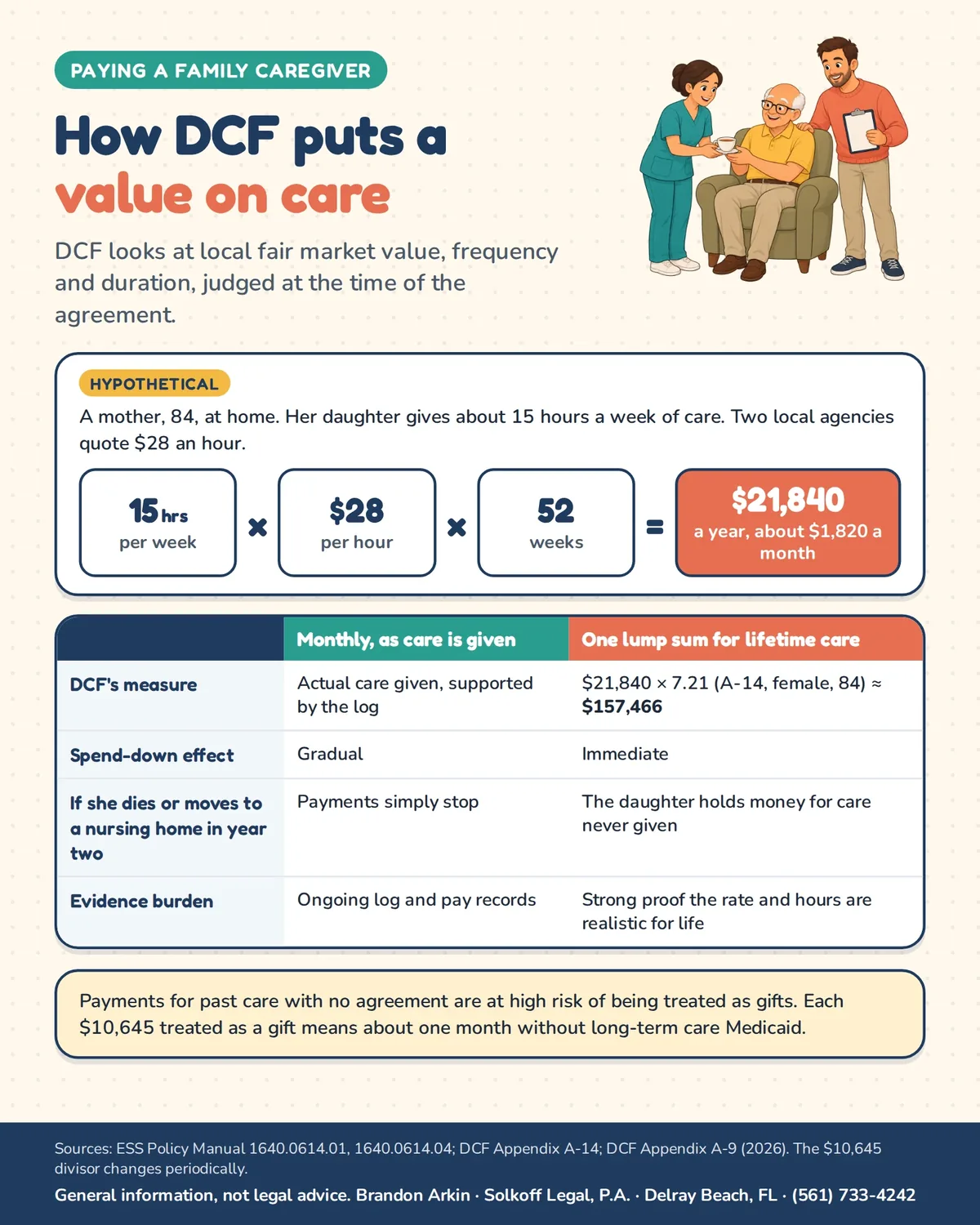
Hypothetical: a mother, 84, lives at home. Her daughter will provide about 15 hours a week of transportation, medication set-up, meals and bill paying. Two local agencies quote $28 an hour for similar services. The yearly value is about $21,840 (15 × $28 × 52), or about $1,820 a month.
Monthly, as care is given One lump sum for lifetime care DCF's measure Actual care given, supported by the log $21,840 × 7.21 (A-14, female, 84) ≈ $157,466 Spend-down effect Gradual Immediate If the mother dies or moves to a nursing home in year two Payments simply stop The daughter holds money for care never given, which can raise transfer, estate and sibling questions Caregiver's taxes Spread across years Generally income in the year received (IRS Publication 525) Evidence burden Ongoing log and pay records Strong proof the rate and hours are realistic for life
Many families find monthly pay easier to defend and easier to explain to siblings. A lump sum is sometimes considered when a large spend-down is needed quickly, but it puts much more weight on the valuation and on the caregiver's follow-through. A contract can include a refund clause for unperformed years. Whether that clause helps or hurts depends on the facts.
When the caregiver is also the agent
Often the child giving care is also the parent's agent under a power of attorney. A Florida agent is a fiduciary who must act in good faith and must not act against the principal's interests. The agent must also try to preserve the principal's known estate plan (Fla. Stat. 709.2114). Signing a contract with yourself, on your parent's behalf, is a conflict. Some ways to reduce it:
have the parent sign while able; have a co-agent or another family member sign for the parent; make sure the power of attorney actually allows the transaction.
Being paid as caregiver is also different from agent compensation. Florida generally allows a qualified agent reasonable compensation for acting as agent, unless the document says otherwise (Fla. Stat. 709.2112). Keep the two separate in the records.
Taxes: W-2, Schedule H, or a 1099
The IRS says a worker is a household employee when the family controls not only what work is done but how it's done. Health aides, caretakers and drivers are among its examples (IRS Publication 926). A daughter following her mother's schedule and instructions usually fits that description. A 1099 generally fits only a caregiver who is genuinely self-employed, offering services to the public in an independent business.
If the caregiver is a household employee and is paid $3,000 or more in cash wages in 2026, the parent generally:
withholds and pays Social Security and Medicare tax; files Schedule H with their 2026 return by April 15, 2027; gives the caregiver a W-2 by February 1, 2027.
Federal unemployment tax applies once wages reach $1,000 in a quarter. The family exceptions (a spouse, a child under 21, and in limited cases a parent) don't cover an adult child caring for a parent. Income tax withholding is optional unless both sides agree. A Form I-9 is completed and kept, not filed (IRS Publication 926). A CPA can set this up.
Fairness among siblings
A sound contract spends the parent's money at fair value, which can reduce what everyone inherits. Families that avoid conflict usually share the draft, quotes and rate with siblings before signing. If the parent's will divides everything equally, the parent might decide whether paid care should change anything. That's a choice for the parent, not the caregiver.
Personal services contract drafting checklist
Use this before anyone signs. Tick boxes on screen or on paper. Nothing is saved.
Tick boxes stay on this device. Nothing is saved or sent.
Common questions
Can Mom pay me for care I already gave her?
She can, but Medicaid will likely treat it as a gift. DCF values compensation by the agreement and expectations of the parties when the exchange happened (ESS 1640.0614.01). Care given years ago with no written agreement has nothing on paper to point to. A payment for past care inside the 60-month look-back is presumed to be a transfer unless the family can rebut that with evidence. In 2026, each $10,645 treated as a gift means roughly one month without long-term care Medicaid. A contract signed now, paying for future care, avoids that problem.
Is a lump-sum personal services contract allowed in Florida?
DCF's manual has a formula for lifetime services. It multiplies the yearly fair market value by the life expectancy factor for the person's age in Appendix A-14 (ESS 1640.0614.04). So lump sums aren't ruled out, but they carry more risk. The payment must match a realistic rate and amount of care. The caregiver generally owes income tax on the full amount in one year. If the parent dies or moves to a nursing home early, the family may face questions about money paid for care never given. Many families prefer paying monthly as care is given.
Does a family caregiver get a W-2 or a 1099?
Usually a W-2. The IRS treats someone as a household employee when the family controls not only what work is done but how it's done. Its examples include health aides and caretakers (IRS Publication 926). An adult child caring for a parent isn't covered by the family exceptions. If cash wages reach $3,000 in 2026, the parent generally owes Social Security and Medicare tax, files Schedule H and issues a W-2. A 1099 generally fits only a caregiver who runs an independent business serving the public.
Can I sign the contract for Mom if I'm her agent and her caregiver?
It's possible, but it's a conflict of interest. A Florida agent is a fiduciary who must act in good faith and must not act against the principal's interests (Fla. Stat. 709.2114). The safer path is for your mother to sign while she can. Otherwise, a co-agent or another person with authority can sign for her. Check that the power of attorney covers the transaction, keep a care log, and share the terms with your siblings. DCF will also want to see the agreement and how the rate was set.
If your family is facing one of these questions, you can reach Brandon Arkin at Solkoff Legal, P.A. at (561) 733-4242.
Related on this site
Talk through the next step
Bring your questions, a list of accounts and any papers a hospital, nursing home or Medicaid office has sent you. Call the Delray Beach office or request a consultation, and I can look at where things stand and what may come next. A phone call or an email does not by itself create an attorney-client relationship.
Solkoff Legal, P.A. · (561) 733-4242