
Resources · Medicaid planning
Medicaid crisis planning in Florida: what families can still do after a nursing home admission
By Brandon Arkin, elder law attorney, Solkoff Legal, P.A. · Updated November 2026

Even after someone has entered a Florida nursing home, families can often still lawfully restructure assets so the person may qualify for Medicaid sooner, using the spousal protections, spend-down on exempt items, compliant annuities and notes, care agreements, or a planned gift paired with income to cover the penalty. Because Florida generally doesn't give retroactive Medicaid to older adults, what you do before the end of the month you apply can decide when coverage starts.
Why the calendar matters so much
Many admissions start with a hospital stay and a Medicare-covered rehab stay. Medicare may cover up to 100 days in a skilled nursing facility, with a daily coinsurance of $217 for days 21 through 100 in 2026 (Medicare.gov), but coverage often ends sooner, when the person no longer needs daily skilled care. Medicare can’t stop coverage just because the person has stopped improving. Skilled care needed to keep them from getting worse can still qualify (Jimmo v. Sebelius settlement). After that, the bill is private pay until Medicaid starts.
Two DCF rules set the pace. Institutional care coverage can begin the first day of the month of admission, but not before the month of application (ESS Policy Manual 0640.0506; 0640.0509). And a person who meets the limits on any day of a month is eligible for that whole month (1640.0405). In practice, a plan finished on the 28th of a month may cover the whole month, while waiting until the 2nd of the next month may cost a month of private pay. At $10,000 or more a month, that's often the single largest number in the case.
The options, at a glance
| Option | Who it's for | Main rule | More detail |
|---|---|---|---|
| Spousal transfers and the CSRA | Married couples | Transfers between spouses are allowed; the spouse at home keeps up to $162,660 | Married couples |
| Spend-down on exempt items | Anyone | Paying fair value for things Medicaid doesn't count isn't a transfer | Medicaid planning |
| Community spouse annuity | Married couples | Must meet DCF's annuity rules; payments are the at-home spouse's income | This page |
| Personal services contract | Anyone with a family caregiver | Written, fair-value, prospective pay only | Personal services contracts |
| Half-a-loaf | Usually single applicants | A gift, plus a compliant annuity or note to pay during the penalty | This page |
| Fair-hearing CSRA increase | Married couples with low income at home | More assets may be protected if income is too low | Spouse's income allowance |
| Spousal refusal | Married couples, in some cases | Assignment of support rights to the state | Spousal refusal |
Option
Spousal transfers and the CSRA
Who it's for
Married couples
Main rule
Transfers between spouses are allowed; the spouse at home keeps up to $162,660
More detail
Married couples
Option
Spend-down on exempt items
Who it's for
Anyone
Main rule
Paying fair value for things Medicaid doesn't count isn't a transfer
More detail
Medicaid planning
Option
Community spouse annuity
Who it's for
Married couples
Main rule
Must meet DCF's annuity rules; payments are the at-home spouse's income
More detail
This page
Option
Personal services contract
Who it's for
Anyone with a family caregiver
Main rule
Written, fair-value, prospective pay only
More detail
Personal services contracts
Option
Half-a-loaf
Who it's for
Usually single applicants
Main rule
A gift, plus a compliant annuity or note to pay during the penalty
More detail
This page
Option
Fair-hearing CSRA increase
Who it's for
Married couples with low income at home
Main rule
More assets may be protected if income is too low
More detail
Spouse's income allowance
Option
Spousal refusal
Who it's for
Married couples, in some cases
Main rule
Assignment of support rights to the state
More detail
Spousal refusal
When the patient is married
Married couples usually have the most room. Two different steps matter. First is the snapshot, also called the resource assessment: DCF adds up both spouses' countable assets as of the start of the first continuous period of institutionalization (42 U.S.C. 1396r-5(c)(1)). That snapshot sets the spouse's share, the CSRA, up to $162,660. Second is the asset test in the month of application, after any spend-down: the couple's combined countable assets must then be no more than the CSRA plus $2,000 (ESS Policy Manual 1640.0314.01). The home, one car and household goods are generally excluded in addition.
Tools often considered for the amount over the line:
Transfers to the spouse. Interspousal transfers are allowable and carry no penalty (ESS Policy Manual 1640.0609.05). After approval, the CSRA assets still in the patient's name should be moved to the spouse before the next renewal (1640.0610). A community spouse annuity. When the at-home spouse buys an annuity within the look-back, it isn't a transfer if it names the Agency for Health Care Administration (AHCA) as primary beneficiary (after a minor or disabled child, if any) and is actuarially sound for the spouse's age. A revocable or assignable annuity is counted as an asset (ESS Policy Manual 1640.0609.03). Because income generally belongs to the spouse whose name is on the check (42 U.S.C. 1396r-5(b)(2)), the payments help the spouse at home without counting against the patient. A fair-hearing CSRA increase. If the CSRA wouldn't generate enough income to raise the spouse at home to the $2,705 minimum, a hearing officer may raise it (1640.0314.01). Federal law requires the patient's available income to be counted first (42 U.S.C. 1396r-5(d)(6)). Our guide to the spouse's income allowance walks through the numbers.
Spend-down that isn't a transfer
Spending money on fair-value purchases or paying a valid, enforceable debt is allowable (ESS Policy Manual 1640.0609.05). Families commonly look at:
paying the nursing home bill, credit cards, medical bills and taxes; repairs or improvements to the home, if it's excluded; replacing an unreliable car; an irrevocable prepaid funeral and burial arrangement, which DCF treats as a purchase (1640.0609.05); clothing, hearing aids, dentures, a wheelchair or other items the person needs.
Keep receipts. DCF reviews bank statements, and unexplained withdrawals may be treated as transfers.
Paying a family caregiver
If a child or other relative provides care, a written personal services contract can pay them fair market value for services going forward. DCF looks at the value, frequency and duration of the services and wants documentation of how the value was set (ESS Policy Manual 1640.0614.04). Payment for care already given without an agreement is often treated as a gift. Our personal services contract guide covers drafting, and paying a family caregiver covers the family side.
Half-a-loaf for a single applicant
A single person can't shelter assets with a spouse, so a common approach is to gift part of the savings and use the rest to pay for care during the penalty that the gift creates. The kept portion is usually converted to income through a Medicaid-compliant annuity (1640.0609.03) or a promissory note that is actuarially sound, has equal payments with no balloon, and can't be forgiven (ESS Policy Manual 1640.0609.08). Our promissory note guide explains the note rules.
This works because of when the penalty starts. For transfers since November 1, 2007, it begins on the later of the first day of the transfer month or the date the person would otherwise be eligible, which requires an application and meeting every other rule (ESS Policy Manual 1640.0619). Partial months count as days (1640.0618).
What can go wrong
A gift made without a plan to cover the penalty can leave a parent with no way to pay the nursing home. DCF's undue hardship exception is narrow and requires a doctor's documentation of endangerment (ESS Policy Manual 1640.0617). An annuity sold as "Medicaid-friendly" with surrender charges, a balloon payment or the wrong beneficiary may be counted as an asset or treated as a transfer. A power of attorney without gifting, trust or annuity powers may stop the plan. Florida requires certain powers to be separately initialed (Fla. Stat. 709.2202), and without them a guardianship may be the only route. Missing the application month, or missing a DCF request for documents, can cost coverage. Our guide to after the Medicaid application covers deadlines.
No option can promise approval. DCF decides each case on its documents.
A hypothetical, in numbers
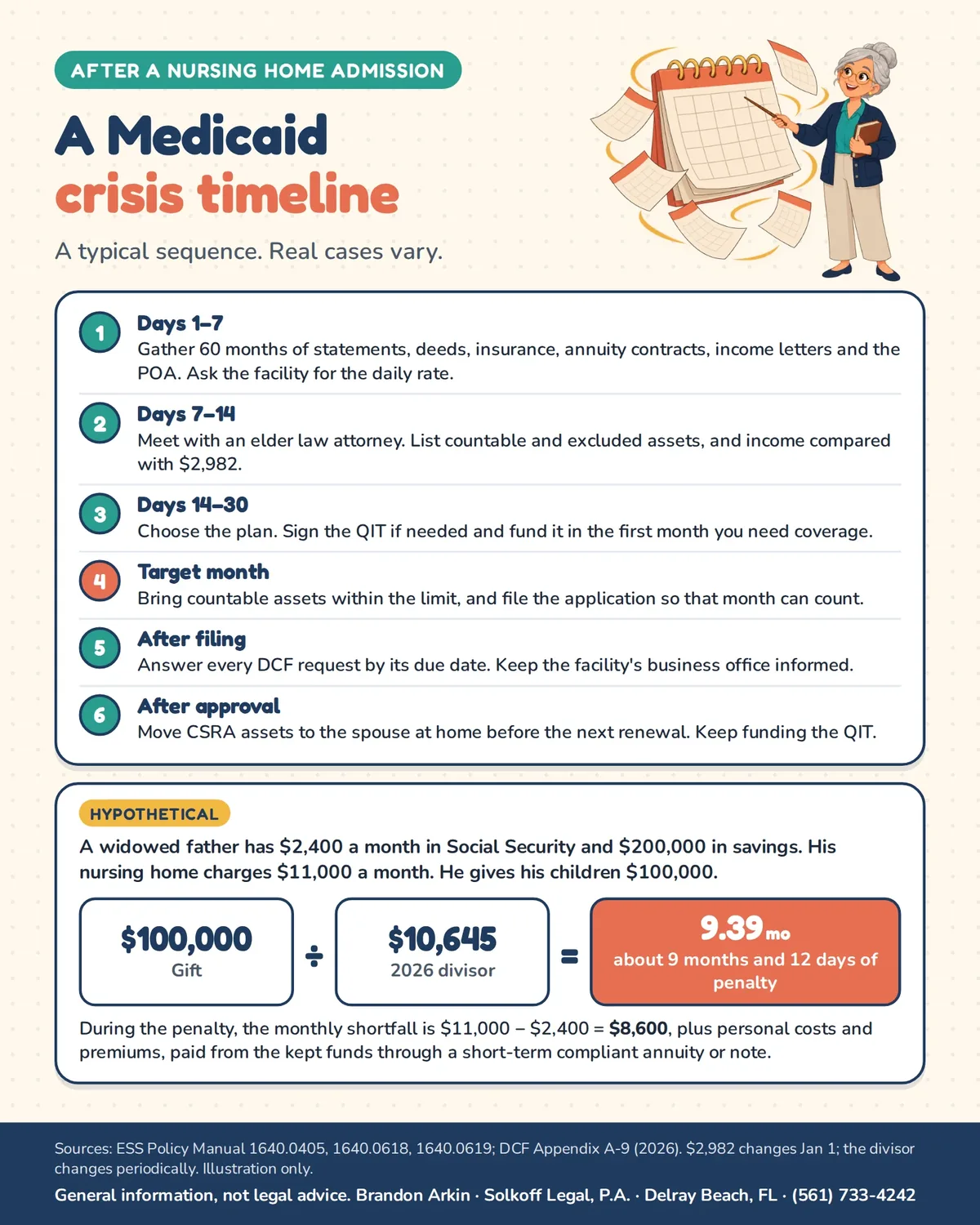
Assume a widowed father in Delray Beach, now in a nursing home, has $2,400 a month in Social Security and $200,000 in savings. The nursing home charges $11,000 a month.
| Step | Generally |
|---|---|
| Gift to his children | $110,000 |
| Penalty | $110,000 ÷ $10,645 = 10.33 months, or about 10 months and 10 days |
| Monthly shortfall during the penalty | $11,000 − $2,400 = $8,600, plus personal costs and premiums |
| Kept funds | $90,000, into a short-term compliant annuity or note paying about $8,700 a month for about 10 months and 10 days, which covers the shortfall (about $88,900 in total) |
| Income check | $2,400 plus $8,700 is over $2,982, so a Qualified Income Trust is likely needed |
| After the penalty | Annuity ends, savings are under $2,000, and Medicaid may begin |
Step
Gift to his children
Generally
$110,000
Step
Penalty
Generally
$110,000 ÷ $10,645 = 10.33 months, or about 10 months and 10 days
Step
Monthly shortfall during the penalty
Generally
$11,000 − $2,400 = $8,600, plus personal costs and premiums
Step
Kept funds
Generally
$90,000, into a short-term compliant annuity or note paying about $8,700 a month for about 10 months and 10 days, which covers the shortfall (about $88,900 in total)
Step
Income check
Generally
$2,400 plus $8,700 is over $2,982, so a Qualified Income Trust is likely needed
Step
After the penalty
Generally
Annuity ends, savings are under $2,000, and Medicaid may begin
Illustration only, rounded and before interest, taxes, personal costs and legal fees, which change the split. The real numbers depend on the facility rate, the annuity terms, taxes and timing. A gift can also expose the money to the children's creditors or divorces, and the children must not give it back during the penalty unless the plan changes, because returned assets reset the calculation (1640.0620). See our Miller trust guide on the income cap.
A crisis timeline
A typical sequence. Real cases move faster or slower.
Tick boxes stay on this device. Nothing is saved or sent.
Common questions
Is it too late to plan once my parent is in a nursing home in Florida?
Often not. Families can still use spend-down on things Medicaid doesn't count, spousal protections if the parent is married, written care agreements, compliant annuities or notes, and sometimes a planned gift paired with income to pay for care during the penalty. Each must follow DCF's rules, and some may not fit the family's goals. Timing matters, because Florida generally doesn't provide retroactive Medicaid to older adults (ESS Policy Manual 0640.0509). A consultation before the application is filed may widen the options.
What is a half-a-loaf strategy?
It's a crisis approach, usually for a single applicant, that gifts part of the savings and keeps the rest to pay for care during the penalty the gift creates. The kept money is often turned into monthly income through a Medicaid-compliant annuity or promissory note. It depends on DCF's rule that the penalty starts only when the person would otherwise be eligible (ESS Policy Manual 1640.0619). It needs careful math, a valid power of attorney if the parent can't sign, and family members who understand their role.
Can the spouse at home keep more than $162,660?
Sometimes. If the CSRA wouldn't produce enough income to bring the spouse at home up to the $2,705 minimum, the allowance may be increased through a DCF fair hearing (ESS Policy Manual 1640.0314.01). Federal law requires the patient's income that could be shifted to the spouse to be counted first (42 U.S.C. 1396r-5(d)(6)), so this mostly helps when both spouses have modest income. A compliant annuity for the spouse at home is another option some couples consider.
Does Florida Medicaid pay for past nursing home months?
Usually not for older adults. DCF's three-month retroactive coverage applies to children under 21 and pregnant women (ESS Policy Manual 0640.0509). For nursing home care, coverage can start on the first day of the month of admission, but not earlier than the month of application, and only for months the person is eligible (ESS Policy Manual 0640.0506). A person eligible on any day of a month is eligible for that whole month, so filing in the right month matters.
If your family is facing one of these questions, you can reach Brandon Arkin at Solkoff Legal, P.A. at (561) 733-4242.
Related on this site
Talk through the next step
Bring your questions, a list of accounts and any papers a hospital, nursing home or Medicaid office has sent you. Call the Delray Beach office or request a consultation, and I can look at where things stand and what may come next. A phone call or an email does not by itself create an attorney-client relationship.
Solkoff Legal, P.A. · (561) 733-4242