
Medicaid income rules
How to Set Up a Miller Trust in Florida, Step by Step
By Brandon Arkin, elder law attorney, Solkoff Legal, P.A. · Updated November 2026

To set up a Miller trust (a Qualified Income Trust, or QIT) in Florida, the applicant or someone with legal authority signs an irrevocable, income-only trust that names the State as remainder beneficiary. A trustee then opens a separate bank account and deposits enough of the applicant's income into it each month to bring the income left outside the trust to $2,982 or less. DCF's legal office reviews the trust, and the deposits must start in the first month coverage is needed, even before approval (DCF QIT information sheet; ESS Policy Manual 1840.0110).
Families usually hear "Miller trust" when a parent's income is called "too high for Medicaid." The fix is mostly paperwork and routine. A QIT doesn't shelter income from the nursing home, because most of it still goes toward care. It gets the person past an income test that would otherwise block coverage. For the basics of the income and asset tests, start with Florida Medicaid planning.
Confirm the trust is actually needed
The test uses gross income: Social Security before the Medicare Part B premium is taken out, pensions before tax withholding, annuity payments, and required IRA withdrawals if they're paid out regularly. Pull the award letters, not the bank deposits, because deposits are net amounts. If the total is $2,982 or less, a QIT isn't needed. If it's even $1 over, it is.
Watch January. Social Security cost-of-living increases arrive then, and the cap usually changes with them. A person who was $20 under the cap in December can be over it in January.
Decide who signs, and check their authority
DCF accepts a QIT signed and dated by the applicant, the applicant's spouse, or a person with legal authority to act for the applicant, or who acts at the applicant's or spouse's request (DCF Appendix A-22.1). A spouse doesn't need a power of attorney to sign. DCF's guidance says income trusts don't need will-style witnessing.
The common problem is an agent signing under a power of attorney. Creating a trust is one of the powers Florida requires the principal to separately initial or sign in the document (Fla. Stat. 709.2202). If that power isn't initialed, and the parent can no longer sign, the family may need a different route, sometimes a court. Check this on day one, not on the 28th of the month. The guide for agents covers the agent's duties more generally.
Use language that meets DCF's checklist
DCF's lawyers review every QIT before approval. They check that it is irrevocable, holds only the applicant's income, was set up for the applicant's benefit, and pays the balance at death to the State up to the Medicaid paid (DCF Appendix A-22.1; Appendix A-22.5, the review form). The trust can say "the State" rather than "the State of Florida."
DCF says professional help is allowed but not required. The trust also has to let all funds be paid out monthly for the person's benefit. Otherwise deposits can be treated as a transfer (ESS 1840.0111). The trust should also name a trustee and a successor trustee. DCF doesn't publish its own fill-in QIT form, so the trust is drafted to meet DCF's required terms.
Choose the trustee and open the account
The trustee is usually the agent, a spouse or an adult child who already pays the bills. They need to be reliable every single month, because one missed deposit can cost a month.
Open a plain checking account titled to the trustee for the trust, separate from every other account. Make the opening deposit from the person's income. Never use savings, and never use a child's or spouse's money. A QIT that holds assets or anyone else's funds isn't treated as a QIT (DCF Appendix A-22.1). Skip debit cards and overdraft links.
Do the monthly deposit math
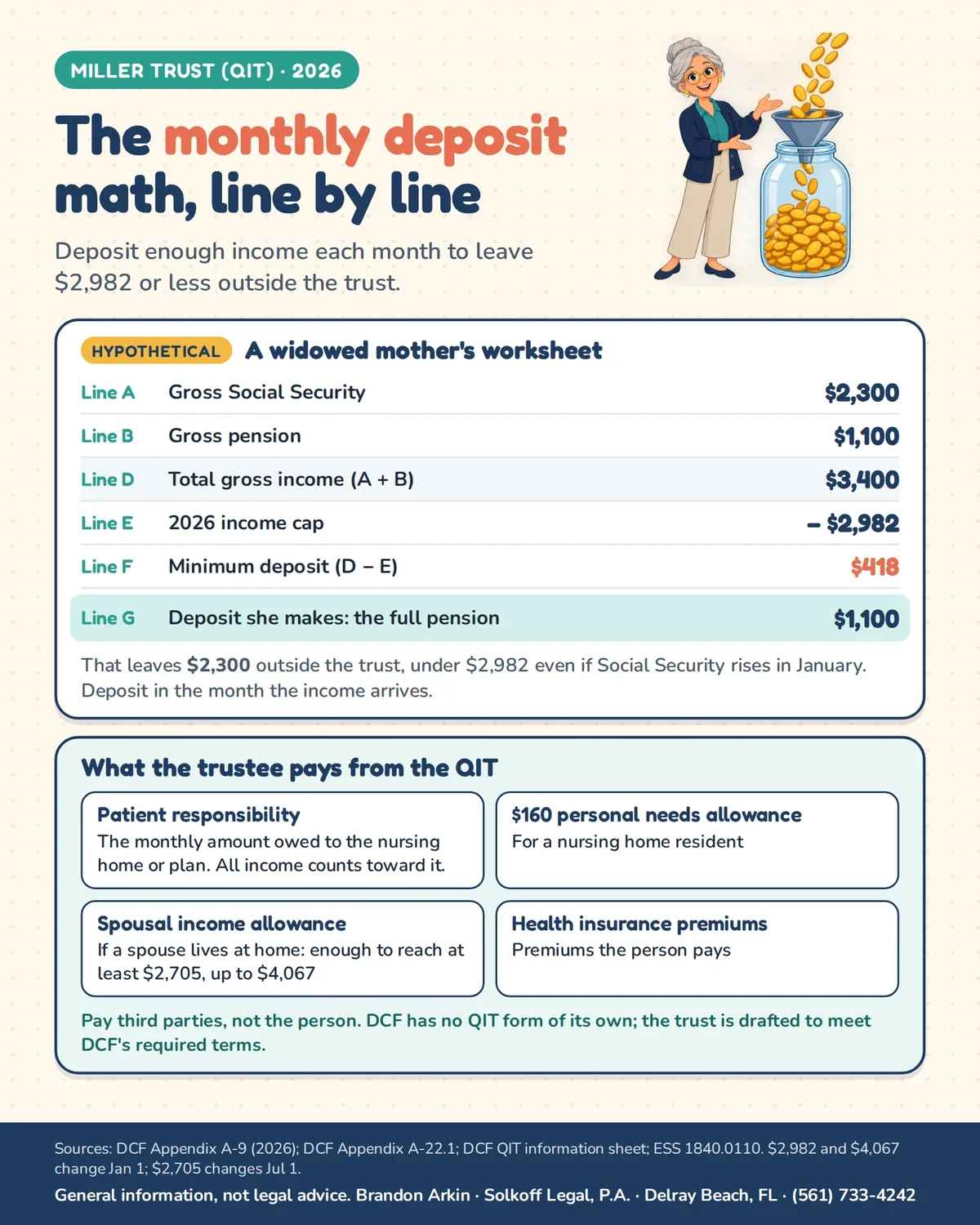
The minimum deposit is gross income minus $2,982. DCF itself says it's better to deposit more than to risk too little (DCF QIT information sheet). Many families deposit one whole income source, such as the full pension, because that leaves a clear cushion.
Hypothetical: a widowed mother receives $2,300 a month in gross Social Security and an $1,100 pension, for a total of $3,400. She is $418 over the cap. Depositing the full $1,100 pension each month leaves $2,300 outside the trust. That's comfortably under $2,982, even if Social Security rises in January.
Deposit in the month the income arrives. If the pension lands on the 30th, the transfer must post by the 31st. A recurring transfer scheduled two days after each payment date is safer than relying on memory.
Know what the trustee pays from the account
All income, inside and outside the trust, goes into the patient responsibility calculation. That's the monthly amount the person pays the nursing home or plan (ESS 1840.0110). Each month the trustee usually sends QIT funds toward that amount and any allowed deductions:
the $160 personal needs allowance, for a nursing home resident; a spousal income allowance, if a spouse lives at home; health insurance premiums the person pays.
Money paid directly to the person counts as their income, so pay third parties. Keep monthly statements.
Hypothetical, continued: with a $250 supplemental insurance premium, patient responsibility would be about $3,400 − $160 − $250 = $2,990. The trustee sends the $1,100 from the QIT to the facility, and the rest of the $2,990 comes from her own account.
If she were married and her husband's own income were $1,400, a spousal allowance of at least $1,305 could bring him to $2,705. It could be more if his housing costs qualify, up to $4,067. Her patient responsibility would drop accordingly. The married couples guide explains that allowance.
The mistakes that cost a month
Signing the trust but not funding it in the first month coverage is needed. Trusts can't be funded retroactively (DCF Appendix A-22.1). Depositing a day late, in the following month. Depositing too little after a January increase. Opening the account with savings, or depositing a spouse's income. Paying the person cash from the QIT, or leaving the account idle while the facility bill goes unpaid. Assuming coverage will reach back. For most adults, Florida long-term care coverage generally starts no earlier than the month of application. See what to expect in the first 30 days.
A missed month usually can't be repaired with a catch-up deposit. The family may owe that month privately.
What happens at death, or at discharge
When the person dies, the trustee asks the facility whether any refund for the month of death is due back to the trust. The account balance on the date of death, plus that refund, is paid to the State up to the Medicaid it paid. DCF's sheet says to make the check payable to the "Agency for Health Care Administration," mail it to the Florida Medicaid TPL Recovery Program, PO Box 12188, Tallahassee, FL 32317-2188, and enclose a short note and the statement covering the date of death (DCF QIT information sheet).
If the person is discharged home and no longer needs long-term care Medicaid, the trust may be revoked if its terms allow. Florida Medicaid is still repaid first (ESS 1840.0110).
Monthly QIT deposit worksheet
Fill this in on screen or on paper. Numbers stay on your device, and nothing is saved or sent.
Tick boxes stay on this device. Nothing is saved or sent.
Common questions
Can I set up a Miller trust in Florida myself?
DCF says professional help is allowed but not required. The trust must still meet DCF's terms: irrevocable, income only, for the applicant's benefit, and paying the State at death up to the Medicaid paid. DCF's legal office reviews each one before approval. The harder parts are often practical. Who has authority to sign? Does the power of attorney allow creating trusts? Will the first deposit happen in the right month? A trust that is rejected, or signed by someone without authority, can delay coverage by a month or more. Many families have the trust prepared or reviewed for that reason.
How much income has to go into a Florida Qualified Income Trust?
At least enough that the gross income left outside the trust is $2,982 a month or less in 2026 (DCF Appendix A-9). The minimum is total gross income minus $2,982. DCF advises depositing more rather than risking too little. Many families deposit one whole income source, such as a pension, to leave a cushion for January increases. The deposit doesn't reduce what the person pays toward care. All income, inside and outside the trust, still counts toward patient responsibility.
What happens if a Miller trust deposit is missed?
DCF says the person is ineligible for long-term care payment in any month without a deposit, or with too small a deposit. Deposits can't be made for a past month, so a late deposit in the next month usually doesn't fix the earlier one (DCF QIT information sheet). The family may owe the facility privately for that month. If it happens, tell the eligibility worker promptly and keep the next month's deposit on time. Then get advice on how the gap affects the case.
Does the Miller trust money go to the family when the person dies?
Usually not much of it. The balance on the date of death, plus any refund from the facility for that month, goes to the State up to the total Medicaid paid. DCF's sheet asks for a check payable to the Agency for Health Care Administration, a short cover note and the statement covering the date of death (DCF QIT information sheet). Because the trustee pays out most income each month, the remaining balance is often small. Anything left after the State is repaid passes under the trust's terms.
If your family is facing one of these questions, you can reach Brandon Arkin at Solkoff Legal, P.A. at (561) 733-4242.
Related on this site
Talk through the next step
Bring your questions, a list of accounts and any papers a hospital, nursing home or Medicaid office has sent you. Call the Delray Beach office or request a consultation, and I can look at where things stand and what may come next. A phone call or an email does not by itself create an attorney-client relationship.
Solkoff Legal, P.A. · (561) 733-4242