Married couples
Spousal Refusal and Florida Medicaid: How the Assignment of Support Works
By Brandon Arkin, elder law attorney, Solkoff Legal, P.A. · Updated November 2026
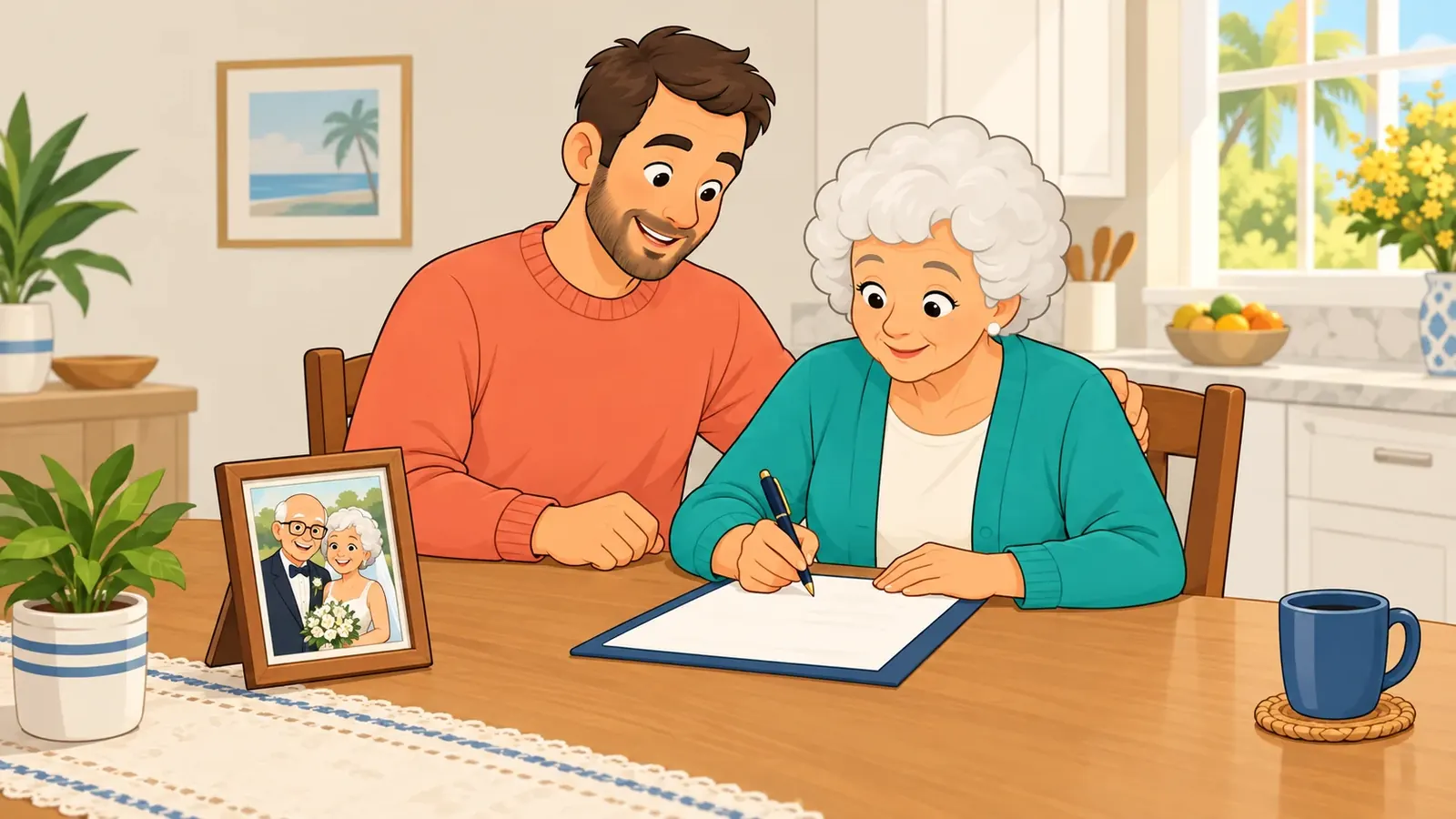
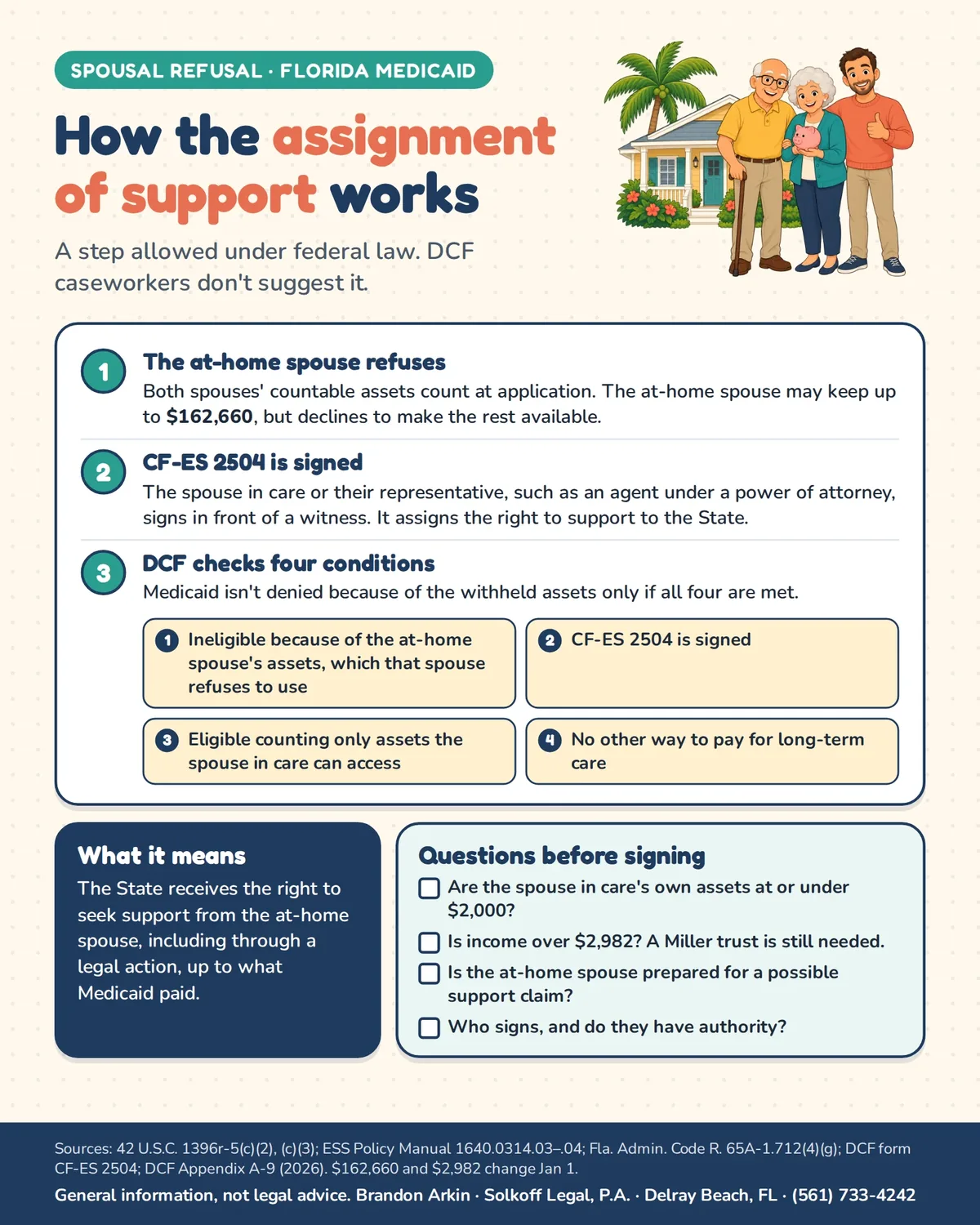
Spousal refusal is when the spouse living at home declines to make their assets available for the spouse who needs long-term care. The spouse needing care then signs DCF's Assignment of Rights to Support (CF-ES 2504). If four conditions are met, Florida doesn't deny Medicaid because of the withheld assets. It's allowed under federal law (42 U.S.C. 1396r-5(c)(3)), but it gives the State the right to seek support from the spouse at home. DCF staff won't suggest it (ESS Policy Manual 1640.0314.03).
Most married couples never need this page. The spousal rules usually let the spouse at home keep the home, a car, up to $162,660 in countable assets and enough income to live on. The married couples guide walks through those rules.
Spousal refusal comes up in a narrower set of situations. Sometimes the at-home spouse has substantial savings of their own and won't spend them on the other spouse's care, or can't be persuaded to. Federal law anticipated this. Here's how Florida applies it, and why it's a serious step.
Why the at-home spouse's money counts at all
At application, federal law treats all countable assets of either spouse as available to the spouse needing care. That applies whatever state property law or a prenuptial agreement says. The protected spousal share comes out first (42 U.S.C. 1396r-5(c)(2)). DCF applies this even to couples who kept finances separate, and even when assets are covered by a prenuptial agreement (ESS 1640.0314.01 and .02).
Hypothetical: a husband needs nursing home care and has $9,000 in his name. His wife of eight years, in a second marriage, has $410,000 in her own IRA and brokerage account. Their combined countable assets are $419,000. After her $162,660 allowance, DCF would treat about $256,340 as available to him, far over $2,000. She considers that money hers, saved before the marriage for her own old age and her children.
What federal law allows
The spousal impoverishment statute says the spouse in care isn't ineligible because of those attributed assets in three situations (42 U.S.C. 1396r-5(c)(3)):
the spouse in care has assigned to the State any rights to support from the at-home spouse; the spouse in care can't sign an assignment because of a physical or mental impairment, but the State has the right to bring a support proceeding anyway; denying eligibility would work an undue hardship.
Florida carries this out through the assignment form and DCF's undue hardship conditions.
DCF's four conditions
DCF won't find the spouse in care ineligible because of the at-home spouse's assets if all four of these exist (ESS 1640.0314.04; Rule 65A-1.712(4)(g)):
The spouse in care isn't eligible because of the at-home spouse's assets, and the at-home spouse refuses to use them for the spouse in care. The Assignment of Rights to Support, CF-ES 2504, is signed. The spouse in care would be eligible if only the assets they can access were counted. The spouse in care has no other way to pay for long-term care.
Condition 3 is often misunderstood. Refusal doesn't shelter the spouse in care's own money. In the hypothetical, the husband's $9,000 still has to come down to $2,000 through ordinary spend-down. The other rules still apply too: the 60-month look-back, the income cap and a Miller trust if income is over $2,982.
What the form says, and how DCF handles it
CF-ES 2504 is short. The spouse in care, or a legal guardian, signs in front of a witness. Signing assigns to the State of Florida "any and all right, claim, title, and interest" to support owed by the named spouse. It also assigns the right to bring legal action to establish or enforce a support order. The assignment lasts while benefits are received and until the State is reimbursed, limited to the amount Florida paid (DCF form CF-ES 2504). Florida's rule says it may be signed by the spouse in care "or their representative" (Rule 65A-1.712(4)(g)).
DCF scans the form into the case file and notifies its Tallahassee headquarters on form CF-ES 2614. The manual is explicit that caseworkers don't suggest the form to a couple who would otherwise be ineligible. It's a response to a situation the family brings forward (ESS 1640.0314.03). Expect a caseworker to answer questions about the form, not to offer it.
The risks, stated plainly
A possible support action. The assignment hands the State the spouse in care's right to seek support. Florida law lets a spouse ask a court for support without a divorce (Fla. Stat. 61.09). The State could seek reimbursement from the at-home spouse, up to what Medicaid paid. DCF and AHCA don't publish how often they pursue these claims, so families shouldn't plan on "they never do." It doesn't erase the marriage. If the at-home spouse dies first, the spouse in care has a surviving spouse's rights, such as the elective share (Fla. Stat. 732.201). That can affect the at-home spouse's estate plan and Medicaid. Their will and beneficiary forms need a fresh look. Family strain. Adult children from a first marriage may read refusal as abandonment, even when both spouses agree to it. Scrutiny of transfers. Moving assets from the spouse in care to the at-home spouse is generally allowed, but late or large moves around the application will be reviewed. No guarantee. DCF must still find that all four conditions exist.
When families consider it
DCF describes the assignment as meant for "an existing situation." In practice, families tend to raise it in a few patterns:
later-life marriages where each spouse kept separate finances, often with a prenuptial agreement; spouses who have lived apart for years without divorcing; an at-home spouse who simply won't cooperate with the application.
If the at-home spouse has been separated for a long time and can't be found, DCF may treat the applicant as single. In that case refusal isn't needed (ESS 1640.0314.01).
Before refusal, families usually look at the ordinary tools:
Spending down on things of fair value. Asking at a fair hearing for a larger spousal allowance, when the standard one wouldn't generate enough income for the at-home spouse (ESS 1640.0314.01). Other lawful steps, depending on the facts.
Divorce is a separate decision with its own costs, and Florida Medicaid myths covers why it's rarely the answer.
Questions to answer before anyone signs CF-ES 2504
Work through this table together, ideally with both spouses, or with their agents, in the room. Tick each row on screen or on paper. Nothing is saved.
| Question | Why it matters |
|---|---|
| [ ] Whose name is each account in, and since when? | Shows what's attributed, and what transfers DCF will review. |
| [ ] Are the spouse in care's own assets at or under $2,000? | Refusal doesn't cover them (condition 3). |
| [ ] Is income over $2,982? | A Miller trust is still needed. |
| [ ] Would the standard spousal allowance, or a fair-hearing increase, be enough? | The ordinary rules may solve it without refusal. |
| [ ] Is the at-home spouse prepared for a possible support claim? | The State receives that right under the form. |
| [ ] Who signs, and do they have authority? | The form is signed by the spouse in care or their representative. |
| [ ] Has the at-home spouse updated their will and beneficiary forms? | Their estate could otherwise flow to the spouse in care. |
| [ ] Do the adult children understand the plan? | It reduces conflict later. |
Question
[ ] Whose name is each account in, and since when?
Why it matters
Shows what's attributed, and what transfers DCF will review.
Question
[ ] Are the spouse in care's own assets at or under $2,000?
Why it matters
Refusal doesn't cover them (condition 3).
Question
[ ] Is income over $2,982?
Why it matters
A Miller trust is still needed.
Question
[ ] Would the standard spousal allowance, or a fair-hearing increase, be enough?
Why it matters
The ordinary rules may solve it without refusal.
Question
[ ] Is the at-home spouse prepared for a possible support claim?
Why it matters
The State receives that right under the form.
Question
[ ] Who signs, and do they have authority?
Why it matters
The form is signed by the spouse in care or their representative.
Question
[ ] Has the at-home spouse updated their will and beneficiary forms?
Why it matters
Their estate could otherwise flow to the spouse in care.
Question
[ ] Do the adult children understand the plan?
Why it matters
It reduces conflict later.
Tick boxes stay on this device. Nothing is saved or sent.
Common questions
Is spousal refusal legal in Florida?
Yes. Federal law says the spouse in care isn't ineligible because of the at-home spouse's assets when the spouse in care has assigned their support rights to the State (42 U.S.C. 1396r-5(c)(3)). Florida applies it through form CF-ES 2504 and four conditions in DCF's manual and rules. Legal doesn't mean risk-free, though. The assignment lets the State seek support from the at-home spouse, and DCF must still find all four conditions met. Whether it fits a particular marriage depends on the couple's assets, health and family.
Will Florida sue the spouse who refuses?
It can. Signing CF-ES 2504 assigns to the State the right to bring legal action to establish or enforce support, limited to what Medicaid pays (DCF form CF-ES 2504). Florida law allows a spouse to seek support without divorcing (Fla. Stat. 61.09). DCF and AHCA don't publish how often they pursue these claims. A spouse considering refusal should assume a claim is possible and decide whether they are prepared for that.
Does a prenuptial agreement keep my assets out of my spouse's Medicaid application?
Generally no. DCF counts assets covered by a prenuptial agreement as part of the couple's total assets for long-term care Medicaid, whenever the agreement was signed (ESS 1640.0314.02). Federal law likewise looks at both spouses' assets whatever state property law says. A prenup still matters for inheritance and divorce, and it's often part of why a second-marriage spouse considers refusal. It doesn't by itself remove the assets from the Medicaid count.
What if the spouse needing care can't sign the form?
Florida's rule allows the assignment to be signed by the spouse in care "or their representative," and the form has a line for a legal guardian (Rule 65A-1.712(4)(g)). Federal law also covers a spouse who can't sign because of impairment when the State can bring a support proceeding anyway (42 U.S.C. 1396r-5(c)(3)(B)). An agent under a durable power of attorney can also sign it for the at-home spouse.
If your family is facing one of these questions, you can reach Brandon Arkin at Solkoff Legal, P.A. at (561) 733-4242.
Related on this site
Talk through the next step
Bring your questions, a list of accounts and any papers a hospital, nursing home or Medicaid office has sent you. Call the Delray Beach office or request a consultation, and I can look at where things stand and what may come next. A phone call or an email does not by itself create an attorney-client relationship.
Solkoff Legal, P.A. · (561) 733-4242