
Resources · Married couples
The spouse at home's income allowance in Florida: MMMNA, shelter costs and the 2026 cap
By Brandon Arkin, elder law attorney, Solkoff Legal, P.A. · Updated November 2026

In Florida, the Minimum Monthly Maintenance Needs Allowance (MMMNA) is $2,705 a month from July 1, 2026, and a spouse at home whose own income is lower may receive part of the institutionalized spouse's income to make up the difference, plus an excess shelter amount, up to a cap of $4,067. A fair hearing may raise the allowance in exceptional circumstances, and because of the federal income-first rule, it can also raise the assets the spouse keeps when the combined income still falls short.
Who this applies to
The allowance applies when one spouse receives nursing home Medicaid (the Institutional Care Program) or long-term care through Statewide Medicaid Managed Care (SMMC LTC) or PACE, and the other spouse lives in the community (ESS Policy Manual 2640.0119.01). Federal law calls them the institutionalized spouse and the community spouse.
The at-home spouse's own income doesn't count toward the other spouse's eligibility, and income generally belongs to the spouse whose name is on the check (42 U.S.C. 1396r-5(b)). The allowance is about what happens after approval. It decides how much of the patient's income goes to the nursing home as "patient responsibility" and how much may go home. Our married couples guide covers the broader picture, including the $162,660 asset allowance.
The formula, step by step
DCF uses this formula (ESS Policy Manual 2640.0119.03):
(MMMNA + excess shelter costs) − the at-home spouse's gross income = the income allowance
The excess shelter piece is figured in three steps (2640.0119.04):
Add the at-home spouse's rent or mortgage (principal and interest), property taxes, homeowner's or renter's insurance, condominium maintenance and mandatory homeowners' association fees. Only expenses the at-home spouse actually pays count. If the at-home spouse pays utility bills (water, sewer, gas or electric), add the standard utility allowance of $445 instead of the actual bills. Federal law reduces this to the extent a condominium maintenance charge already includes utilities (42 U.S.C. 1396r-5(d)(4)). Subtract the $812 excess shelter standard. Anything left is the excess shelter cost.
MMMNA plus excess shelter can't exceed the $4,067 cap. In the patient's budget, the $160 personal needs allowance comes off first, then the spouse's allowance, then any family allowance, then allowed medical expenses such as health insurance premiums (42 U.S.C. 1396r-5(d)(1)). Whatever remains is the patient responsibility paid to the nursing home.
The income-first rule
Couples sometimes ask whether the spouse at home can keep more savings instead of receiving the patient's income. Federal law answers that. Before a state protects extra assets to produce income for the spouse at home, it must treat all of the patient's income that could be sent home as already sent (42 U.S.C. 1396r-5(d)(6)). DCF applies this by counting the full income allowance as the at-home spouse's income during the hearing, even if the spouse refuses part of it (ESS Policy Manual 2640.0119.02 and 2640.0119.03).
In practice, a larger asset allowance is mostly available in cases like Example C, where both spouses have modest income and the patient's income can't close the gap.
Fair-hearing increases
There are two kinds, and both go through a DCF fair hearing.
A higher income allowance. If either spouse shows the at-home spouse needs more income because of "exceptional circumstances resulting in significant financial duress," the hearing officer may set an allowance above the standard (42 U.S.C. 1396r-5(e)(2)(B); ESS Policy Manual 2640.0122). Examples families raise include large uncovered medical costs for the spouse at home, or the cost of a disabled family member living with them. Ordinary living expenses usually aren't enough. A higher asset allowance. If the $162,660 CSRA, plus the income allowance, wouldn't raise the at-home spouse's income to the MMMNA, the asset allowance may be raised to an amount that would (42 U.S.C. 1396r-5(e)(2)(C); ESS Policy Manual 1640.0314.01). How much extra is protected depends on how much income the assets are assumed to earn, which the hearing decides.
Bring documents: bills, leases, tax and insurance statements, medical receipts and income letters. Our crisis planning guide explains where these fit among other options.
Other rules worth knowing
Family allowance. If a minor or dependent child, dependent parent or dependent sibling lives with the spouse at home, each may receive one-third of the amount by which the MMMNA exceeds their own income (ESS Policy Manual 2640.0120.02). Court-ordered support. If a court orders the patient to pay support to the spouse at home, the allowance can't be less than the ordered amount (2640.0119.03). Refusing the allowance. The spouse at home may decline all or part of it, but it still counts in a hearing (2640.0119.03). Actually sending the money. The allowance is deducted only to the extent the income is actually made available to the spouse at home (1396r-5(d)(1)(B)). Set up a transfer from the patient's account, or from the QIT if there is one, and keep records.
When the numbers change
The dates come from the notes on DCF Appendix A-9 and Appendix A-1. Federal law ties the MMMNA to 150% of the poverty line for two people (42 U.S.C. 1396r-5(d)(3)), and the $812 standard is 30% of that amount. The cap is indexed to inflation (1396r-5(g)). Social Security raises each January also change both spouses' incomes. Check every DCF notice of patient responsibility after these dates, and report changes in rent, taxes or insurance. Our guide to renewals and reporting covers how.
| Figure | 2026 amount | Changes each |
|---|---|---|
| MMMNA | $2,705 | July 1 |
| Excess shelter standard | $812 | July 1 |
| Income allowance cap (CSMIA) | $4,067 | January 1 |
| Asset allowance (CSRA) | $162,660 | January 1 |
| Standard utility allowance | $445 | October 1 |
Figure
MMMNA
2026 amount
$2,705
Changes each
July 1
Figure
Excess shelter standard
2026 amount
$812
Changes each
July 1
Figure
Income allowance cap (CSMIA)
2026 amount
$4,067
Changes each
January 1
Figure
Asset allowance (CSRA)
2026 amount
$162,660
Changes each
January 1
Figure
Standard utility allowance
2026 amount
$445
Changes each
October 1
Three worked examples
Hypotheticals using the 2026 figures. Each assumes the wife lives at home with $1,250 a month in gross Social Security, except Example C.
| Line | A: condo owner | B: renter, high rent | C: both incomes low |
|---|---|---|---|
| Wife's shelter costs | $1,040 (taxes, insurance, condo fee) | $2,325 (rent and renter's insurance) | $600 (rent) |
| Plus utility allowance | $445 | $445 | $445 |
| Total shelter | $1,485 | $2,770 | $1,045 |
| Minus $812 standard = excess shelter | $673 | $1,958 | $233 |
| MMMNA + excess shelter | $3,378 | $4,663, capped at $4,067 | $2,938 |
| Wife's own income | $1,250 | $1,250 | $900 |
| Income allowance needed | $2,128 | $2,817 | $2,038 |
| Husband's gross income | $3,300 | $3,300 | $1,900 |
| Minus $160 personal needs allowance | $3,140 | $3,140 | $1,740 |
| Allowance he can actually send | $2,128 | $2,817 | $1,740 (all he has left) |
| Patient responsibility before medical deductions | $1,012 | $323 | $0 |
Line
Wife's shelter costs
A: condo owner
$1,040 (taxes, insurance, condo fee)
B: renter, high rent
$2,325 (rent and renter's insurance)
C: both incomes low
$600 (rent)
Line
Plus utility allowance
A: condo owner
$445
B: renter, high rent
$445
C: both incomes low
$445
Line
Total shelter
A: condo owner
$1,485
B: renter, high rent
$2,770
C: both incomes low
$1,045
Line
Minus $812 standard = excess shelter
A: condo owner
$673
B: renter, high rent
$1,958
C: both incomes low
$233
Line
MMMNA + excess shelter
A: condo owner
$3,378
B: renter, high rent
$4,663, capped at $4,067
C: both incomes low
$2,938
Line
Wife's own income
A: condo owner
$1,250
B: renter, high rent
$1,250
C: both incomes low
$900
Line
Income allowance needed
A: condo owner
$2,128
B: renter, high rent
$2,817
C: both incomes low
$2,038
Line
Husband's gross income
A: condo owner
$3,300
B: renter, high rent
$3,300
C: both incomes low
$1,900
Line
Minus $160 personal needs allowance
A: condo owner
$3,140
B: renter, high rent
$3,140
C: both incomes low
$1,740
Line
Allowance he can actually send
A: condo owner
$2,128
B: renter, high rent
$2,817
C: both incomes low
$1,740 (all he has left)
Line
Patient responsibility before medical deductions
A: condo owner
$1,012
B: renter, high rent
$323
C: both incomes low
$0
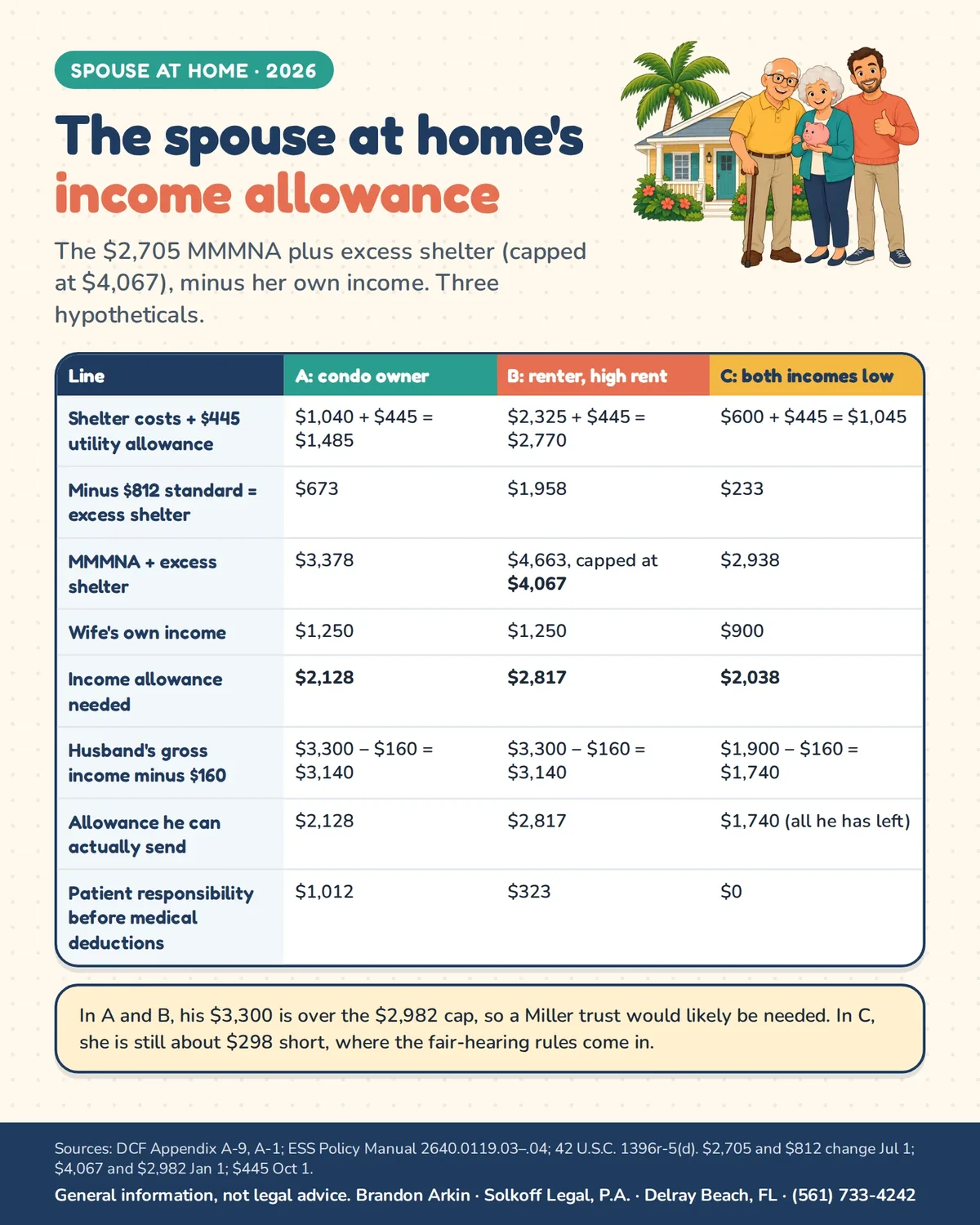
In A and B, the husband's $3,300 is over the $2,982 income cap, so a Qualified Income Trust would likely be needed before approval; see our Miller trust guide. In C, the wife is still about $298 a month short of her allowance, which is where the fair-hearing rules below come in. Illustration only.
Worksheet: estimate the allowance
Fill in the blanks, then bring this to a planning meeting. It's an estimate, not DCF's decision.
Tick boxes stay on this device. Nothing is saved or sent.
Common questions
What is the MMMNA in Florida for 2026?
Florida's Minimum Monthly Maintenance Needs Allowance is $2,705 a month, effective July 1, 2026 (DCF Appendix A-9). It's the income floor DCF recognizes for a spouse living at home when the other spouse receives nursing home or long-term care Medicaid. If the at-home spouse's own income is lower, part of the patient's income may be sent home to make up the gap. High shelter costs above the $812 standard can raise the figure, up to a $4,067 cap. The MMMNA changes every July 1.
How is the excess shelter allowance calculated?
DCF adds the at-home spouse's rent or mortgage, property taxes, homeowner's or renter's insurance, and condo or mandatory HOA fees, then adds the $445 standard utility allowance if that spouse pays utility bills (ESS Policy Manual 2640.0119.04). It subtracts the $812 excess shelter standard. Anything above zero is added to the $2,705 MMMNA, up to the $4,067 cap. For example, total shelter costs of $1,485 produce $673 in excess shelter. Only costs the at-home spouse actually pays count.
Can the spouse at home get more than $4,067 a month?
Possibly, but only through a fair hearing. Federal law lets a hearing officer substitute a higher amount if either spouse shows the at-home spouse needs more income because of exceptional circumstances resulting in significant financial duress (42 U.S.C. 1396r-5(e)(2)(B)). DCF's manual reflects the same rule (ESS Policy Manual 2640.0122). Ordinary bills usually don't qualify. Large uncovered medical costs or other unusual expenses might. Bring complete documentation, because the hearing decides on the evidence.
What is the income-first rule?
It's the federal rule that, before a state lets the spouse at home keep extra assets to generate income, it must treat all of the patient's income that could be sent home as already sent (42 U.S.C. 1396r-5(d)(6)). DCF counts the full income allowance as the at-home spouse's income in the hearing, even if the spouse turns it down. So a higher asset allowance usually helps only when both spouses' incomes together still fall short of the $2,705 minimum.
If your family is facing one of these questions, you can reach Brandon Arkin at Solkoff Legal, P.A. at (561) 733-4242.
Related on this site
Talk through the next step
Bring your questions, a list of accounts and any papers a hospital, nursing home or Medicaid office has sent you. Call the Delray Beach office or request a consultation, and I can look at where things stand and what may come next. A phone call or an email does not by itself create an attorney-client relationship.
Solkoff Legal, P.A. · (561) 733-4242