
Resources · Medicaid planning
Florida Medicaid renewal and reporting changes: how to keep coverage after approval
By Brandon Arkin, elder law attorney, Solkoff Legal, P.A. · Updated November 2026

Florida reviews Medicaid eligibility about every 12 months, and DCF tells recipients to report changes in their household, income or assets within 10 days. For a nursing home resident, the asset limit usually stays at $2,000 after approval, so a refund, an inheritance or a growing bank balance can put coverage at risk unless it is reported and handled quickly.
The annual renewal
Once your parent is approved, DCF sets a review date about a year out. At review, DCF looks at every eligibility factor again: income, assets, living arrangement and, for a married couple, the spouse's finances under the spousal rules (ESS 0840.0100).
Some renewals need no paperwork. Florida runs data matches at the start of the month before the review date and renews what it can automatically, a process called an ex parte review (DCF). If the data isn't enough, DCF sends a renewal form or a list of items it needs. You can see the next renewal date, the items needed, and upload documents in your parent's MyACCESS account.
Federal rules give most Medicaid recipients at least 30 days to return a renewal form, and states have until June 2027 to apply that rule fully to non-MAGI groups such as nursing home Medicaid (CMS). Don't wait for the deadline. When DCF asks for specific proof, Florida policy gives 10 calendar days from the date the checklist was mailed (ESS 0840.0505).
DCF usually wants bank statements, current income letters, Miller trust statements showing each monthly deposit, and proof of any change since the last review. The checklist below covers the rest.
The 10-day rule for reporting changes
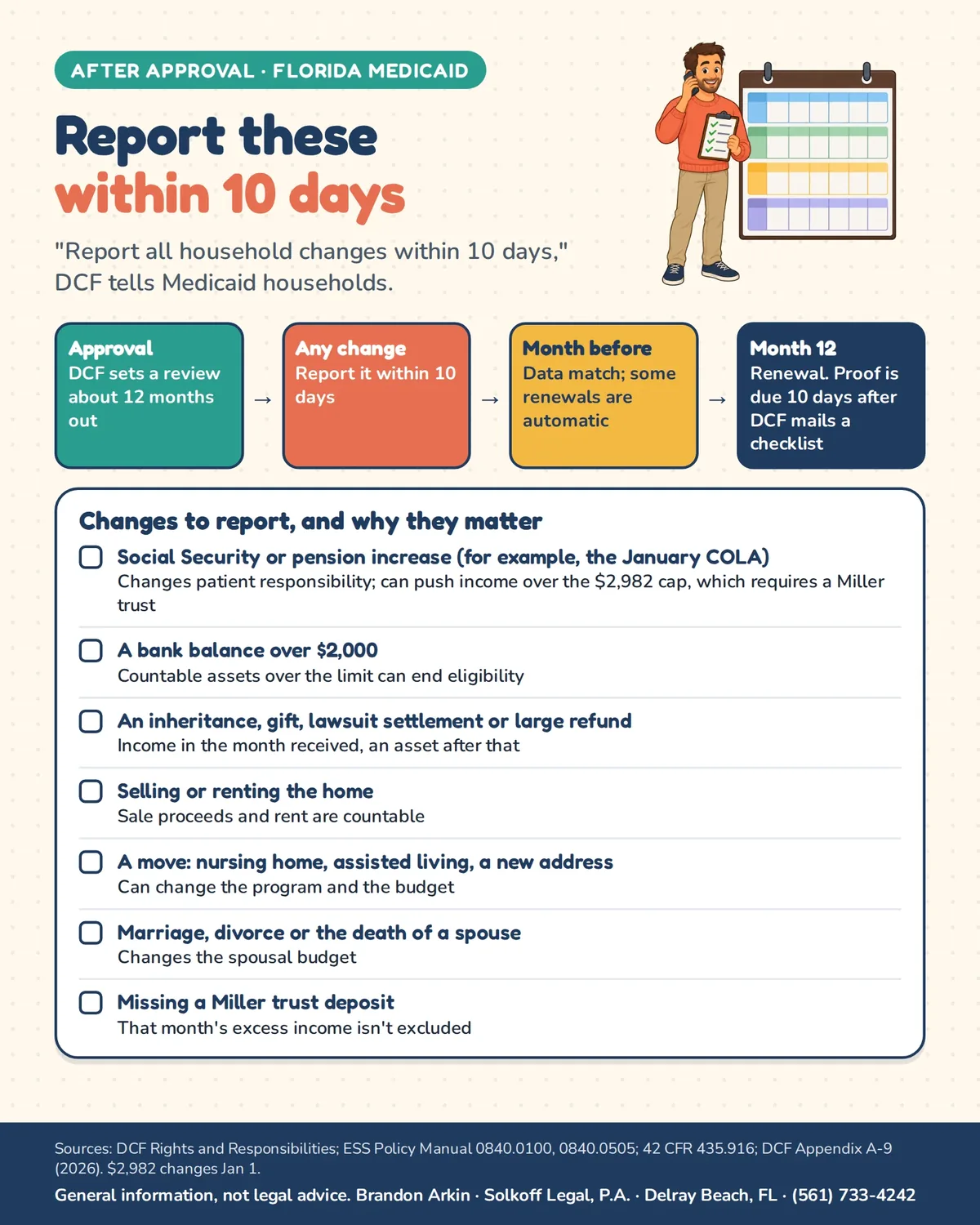
DCF's rights and responsibilities page tells Medicaid households to "report all household changes within 10 days" (DCF). The responsibility is the same when you are the one applying or reporting for a parent.
DCF's own manual lists the kinds of "unexpected changes" it acts on, including changes in income or assets, a move, and a change in living situation, such as going from a community program to nursing home care (ESS 0840.0500). It also builds in "expected changes", such as a quarterly review of the monthly deposits to an income trust.
| Change | Why it matters |
|---|---|
| Social Security or pension increase (for example, the January COLA) | Changes your parent's monthly patient responsibility, and can push gross income over the $2,982 cap, which requires a Miller trust |
| A bank balance over $2,000 | Countable assets over the limit can end eligibility |
| An inheritance, gift, lawsuit settlement or large refund | Counted as income in the month received, and as an asset after that |
| Selling or renting the home | Sale proceeds and rent are countable |
| A move: nursing home, assisted living, a new address | Can change the program and the budget |
| Marriage, divorce or the death of a spouse | Changes the spousal budget |
| Missing a Miller trust deposit | That month's excess income isn't excluded |
Change
Social Security or pension increase (for example, the January COLA)
Why it matters
Changes your parent's monthly patient responsibility, and can push gross income over the $2,982 cap, which requires a Miller trust
Change
A bank balance over $2,000
Why it matters
Countable assets over the limit can end eligibility
Change
An inheritance, gift, lawsuit settlement or large refund
Why it matters
Counted as income in the month received, and as an asset after that
Change
Selling or renting the home
Why it matters
Sale proceeds and rent are countable
Change
A move: nursing home, assisted living, a new address
Why it matters
Can change the program and the budget
Change
Marriage, divorce or the death of a spouse
Why it matters
Changes the spousal budget
Change
Missing a Miller trust deposit
Why it matters
That month's excess income isn't excluded
Staying under the asset limit after approval
The asset limit doesn't go away once your parent is approved. For a single nursing home resident, it is $2,000 (or $5,000 if their income is within the MEDS-AD limit, which is $1,171 a month in July 2026) (ESS 1640.0205; A-9).
The quiet risk is the slow build-up. Florida doesn't count income as an asset in the month it arrives, but income that isn't spent becomes an asset the next month (ESS 1640.0406). In a nursing home, most of your parent's income goes to the facility as patient responsibility, and they keep a personal needs allowance of $160 a month. If that $160 sits untouched in the bank for a year, together with refunds and small credits, the balance can drift up toward the limit.
Simple habits help:
Check the balance every month, especially in the month before renewal. Spend the personal needs allowance on your parent: clothing, haircuts, phone, small comforts. Ask the facility how refunds are handled after a Medicare or insurance adjustment. Keep receipts. At renewal, DCF may ask where money went.
Spend-down: what it is and what it isn't
"Spend-down" means bringing countable assets back under the limit by spending on your parent's own needs at fair value. Paying the nursing home, buying clothing or a hearing aid, paying a legitimate bill, or repairing the home, if your parent owns one, are all spending for fair value. Giving money to family isn't. A gift, or a sale for less than fair value, can be treated as a transfer and cause a penalty period, even after approval (ESS 1640.0607). In July 2026, each $10,645 of uncompensated value equals about one month without Medicaid nursing home coverage (A-9).
Timing matters too. In Florida, a person who is eligible on any day of the month is eligible for the whole month (ESS 1640.0405). Bringing assets back under the limit within the month can protect that month. Whether a given purchase is excluded or counted depends on DCF's rules, so check before spending a large amount.
Inheritances and other windfalls
An inheritance is one of the most common reasons a nursing home resident loses Medicaid. Under the SSI rules Florida follows for long-term care Medicaid, an inheritance is unearned income in the month it is received (20 CFR 416.1121). Whatever remains the next month is an asset (ESS 1640.0406). A large inheritance can make your parent ineligible for the month it arrives, and for every month after that until the balance is back under the limit.
Hypothetical: Rosa, 88, lives in a Delray Beach nursing home on Medicaid. Her brother dies, and in March she receives a $40,000 check from his estate.
| Month | What happens |
|---|---|
| March | The $40,000 is income in the month received. Rosa's family reports it within 10 days. |
| April | Whatever is left is a countable asset. With $40,000 in the bank, she is over the $2,000 limit. |
| April onward | Until the balance is back under $2,000 through fair-value spending or another option that fits the rules, she may be private pay. |
Month
March
What happens
The $40,000 is income in the month received. Rosa's family reports it within 10 days.
Month
April
What happens
Whatever is left is a countable asset. With $40,000 in the bank, she is over the $2,000 limit.
Month
April onward
What happens
Until the balance is back under $2,000 through fair-value spending or another option that fits the rules, she may be private pay.
If DCF proposes to end or cut coverage
DCF must send notice before an adverse action. Florida policy builds in 10 days' advance notice before a change that cuts or ends benefits (ESS 0840.0500). Read the notice the day it comes, and note the reason and the date. If the problem is a missing document, sending it quickly may fix the case. If you disagree with the decision, you can ask for a fair hearing, and asking quickly can matter for whether benefits continue while you wait. Our guide to what happens after you apply for Medicaid explains notices and hearings.
Renewal checklist
Start this list about 60 days before the review date shown in MyACCESS.
Tick boxes stay on this device. Nothing is saved or sent.
Common questions
How often does Florida renew long-term care Medicaid?
About once a year. DCF schedules an eligibility review 12 months from the month eligibility was last determined, and federal rules require a renewal at least every 12 months. Florida first tries to renew automatically using data it already has. If it can't, it sends a renewal form or a list of what it needs, which you can also see in MyACCESS. When DCF asks for specific proof, its policy gives 10 calendar days from the mailing date. Returning everything early, and keeping copies, is the simplest way to avoid a gap in coverage.
How long do we have to report a change to Florida Medicaid?
DCF tells Medicaid households to report all household changes within 10 days, including a new address. That includes changes in income, such as a pension increase; in assets, such as an inheritance or a growing bank balance; and in living situation, such as moving from home to a nursing home. You can report through MyACCESS, by phone or at a service center. If you are reporting for a parent, the same responsibility applies to you.
Does the $2,000 asset limit still apply after my parent is approved?
Yes. For a single nursing home or long-term care recipient, countable assets generally must stay at or under $2,000, or $5,000 if income is within the MEDS-AD limit. Florida doesn't count income as an asset in the month it arrives, but anything left over becomes an asset the next month. That is why small amounts, such as an unspent personal needs allowance or refunds, can add up over a year. Check balances monthly, spend the allowance on your parent's needs and keep receipts.
What happens if my parent on Medicaid inherits money?
Report it within 10 days, and talk to an elder law attorney before spending or giving any of it away. An inheritance counts as income in the month it is received, and whatever is left becomes a countable asset the next month. That can make your parent ineligible until the balance is back under the limit. Giving the money to family would be a transfer and could cause a penalty. Depending on age and disability, there may be options that fit the rules, so the timing of that first call matters.
If your family is facing one of these questions, you can reach Brandon Arkin at Solkoff Legal, P.A. at (561) 733-4242.
Related on this site
Talk through the next step
Bring your questions, a list of accounts and any papers a hospital, nursing home or Medicaid office has sent you. Call the Delray Beach office or request a consultation, and I can look at where things stand and what may come next. A phone call or an email does not by itself create an attorney-client relationship.
Solkoff Legal, P.A. · (561) 733-4242