
Resources · Medicaid
An Inheritance or Settlement While on Florida Medicaid: What Happens and What You Can Do
By Brandon Arkin, elder law attorney, Solkoff Legal, P.A. · Updated November 2026

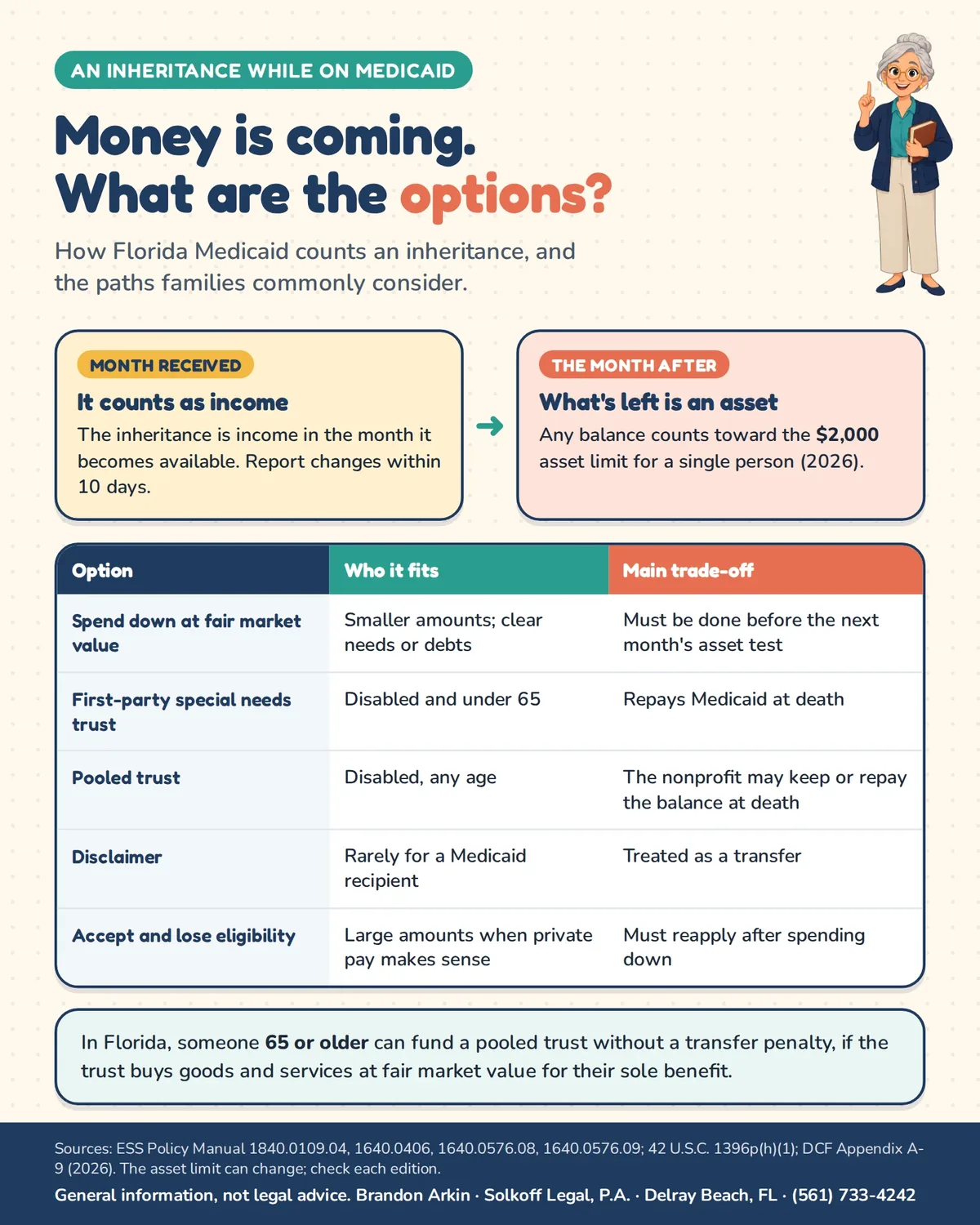
In Florida, an inheritance counts as income for Medicaid in the month it becomes available, and whatever is left the next month counts as an asset against the $2,000 limit (ESS Policy Manual 1840.0109.04 and 1640.0406). Depending on the person's age and disability, options include spending it down on allowable items, a pooled trust or a first-party special needs trust. Refusing the money, by contrast, is treated as a transfer (42 U.S.C. 1396p(h)(1)).
How Florida counts an inheritance
Florida's eligibility manual treats an inheritance as unearned income. It counts when the money actually becomes available, and in no case later than when the estate closes (ESS Policy Manual 1840.0109.04). Usually that's the month the check arrives or a distribution is made. Income that isn't spent in that month becomes an asset the following month (ESS 1640.0406).
Two consequences follow:
In the month received, the income can push the person over the $2,982 monthly income limit, or raise what they owe the nursing home that month. From the next month on, any balance counts toward the $2,000 asset limit. The same asset rules apply after approval as before it.
Some money isn't counted. Under the federal SSI rules Florida follows, any part of an inheritance used to pay the deceased person's last illness and burial expenses isn't income (20 CFR 416.1121(g)). Life insurance death benefits are counted as income in the month received, after subtracting last-illness and burial expenses paid from them (ESS 1840.0913).
An heir can also be treated as owning a share of an unprobated estate, for example inherited real estate (ESS 1640.0305.04).
Report it within 10 days
DCF requires Medicaid recipients to report changes in their situation within 10 days (DCF MyACCESS program rules). You can report through the MyACCESS account, or upload documents there. Keep a copy of what you sent and the date.
Report early if you know money is coming. Unreported income can lead to an overpayment you must repay. Reporting doesn't take away your options.
If your parent is the Medicaid recipient and you're the agent under a power of attorney, the duty to report falls on you as the person handling their affairs. Our guide for agents explains those duties.
Option 1: Spend down on allowable items
The simplest path, for smaller amounts, is to spend the money on things the person needs, at fair market value, before the asset test the following month. Common choices:
paying the person's debts, including a nursing home bill or medical bills; an irrevocable prepaid funeral contract, which isn't counted as an asset (ESS 1640.0509); clothing, a hearing aid, a wheelchair, dental work or other items Medicaid doesn't cover; repairs to the home, if the person or a spouse still lives there.
Spending must be for the person's benefit. Paying a relative for "help" with no written care agreement, or buying a grandchild a car, is a gift. A gift during the 60-month look-back period triggers a penalty. In 2026, it's calculated as the amount divided by $10,645, the number of months Medicaid won't pay for long-term care (DCF Appendix A-9). Our article on caregiver pay covers proper care agreements.
Option 2: A pooled trust or first-party special needs trust
When the amount is larger, a trust can keep the money available for the person's extra needs without counting it against Medicaid. Federal law creates two kinds for people who are disabled under Social Security's definition. Florida's manual confirms both (42 U.S.C. 1396p(d)(4)(A), (C); ESS 1640.0576.08):
First-party special needs trust. Only for a disabled person under 65. It's set up by the person, a parent, grandparent, guardian or court, and must repay Medicaid at death. Pooled trust. Available at any age. A nonprofit keeps a separate account for each beneficiary and invests the accounts together. At death, any balance the nonprofit doesn't keep goes to repay Medicaid.
In Florida, someone 65 or older can fund a pooled trust without a transfer penalty, as long as the trust buys goods and services at fair market value for the person's sole benefit. DCF's Circuit Legal Counsel reviews the trust document (ESS 1640.0576.09). For a nursing home resident over 65, a pooled trust is often the only trust option. Timing matters: the money should go in before it's counted as an asset the following month.
Our special needs planning guide covers trust drafting and ABLE accounts.
Personal injury settlements and the Medicaid lien
If Medicaid paid for care after an injury, Florida has a right to be repaid from any settlement. The attorney handling the claim must notify AHCA when the lawsuit is filed and when it settles (Fla. Stat. 409.910(11)(a), (g)). Unless the amount is successfully challenged, the statute sets the formula (Fla. Stat. 409.910(11)(f)):
The attorney's fee is treated as 25% of the settlement, whatever the actual fee. Taxable costs are subtracted. Half of what remains goes to AHCA, up to the total Medicaid paid.
A recipient who believes less of the settlement represents medical expenses can file a petition with the Division of Administrative Hearings within 21 days after paying AHCA or placing the lien amount in trust. The burden of proof is clear and convincing evidence (Fla. Stat. 409.910(17)(b)).
After the lien is paid, the net settlement is the person's money, and the usual counting rules apply. The trust options above work for settlements too. Coordinate with the injury lawyer before the settlement closes, because the trust should be ready to receive the funds.
Why disclaiming an inheritance doesn't work for Medicaid
Florida law lets a person disclaim, or refuse, an inheritance, but not after accepting or transferring it (Fla. Stat. 739.402).
For Medicaid, though, federal law defines a person's assets to include income or resources they're "entitled to but does not receive" because of their own action (42 U.S.C. 1396p(h)(1)). Florida's manual treats any disposal of an asset without fair compensation, or a reduction of one's ownership interest, as a transfer (ESS 1640.0606). Put together, a disclaimer by a Medicaid recipient or applicant istreated as a transfer during the look-back, with the usual penalty.
The DCF manual doesn't address disclaimers by name, so get advice before anyone signs a disclaimer or accepts the inheritance.
When the healthy spouse inherits, and planning ahead
After a nursing home resident is approved, the community spouse's later assets aren't deemed available to the resident (42 U.S.C. 1396r-5(c)(4)). An inheritance to the healthy spouse after approval generally doesn't affect the resident's eligibility. Our guide for married couples explains the spousal rules.
The best fix is often upstream. A relative whose will or beneficiary form leaves money outright to someone on Medicaid can leave it instead to a third-party special needs trust, which avoids both counting and payback. See estate planning and gifts to grandchildren.
A worked example: the lien formula
Hypothetically, Daniel, 58, is disabled after a fall and receives Medicaid. Medicaid has paid $95,000 for his care. His case settles for $300,000, with $12,000 in taxable costs.
Deemed fee: 25% × $300,000 = $75,000 Remaining after fee and costs: $300,000 − $75,000 − $12,000 = $213,000 Half of the remainder: $106,500. Medicaid paid $95,000, so AHCA's share is capped at $95,000.
Daniel's net, after his actual attorney's fee, costs and the lien, can go into a first-party special needs trust because he's under 65. If he were 70, a pooled trust would be the trust option.
When money is coming: a step list
Tick each step as you go. Nothing is saved.
Options at a glance
| Option | Who it fits | Main trade-off |
|---|---|---|
| Spend down at fair market value | Smaller amounts; clear needs or debts | Must be done before the next month's asset test |
| First-party special needs trust | Disabled and under 65 | Repays Medicaid at death |
| Pooled trust | Disabled, any age | The nonprofit may keep or repay the balance at death |
| Disclaimer | Rarely for a Medicaid recipient | Treated as a transfer |
| Accept and lose eligibility | Large amounts when private pay makes sense | Must reapply after spending down |
Option
Spend down at fair market value
Who it fits
Smaller amounts; clear needs or debts
Main trade-off
Must be done before the next month's asset test
Option
First-party special needs trust
Who it fits
Disabled and under 65
Main trade-off
Repays Medicaid at death
Option
Pooled trust
Who it fits
Disabled, any age
Main trade-off
The nonprofit may keep or repay the balance at death
Option
Disclaimer
Who it fits
Rarely for a Medicaid recipient
Main trade-off
Treated as a transfer
Option
Accept and lose eligibility
Who it fits
Large amounts when private pay makes sense
Main trade-off
Must reapply after spending down
Common questions
Will I lose Medicaid if I get an inheritance in Florida?
You may, unless you act quickly. Florida counts the inheritance as income in the month it becomes available, and any balance the next month as an asset against the $2,000 limit (ESS 1840.0109.04; ESS 1640.0406). Depending on age and disability, options include an allowable spend-down, a pooled trust or a first-party special needs trust. Report the change within 10 days.
Can I refuse an inheritance to stay on Medicaid?
No. Federal Medicaid law counts assets a person is entitled to but doesn't receive because of their own action (42 U.S.C. 1396p(h)(1)). A disclaimer is treated as a transfer for less than fair value, which can mean months without long-term care coverage. Get advice before signing.
Can a person over 65 on Medicaid put an inheritance in a trust?
Often, yes, through a pooled trust, if the person meets Social Security's disability standard. Florida's manual says pooled trusts can be set up for people of any age, and that funding a qualifying trust isn't a penalized transfer when the trust spends for the person's sole benefit at fair value (ESS 1640.0576.08–.09). A first-party special needs trust is only available under 65.
How much of a personal injury settlement does Florida Medicaid take?
Under the statutory formula, AHCA gets half of what's left after a deemed 25% attorney's fee and taxable costs, up to the total Medicaid paid (Fla. Stat. 409.910(11)(f)). A recipient can challenge the amount at the Division of Administrative Hearings within 21 days, with clear and convincing evidence (Fla. Stat. 409.910(17)(b)).
If your family is facing one of these questions, you can reach Brandon Arkin at Solkoff Legal, P.A. at (561) 733-4242.
Related on this site
Talk through the next step
Bring your questions, a list of accounts and any papers a hospital, nursing home or Medicaid office has sent you. Call the Delray Beach office or request a consultation, and I can look at where things stand and what may come next. A phone call or an email does not by itself create an attorney-client relationship.
Solkoff Legal, P.A. · (561) 733-4242