Resources · Medicaid
Florida Medicaid Estate Recovery: What the State Can Claim After a Death
By Brandon Arkin, elder law attorney, Solkoff Legal, P.A. · Updated November 2026

Florida can seek repayment of Medicaid paid for a person after age 55 by filing a claim against that person's probate estate after death. The claim isn't enforced while a spouse, a child under 21, or a blind or disabled child survives, and it can't be enforced against protected homestead or other property exempt from creditors (Fla. Stat. 409.9101).
What estate recovery is, and what it covers
Federal law requires every state to seek repayment from the estates of people who received Medicaid at 55 or older. At a minimum, that covers nursing facility care, home and community-based services, and related hospital and prescription costs. States may choose to recover for other Medicaid services too, but not for help with Medicare cost-sharing (42 U.S.C. 1396p(b)(1)(B)). Florida's statute is written broadly. It makes the debt "the total amount paid to or for the benefit of the recipient for medical assistance" after age 55 (Fla. Stat. 409.9101(3)).
Three points often reassure families:
The debt belongs to the estate, not to the children. See paying for care. Florida collects by filing a claim in the probate case, like any other creditor (Fla. Stat. 409.9101(2)). The claim can never be more than what Medicaid actually paid.
When Florida won't enforce the claim
Florida doesn't enforce the debt if the Medicaid recipient is survived by any of these (Fla. Stat. 409.9101(6)):
a spouse; a child under 21; or a child of any age who is blind or permanently and totally disabled under Medicaid's rules.
Federal law describes this as timing: recovery may happen only after the surviving spouse has died, and only when there's no child under 21 or blind or disabled child (42 U.S.C. 1396p(b)(2)). So if Dad was on Medicaid and Mom survives him, no claim is enforced at his death.
Protected homestead: why the house is usually safe
The estate recovery debt can't be enforced against property that Florida's Constitution or laws protect from creditors (Fla. Stat. 409.9101(7)). The most important example is protected homestead, the Florida home the person lived in, when it passes to the people the Constitution protects, such as a spouse or children.
The protection has limits:
It covers the home, not cash. If the home was sold before death, the money in the bank is generally reachable. A home left by will to someone outside the protected heirs may lose protection. The form of ownership matters. Our Florida law updates page explains a recent appellate opinion where a co-op apartment was not treated as homestead against AHCA's claim, because of the law in force on the date of death. Other real estate, such as a second home, isn't homestead. If there's no cash to pay the claim, the statute says nonexempt property is sold when sale costs won't exceed the proceeds. The state never takes title to real property itself (Fla. Stat. 409.9101(10)).
Our Lady Bird deed guide covers passing the home outside probate.
How the claim arrives in probate
When a probate case is opened for someone who was 55 or older, the personal representative must serve the notice to creditors and a death certificate on AHCA within 3 months after the notice is first published, unless AHCA has already filed a claim (Fla. Stat. 733.2121(3)(d)). This applies whether or not the person had Medicaid. Notices go to the Florida Medicaid TPL Recovery Program, P.O. Box 12188, Tallahassee, FL 32317-2188 (AHCA).
Once it files, AHCA is an "interested person" in the case and may amend its claim as a matter of right for up to 1 year after the last date of service (Fla. Stat. 409.9101(3), (4)). The estate pays debts in a fixed order. First come administration costs and fees (class 1), then funeral expenses up to $6,000 (class 2), then the Medicaid claim along with certain federal debts and taxes (class 3). Last-illness bills, family allowance and ordinary creditors come after (Fla. Stat. 733.707(1)).
For the general creditor timeline and the first steps after a death, see what to do after a death and Florida probate explained.
Nonprobate assets, and the revocable trust catch
Federal law lets states choose an expanded definition of "estate" that reaches jointly owned property, life estates and living trusts (42 U.S.C. 1396p(b)(4)). Florida's statute instead works through a claim against the estate in probate (Fla. Stat. 409.9101(2)). Assets that pass directly to a named person, such as survivorship joint accounts, payable-on-death accounts, IRAs and life insurance with a living beneficiary, usually don't enter probate.
A revocable living trust is different. Florida law makes a revocable trust liable for the estate's expenses and claims when the probate estate isn't enough to pay them. (Fla. Stat. 733.707(3); Fla. Stat. 736.05053). A revocable trust avoids probate, but it isn't a shield from a valid Medicaid claim.
If the estate includes an injury settlement, AHCA's separate lien is paid first, and half of the rest is available for the estate claim (Fla. Stat. 409.9101(9)).
Trust paybacks are separate from the estate claim
Some Medicaid planning trusts repay the state directly at death, even without probate or if a spouse survives:
Qualified Income Trust (Miller trust). It holds income over the $2,982 monthly limit. At death, the state receives what's left, up to the total Medicaid paid (42 U.S.C. 1396p(d)(4)(B)). See our Miller trust guide. First-party special needs trust. It holds the assets of a disabled person under 65 and must repay Medicaid at the person's death (42 U.S.C. 1396p(d)(4)(A)). Pooled trust account. To the extent the nonprofit doesn't keep the balance, it repays the state (42 U.S.C. 1396p(d)(4)(C)).
A third-party special needs trust, funded with someone else's money, has no payback. See special needs planning.
The hardship waiver
AHCA can't recover from an estate when recovery would cause undue hardship for qualified heirs. The personal representative or any heir may ask AHCA to waive some or all of the debt (Fla. Stat. 409.9101(8)). Losing an expected inheritance isn't a hardship by itself. AHCA considers whether:
the heir lives in the home now, lived there at the death and for the 12 months before it, and owns no other home; the heir would be deprived of food, clothing, shelter or medical care necessary for life or health; a son, daughter or sibling who lived with the recipient for at least a year gave full-time care that delayed nursing home entry; or the cost of selling the property would equal or exceed its value.
Make the request in writing, with proof, early in the probate case.
A worked example
Hypothetically, Rose, a Delray Beach widow, received about $180,000 in Medicaid long-term care from age 81 to 84. Two adult sons, neither disabled, survive her. She owns:
her condo, which she lived in, passing to her sons under her will; an IRA naming both sons as beneficiaries; a checking account in her name alone with $14,000; and a Qualified Income Trust account holding $900.
The $900 QIT balance goes to the state. The IRA passes to her sons outside probate. If the condo is protected homestead, it's exempt from AHCA's claim. The $14,000 in checking pays administration costs, then up to $6,000 of funeral expenses, and the rest goes toward AHCA's class 3 claim. Her sons don't owe the balance personally.
Your estate recovery check
Use this list with your family's records. Tick each item as you confirm it. Nothing is saved.
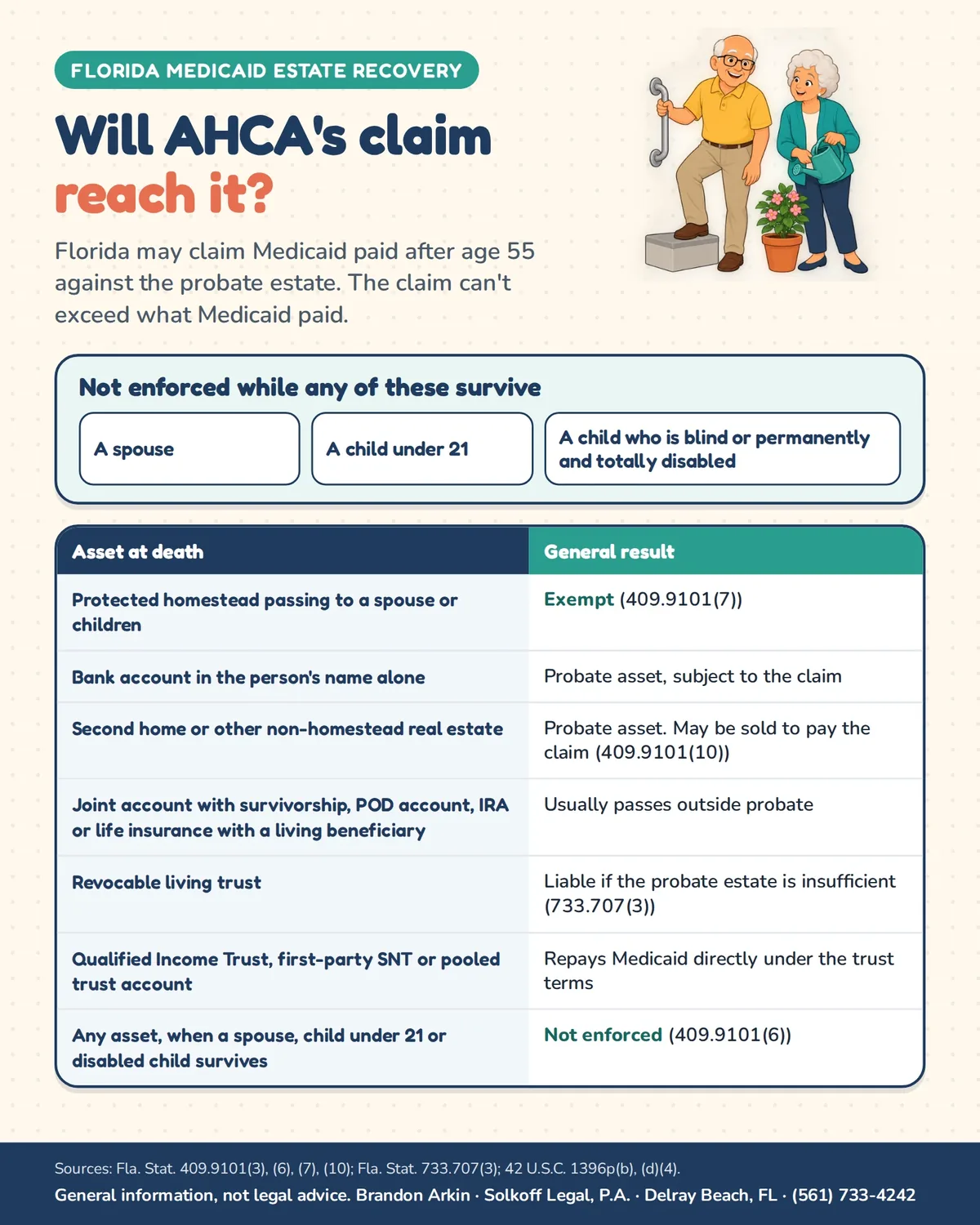
Will AHCA's claim reach it?
| Asset at death | General result |
|---|---|
| Protected homestead passing to a spouse or children | Exempt (409.9101(7)) |
| Bank account in the person's name alone | Probate asset, subject to the claim |
| Second home or other non-homestead real estate | Probate asset. May be sold to pay the claim (409.9101(10)) |
| Joint account with survivorship, POD account, IRA or life insurance with a living beneficiary | Usually passes outside probate |
| Revocable living trust | Liable if the probate estate is insufficient (733.707(3)) |
| Qualified Income Trust, first-party SNT or pooled trust account | Repays Medicaid directly under the trust terms |
| Any asset, when a spouse, child under 21 or disabled child survives | Not enforced (409.9101(6)) |
Asset at death
Protected homestead passing to a spouse or children
General result
Exempt (409.9101(7))
Asset at death
Bank account in the person's name alone
General result
Probate asset, subject to the claim
Asset at death
Second home or other non-homestead real estate
General result
Probate asset. May be sold to pay the claim (409.9101(10))
Asset at death
Joint account with survivorship, POD account, IRA or life insurance with a living beneficiary
General result
Usually passes outside probate
Asset at death
Revocable living trust
General result
Liable if the probate estate is insufficient (733.707(3))
Asset at death
Qualified Income Trust, first-party SNT or pooled trust account
General result
Repays Medicaid directly under the trust terms
Asset at death
Any asset, when a spouse, child under 21 or disabled child survives
General result
Not enforced (409.9101(6))
Common questions
Can Florida Medicaid take my parent's house after death?
Usually not, if the home is protected homestead passing to the family members Florida protects. The estate recovery debt can't be enforced against property exempt from creditors (Fla. Stat. 409.9101(7)), and the state never takes title to real property. The answer can change if the home was sold, left outside the protected heirs, or owned as a co-op.
Do I have to pay back my mother's Medicaid?
No, not personally. The debt is against the estate of the person who received Medicaid (Fla. Stat. 409.9101). It's paid only from estate assets that aren't exempt, in the order set by Fla. Stat. 733.707. If the estate runs out, the rest isn't collected from you. Be careful about signing anything that makes you personally responsible.
Does a revocable living trust protect assets from Medicaid estate recovery in Florida?
No. A revocable trust avoids probate, but Florida makes it liable for the estate's claims, including AHCA's, when the probate estate is insufficient (Fla. Stat. 733.707(3); Fla. Stat. 736.05053). Homestead held in a revocable trust may keep its protected status, depending on the trust terms and who receives it.
Does estate recovery apply if my father's wife survives him?
Not at his death. Florida doesn't enforce the debt when the Medicaid recipient is survived by a spouse (Fla. Stat. 409.9101(6)). Trusts with payback terms, such as a Qualified Income Trust, still repay the state at his death under their own terms (42 U.S.C. 1396p(d)(4)).
If your family is facing one of these questions, you can reach Brandon Arkin at Solkoff Legal, P.A. at (561) 733-4242.
Related on this site
Talk through the next step
Bring your questions, a list of accounts and any papers a hospital, nursing home or Medicaid office has sent you. Call the Delray Beach office or request a consultation, and I can look at where things stand and what may come next. A phone call or an email does not by itself create an attorney-client relationship.
Solkoff Legal, P.A. · (561) 733-4242