
Resources · Medicaid planning
Joint bank accounts and Medicaid in Florida: whose money is it?
By Brandon Arkin, elder law attorney, Solkoff Legal, P.A. · Updated November 2026

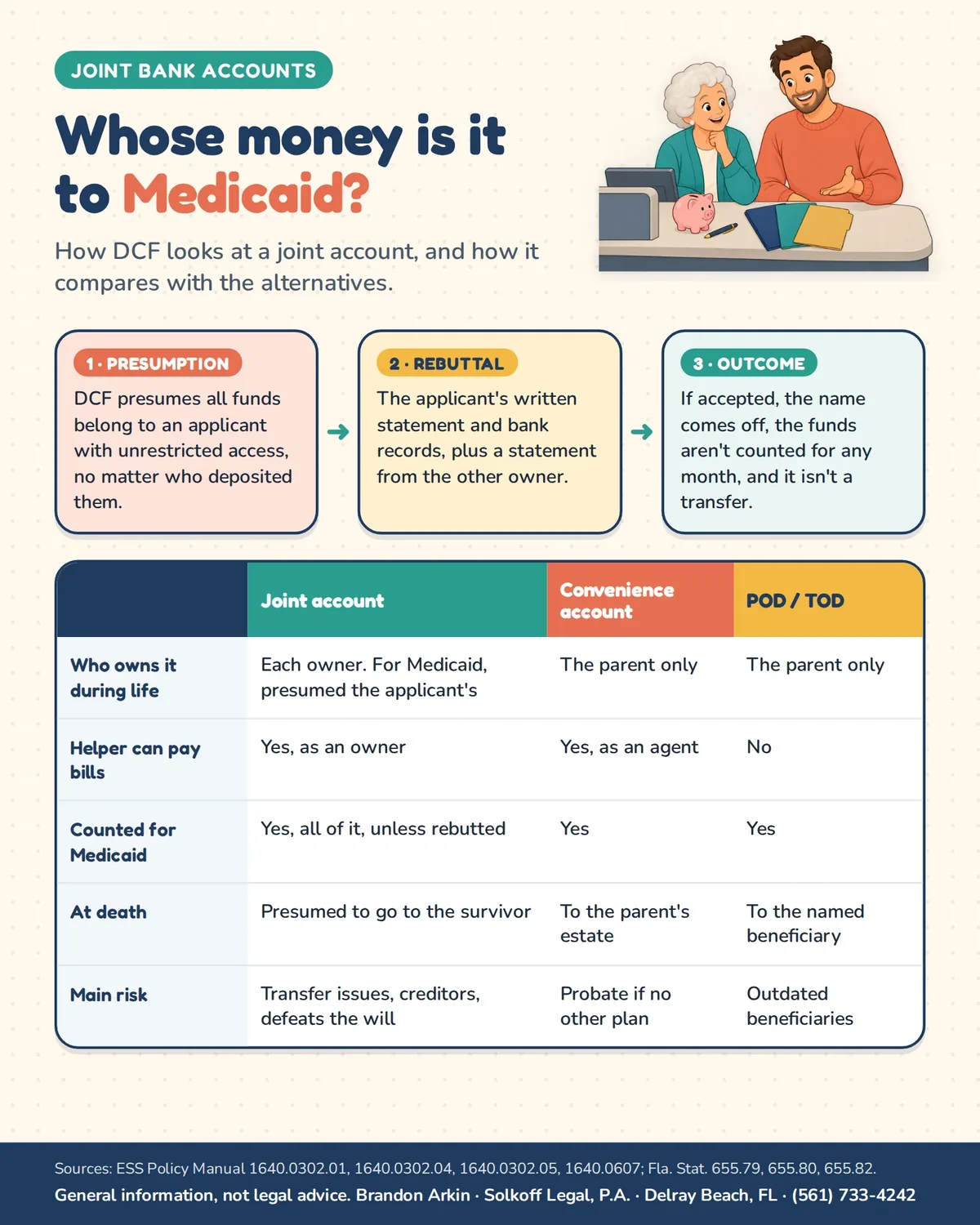
For Florida long-term care Medicaid, DCF presumes that all the money in a joint bank account belongs to the applicant if the applicant has unrestricted access to it, no matter who deposited it. The applicant can rebut that presumption with bank records and written statements, but adding a child to an account doesn't shelter anything, and money the child later takes out can be treated as a transfer.
How DCF counts a joint account
Banks and families tend to think of a joint account as "ours". DCF starts somewhere else. Under its policy for SSI-related Medicaid, which includes nursing home Medicaid (ICP) and the long-term care waiver, when an applicant is a joint holder with unrestricted access, DCF must presume that all of the funds belong to the applicant. That presumption applies "regardless of the source of the funds" and covers checking, savings, CDs and other joint financial accounts (ESS 1640.0302.01).
So if your mother's name is on your savings account, DCF starts by counting your whole balance as hers. If two Medicaid applicants or recipients share an account, such as a married couple who both receive Medicaid, DCF divides the funds equally between them (ESS 1640.0302.02).
Married couples have an extra layer. When one spouse applies for nursing home Medicaid, DCF looks at the assets of both spouses, wherever they are held, and then lets the spouse at home keep a protected amount, up to $162,660 in 2026 (ESS 1640.0314.01; A-9). For couples, the question usually isn't whose name is on the account but how the total is divided. See If one spouse needs nursing home care.
Rebutting the presumption
The presumption isn't the final word. If the applicant says some or all of the money belongs to someone else, DCF must allow them to prove it (ESS 1640.0302.01). The proof DCF asks for comes in two parts (ESS 1640.0302.04):
First, a written statement from the applicant, backed up by bank records and other evidence, showing who owns the funds, why the account was opened, whose money went in, who took money out, and what the withdrawals were spent on. Second, a written statement from the other owner explaining their understanding of the same points.
If the other owner is a minor or lacks capacity, a statement from a third party who knows the facts can take its place. The evidence must "clearly support" that the applicant doesn't own the funds.
If the rebuttal succeeds, the applicant's name has to come off the account, and DCF treats that removal as not being a transfer. The funds aren't counted for any month, even months before the name came off (ESS 1640.0302.05). If only part of the money is shown to be someone else's, the account has to be split so the applicant no longer has access to that part.
Hypothetical: Walter, 84, is applying for nursing home Medicaid. Years ago his daughter Ana opened a savings account and added Walter "in case something happened to her". Ana's paychecks went in, Walter never deposited or withdrew a dollar, and the balance is $38,000.
| Step | What happens |
|---|---|
| Application | DCF presumes the $38,000 is Walter's. With it, he is over the $2,000 limit. |
| Rebuttal | Walter's statement, Ana's statement, and bank records showing only Ana's deposits and Ana's withdrawals. |
| If DCF accepts it | Walter's name comes off the account. The $38,000 isn't counted for any month, and the removal isn't a transfer. |
| If the records are thin | DCF decides on the evidence it has. Gaps in records are the most common problem. |
Step
Application
What happens
DCF presumes the $38,000 is Walter's. With it, he is over the $2,000 limit.
Step
Rebuttal
What happens
Walter's statement, Ana's statement, and bank records showing only Ana's deposits and Ana's withdrawals.
Step
If DCF accepts it
What happens
Walter's name comes off the account. The $38,000 isn't counted for any month, and the removal isn't a transfer.
Step
If the records are thin
What happens
DCF decides on the evidence it has. Gaps in records are the most common problem.
Adding a child to a parent's account
The more common situation is the reverse: the parent's money, with a child added "to help with bills". For Medicaid, adding the child's name does nothing to protect the money. The parent still has unrestricted access, so DCF still counts all of it as the parent's.
The risk comes later. DCF's transfer rules apply when the individual, their spouse, a legal representative or "a joint owner of a jointly owned asset" disposes of it without fair compensation (ESS 1640.0607). If the child withdraws $20,000 of the parent's money for their own use, or the parent's name is taken off so the money becomes the child's, that can be a transfer within the 60-month look-back. At $10,645 a month, $20,000 is close to two months without Medicaid nursing home coverage.
Other side effects families don't expect:
At death, a joint account is presumed to go to the surviving owner, not under the will (Fla. Stat. 655.79). If the parent meant the money to be shared among all the children, the account may defeat that plan. The presumption can be overcome only by proof of fraud, undue influence or clear and convincing evidence of a different intent. The child's creditors, a divorce or a lawsuit against the child can create problems with money that legally appears to be partly theirs. Siblings may see the account as a gift to one child. See When siblings disagree.
Convenience accounts: help without ownership
Florida offers a better fit for the "help with bills" goal. A convenience account is an account in one person's name, the principal, with one or more agents who can deposit, withdraw and write checks (Fla. Stat. 655.80). All rights to the money remain the principal's alone. Only the principal can add or remove agents, and the arrangement survives the principal's incapacity. At death, the balance goes to the principal's estate, not to the helper. Certificates of deposit can't be convenience accounts.
For Medicaid, nothing changes: the money is the parent's and is counted. What a convenience account avoids is the confusion over ownership, the survivorship surprise and the child's creditors. Helpers should still keep records and use the money only for the parent. A durable power of attorney gives broader authority. See You're mom's agent. Now what?.
POD and TOD designations
A pay-on-death (POD) designation names who receives a bank account at death. During the owner's life, the beneficiary "has no right to sums on deposit" (Fla. Stat. 655.82). Brokerage accounts can do the same with a transfer-on-death (TOD) registration under Florida's Uniform TOD Security Registration Act.
For Medicaid, a POD or TOD account is simply the owner's money, fully countable. Naming a beneficiary isn't a transfer, because the beneficiary gets nothing until death. These designations can avoid probate, but they don't protect assets from long-term care costs. If they aren't coordinated with the will, they can also leave the estate without cash to pay bills. Review them alongside the rest of the plan; see Estate planning.
| Joint account | Convenience account | POD / TOD | |
|---|---|---|---|
| Who owns it during life | Each owner. For Medicaid, presumed the applicant's | The parent only | The parent only |
| Helper can pay bills | Yes, as an owner | Yes, as an agent | No |
| Counted for Medicaid | Yes, all of it, unless rebutted | Yes | Yes |
| At death | Presumed to go to the survivor | To the parent's estate | To the named beneficiary |
| Main risk | Transfer issues, creditors, defeats the will | Probate if no other plan | Outdated beneficiaries |
Who owns it during life
Joint account
Each owner. For Medicaid, presumed the applicant's
Convenience account
The parent only
POD / TOD
The parent only
Helper can pay bills
Joint account
Yes, as an owner
Convenience account
Yes, as an agent
POD / TOD
No
Counted for Medicaid
Joint account
Yes, all of it, unless rebutted
Convenience account
Yes
POD / TOD
Yes
At death
Joint account
Presumed to go to the survivor
Convenience account
To the parent's estate
POD / TOD
To the named beneficiary
Main risk
Joint account
Transfer issues, creditors, defeats the will
Convenience account
Probate if no other plan
POD / TOD
Outdated beneficiaries
Before you add a name to a parent's account
Go through this list before you visit the bank, and print it for the meeting.
Tick boxes stay on this device. Nothing is saved or sent.
Common questions
Does Florida Medicaid count a joint bank account with my mother?
Usually all of it, at first. If your mother has unrestricted access to a joint account, DCF presumes all of the money in it is hers, regardless of who deposited it. She can rebut that presumption with a written statement, bank records showing whose money went in and who took money out, and a written statement from you. If DCF accepts the rebuttal, her name must come off the account, which DCF doesn't treat as a transfer, and the money isn't counted for any month. Without good records, rebuttal is hard.
Is adding my child's name to my account a gift for Medicaid?
Adding a name alone doesn't remove the money from your countable assets, because you still have full access and DCF presumes it is all yours. The problem comes if your child takes money out for their own use, or your name comes off the account. DCF's transfer rules cover a joint owner who disposes of an asset without fair compensation, so a withdrawal like that during the 60-month look-back can cause a penalty. In July 2026, each $10,645 transferred equals about one month without Medicaid nursing home coverage.
What is a convenience account in Florida?
A convenience account under Florida Statute 655.80 is a bank account owned by one person, with one or more agents who can deposit money, withdraw funds and write checks. The money remains the owner's alone, only the owner can change the agents, and the arrangement survives the owner's incapacity. At death, the balance goes to the owner's estate, not to the agent. For Medicaid, it is fully counted as the owner's, but it avoids the ownership confusion and survivorship surprises of a joint account. CDs can't be set up this way.
Do POD accounts avoid Medicaid?
No. A pay-on-death designation decides who receives the account at death, but during the owner's life the beneficiary has no right to the money. For Medicaid, the account is fully counted as the owner's. Naming a beneficiary isn't a transfer, so it doesn't cause a penalty, but it doesn't protect the money either. POD and TOD designations are useful for avoiding probate. Planning for long-term care costs needs other tools, such as those described on our Medicaid planning page.
If your family is facing one of these questions, you can reach Brandon Arkin at Solkoff Legal, P.A. at (561) 733-4242.
Related on this site
Talk through the next step
Bring your questions, a list of accounts and any papers a hospital, nursing home or Medicaid office has sent you. Call the Delray Beach office or request a consultation, and I can look at where things stand and what may come next. A phone call or an email does not by itself create an attorney-client relationship.
Solkoff Legal, P.A. · (561) 733-4242