
Medicaid planning tools
Medicaid Compliant Promissory Notes in Florida: The Rules, the Math and the Risks
By Brandon Arkin, elder law attorney, Solkoff Legal, P.A. · Updated November 2026

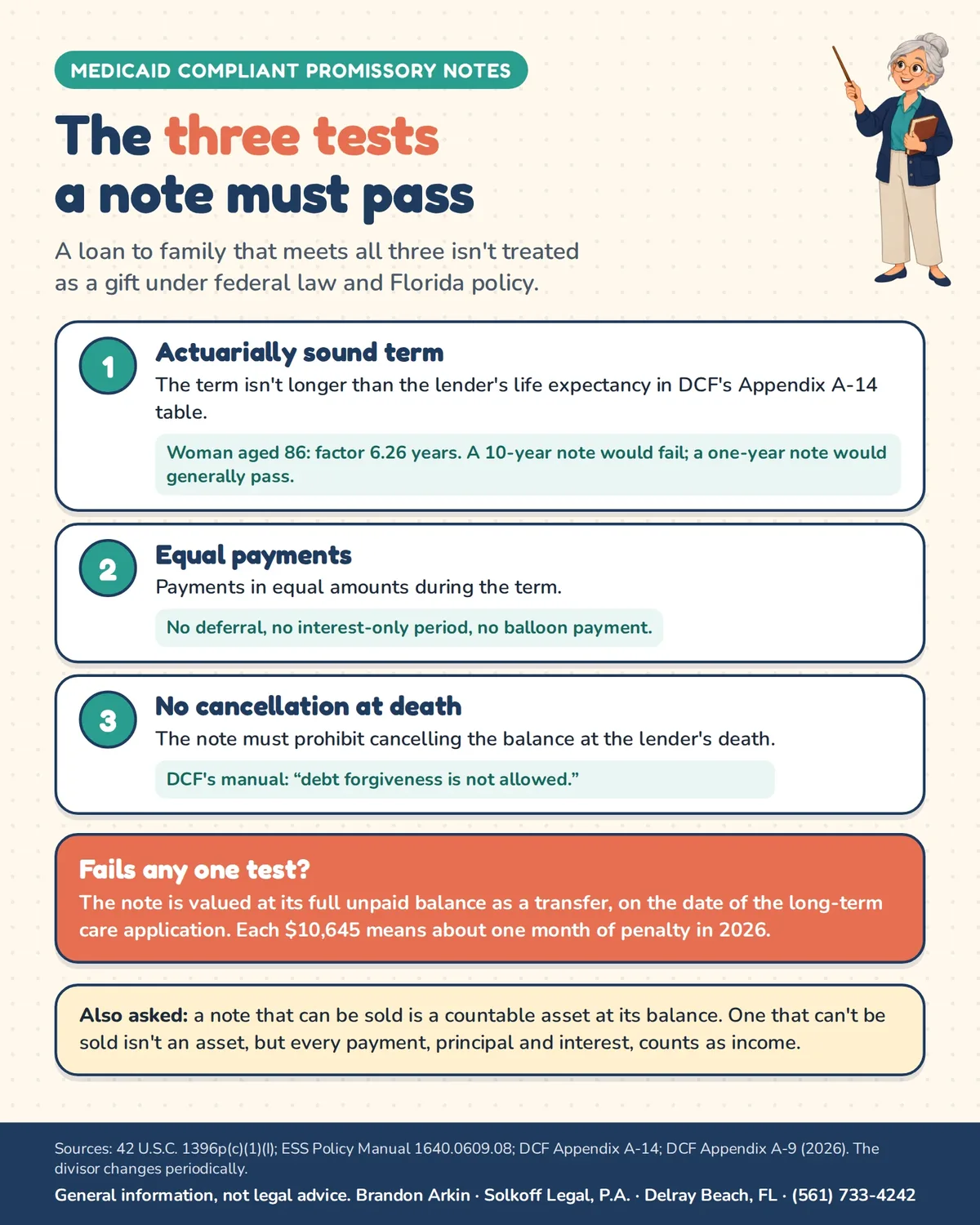
A Medicaid compliant promissory note is a loan, usually from a parent to family, that federal law and Florida don't treat as a gift. To qualify, it must have an actuarially sound repayment term, pay in equal amounts with no deferral or balloon payment, and forbid cancelling the balance at the lender's death. A note that fails any one of those tests is valued at its full unpaid balance as a transfer (42 U.S.C. 1396p(c)(1)(I); ESS Policy Manual 1640.0609.08).
When a family hears "you'll have to spend almost all of Mom's savings before Medicaid helps," someone eventually asks: can Mom lend it to us instead? Under federal law since 2006, and DCF policy for notes signed on or after November 1, 2007, the answer can be yes, if the loan is built to strict rules. A loan that's really a gift in disguise is treated as one.
This page explains those rules and the most common way the note is used, alongside a gift in what planners call "half-a-loaf." It's education, not a recommendation. The math is unforgiving, and the risks fall on real people.
The three federal requirements
Federal law counts money used to buy a promissory note, loan or mortgage as a transferred asset unless the note (42 U.S.C. 1396p(c)(1)(I)):
has a repayment term that is actuarially sound under the Social Security Administration's actuarial publications; provides for payments in equal amounts during the term, with no deferral and no balloon payments; and prohibits cancelling the balance at the lender's death.
Florida's manual adopts the same three tests. It phrases the third as "debt forgiveness is not allowed" (ESS 1640.0609.08). If a note fails, the transfer is valued at the outstanding balance on the date of the long-term care application.
"Actuarially sound" in practice means the term isn't longer than the lender's life expectancy under DCF's table. A woman aged 86 has a factor of 6.26 years, so a 10-year note would fail. A one-year note would generally pass on that test.
How DCF counts the note and the payments
Meeting the transfer tests is only half the analysis. DCF also asks whether the note itself is an asset (ESS 1640.0561.03):
Negotiable note: the lender can sell it or convert it to cash, so it's a countable asset at its equity value. Only the interest portion of payments is income. A large negotiable note can keep the parent over the $2,000 limit. Non-negotiable note: it can't be sold, so it isn't an asset. Every payment, principal and interest, is counted as unearned income.
DCF presumes a note is "bona fide and negotiable" unless the evidence shows otherwise. That's why compliant notes are usually drafted with clear non-assignment and non-transfer language.
There's a knock-on effect. If the payments count as income, the parent's monthly income can rise above Florida's $2,982 income cap (DCF Appendix A-9). A Miller trust may then be needed for the parent to be "otherwise eligible." That status is what starts the penalty clock on any gift made alongside the note.
The half-a-loaf idea
Half-a-loaf planning pairs a gift with a compliant note (or sometimes a compliant annuity). The gift creates a penalty period. Payments on the note, plus the parent's own income, are sized to cover the nursing home bill during that penalty. When the penalty ends, Medicaid can begin, and the gifted amount has stayed in the family.
Two Florida rules make it work:
the penalty is the gift divided by $10,645, with partial months converted to days; the penalty starts only when the person is otherwise eligible, meaning assets at $2,000 or less and income handled (Appendix A-8).
For a married couple, the spouse at home has separate tools, covered in married couples and Medicaid. Half-a-loaf is usually discussed for a single, widowed or divorced applicant.
A worked hypothetical
A widowed mother, 86, enters a nursing home. She has $161,560 in countable savings and $2,200 a month in income. The facility's private rate is $11,500 a month, so the monthly gap above her income is $9,300. For simplicity, the example leaves out interest, taxes, premiums and the personal needs allowance.
Step Amount Gift to her three children $85,160 Penalty: $85,160 ÷ $10,645 8.0 months Loan to the children under a compliant note $74,400 Note terms 8 equal monthly payments of $9,300, no balloon, no forgiveness Term vs. life expectancy (A-14, female, 86) 8 months vs. 6.26 years: sound Kept by the mother $2,000 Income during the penalty $2,200 + $9,300 = $11,500, over the cap, so a QIT is likely needed
She applies right after the gift and the note are in place. If DCF agrees she's otherwise eligible, the eight-month penalty begins then. Each month her income plus the note payment covers the $11,500 bill. When the note is paid off, the penalty ends. Medicaid may then cover her care, subject to her patient responsibility. The children keep the $85,160 gift.
Change any number and the plan changes. If the facility raises its rate, the note payments fall short. In July the divisor may change, and if the application month slips, so does the start of the penalty.
The risks, stated plainly
The borrowers must pay, on time, every month. The note can't be forgiven. If a child stops paying, the parent may be unable to pay the facility during the penalty. Life happens to borrowers. A child's divorce, death, bankruptcy or creditor can complicate both the gift and the loan. Death mid-term. If the parent dies before the note is repaid, the balance is generally owed to her estate. That can mean probate and a claim by Florida's Medicaid estate recovery program (Fla. Stat. 409.9101). DCF review. DCF must still agree the note is bona fide, non-negotiable and compliant. It will also review the gift under its rebuttal process (ESS 1640.0616). Taxes. Gifts over $19,000 per recipient in 2026 generally require a federal gift tax return, though tax is rarely due (IRS; Form 709 instructions). Interest on the note is income to the parent. Loans at very low interest can raise imputed-interest questions, which is why many notes reference the IRS's monthly applicable federal rates. Family dynamics. Siblings who receive the gift but not the loan, or the reverse, may feel differently about it later. No guarantee. This is lawful planning under federal and Florida rules, but each piece is reviewed, and outcomes depend on the facts.
Note review checklist
Use this to review a draft note with your advisor. Tick boxes on screen or on paper. Nothing is saved.
Tick boxes stay on this device. Nothing is saved or sent.
Common questions
What makes a promissory note Medicaid compliant in Florida?
Federal law and DCF policy require three things. The repayment term must be actuarially sound under the Social Security life table DCF uses. Payments must be equal, with no deferral and no balloon. The balance can't be cancelled at the lender's death (42 U.S.C. 1396p(c)(1)(I); ESS 1640.0609.08). A note that fails any test is treated as a transfer of its full unpaid balance. A compliant note must also be non-negotiable to stay out of the asset count. Otherwise DCF counts it as an asset.
Do promissory note payments count as income for Florida Medicaid?
It depends on whether the note can be sold. If it's negotiable, it's a countable asset, and only the interest portion of each payment is income. If it's non-negotiable, it isn't an asset, and the whole payment, principal and interest, is unearned income (ESS 1640.0561.03). Large monthly payments can push the parent over the $2,982 income cap in 2026. That's why compliant notes are often paired with a Qualified Income Trust during the penalty period.
What is half-a-loaf Medicaid planning?
It's a strategy that pairs a gift with a compliant promissory note or annuity. The gift creates a penalty: the amount divided by $10,645 in 2026. The note payments, plus the parent's income, are sized to pay the nursing home during that penalty. The penalty starts only when the parent is otherwise eligible (DCF Appendix A-8). If it works as planned, Medicaid begins when the penalty ends and the gifted amount stays with family. It depends on exact math, timely payments and DCF's review, and it doesn't fit every family.
What happens if Mom dies before the note is paid off?
A compliant note can't be cancelled at death, so the remaining balance is generally owed to her estate. The borrowers keep paying, or pay off the balance. That money is then handled like other estate property, which can mean probate. If she received Medicaid after age 55, Florida may file a claim against the estate for benefits paid (Fla. Stat. 409.9101). Families often keep note terms short partly to limit that risk.
If your family is facing one of these questions, you can reach Brandon Arkin at Solkoff Legal, P.A. at (561) 733-4242.
Related on this site
Talk through the next step
Bring your questions, a list of accounts and any papers a hospital, nursing home or Medicaid office has sent you. Call the Delray Beach office or request a consultation, and I can look at where things stand and what may come next. A phone call or an email does not by itself create an attorney-client relationship.
Solkoff Legal, P.A. · (561) 733-4242