Resources guide
Respite Care in Palm Beach County: Who Pays for a Caregiver's Break
By Brandon Arkin, elder law attorney, Solkoff Legal, P.A. | Updated November 2026 · Updated November 2026

Respite care is short-term care for an older or disabled person so the family caregiver can rest, work, travel or handle an emergency. As of November 2026, Palm Beach County families may get respite through Medicare (only inside hospice), Medicaid's Long-Term Care program, the VA, state programs run by the Area Agency on Aging, adult day centers, or private pay, and the right mix depends on diagnosis, income and who is eligible.
Last checked: The program details on this page were checked in November 2026. The Medicare hospice respite copay is capped at the Part A inpatient deductible, which is $1,736 for 2026 (CMS). CMS usually announces the 2027 amount in the fall, and it takes effect January 1, 2027. State program funding and openings can change when Florida's budget year starts on July 1. Confirm current details with the helpline or the VA before relying on them.
What respite care is
Someone else takes over care for a few hours, a day or longer. Respite usually takes one of four forms:
In-home respite. An aide or companion comes to the house so the caregiver can leave. Adult day care. The person spends the day at a licensed center. Florida law lists respite as one of the basic services of an adult day care center (Fla. Stat. 429.901). Overnight or short-stay respite. The person stays briefly in a nursing home or another facility, for example while the caregiver has surgery or travels. Emergency respite. Care arranged quickly when the caregiver suddenly can't continue.
The goal isn't permanent placement. It's to let the family keep caring at home for as long as that's safe.
Medicare: respite only inside hospice
Medicare's only respite benefit is part of hospice. If the hospice team arranges a short inpatient stay to give the caregiver a rest, Medicare covers it (Medicare.gov). Each stay can last up to five consecutive days (42 CFR 418.204(b)). For a sixth day or longer, Medicare pays the hospice only its routine home care rate (42 CFR 418.302), so the family may be billed for those extra days. The stay must be in a certified facility with 24-hour nursing (42 CFR 418.108(b)).
Outside hospice, Original Medicare and Medigap generally don't pay for custodial care at home, in the community or in a nursing home (Medicare.gov). For the rest of the hospice rules, see our hospice, Medicare and Medicaid guide.
Medicaid: the SMMC Long-Term Care program
Florida's Statewide Medicaid Managed Care Long-Term Care program (SMMC LTC) is the Medicaid program for home and community care. It covers respite, defined as short-term services when the member's "natural supports" (the unpaid family or friends who usually give care) are absent or need relief, either planned or in an emergency (AHCA LTC Coverage Policy). The plan may provide it at home or in a facility.
The same program covers adult day health care and caregiver training for an unpaid caregiver (AHCA LTC Coverage Policy). It doesn't cover respite for members who already live in a nursing home or ALF. The plan must approve services in the plan of care (Department of Elder Affairs).
Enrollment for home care depends on available funding, and it starts with a screening by the local Aging and Disability Resource Center. Our how to apply section explains the waitlist and the 2026 income and asset limits ($2,982 a month and $2,000 for one person (DCF Appendix A-9)).
VA respite for veterans
Any veteran enrolled in VA health care who has a clinical need may be eligible for respite, though services vary by location (VA). If a community agency, adult day health center or nursing home provides the respite, the veteran must also meet community care eligibility (VA).
The VA describes two types (VA):
Home respite. An aide comes for up to six hours, or the veteran attends adult day care. Each visit counts as one day. Nursing home respite. A stay in a VA Community Living Center or community nursing home, available for 30 days each calendar year.
A veteran can split the 30 days between types, for example 10 short stays of three days each (VA). A copay may apply, depending on service-connected status and finances. The VA social worker can help complete VA Form 10-10EC to work out the amount (VA).
State and local programs in Palm Beach County
Florida's Department of Elder Affairs funds several caregiver programs. In Palm Beach County, they're reached through the Area Agency on Aging of Palm Beach/Treasure Coast helpline, 1-866-684-5885 (AAA PB/TC).
Alzheimer's Disease Initiative (ADI). For adults 18 and older with diagnosed or suspected Alzheimer's or a related disorder, and their caregivers (AAA PB/TC). It offers in-home, adult day, emergency and extended respite of up to 30 days (Department of Elder Affairs). It is funded under Fla. Stat. 430.502(8). Community Care for the Elderly (CCE). For people 60 and older who are functionally impaired. Priority goes to people at risk of nursing home placement (AAA PB/TC). Home Care for the Elderly (HCE). For a caregiver who lives with an elder 60 or older who meets functional and financial criteria (AAA PB/TC). The basic subsidy paid to the caregiver is a standard $160 a month (DOEA HCE Handbook). National Family Caregiver Support Program. Federal Older Americans Act Title III-E money for adults caring for someone 60 or older. It includes respite and caregiver training (Department of Elder Affairs). RELIEF. Trained volunteers give in-home respite for up to four hours at a time, including evenings and weekends (Department of Elder Affairs).
These programs depend on funding and assessments, so ask the helpline which ones have openings.
Adult day centers, including dementia-specific centers
An adult day center gives the person a protective setting for part of the day, with activities, meals and rest (Fla. Stat. 429.901).
Alzheimer's Community Care, a nonprofit, runs dementia-specific day centers in Boca Raton, Pahokee, Wellington, West Palm Beach and Palm Springs (Alzheimer's Community Care). It scheduled the grand opening of a new center in Lake Park for November 10, 2026 (Alzheimer's Community Care). It describes its support as low- or no-cost. Call (561) 683-2700 (Alzheimer's Community Care).
Paying privately, and paying with a parent's money
When no program fits, families pay privately for a home care agency, an adult day center, or a short facility stay. Prices vary, so get written rates.
If the parent's own money pays, the agent under a durable power of attorney can usually write the checks. Keep receipts (POA agent guide). If Medicaid may be needed later, unexplained payments, especially to relatives, can look like gifts. When a family member is the paid respite worker, a written agreement helps. See our personal services contract guide.
A hypothetical example
Consider a hypothetical daughter in Wellington who cares for her 84-year-old father. He has moderate dementia and served in the Army. She needs knee surgery and six weeks to recover. She calls the Area Agency on Aging helpline, which screens her father for state programs and the Medicaid waitlist. His VA social worker arranges nursing home respite, and the VA's 30 days may cover most of the recovery. A dementia day center, through ADI or private pay, may cover the rest. As his agent under a durable power of attorney, she pays private bills from his account and keeps receipts. Different facts could lead to a different mix.
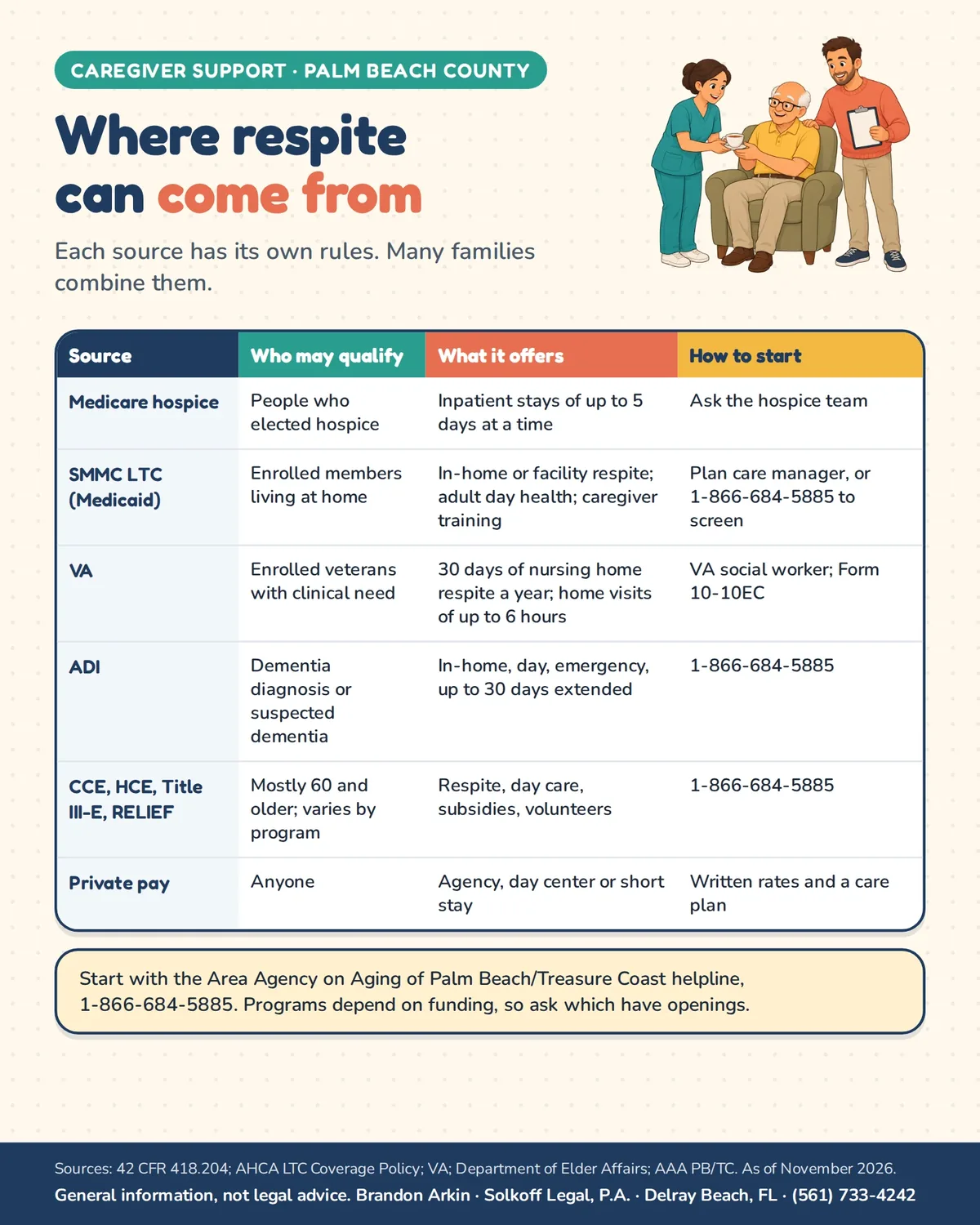
Where respite can come from
| Source | Who may qualify | What it offers | How to start |
|---|---|---|---|
| Medicare hospice | People who elected hospice | Inpatient stays of up to 5 days at a time (42 CFR 418.204) | Ask the hospice team |
| SMMC LTC (Medicaid) | Enrolled members living at home | In-home or facility respite; adult day health; caregiver training (AHCA) | Plan care manager, or 1-866-684-5885 to screen |
| VA | Enrolled veterans with clinical need | 30 days of nursing home respite a year; home visits of up to 6 hours (VA) | VA social worker; Form 10-10EC |
| ADI | Dementia diagnosis or suspected dementia | In-home, day, emergency, up to 30 days extended (DOEA) | 1-866-684-5885 |
| CCE, HCE, Title III-E, RELIEF | Mostly 60 and older; varies by program (AAA PB/TC) | Respite, day care, subsidies, volunteers | 1-866-684-5885 |
| Private pay | Anyone | Agency, day center or short stay | Written rates and a care plan |
Source
Medicare hospice
Who may qualify
People who elected hospice
What it offers
Inpatient stays of up to 5 days at a time (42 CFR 418.204)
How to start
Ask the hospice team
Source
SMMC LTC (Medicaid)
Who may qualify
Enrolled members living at home
What it offers
In-home or facility respite; adult day health; caregiver training (AHCA)
How to start
Plan care manager, or 1-866-684-5885 to screen
Source
VA
Who may qualify
Enrolled veterans with clinical need
What it offers
30 days of nursing home respite a year; home visits of up to 6 hours (VA)
How to start
VA social worker; Form 10-10EC
Source
ADI
Who may qualify
Dementia diagnosis or suspected dementia
What it offers
In-home, day, emergency, up to 30 days extended (DOEA)
How to start
1-866-684-5885
Source
CCE, HCE, Title III-E, RELIEF
Who may qualify
Mostly 60 and older; varies by program (AAA PB/TC)
What it offers
Respite, day care, subsidies, volunteers
How to start
1-866-684-5885
Source
Private pay
Who may qualify
Anyone
What it offers
Agency, day center or short stay
How to start
Written rates and a care plan
Respite planning checklist
Tick what you have done. Nothing is saved, and the list doesn't decide eligibility.
Tick boxes stay on this device. Nothing is saved or sent.
Common questions
Does Medicare pay for respite care if my parent isn't on hospice?
Generally no. Medicare's respite benefit is part of hospice, where the hospice team can arrange inpatient stays of up to five consecutive days at a time (42 CFR 418.204(b)). Outside hospice, Medicare and Medigap don't pay for long-term custodial care, including adult day health care (Medicare.gov). Medicaid, the VA and state programs are more common sources.
Can my mother get respite through Medicaid if she lives in assisted living?
Not as respite. Florida's SMMC LTC program doesn't cover respite for members who live in an assisted living facility or a nursing home (AHCA LTC Coverage Policy), because the facility already provides daily care. Our assisted living Medicaid guide explains what the program pays in an ALF and what the family pays.
How many days of respite does the VA provide?
Nursing home respite is available for 30 days each calendar year, and each home visit of up to six hours counts as one day (VA). The veteran must be enrolled in VA health care and have a clinical need, services vary by location, and a copay may apply (VA). Start with the VA social worker.
Is there respite help specifically for dementia caregivers in Palm Beach County?
Yes. Florida's Alzheimer's Disease Initiative offers in-home, adult day, emergency and extended respite of up to 30 days for caregivers of adults with Alzheimer's or a related disorder (Department of Elder Affairs), reached through 1-866-684-5885. Alzheimer's Community Care, a nonprofit, runs dementia-specific day centers across Palm Beach County (Alzheimer's Community Care), and its main number is (561) 683-2700.
If your family is facing one of these questions, you can reach Brandon Arkin at Solkoff Legal, P.A. at (561) 733-4242.
Related on this site
Talk through the next step
Bring your questions, a list of accounts and any papers a hospital, nursing home or Medicaid office has sent you. Call the Delray Beach office or request a consultation, and I can look at where things stand and what may come next. A phone call or an email does not by itself create an attorney-client relationship.
Solkoff Legal, P.A. · (561) 733-4242