Resources guide
Hospice and Medicaid in Florida: Who Pays for What
By Brandon Arkin, elder law attorney, Solkoff Legal, P.A. · Updated November 2026

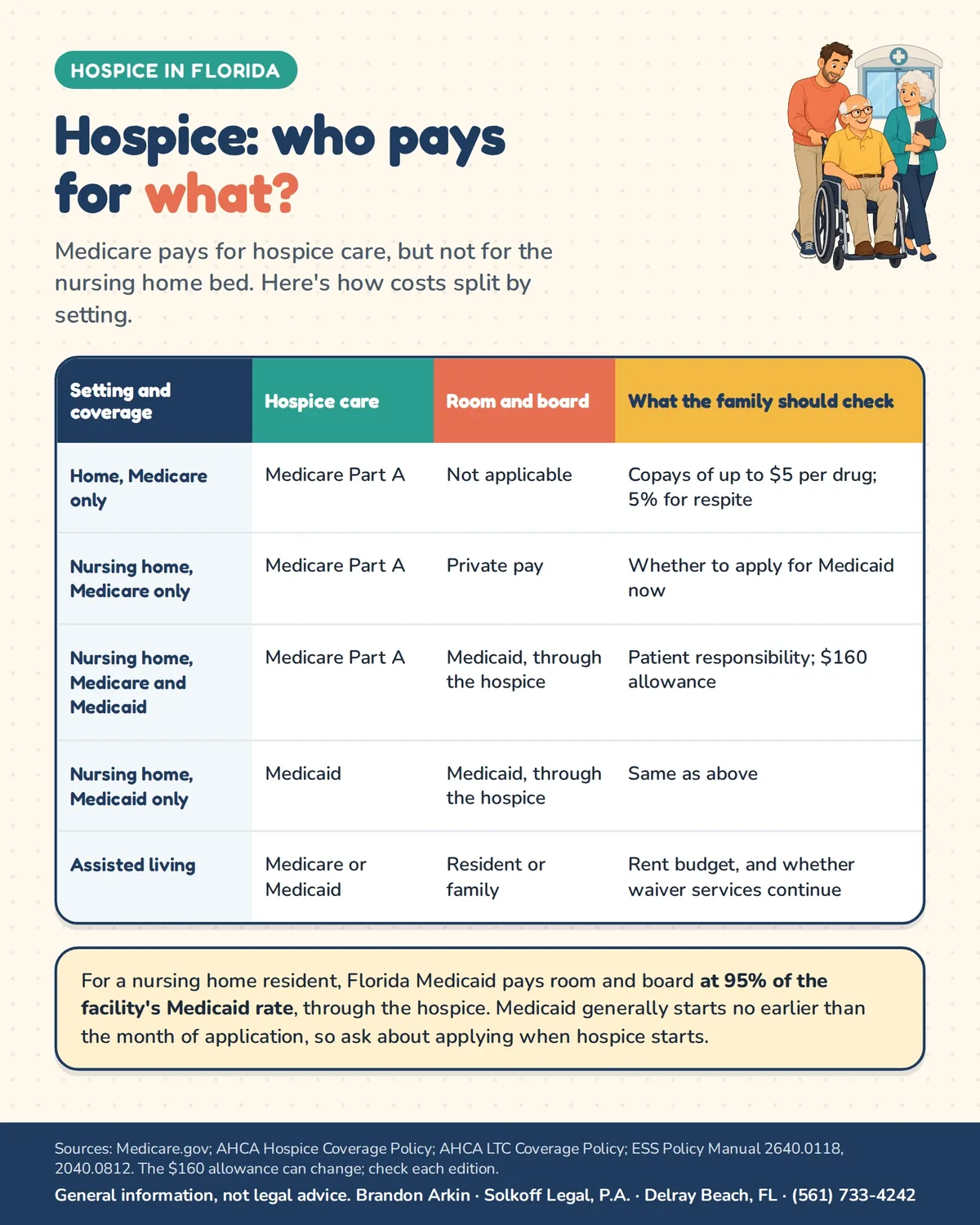
Medicare Part A pays for hospice when a doctor certifies a life expectancy of six months or less and the patient chooses comfort care, but it doesn't pay room and board in a nursing home or other residence. In Florida, Medicaid can cover hospice for people who qualify financially, and for nursing home residents it pays the room and board through the hospice at 95% of the facility's Medicaid rate.
Consider a hypothetical couple in Boynton Beach. The wife has advanced dementia. She has lived in a nursing home for eight months, and her husband has paid the bill privately. Her doctor now recommends hospice. The husband hears that "Medicare pays for hospice" and expects the nursing home bill to stop. It doesn't. Medicare will pay the hospice team, but the monthly charge for her room, meals and daily care continues. Whether Medicaid can step in depends on her income, the couple's assets, and the spousal rules. This guide explains how the two programs divide the costs.
The Medicare hospice benefit
To qualify for Medicare hospice, you need Part A and a certification that you are terminally ill (42 CFR 418.20). The hospice doctor and your regular doctor, if you have one, certify a life expectancy of six months or less if the illness runs its normal course. You accept comfort care in place of treatment aimed at a cure, and you sign a statement choosing hospice (Medicare.gov).
Some details matter in practice:
The election statement. It names the hospice and your attending doctor. It confirms that you understand hospice care is palliative, not curative. A representative can sign it if you are physically or mentally incapacitated (42 CFR 418.24). This is one reason a health care surrogate designation matters. What you give up. For the terminal illness and related conditions, you waive regular Medicare payment for care other than what the hospice provides or arranges. Your own attending doctor's services are an exception (42 CFR 418.24(g)). Medicare still pays for unrelated health problems, with the usual deductibles and coinsurance (Medicare.gov). Recertification. A doctor must recertify the prognosis for each period. Before the third period, and before every period after that, a hospice doctor or nurse practitioner must see the patient face to face (42 CFR 418.22). Changing your mind. You can revoke hospice at any time and go back to standard Medicare. You can also elect hospice again later (42 CFR 418.28). You can change hospice providers once in each benefit period (Medicare.gov).
What hospice pays for, and what it doesn't
The hospice team provides or arranges nursing, physician services, medical social work, counseling, aide visits, medical equipment and supplies, drugs for symptoms, and therapies (AHCA Hospice Coverage Policy). Under Medicare, you pay up to $5 per prescription for pain and symptom drugs and 5% of the approved amount for inpatient respite care (Medicare.gov). Respite stays give a caregiver a break and can last up to five days in a row (42 CFR 418.204(b)).
The big gap is room and board. Medicare doesn't pay it when you get hospice care at home, in a nursing home or in a hospice residence (Medicare.gov). For someone living in a nursing home, that daily rate is usually the largest bill.
Florida Medicaid hospice
Florida Medicaid covers hospice for recipients who are certified as terminally ill and who elect hospice under the federal rules (AHCA). Hospice is a covered service in every Managed Medical Assistance and Long-Term Care plan (AHCA). For recipients 21 and older, curative treatment isn't covered once hospice is elected (AHCA Hospice Coverage Policy).
On the eligibility side, DCF requires a person who isn't already on Medicaid to meet the SSI-related rules and the income and asset limits for ICP, MEDS-AD or Medically Needy (ESS Policy Manual 2040.0814.01). The person must also have a physician-certified prognosis of six months or less, sign an election choosing hospice over other regular Medicaid services, and use a qualified hospice (ESS Policy Manual 2040.0814.02).
In 2026 the institutional income limit is $2,982 a month. The asset limit for hospice is $2,000 for one person, or $5,000 if income is within the MEDS-AD limit (DCF Appendix A-9; ESS Policy Manual 1640.0200). People with income above $2,982 usually need a qualified income trust. Medically Needy hospice is another option when the share of cost is met (ESS Policy Manual 2040.0814.04).
Nursing home residents on hospice
This is where the two programs fit together. For a resident who has both Medicare and Medicaid, Medicare pays the hospice for its care, and Medicaid pays room and board. Medicaid pays that money to the hospice, which then pays the nursing home (AHCA Hospice Coverage Policy). Federal law requires the room and board payment to be at least 95% of what Medicaid would have paid the facility (42 U.S.C. 1396a(a)(13)(B)), and Florida pays at 95% of the facility's rate on file (AHCA Hospice Coverage Policy).
The hospice and the nursing home must have a written agreement. The facility provides 24-hour room and board, and the hospice manages the hospice care (42 CFR 418.112).
The resident still pays a share. Institutional hospice uses the same patient responsibility calculation as ICP. The resident keeps a $160 personal needs allowance, and most of the rest of their income goes toward the cost of care (ESS Policy Manual 2640.0117–2640.0118). If a spouse lives at home, the spousal impoverishment rules apply (ESS Policy Manual 2040.0814.03). In 2026 those rules let the spouse keep up to $162,660 in assets and receive an income allowance based on a minimum of $2,705 a month (DCF Appendix A-9).
In the Boynton Beach example, if the wife qualifies, Medicaid takes over the room and board through the hospice. Her husband stops paying privately, and her income, minus the allowances, goes to the facility.
Hospice at home or in assisted living
Medicaid "community hospice" keeps more income at home. The personal needs allowance equals the federal poverty level, which is $1,330 in 2026 (ESS Policy Manual 2640.0118; DCF Appendix A-9). If there is a spouse and no dependents, the spouse can receive the SSI federal benefit rate minus the spouse's own income (ESS Policy Manual 2640.0121).
Assisted living works differently. Florida's Long-Term Care program doesn't pay room and board to an ALF (AHCA LTC Coverage Policy). A resident on hospice in an ALF usually keeps paying rent from income or family help. Our assisted living Medicaid guide covers that budget.
Palliative care is not the same as hospice
Palliative care focuses on comfort and quality of life. It can begin at diagnosis and continue alongside treatment aimed at a cure. In hospice, efforts to cure the illness stop, though other helpful care can continue (National Institute on Aging). Medicare, Medicaid and private insurance may cover palliative care, depending on the benefits and the treatment plan (National Institute on Aging).
Florida's hospice licensing law defines palliative care as non-curative care that reduces pain and suffering. For licensing purposes, it defines "terminally ill" as a prognosis of one year or less (Fla. Stat. 400.601). Medicare and Medicaid payment, however, still requires the six-month certification (ESS Policy Manual 2040.0814.02).
Who pays for what
| Setting and coverage | Hospice care | Room and board | What the family should check |
|---|---|---|---|
| Home, Medicare only | Medicare Part A | Not applicable | Copays of up to $5 per drug; 5% for respite (Medicare.gov) |
| Nursing home, Medicare only | Medicare Part A | Private pay (Medicare.gov) | Whether to apply for Medicaid now |
| Nursing home, Medicare and Medicaid | Medicare Part A | Medicaid, through the hospice (AHCA) | Patient responsibility; $160 allowance (ESS 2640.0118) |
| Nursing home, Medicaid only | Medicaid | Medicaid, through the hospice (AHCA) | Same as above |
| Assisted living | Medicare or Medicaid | Resident or family (AHCA LTC policy) | Rent budget, and whether waiver services continue |
Setting and coverage
Home, Medicare only
Hospice care
Medicare Part A
Room and board
Not applicable
What the family should check
Copays of up to $5 per drug; 5% for respite (Medicare.gov)
Setting and coverage
Nursing home, Medicare only
Hospice care
Medicare Part A
Room and board
Private pay (Medicare.gov)
What the family should check
Whether to apply for Medicaid now
Setting and coverage
Nursing home, Medicare and Medicaid
Hospice care
Medicare Part A
Room and board
Medicaid, through the hospice (AHCA)
What the family should check
Patient responsibility; $160 allowance (ESS 2640.0118)
Setting and coverage
Nursing home, Medicaid only
Hospice care
Medicaid
Room and board
Medicaid, through the hospice (AHCA)
What the family should check
Same as above
Setting and coverage
Assisted living
Hospice care
Medicare or Medicaid
Room and board
Resident or family (AHCA LTC policy)
What the family should check
Rent budget, and whether waiver services continue
Tick boxes stay on this device. Nothing is saved or sent.
Common questions
Does Medicaid pay for hospice in a Florida nursing home?
Yes, for people who qualify. Florida Medicaid pays nursing home room and board through the hospice at 95% of the facility's Medicaid rate. Medicare pays the hospice care itself for people who have both (AHCA Hospice Coverage Policy).
Does choosing hospice mean giving up all other medical care?
No. You give up curative treatment for the terminal illness and related conditions. Medicare still pays for unrelated problems (Medicare.gov), and you can revoke hospice at any time (42 CFR 418.28).
What if hospice lasts longer than six months?
Hospice can continue as long as a doctor recertifies the prognosis. After the two 90-day periods there's no limit on the number of 60-day periods (42 CFR 418.21).
Can a family member sign the hospice election?
Yes, if the patient is physically or mentally incapacitated, a representative can sign it (42 CFR 418.24(a)). Signed health care documents make that easier. See our guide to the five documents every adult needs.
If your family is facing one of these questions, you can reach Brandon Arkin at Solkoff Legal, P.A. at (561) 733-4242.
Related on this site
Talk through the next step
Bring your questions, a list of accounts and any papers a hospital, nursing home or Medicaid office has sent you. Call the Delray Beach office or request a consultation, and I can look at where things stand and what may come next. A phone call or an email does not by itself create an attorney-client relationship.
Solkoff Legal, P.A. · (561) 733-4242