Resources guide
Medicare Savings Programs in Florida: QMB, SLMB and QI in 2026
By Brandon Arkin, elder law attorney, Solkoff Legal, P.A. · Updated November 2026

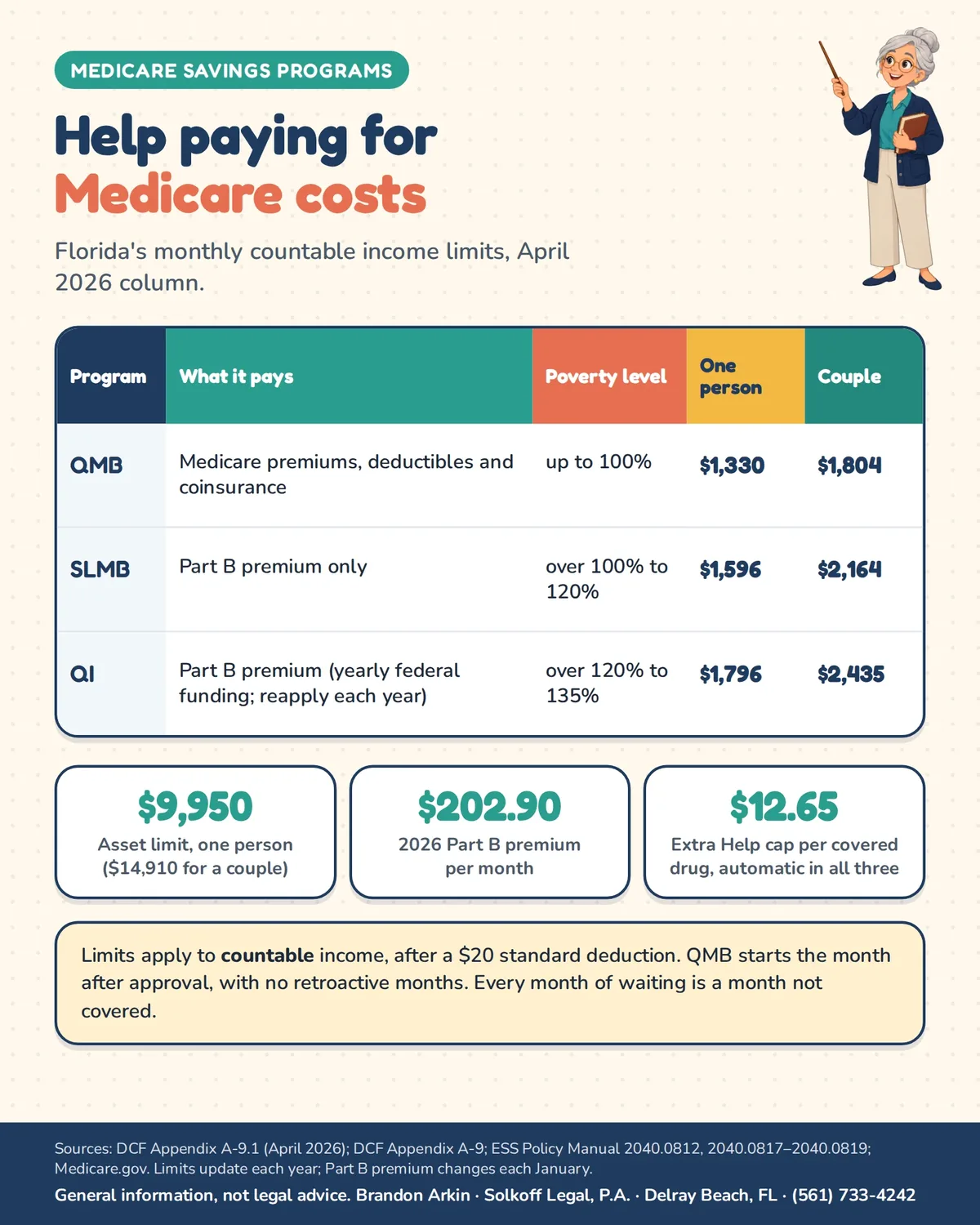
In Florida, the Qualified Medicare Beneficiary (QMB) program pays Medicare premiums, deductibles and coinsurance for people with countable income up to $1,330 a month ($1,804 for a couple) and assets up to $9,950 ($14,910 for a couple). Two related programs, SLMB and QI, pay the $202.90 Part B premium at somewhat higher incomes, and all three come with Extra Help for prescriptions.
Consider a hypothetical widow in Lake Worth Beach. She gets $1,300 a month from Social Security and has $8,000 in savings. Each month $202.90 comes out of her check for Part B. Her Medigap premium costs more than she can manage, so she has dropped her supplement and is facing a 20% share of every doctor bill. She has never applied for Medicaid because she assumes she has too much. She may well qualify for QMB, which would pay her Part B premium, her deductibles and her 20% coinsurance. This guide explains how that works.
What each program pays
The three Medicare Savings Programs are Medicaid coverage groups run by the Florida Department of Children and Families (DCF). They pay Medicare costs. They don't provide full Medicaid coverage.
QMB (Qualified Medicare Beneficiary). QMB pays Medicare premiums, coinsurance and deductibles, including the full Medicare coinsurance for a covered nursing home stay (ESS Policy Manual 2040.0817). Medicare providers also can't bill a QMB member for Medicare-covered services, including deductibles, coinsurance and copays (Medicare.gov; 42 U.S.C. 1396a(n)(3)(B)). SLMB (Specified Low-Income Medicare Beneficiary). SLMB pays the Part B premium only (ESS Policy Manual 2040.0818). QI (Qualifying Individual). QI also pays the Part B premium. It runs on a yearly federal allotment, so it isn't an open entitlement (ESS Policy Manual 2040.0819). States approve QI applications first-come, first-served, with priority for people who had QI the year before, and you have to reapply each year (Medicare.gov).
All three require enrollment in Medicare Part A, citizenship or qualified noncitizen status, and applying for any other benefits you may be entitled to (ESS Policy Manual 2040.0817–2040.0819). QI has one more condition: you can't qualify for any other Medicaid group except Medically Needy (ESS Policy Manual 2040.0819).
The 2026 income limits
DCF publishes the limits on its own chart, Appendix A-9.1, which is separate from the long-term care chart. The current column took effect in April 2026 (DCF Appendix A-9.1):
Program Share of poverty level One person Couple QMB up to 100% $1,330 $1,804 SLMB over 100% to 120% $1,596 $2,164 QI over 120% to 135% $1,796 $2,435
These limits apply to countable income, not gross income. For these groups, DCF adds up unearned income, subtracts the allowed deductions, adds earned income after its exclusions, and then compares the total to the A-9.1 chart (ESS Policy Manual 2640.0126). The standard deduction is $20, and earned income gets a further $65 plus half of what's left (DCF Appendix A-9). Because of the $20 deduction, a person whose only income is Social Security can usually have about $20 more in gross income than the chart shows.
The chart also includes an interim column effective January 2026 with slightly different numbers. Use the April 2026 column for current applications (DCF Appendix A-9.1).
The asset limit and what counts
The asset limit for QMB, SLMB and QI is three times the SSI resource limit, raised each year for inflation (ESS Policy Manual 1640.0200). In 2026 that comes to $9,950 for one person and $14,910 for a couple (DCF Appendix A-9.1). That is much higher than the $2,000 limit for nursing home Medicaid or the $5,000 limit for MEDS-AD (ESS Policy Manual 1640.0200).
DCF uses the same SSI-related asset rules it uses for its other programs. In general, the home you live in and one car don't count. Bank accounts, CDs, stocks and the cash value of some life insurance do. If you aren't sure whether something counts, our guide to exempt assets walks through the list. A spouse's retirement account is excluded for these programs, though any payments the spouse receives from it are counted as income (ESS Policy Manual 1640.0505.05).
Where MEDS-AD fits, and where it doesn't
MEDS-AD is Florida's full Medicaid group for aged and disabled people with income at or below 88% of the poverty level (ESS Policy Manual 2040.0813.01). In 2026 that's $1,171 for one person and $1,588 for a couple, with assets up to $5,000 and $6,000 (DCF Appendix A-9).
Many families miss one rule. In Florida, a person who has Medicare qualifies for MEDS-AD only if they are also receiving institutional care, hospice, or home and community-based services, such as the long-term care waiver or PACE (ESS Policy Manual 2040.0813.03). That means most Medicare beneficiaries living at home with low incomes end up in QMB, not MEDS-AD. Some can also use Medically Needy, which has a monthly share of cost based on an income standard of $180 for one person (DCF Appendix A-9).
If someone later needs a nursing home or in-home long-term care, the rules change. Our nursing home admission guide and Miller trust guide cover those.
Extra Help for prescriptions
Extra Help, also called the Low-Income Subsidy, lowers Part D premiums, deductibles and copays. Anyone who gets full Medicaid, a Medicare Savings Program or SSI gets it automatically (Medicare.gov). For people in an MSP, the 2026 cap is $12.65 for each covered drug (Medicare.gov).
People who earn too much for QI can still apply to Social Security for Extra Help on its own. The 2026 limits are $23,940 a year in income and $18,090 in resources for one person, or $32,460 and $36,100 for a married couple (Medicare.gov). When you apply for Extra Help, Social Security can send your information to DCF, with your consent, and that starts a Medicare Savings Program application (42 U.S.C. 1320b-14(c)(3)). You can apply online or call Social Security at 1-800-772-1213 (SSA).
Timing and estate recovery
Under federal law, QMB starts with services furnished after the end of the month in which you're approved (42 U.S.C. 1396a(e)(8)). DCF's manual says there is no retroactive coverage for QMB. It also limits retroactive Medicaid in general to children and pregnant women (ESS Policy Manual 2040.0812). In practice, every month you wait is a month you don't get back, so apply as soon as you think you might qualify.
Many people hold back because they're worried about estate recovery. Federal law leaves Medicare cost-sharing paid under these programs out of the costs a state may recover from an estate (42 U.S.C. 1396p(b)(1)(B)(ii)). For more on what Florida does recover, see our estate recovery guide.
How to apply
Which program fits? A quick screen
| If your monthly countable income is... | One person | Couple | Likely program | What it pays |
|---|---|---|---|---|
| At or below 100% of poverty | up to $1,330 | up to $1,804 | QMB | Part A and B premiums, deductibles, coinsurance |
| Over 100% to 120% | $1,331–$1,596 | $1,805–$2,164 | SLMB | Part B premium |
| Over 120% to 135% | $1,597–$1,796 | $2,165–$2,435 | QI | Part B premium (if funds remain) |
| Over 135% to 150% | $1,797–$1,995 | $2,436–$2,705 | Extra Help only | Part D help |
If your monthly countable income is...
At or below 100% of poverty
One person
up to $1,330
Couple
up to $1,804
Likely program
QMB
What it pays
Part A and B premiums, deductibles, coinsurance
If your monthly countable income is...
Over 100% to 120%
One person
$1,331–$1,596
Couple
$1,805–$2,164
Likely program
SLMB
What it pays
Part B premium
If your monthly countable income is...
Over 120% to 135%
One person
$1,597–$1,796
Couple
$2,165–$2,435
Likely program
QI
What it pays
Part B premium (if funds remain)
If your monthly countable income is...
Over 135% to 150%
One person
$1,797–$1,995
Couple
$2,436–$2,705
Likely program
Extra Help only
What it pays
Part D help
Assets must also be at or below $9,950 for one person or $14,910 for a couple for QMB, SLMB and QI, or $16,590 and $33,100 under DCF's Extra Help column (DCF Appendix A-9.1).
Tick boxes stay on this device. Nothing is saved or sent.
Common questions
What is QMB in Florida, and what are the 2026 limits?
QMB is a Medicaid program that pays Medicare premiums, deductibles and coinsurance (ESS Policy Manual 2040.0817). As of April 2026, the limits are $1,330 a month in countable income for one person ($1,804 for a couple) and $9,950 in assets ($14,910 for a couple) (DCF Appendix A-9.1).
Can a doctor bill me if I'm in QMB?
Not for Medicare-covered services. Providers aren't allowed to bill QMB members for Medicare deductibles, coinsurance or copays, though you may owe a small Medicaid copay (Medicare.gov). If you get a bill like that, show the office your QMB notice.
I have Medicare and very low income. Why didn't I get full Medicaid?
In Florida, a Medicare beneficiary qualifies for MEDS-AD, the full Medicaid group, only when also receiving institutional care, hospice or home and community-based services (ESS Policy Manual 2040.0813.03). Otherwise QMB, and in some cases Medically Needy, is the usual route.
Will Florida take my house to repay QMB?
Federal law excludes Medicare cost-sharing paid under these programs from the costs a state may recover from an estate (42 U.S.C. 1396p(b)(1)(B)(ii)). Full Medicaid and long-term care benefits follow different rules, which our estate recovery guide explains.
If your family is facing one of these questions, you can reach Brandon Arkin at Solkoff Legal, P.A. at (561) 733-4242.
Related on this site
Talk through the next step
Bring your questions, a list of accounts and any papers a hospital, nursing home or Medicaid office has sent you. Call the Delray Beach office or request a consultation, and I can look at where things stand and what may come next. A phone call or an email does not by itself create an attorney-client relationship.
Solkoff Legal, P.A. · (561) 733-4242