
Resources · Medicaid
What Assets Are Exempt for Medicaid in Florida? The Full List, Item by Item
By Brandon Arkin, elder law attorney, Solkoff Legal, P.A. · Updated November 2026

For Florida long-term care Medicaid, the main exempt assets are your home (within the 2026 equity limit), one car of any value, household goods and personal effects, up to $2,500 in burial funds, burial spaces, an irrevocable prepaid funeral contract, and property that produces income consistent with its value (ESS Policy Manual, chapter 1600). Most other assets, such as bank accounts, investments, second homes, extra cars and timeshares, count toward the $2,000 limit for a single applicant (DCF Appendix A-9).
Countable, exempt and the $2,000 limit
Florida's Department of Children and Families (DCF) splits everything you own into two groups. Exempt (or "excluded") assets are ignored. Countable assets are added up and compared with the limit. For nursing home Medicaid (the Institutional Care Program), PACE and the home and community-based waiver, a single applicant can have $2,000. The limit is $5,000 if the applicant's income is within the lower MEDS-AD limit (ESS 1640.0205).
DCF values countable property at what you could sell it for, minus what you owe on it. For real estate, that means fair market value from a knowledgeable source, not just the tax assessment (ESS 1640.0581).
For married couples, DCF counts both spouses' assets together, then sets aside the Community Spouse Resource Allowance of up to $162,660 for the spouse at home. Our married couples guide explains that calculation. Everything below is about which items stay out of the count in the first place.
The home
DCF excludes the home "regardless of its value" if it's the principal place of residence. Only one home can be excluded. The rule isn't limited to houses: condominiums, cooperative apartments, mobile homes, motor homes and houseboats can all qualify, along with the land the home sits on (ESS 1640.0534).
There's a separate equity test for long-term care. If your share of the home's equity is over $752,000 in 2026, you can't get nursing home or home-care Medicaid unless a spouse, a child under 21 or a blind or disabled child lives in the home (ESS 1640.0307.04). A home stays excluded during a nursing home stay if you state an intent to return. Our guide to selling a home on Medicaid covers that rule and what happens to sale proceeds.
Car, household goods and personal effects
One automobile is excluded regardless of its value or use. If there's more than one, DCF excludes whichever has the most equity. Any other vehicle counts at its average trade-in value minus any loan (ESS 1640.0591).
Household goods and personal effects are excluded "regardless of their dollar value" (ESS 1640.0565.01). That covers:
furniture, appliances, televisions, computers, carpets, dishes and cookware; clothing, personal care items, and jewelry you wear, including wedding and engagement rings; books, musical instruments, hobby materials and pets; items of cultural or religious significance, and items needed because of a disability.
The exception is property held for its value or as an investment. Gems, collectibles, and jewelry you don't wear and that has no family meaning are countable. DCF's own example is a woman who spent a settlement on $3,000 of jewelry to spend down, and the jewelry was counted (ESS 1640.0565.01). If a spouse lives at home, all personal property is excluded for the spouse applying for institutional or home-care Medicaid (ESS 1640.0563).
Burial funds, spaces, contracts and small life insurance
Florida gives several separate burial exclusions, and they stack:
Burial funds. You and your spouse may each set aside up to $2,500, kept separate from other money and designated for burial. That amount isn't reduced by an excluded life insurance policy or an irrevocable burial contract (ESS 1640.0514). Irrevocable prepaid funeral contracts aren't counted (ESS 1640.0509). Burial spaces for you, your spouse or immediate family (children, stepchildren, siblings, parents and their spouses) are excluded. That includes caskets, headstones and opening and closing the grave (ESS 1640.0516). Life insurance. If the total face value of all policies on one person is $2,500 or less, none of the cash value counts. Above that, all of the cash surrender value counts. Term and burial insurance with no cash value are left out (ESS 1640.0554).
Rental property and property essential to self-support
Real estate that isn't your home and isn't a life estate generally counts (ESS 1640.0578). Florida's manual has two related exclusions:
Property essential to self-support. You can exclude the fair market value of income-producing property "that is essential to self-support" (ESS 1640.0544). Income consistent with value. Any income-producing property, including equipment, can be excluded if it "annually produces income consistent with its fair market value," even if only seasonally. The manual names rental and vacation homes, farmland and work equipment (ESS 1640.0548).
DCF may accept your statement that the return is reasonable. If it's questionable, it asks for verification from a knowledgeable source. Property that earns less than a reasonable return counts in full. A temporary drop from something like a fire or a hurricane can be excused for up to 18 months after the end of that tax year (ESS 1640.0549). The manual doesn't set a percentage, so keep leases, the rent ledger, the expenses and a recent value estimate.
Keep in mind that the rent itself counts as income, which can affect the $2,982 income limit and the monthly amount owed to a nursing home.
Timeshares, property for sale and life estates
DCF's manual has no passage on timeshares. Under the general rules, a timeshare that isn't rented out at a fair return is non-home property, counted at what it would sell for minus any debt (ESS 1640.0578 and 1640.0581). Many timeshares have little resale value, so get a written estimate from a knowledgeable source.
Property you can't sell easily can still help. Real estate is excluded temporarily while you make a good faith effort to sell it at fair market value, for example with a broker listing, as long as you haven't turned down a reasonable offer (ESS 1640.0537).
A life estate, such as the interest you keep under a Lady Bird deed, isn't counted as an asset (ESS 1640.0551). See our Lady Bird deed guide.
Retirement accounts and other special exclusions
If you're eligible for regular payments from an IRA, pension or similar plan, the payments are income and the account isn't a countable asset. If you can't receive payments, the available balance counts (ESS 1640.0505.04). In Florida practice, every IRA can get this payout-status treatment. Our IRA and 401(k) guide explains how that works.
Federal law excludes a few more items for a limited time (ESS 1640.0593):
back-payment lump sums from SSI or Social Security, for 9 months after receipt, if kept separate; federal tax refunds, for 12 months; federal disaster assistance and comparable state or local aid.
Changing countable money into exempt property at fair value, such as repairing the home, replacing the car or buying a funeral contract, is generally allowable. Giving money away isn't (ESS 1640.0609.05).
A worked example
Hypothetically, Marie, 84 and widowed, is moving to a Boca Raton nursing home. She owns:
her condo, worth $340,000 with no mortgage, which she intends to return to; a 2019 sedan; $9,000 in checking; a $2,000 whole life policy with $1,400 of cash value; a timeshare with a written resale estimate of $1,500; an IRA paying her required distributions.
The condo, the car, her furniture and jewelry, and the small policy (face value under $2,500) are excluded. The IRA isn't counted because she takes regular payments. The payments are income. Her countable assets are $9,000 checking plus $1,500 for the timeshare, $10,500 in all, which is $8,500 over the limit. Buying an irrevocable funeral contract and setting aside $2,500 in a burial account could bring her close, and paying her first nursing home bill could finish the job.
Asset sorter worksheet
List every asset, then use the table above to sort it. Nothing you enter is saved. Bring the completed sheet to a planning meeting.
| Asset | Owner | Value (minus debt) | Likely treatment | Question to ask |
|---|---|---|---|---|
| Home: whose name is on the deed, and is equity under $752,000? | ||||
| Each vehicle: which one has the most equity? | ||||
| Every bank and investment account, including joint accounts | ||||
| Each life insurance policy: face value and cash value | ||||
| Burial: funeral contract (revocable or irrevocable?), plots, burial account | ||||
| Other real estate: is it rented, at what rent, and what's it worth? | ||||
| Retirement accounts: are payments being taken? | ||||
| Collectibles, coins or jewelry held for value |
Asset
Home: whose name is on the deed, and is equity under $752,000?
Owner
Value (minus debt)
Likely treatment
Question to ask
Asset
Each vehicle: which one has the most equity?
Owner
Value (minus debt)
Likely treatment
Question to ask
Asset
Every bank and investment account, including joint accounts
Owner
Value (minus debt)
Likely treatment
Question to ask
Asset
Each life insurance policy: face value and cash value
Owner
Value (minus debt)
Likely treatment
Question to ask
Asset
Burial: funeral contract (revocable or irrevocable?), plots, burial account
Owner
Value (minus debt)
Likely treatment
Question to ask
Asset
Other real estate: is it rented, at what rent, and what's it worth?
Owner
Value (minus debt)
Likely treatment
Question to ask
Asset
Retirement accounts: are payments being taken?
Owner
Value (minus debt)
Likely treatment
Question to ask
Asset
Collectibles, coins or jewelry held for value
Owner
Value (minus debt)
Likely treatment
Question to ask
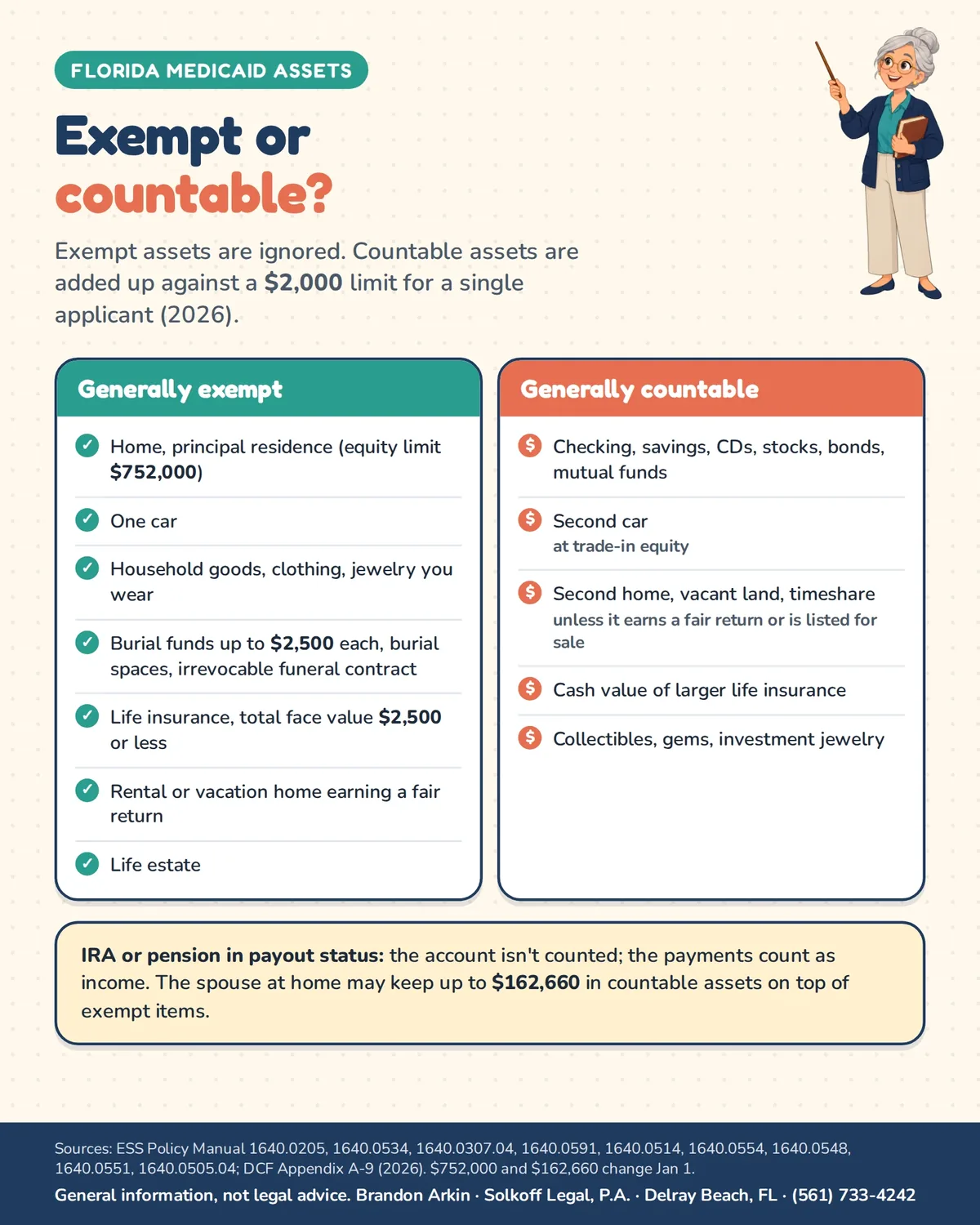
Exempt or countable at a glance
| Asset | Generally |
|---|---|
| Home, principal residence (equity limit $752,000) | Exempt |
| One car | Exempt |
| Household goods, clothing, jewelry you wear | Exempt |
| Burial funds up to $2,500 each, burial spaces, irrevocable funeral contract | Exempt |
| Life insurance, total face value $2,500 or less | Exempt |
| Rental or vacation home earning a fair return | Exempt |
| Life estate | Exempt |
| IRA or pension in payout status | Payments count as income |
| Checking, savings, CDs, stocks, bonds, mutual funds | Countable |
| Second car | Countable at trade-in equity |
| Second home, vacant land, timeshare | Countable unless it earns a fair return or is listed for sale |
| Cash value of larger life insurance | Countable |
| Collectibles, gems, investment jewelry | Countable |
Asset
Home, principal residence (equity limit $752,000)
Generally
Exempt
Asset
One car
Generally
Exempt
Asset
Household goods, clothing, jewelry you wear
Generally
Exempt
Asset
Burial funds up to $2,500 each, burial spaces, irrevocable funeral contract
Generally
Exempt
Asset
Life insurance, total face value $2,500 or less
Generally
Exempt
Asset
Rental or vacation home earning a fair return
Generally
Exempt
Asset
Life estate
Generally
Exempt
Asset
IRA or pension in payout status
Generally
Payments count as income
Asset
Checking, savings, CDs, stocks, bonds, mutual funds
Generally
Countable
Asset
Second car
Generally
Countable at trade-in equity
Asset
Second home, vacant land, timeshare
Generally
Countable unless it earns a fair return or is listed for sale
Asset
Cash value of larger life insurance
Generally
Countable
Asset
Collectibles, gems, investment jewelry
Generally
Countable
Common questions
What assets are exempt for Medicaid in Florida?
The main exempt assets are the home (with 2026 equity of $752,000 or less, unless a spouse or qualifying child lives there), one car, household goods and personal effects, up to $2,500 in burial funds per spouse, burial spaces, irrevocable prepaid funeral contracts, small life insurance policies and income-producing property earning a fair return (ESS Policy Manual, chapter 1600). Most cash and investments count toward the $2,000 limit.
Does a rental property count for Florida Medicaid?
Only if it doesn't earn a reasonable return. DCF excludes income-producing property, including rental and vacation homes, that "annually produces income consistent with its fair market value" (ESS 1640.0548). Property earning less counts in full, with an 18-month allowance for temporary setbacks (ESS 1640.0549). The rent counts as income.
Is a timeshare counted as an asset for Medicaid?
Generally yes, at its resale value minus any debt, because it's real property other than the home (ESS 1640.0578 and 1640.0581). It may be excluded if it's rented at a fair return or listed for sale in good faith (ESS 1640.0537). Resale values are often low, so get a written estimate.
Can I keep an expensive car and still qualify?
Yes. Florida excludes one automobile "regardless of value or use" (ESS 1640.0591). A second car counts at its average trade-in value minus any loan. Replacing an older car with a reliable one, at fair value and for your own use, is a common and allowable way to spend down.
If your family is facing one of these questions, you can reach Brandon Arkin at Solkoff Legal, P.A. at (561) 733-4242.
Related on this site
Talk through the next step
Bring your questions, a list of accounts and any papers a hospital, nursing home or Medicaid office has sent you. Call the Delray Beach office or request a consultation, and I can look at where things stand and what may come next. A phone call or an email does not by itself create an attorney-client relationship.
Solkoff Legal, P.A. · (561) 733-4242