
Resources guide
IRAs, 401(k)s and Florida Medicaid: What Counts and What Doesn't
By Brandon Arkin, elder law attorney, Solkoff Legal, P.A. · Updated November 2026

In Florida, an IRA or 401(k) that pays you regular payments is generally not counted as an asset for long-term care Medicaid; the payments are counted as income instead. An account that isn't paying out, but that you could withdraw, generally counts at its full value minus any early-withdrawal penalty, not minus taxes.
Imagine Carol, 81, a widow in Delray Beach. She has $1,900 a month in Social Security, $8,000 in checking and an IRA worth $240,000. After a stroke, she needs nursing home care. Her son assumes the IRA has to be spent before Medicaid will help, and that taxes on a full withdrawal will take a big bite. Neither assumption is quite right. The answer turns on how the IRA is set up when she applies, and on choices the family can make before then.
This guide explains how the Florida Department of Children and Families (DCF) treats retirement accounts for nursing home and home-care Medicaid, with worked numbers. For the bigger picture, start with our Medicaid planning page.
Payout status: the rule that matters most
DCF's manual treats retirement funds, from employer and union pensions to IRAs and Keogh plans, as either an asset or income. Which one depends on payments (ESS Policy Manual 1640.0505.04):
If you're eligible to receive regular payments and you're receiving them, the payments count as unearned income and the account isn't a countable asset. If you aren't receiving payments but the money is currently available, the account's value counts as an asset. Early-withdrawal penalties are subtracted from the value, but the taxes you'd owe are not. An account you can't touch until you leave your job, or one that's legally unavailable, isn't counted.
The manual adds a warning. Someone who is eligible for regular payments but chooses not to take them can be found ineligible for failing to claim a benefit they're entitled to.
DCF applies the same payout-status approach to IRAs as to employer plans, so a 401(k), 403(b), traditional IRA or Roth IRA is analyzed the same way. In practice, the question for many families is whether to set up regular payments before applying. Keep a copy of the plan's payment confirmation and recent statements, because DCF will want to see them.
How the payments affect income and the patient bill
Once an IRA is paying out, the monthly payment joins Social Security and any pension as income. That matters in two ways.
The income cap. In 2026, a person with gross income over $2,982 a month generally needs a Qualified Income Trust, also called a Miller trust, to qualify (DCF Appendix A-9). A larger IRA payment can push someone over the cap who wasn't over it before. Our Miller trust guide walks through the setup.
Patient responsibility. After approval, most of a nursing home resident's income goes to the facility each month. They keep a $160 personal needs allowance (DCF Appendix A-9). Health insurance premiums and, for a married person, an allowance for the spouse at home are also deducted (42 C.F.R. 435.725). So the IRA payments mostly go toward care. The account itself isn't spent down all at once, and what's left can pass to beneficiaries.
A worked example
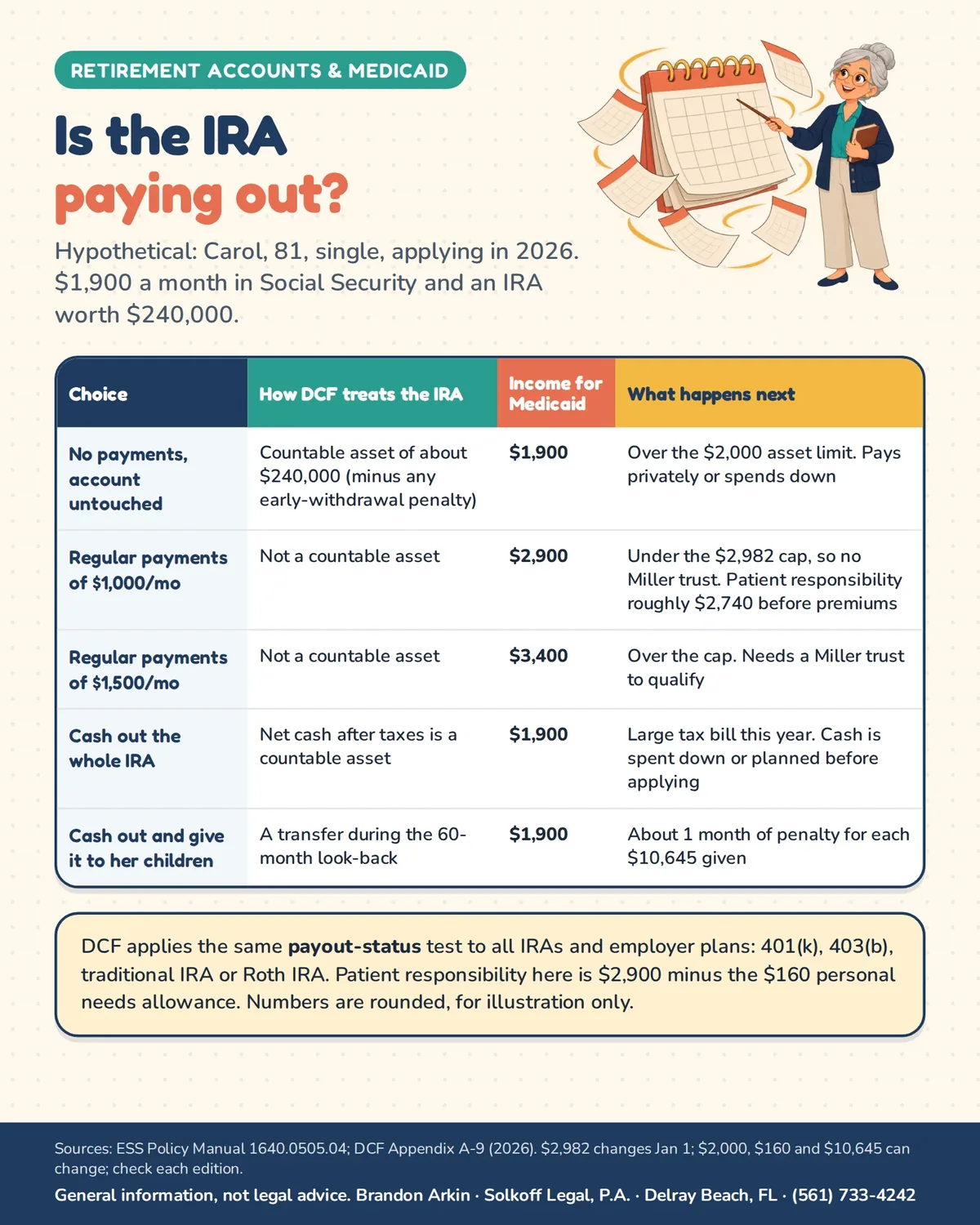
Back to Carol: $1,900 a month in Social Security, an IRA worth $240,000, single, applying in 2026. The table shows how three choices play out. The numbers are rounded and for illustration only.
When the spouse at home has a retirement account
For married couples, DCF adds up both spouses' countable assets when one spouse applies for long-term care Medicaid. The spouse at home, called the community spouse, can keep up to $162,660 of the total in 2026 (DCF Appendix A-9).
The community spouse's own retirement accounts follow a specific rule (ESS Policy Manual 1640.0505.05):
If, at application, the community spouse is receiving payments from the account, the account is left out of the couple's total. The payments count as that spouse's income when DCF figures the spousal income allowance. If the community spouse isn't receiving payments but could withdraw a lump sum, the full value counts toward the couple's total. Early-withdrawal penalties are subtracted; taxes are not.
Take a hypothetical couple in Boca Raton. Ed is applying, and his wife Linda has a $300,000 IRA. If Linda is not taking payments, her IRA alone puts the couple well over what she can keep. If she's receiving regular payments at application, the IRA is left out, and the payments simply become part of her monthly income. The timing is "at the time of application," so setting this up before applying matters.
Required minimum distributions
Federal tax law makes most retirement account owners start taking required minimum distributions (RMDs) for the year they reach 73. The first one is due by April 1 of the next year, and later ones by December 31 each year (IRS). Roth IRA owners don't have RMDs during their lifetime. People still working can usually delay RMDs from their current employer's plan, unless they own 5% or more of the business. A missed RMD can trigger a 25% excise tax, reduced to 10% if corrected within two years.
For Medicaid, RMDs are income in the month received. A once-a-year RMD is a large lump in one month. Many applicants switch to monthly payments so income is steady and easier to match with the patient-responsibility bill. Whether an annual-only RMD schedule satisfies DCF's "regular payments" standard isn't spelled out in the manual, so it's a point to confirm when you apply.
Taxes if you cash out
Withdrawals from a traditional IRA or 401(k) are generally taxed as ordinary income in the year you take them. Cashing out a large account in one year can push income into a higher bracket. Qualified Roth withdrawals are generally tax-free.
One offset helps some families. If a principal reason for being in a nursing home is medical care, the full cost, including meals and lodging, can count as a medical expense. Medical expenses above 7.5% of adjusted gross income are deductible if you itemize (IRS Publication 502). A year of private-pay nursing home bills can absorb a good part of a large withdrawal. A CPA should run the numbers before anyone withdraws.
Note also that DCF doesn't subtract taxes owed when it values an account that isn't paying out (ESS Policy Manual 1640.0505.04). A $240,000 IRA counts as $240,000, even though it might be worth much less after tax.
Annuities, beneficiaries and what happens at death
Annuitizing an IRA. Florida's strict annuity rules for Medicaid (state as beneficiary, equal payments and so on) generally don't apply to an IRA, an individual retirement annuity, a SEP or a Roth IRA set up by an employee or employer (ESS Policy Manual 1640.0609.03). Buying a commercial annuity with non-retirement money is different and must meet those rules.
Beneficiaries. Check the beneficiary form on every account. Florida Medicaid recovers costs by filing a claim in the probate estate of a recipient who was 55 or older (Fla. Stat. 409.9101). An IRA that names a living person usually passes outside probate. One that names "my estate," or has no beneficiary on file, may end up in probate and exposed to that claim. If a beneficiary has a disability, a special needs trust may be a better choice than naming them directly (our special needs guide).
Before you apply: retirement account checklist
Carol's IRA: three choices compared
| Choice | How DCF treats the IRA | Monthly income for Medicaid | What happens next |
|---|---|---|---|
| No payments, account untouched | Countable asset of about $240,000 (minus any early-withdrawal penalty) | $1,900 | Over the $2,000 asset limit. Carol pays privately or spends down until she's under it |
| Regular payments of $1,000 a month | Not a countable asset | $2,900 | Under the $2,982 cap, so no Miller trust. Patient responsibility is roughly $2,740 before premium deductions |
| Regular payments of $1,500 a month | Not a countable asset | $3,400 | Over the cap. Carol needs a Miller trust to qualify |
| Cash out the whole IRA | Gone as an IRA; net cash after taxes is a countable asset | $1,900 | Large tax bill this year. Cash is spent down or planned before applying |
| Cash out and give it to her children | A transfer during the 60-month look-back | $1,900 | About 1 month of penalty for each $10,645 given (DCF Appendix A-9) |
Choice
No payments, account untouched
How DCF treats the IRA
Countable asset of about $240,000 (minus any early-withdrawal penalty)
Monthly income for Medicaid
$1,900
What happens next
Over the $2,000 asset limit. Carol pays privately or spends down until she's under it
Choice
Regular payments of $1,000 a month
How DCF treats the IRA
Not a countable asset
Monthly income for Medicaid
$2,900
What happens next
Under the $2,982 cap, so no Miller trust. Patient responsibility is roughly $2,740 before premium deductions
Choice
Regular payments of $1,500 a month
How DCF treats the IRA
Not a countable asset
Monthly income for Medicaid
$3,400
What happens next
Over the cap. Carol needs a Miller trust to qualify
Choice
Cash out the whole IRA
How DCF treats the IRA
Gone as an IRA; net cash after taxes is a countable asset
Monthly income for Medicaid
$1,900
What happens next
Large tax bill this year. Cash is spent down or planned before applying
Choice
Cash out and give it to her children
How DCF treats the IRA
A transfer during the 60-month look-back
Monthly income for Medicaid
$1,900
What happens next
About 1 month of penalty for each $10,645 given (DCF Appendix A-9)
Tick boxes stay on this device. Nothing is saved or sent.
Questions families ask about IRAs and Medicaid
Does my IRA count as an asset for Florida Medicaid?
It depends on payout status. If you're receiving regular payments, DCF counts the payments as income and doesn't count the account as an asset. If you aren't receiving payments but could withdraw the money, the account counts at its value minus any early-withdrawal penalty, with no deduction for taxes (ESS Policy Manual 1640.0505.04). DCF treats IRAs, 401(k)s and other retirement plans the same way here.
Does my husband's IRA count if I'm the one applying?
It can. If, at the time you apply, your husband is receiving payments from his own retirement account, the account is left out of the couple's countable assets and the payments count as his income. If he isn't taking payments but could withdraw a lump sum, the full value counts toward the couple's total (ESS Policy Manual 1640.0505.05). In 2026, the spouse at home can keep up to $162,660 of the couple's countable assets (DCF Appendix A-9).
Should I cash out my IRA before applying for Medicaid?
Often not. Cashing out triggers income tax on traditional accounts, and the cash left over is still a countable asset. Setting up regular payments may let the account stay intact and be left out of your assets, with the payments counted as income instead (ESS Policy Manual 1640.0505.04). The right choice depends on your income, your spouse and your taxes. Large private-pay nursing home bills may be deductible medical expenses (IRS Publication 502).
Do RMDs count as income for Medicaid?
Yes. Payments from a retirement account count as unearned income in the month you receive them (ESS Policy Manual 1640.0505.04). RMDs generally begin for the year you turn 73 (IRS). Many people switch from one annual RMD to monthly payments, so income is steady and lines up with the monthly patient-responsibility bill. If the added income pushes you over $2,982 a month, a Miller trust may be needed.
If your family is facing one of these questions, you can reach Brandon Arkin at Solkoff Legal, P.A. at (561) 733-4242.
Related on this site
Talk through the next step
Bring your questions, a list of accounts and any papers a hospital, nursing home or Medicaid office has sent you. Call the Delray Beach office or request a consultation, and I can look at where things stand and what may come next. A phone call or an email does not by itself create an attorney-client relationship.
Solkoff Legal, P.A. · (561) 733-4242