
Resources guide
Selling Your House While on Medicaid in Florida
By Brandon Arkin, elder law attorney, Solkoff Legal, P.A. · Updated November 2026

Selling your home while on Florida Medicaid usually turns an exempt asset into countable cash, which can end eligibility once the proceeds are counted. Unless the money goes into another exempt home within three months or is otherwise planned for, it generally counts toward the $2,000 asset limit, so plan before you list the house.
Imagine Frank, 84, who has lived in a nursing home in Boynton Beach for a year. He's on Medicaid. His house in Lake Worth Beach sits empty, and his daughter is paying the insurance and the lawn service. A buyer offers $380,000. Selling seems sensible. But the day the sale closes, Frank goes from owning an exempt home to holding $380,000 in cash, and his Medicaid is at risk.
Many families don't have to sell at all. Our Medicaid myths guide explains why the home is usually protected. This page is for families who have decided to sell, or are thinking about it, and want to know what happens next.
Why the home is protected now
While you own and intend to return to your home, Florida Medicaid generally doesn't count it. The Florida Department of Children and Families (DCF) excludes the home during an absence of any length if any one of these is true (ESS Policy Manual 1640.0543.01):
A spouse or dependent relative still lives there. Selling would cause undue hardship to a co-owner who lives there. You, or your representative, state an intent to return home.
That statement of intent is enough. DCF records it and doesn't require proof that a return is likely. A Florida resident's home in another state can be excluded the same way (ESS Policy Manual 1640.0543.02).
There's one ceiling. If no spouse, child under 21 or blind or disabled child lives there, equity over $752,000 makes the person ineligible for long-term care Medicaid in 2026 (ESS Policy Manual 1640.0307.04; DCF Appendix A-9).
What changes when the house sells
When the home sells, its protection ends, and the money takes its place. DCF treats sale proceeds as an asset, not as income (ESS Policy Manual 1640.0409).
There is a short window. Proceeds from selling an excluded home can stay excluded for up to three months while you replace the home with another excluded home (ESS Policy Manual 1640.0543.03). The clock starts the day the proceeds are received and ends three months later on the same day of the month. It can't be extended. Replacement happens when the replacement home is paid for or a written contract to buy it is signed. Moving costs and the property taxes needed to close count as replacement costs (ESS Policy Manual 1640.0543.04).
If no replacement is completed in time, all the proceeds count starting the month after the three months end, after a 10-day advance notice from DCF. If a replacement home costs less than the proceeds, the leftover counts the same way.
For Frank, single and in a nursing home, a replacement home rarely helps. Intent to return only protects a home he lived in before he left, not a newly bought one (ESS Policy Manual 1640.0543.01). So his roughly $380,000, less closing costs, would count against the $2,000 limit (DCF Appendix A-9). He'd generally pay privately until the money is spent or planned for. Report the sale to DCF promptly. Whatever is left in his probate estate at death can also face a Medicaid estate recovery claim (our estate recovery guide).
Timing the sale
Timing can make a real difference.
Selling before applying. If you already received sale proceeds before applying, the three-month replacement period starts on the date you apply (ESS Policy Manual 1640.0543.04). Selling after approval. The proceeds affect eligibility going forward, so work out the plan before the closing date, not after. Carrying costs. An empty house still costs money: insurance, taxes, repairs, storm prep. These sometimes push families to sell. Weigh them against the cost of losing Medicaid for a period. Estate recovery. Keeping the home until death can matter for what passes to heirs, especially if it qualifies as protected homestead. That's a separate question to ask before selling.
Options for the sale proceeds
Every family's facts differ, but these are the common paths.
Spend down on allowable items. Paying for care, paying valid debts and buying things for the Medicaid recipient at fair value are generally allowed, because fair compensation is received (ESS Policy Manual 1640.0609.05). An irrevocable prepaid funeral contract isn't counted as an asset (ESS Policy Manual 1640.0509). Burial spaces for the person and immediate family aren't counted either (ESS Policy Manual 1640.0516).
A replacement home for the spouse at home. If a spouse still lives at home, selling the larger house and buying a smaller one within three months can keep the money in an excluded home (ESS Policy Manual 1640.0543.03). Transfers between spouses are allowable (ESS Policy Manual 1640.0609.05). After approval, assets owned only by the community spouse aren't counted for the spouse on Medicaid (ESS Policy Manual 1640.0315). So whose name is on the deed at the time of the sale matters a great deal.
An annuity for the community spouse. A spouse at home may be able to turn proceeds into income with an annuity. It must name the state as beneficiary for the Medicaid paid (after a minor or disabled child, if any) and be actuarially sound. Annuities the community spouse buys after the other spouse's approval aren't evaluated under the transfer rules (ESS Policy Manual 1640.0609.03). Annuities are technical. Get advice before buying one.
A care contract. Paying a family caregiver under a written, fair-market agreement can be fair compensation rather than a gift. DCF looks at the value, frequency and duration of the services (ESS Policy Manual 1640.0614.04). Our caregiver pay guide explains the setup.
Selling or giving the house to family
Selling the house to a relative for less than it's worth, or giving it away, is generally a transfer for less than fair value. Each $10,645 of the difference means about one month without long-term care Medicaid in 2026 (DCF Appendix A-9).
Florida allows some transfers of the home with no penalty (ESS Policy Manual 1640.0609.04):
to a spouse, to a child under 21, to a blind or permanently disabled adult child, to a sibling who has an equity interest and lived there at least a year before the person entered the facility, or to an adult child who lived there at least two years before that date and gave care that delayed the move.
If one of these fits, transferring the house may be better than selling it.
If the home has a Lady Bird deed
An enhanced life estate deed, often called a Lady Bird deed, lets the owner keep full control during life and name who receives the home at death. DCF doesn't treat signing one as a transfer, because the owner keeps full ownership powers until death (ESS Policy Manual 1640.0613.01). That includes the right to sell (ESS Policy Manual 1640.0613.02).
So if a Lady Bird deed owner sells, the proceeds generally belong to the owner, not to the people named in the deed, and the same rules above apply. The deed's benefit, passing the home at death without probate, is lost once the house is sold. Our Lady Bird deed guide explains the deed.
Taxes on the sale
Federal law lets a homeowner exclude up to $250,000 of gain, or $500,000 for many married couples filing jointly, if they owned and lived in the home for at least 2 of the 5 years before the sale (26 U.S.C. 121). There's a special rule for nursing home residents. Someone who becomes unable to care for themselves, and lived in the home at least 1 of the 5 years, is treated as still living there while in a licensed facility (26 U.S.C. 121(d)(7)). Frank may still qualify for the exclusion even after a long stay. Ask a CPA to confirm.
Before you list the house: a timeline
Tick boxes stay on this device. Nothing is saved or sent.
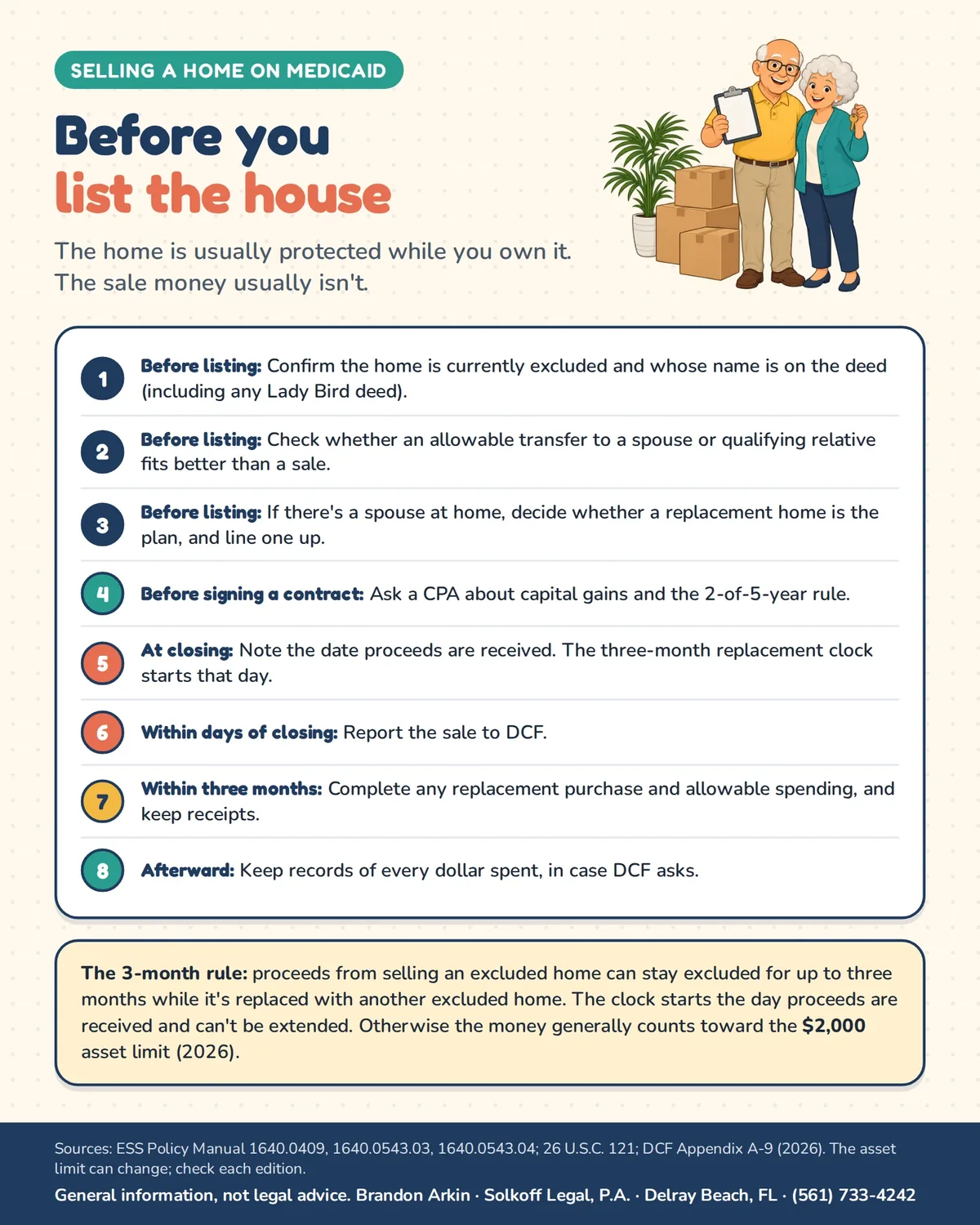
Questions families ask about selling a home on Medicaid
Can I sell my house while on Medicaid in Florida?
Yes, but the sale proceeds are treated as an asset, not income (ESS Policy Manual 1640.0409). They can stay excluded for up to three months while you buy a replacement home. After that, any proceeds not used for a replacement generally count toward the 2026 asset limit of $2,000 for a single person (ESS Policy Manual 1640.0543.04; DCF Appendix A-9). Plan before you list, and report the sale to DCF.
How long do I have to reinvest the money from my house sale?
Three months. The period starts the day you receive the proceeds and ends three months later on the same day of the month, with no extensions. Replacement happens when you pay for the new home or sign a written contract to buy it. If you sold before applying, the three months start on your application date (ESS Policy Manual 1640.0543.04).
Does my house count if I'm in a nursing home and say I'll return home?
Generally no. DCF excludes the home during an absence of any length if you, or your representative, state an intent to return, or if a spouse or dependent relative lives there (ESS Policy Manual 1640.0543.01). In 2026, equity over $752,000 can block long-term care Medicaid unless a spouse, a child under 21, or a blind or disabled child lives in the home (ESS Policy Manual 1640.0307.04).
Can I give my house to my children instead of selling it?
Usually that's treated as a transfer, with about one month without long-term care Medicaid for each $10,645 of value in 2026 (DCF Appendix A-9). There are exceptions for a spouse, a child under 21, a blind or disabled child, a qualifying sibling, and an adult child who lived in the home for two years and gave care that delayed the move to a facility (ESS Policy Manual 1640.0609.04).
If your family is facing one of these questions, you can reach Brandon Arkin at Solkoff Legal, P.A. at (561) 733-4242.
Related on this site
Talk through the next step
Bring your questions, a list of accounts and any papers a hospital, nursing home or Medicaid office has sent you. Call the Delray Beach office or request a consultation, and I can look at where things stand and what may come next. A phone call or an email does not by itself create an attorney-client relationship.
Solkoff Legal, P.A. · (561) 733-4242