Resources guide
Elder Financial Exploitation in Florida: What to Do This Week
By Brandon Arkin, elder law attorney, Solkoff Legal, P.A. · Updated November 2026
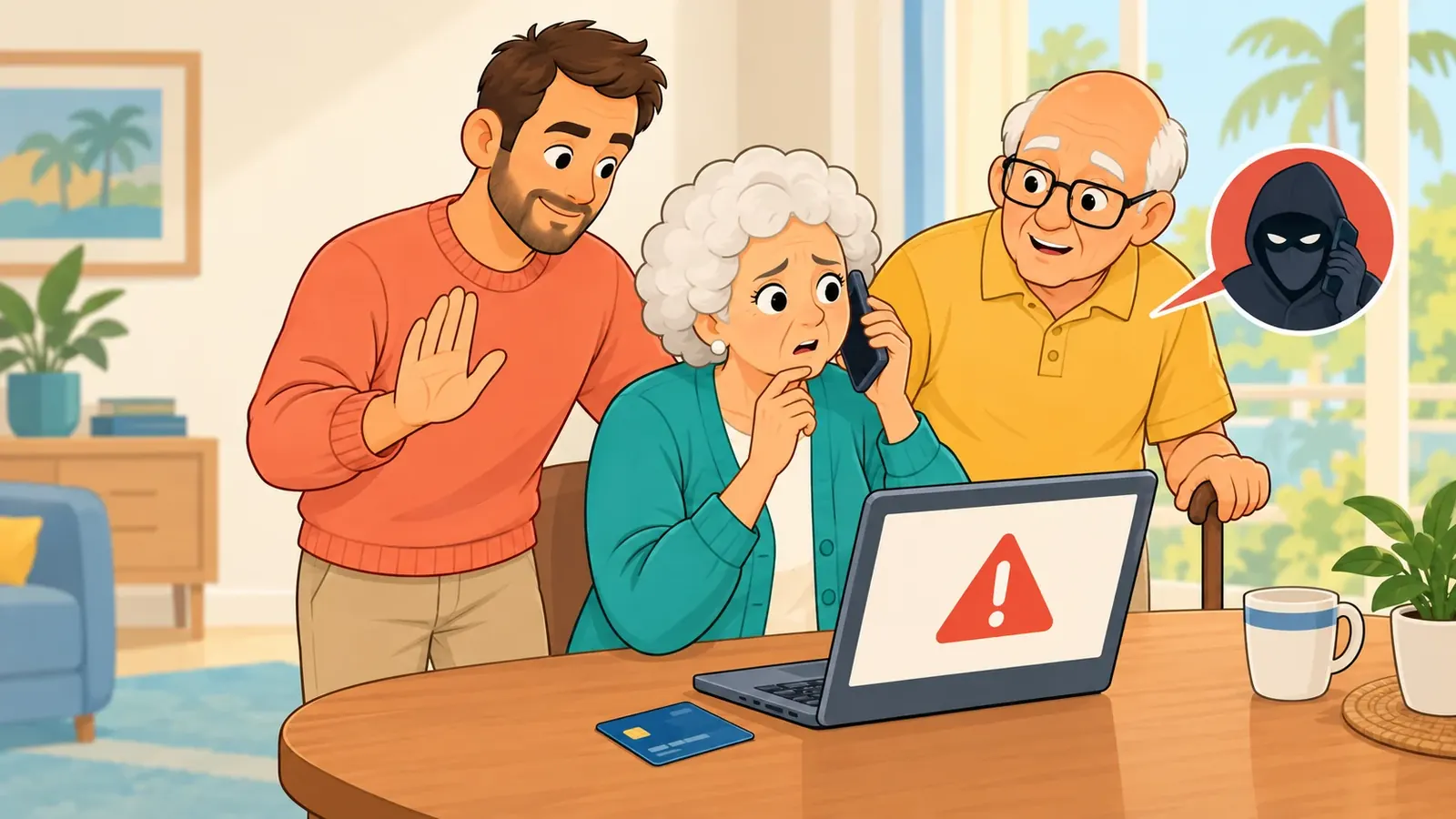
If you suspect someone is exploiting an older or vulnerable adult in Florida, report it to the Florida Abuse Hotline at 1-800-962-2873, or call 911 if the person is in immediate danger. Then move to protect the money. Florida law lets banks delay suspicious transactions, and it lets a court freeze accounts through an injunction for protection against exploitation, with no filing fee.
Last checked: The statutes cited here are as they read in November 2026. The FBI loss figures are from its 2025 report, and the FBI usually publishes the next year's figures in the spring. Check for updates after spring 2027.
Consider a hypothetical widower in Jupiter who is 81 and starting to forget things. His daughter in Ohio sees three things on his statements: checks to a man he met at the gym eight months ago, a new debit card, and $40,000 moved out of his savings. He says the man is "helping with paperwork." She doesn't know whether to call the police, the bank or a lawyer first. The steps below follow the order that usually works.
What Florida law calls exploitation
Florida has two definitions.
The adult protective services law covers "vulnerable adults." These are people 18 or older whose ability to care for or protect themselves is impaired, including by the infirmities of aging. Under that law, exploitation means that someone in a position of trust uses deception or intimidation to get the adult's money or property. It also covers anyone who takes money from an adult they know, or should know, lacks the capacity to consent (Fla. Stat. 415.102).
The criminal law covers "elderly persons," meaning people 60 or older whose ability to care for themselves is impaired, and disabled adults (Fla. Stat. 825.101). It reaches more conduct than the civil definition. It covers people with a business relationship with the victim. It also covers a guardian, trustee or agent under a power of attorney who breaches a fiduciary duty, and anyone who misuses a will or trust to get money (Fla. Stat. 825.103(1)).
One rule fits the Jupiter example closely. When someone 65 or older transfers more than $10,000 to a nonrelative they've known for less than two years, without getting fair value in return, the law creates a permissive presumption that the transfer was exploitation. That applies whether the parties called it a gift or a loan, unless it's a written loan with definite repayment dates that isn't in default (Fla. Stat. 825.103(2)).
Signs families notice first
According to federal consumer regulators, common signs include (CFPB):
money missing from accounts, unexplained withdrawals or wires bills going unpaid new names on accounts statements that stop arriving gifts to a "new best friend" changes to beneficiaries someone new suddenly handling the money
Regulators also flag a new power of attorney, a change to a joint account, and a caregiver who won't let the older person speak for themselves (CFPB report to financial institutions).
For outside scams, such as callers posing as a grandchild or a government agency, see our scam warning list. This page covers what to do once money is moving.
Step one: report it
Under Florida law, anyone who knows or has reasonable cause to suspect that a vulnerable adult is being exploited must report it right away to the central abuse hotline. The listed reporters include bank, savings and loan and credit union employees, and investment advisers (Fla. Stat. 415.1034). The Hotline is 1-800-962-2873, and you can also report online (Florida DCF).
Where to report beyond the Hotline:
Theft in progress or threats: call local law enforcement. Fraud by strangers, especially by phone, online or through cryptocurrency: file with the FBI's Internet Crime Complaint Center at ic3.gov and with the FTC at ReportFraud.ftc.gov. Help working out where to report: the Justice Department's National Elder Fraud Hotline is 1-833-372-8311, weekdays from 10 a.m. to 6 p.m. Eastern (Office for Victims of Crime).
Keep dated copies of statements, texts and notes.
Step two: stop the money
Call the bank. A Florida bank that reports suspected exploitation of someone 65 or older can delay a disbursement or transaction. Within 3 business days it must notify, in writing, everyone authorized on the account and any "trusted contact." It doesn't notify anyone it believes is the exploiter. The delay ends after 15 business days and can be extended by up to 30 more, and a court can shorten or lengthen it (Fla. Stat. 415.10341). A trusted contact is someone 18 or older whom the account owner names in the bank's records (Fla. Stat. 415.10341(1)(d)). Ask your parent to name one now, before there is a problem.
Ask the court for an injunction. Florida has a specific injunction for protection against exploitation of a vulnerable adult. These people can file (Fla. Stat. 825.1035):
the vulnerable adult a guardian someone acting with the adult's consent an agent whose durable power of attorney specifically grants the authority a person who files at the same time for an emergency temporary guardian
The petition can ask the court to:
bar contact freeze the adult's accounts and credit lines, even accounts held jointly with the respondent or in the respondent's name alone set out which critical expenses keep getting paid during the freeze
The petitioner must certify that the matter has been reported to the Hotline. The clerk helps with the forms and can't charge a filing fee. If the judge finds immediate danger, an ex parte temporary injunction can be entered and lasts up to 15 days. It can be extended once, for up to 30 more days, before the full hearing (Fla. Stat. 825.1035).
Step three: deal with a power of attorney
If the parent still has capacity. They can revoke a power of attorney with a later signed writing and give notice to the agent (Fla. Stat. 709.2110). Signing a new POA doesn't revoke the old one by itself, so the new document should say so. Send copies to every bank and brokerage.
If the parent can't act. A court can review an agent's conduct, remove the agent and grant other relief. Family members who show a good-faith interest in the parent's welfare can file that petition (Fla. Stat. 709.2116).
What a Florida agent must do and can't do. Agents must keep records of every receipt, disbursement and transaction (Fla. Stat. 709.2114). They may make gifts, change beneficiaries or create survivorship rights only if the principal separately signed or initialed each of those powers. Unless the document says otherwise, a general gift power is capped at the federal annual exclusion per person (Fla. Stat. 709.2202). If an agent used a POA to pay themselves large "gifts," compare the transfers with the initialed pages.
Step four: lock down credit and identity
Credit freeze. A freeze is free and lasts until it's lifted, but you have to place it separately with Equifax, Experian and TransUnion (FTC).
Fraud alert. An initial fraud alert lasts one year. An extended alert, available with an FTC identity theft report or police report, lasts seven years. For either one, contacting one bureau is enough, because that bureau tells the other two (FTC).
Other changes. Change online banking passwords and the email on file. Ask the post office about any change-of-address requests you didn't make.
Getting money back, and the Medicaid problem
A civil lawsuit. A vulnerable adult who has been exploited can sue for actual and punitive damages. The prevailing party may recover attorney's fees (Fla. Stat. 415.1111).
Return of seized property. In a criminal case involving more than $5,000, the court can order seized property returned to the victim before trial (Fla. Stat. 825.103(4)).
Loss of inheritance. Someone convicted of exploiting the decedent loses any benefits under the will and the Probate Code. A court can also make that finding by the greater weight of the evidence without a conviction (Fla. Stat. 732.8031).
The Medicaid problem. Families often miss this one. If the parent later applies for Medicaid long-term care, DCF reviews transfers from the past five years. Money taken by an exploiter can look like a gift. DCF's manual lists exploitation, meaning "another person stole the funds of the individual," as a factor that can rebut the presumption that a transfer was made to qualify for Medicaid (ESS Policy Manual 1640.0616). A police report, an APS finding or an injunction order is the kind of evidence that helps. Undue hardship is a separate route (ESS Policy Manual 1640.0617).
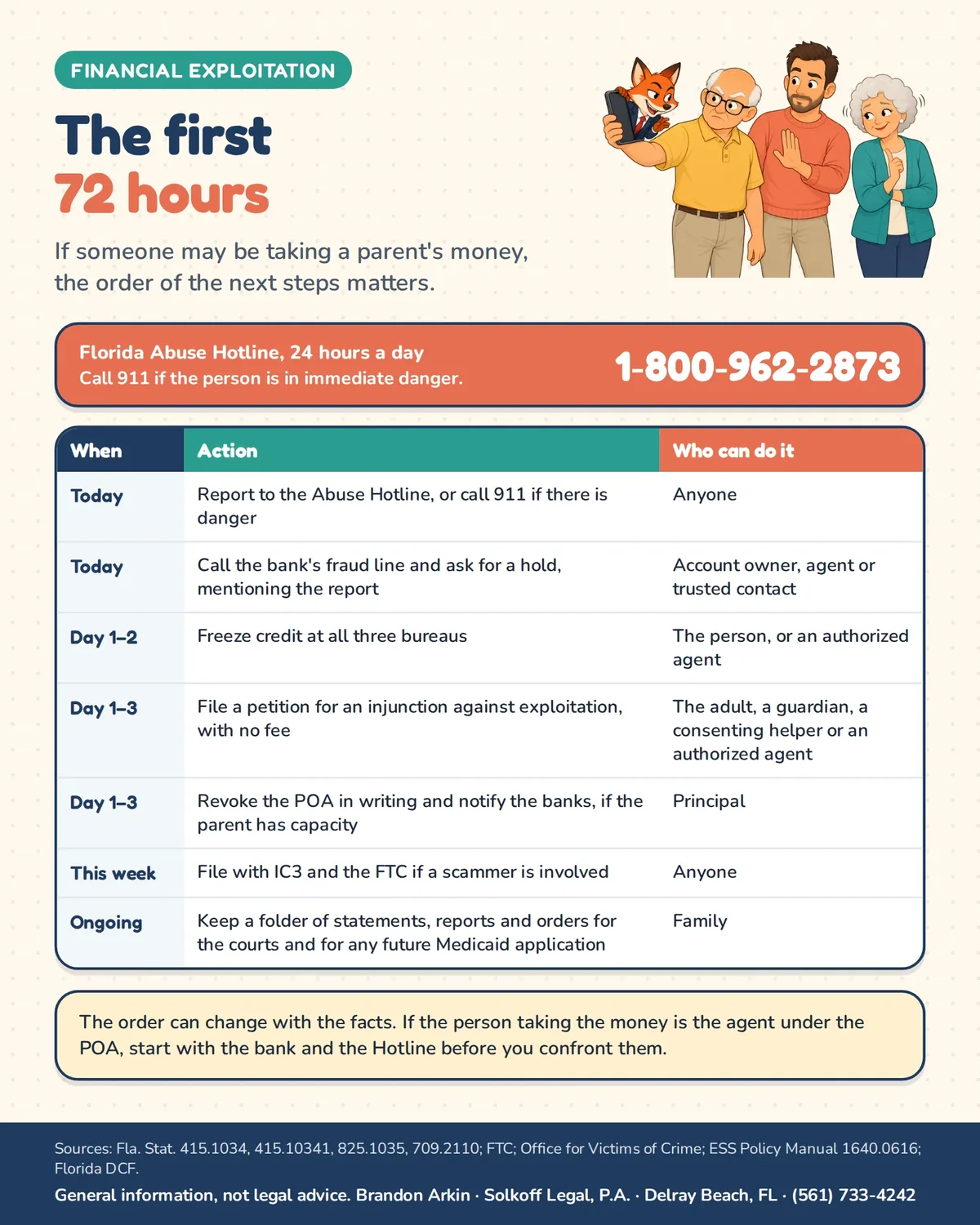
The first 72 hours: an action table
| When | Action | Who can do it | Authority |
|---|---|---|---|
| Today | Report to the Abuse Hotline at 1-800-962-2873, or call 911 if there is danger | Anyone | Fla. Stat. 415.1034 |
| Today | Call the bank's fraud line and ask for a hold, mentioning the report | Account owner, agent or trusted contact | Fla. Stat. 415.10341 |
| Day 1–2 | Freeze credit at all three bureaus | The person, or an authorized agent | FTC |
| Day 1–3 | File a petition for an injunction against exploitation, with no fee | The adult, a guardian, a consenting helper or an authorized agent | Fla. Stat. 825.1035 |
| Day 1–3 | Revoke the POA in writing and notify the banks, if the parent has capacity | Principal | Fla. Stat. 709.2110 |
| This week | File with IC3 and the FTC if a scammer is involved | Anyone | Office for Victims of Crime |
| Ongoing | Keep a folder of statements, reports and orders for the courts and for any future Medicaid application | Family | ESS Policy Manual 1640.0616 |
When
Today
Action
Report to the Abuse Hotline at 1-800-962-2873, or call 911 if there is danger
Who can do it
Anyone
Authority
Fla. Stat. 415.1034
When
Today
Action
Call the bank's fraud line and ask for a hold, mentioning the report
Who can do it
Account owner, agent or trusted contact
Authority
Fla. Stat. 415.10341
When
Day 1–2
Action
Freeze credit at all three bureaus
Who can do it
The person, or an authorized agent
Authority
FTC
When
Day 1–3
Action
File a petition for an injunction against exploitation, with no fee
Who can do it
The adult, a guardian, a consenting helper or an authorized agent
Authority
Fla. Stat. 825.1035
When
Day 1–3
Action
Revoke the POA in writing and notify the banks, if the parent has capacity
Who can do it
Principal
Authority
Fla. Stat. 709.2110
When
This week
Action
File with IC3 and the FTC if a scammer is involved
Who can do it
Anyone
Authority
Office for Victims of Crime
When
Ongoing
Action
Keep a folder of statements, reports and orders for the courts and for any future Medicaid application
Who can do it
Family
Authority
ESS Policy Manual 1640.0616
Tick boxes stay on this device. Nothing is saved or sent.
Common questions
What should I do first if I think a parent is being financially exploited in Florida?
Report it to the Florida Abuse Hotline at 1-800-962-2873, or call 911 if there is immediate danger (Florida DCF). Then call the bank. Florida banks can delay suspicious transactions for 15 business days after a report (Fla. Stat. 415.10341).
Can a court freeze a joint account the exploiter is on?
Yes. In an injunction for protection against exploitation, the court has discretion to freeze the vulnerable adult's assets even if they are held jointly with the respondent or in the respondent's name alone (Fla. Stat. 825.1035).
Is it exploitation if my mother says the money was a gift?
It can be. Transfers of more than $10,000 by someone 65 or older to a nonrelative known for less than two years, without fair value in return, create a presumption of exploitation even when the transfer was called a gift (Fla. Stat. 825.103(2)).
Will stolen money count against my parent for Medicaid?
DCF reviews transfers, but its manual lists exploitation as a factor that can rebut the presumption that the transfer was made to qualify for Medicaid (ESS Policy Manual 1640.0616). Documentation matters, so keep reports and court orders.
If your family is facing one of these questions, you can reach Brandon Arkin at Solkoff Legal, P.A. at (561) 733-4242.
Related on this site
Talk through the next step
Bring your questions, a list of accounts and any papers a hospital, nursing home or Medicaid office has sent you. Call the Delray Beach office or request a consultation, and I can look at where things stand and what may come next. A phone call or an email does not by itself create an attorney-client relationship.
Solkoff Legal, P.A. · (561) 733-4242