Resources · Residents' rights
Nursing home discharge appeals in Florida: the notice, the 10-day window and what happens at the hearing
By Brandon Arkin, elder law attorney, Solkoff Legal, P.A. · Updated November 2026

In Florida, a resident who gets a nursing home discharge or transfer notice can ask for a fair hearing with the Department of Children and Families (DCF) Office of Appeal Hearings at any time within 90 days. If the request is made within 10 days of receiving the notice, the resident generally may stay in the facility until the hearing decision, except in a documented emergency.
What counts as a discharge
Florida law uses two terms. A discharge is a move to a noninstitutional setting, such as home or an assisted living facility, where the nursing home stops being responsible for care. A transfer is a move to another institution, such as a different nursing home (Fla. Stat. 400.0255(1)). The same rights apply to both.
These rules cover moves the facility starts. They don't apply when the resident, the resident's doctor or a guardian or representative chooses the move (400.0255(17)). Be careful before signing anything that describes a move as "voluntary" if it wasn't.
One situation families often miss: a resident goes to the hospital, and the nursing home then says it won't take them back. Federal rules treat that refusal as a discharge, so the facility must follow the same notice and appeal rules (42 CFR 483.15(e)(1)(ii)).
The six lawful reasons
A Medicare- or Medicaid-certified nursing home must let a resident stay unless one of these applies (42 CFR 483.15(c)(1)(i)):
The resident's needs can't be met in the facility, and the move is necessary for their welfare. The resident's health has improved, so they no longer need the facility's services. The resident's clinical or behavioral status endangers the safety of others. The health of others would otherwise be endangered. Nonpayment after reasonable and appropriate notice. The facility is closing.
For reasons 1 and 2, the resident's physician must document the basis in the medical record. For reason 1, the record must also show the specific needs the facility can't meet, what it tried, and what the receiving setting offers (483.15(c)(2)). On AHCA's notice form, the four medical and safety reasons need a physician's signature or attached order (AHCA Form 3120-0002).
Nonpayment and Medicaid pending
Nonpayment is the reason most tied to elder law. Under the federal rule, it applies if the resident doesn't submit the paperwork needed for third-party payment, or if Medicare or Medicaid denies the claim and the resident refuses to pay (42 CFR 483.15(c)(1)(i)(E)). So a Medicaid application that is filed and being worked on in good faith is generally a strong answer to a nonpayment notice. An application stalled because no one sent DCF the requested papers is a weak one.
Florida adds that a Medicaid-certified facility may not discharge a resident solely because the payment source changes, for example from private pay to Medicaid. Any admission document waiving that right is void (Fla. Stat. 400.022(1)(p)).
If the notice cites nonpayment, gather proof right away: the application date, DCF's pending notice, each document sent and the patient responsibility paid so far. After you apply for Medicaid explains those deadlines.
What the notice must say
Florida requires AHCA's standard form. It must be signed by the administrator or a designee and state the reason, the effective date and the place the resident is going (Fla. Stat. 400.0255(3), (8)). Federal rules add appeal rights and contact details for the appeals office and the Ombudsman, and the facility must send the Ombudsman a copy (42 CFR 483.15(c)(3), (5)).
The 30 days can be shortened to "as soon as practicable" only in limited cases. These include urgent medical needs or danger to others, documented by a physician, and residents who haven't lived there 30 days (400.0255(7); 483.15(c)(4)). A notice missing a destination, a physician's documentation or appeal information may itself be a defect worth raising.
Asking for the hearing
The resident, or their legal representative or designee, asks DCF's Office of Appeal Hearings for a fair hearing. Under Fla. Stat. 400.0255(10):
Within 10 days of receiving the notice: the request stays the discharge. The resident may remain until the initial hearing decision. After 10 days but within 90: the hearing still happens, but the stay isn't automatic, and the facility may try to discharge after the 30-day period. If day 10 has passed, get advice right away and ask for the hearing and a stay anyway. If the resident wins, they must be readmitted to the first available bed (400.0255(15)(c)).
Federal rules also bar a move while an appeal is pending, unless staying would endanger the resident or others and the facility documents that danger (42 CFR 483.15(c)(1)(ii)).
How to ask: call or write the DCF Office of Appeal Hearings, 2415 North Monroe Street, Suite 400-I, Tallahassee, FL 32303-4190, (850) 488-1429 (DCF), or email appeal.hearings@myflfamilies.com, the address on AHCA's form. Facility staff must help with the request if asked (AHCA Form 3120-0002). Ask in writing too, and keep proof of the date.
The Ombudsman's role
The State Long-Term Care Ombudsman Program is a free, confidential advocate for residents. A resident can ask it to review any discharge notice, and the local council must do so within 7 days of the request. If the request is made through the facility, the administrator must forward it within 24 hours. If it doesn't, the 30-day notice period stops running until it does (Fla. Stat. 400.0255(9)). The Ombudsman can also help file the appeal and may attend the hearing (400.0255(12)–(13)).
Call 1-888-831-0404 (Ombudsman). Calling the Ombudsman doesn't replace the hearing request. Do both inside the 10 days.
What happens at the hearing
Most DCF hearings are by phone, though a resident may ask for one in person (DCF). The resident or representative and the facility administrator or its representative must attend (400.0255(13)).
The facility carries the burden, and the standard is clear and convincing evidence, a demanding standard. A decision must issue within 90 days of the request. It is final at the agency level, and either side may appeal to the district court of appeal (400.0255(15)). Useful evidence often includes care plans, physician notes, therapy records, payment records and proof of the Medicaid application.
Example (hypothetical)
Rosa, 84, has lived in a Boca Raton nursing home for a year. Her savings ran out in May, and her son filed a Medicaid application in June. On July 2 the home hands him a notice citing nonpayment, with an August 1 move date and "home with family" as the destination. On July 6 he calls the Office of Appeal Hearings, follows up by email and asks the Ombudsman to review. Because he asked within 10 days, Rosa may generally stay until the decision. At the hearing, his proof of the application and the documents sent to DCF go to whether nonpayment applies at all.
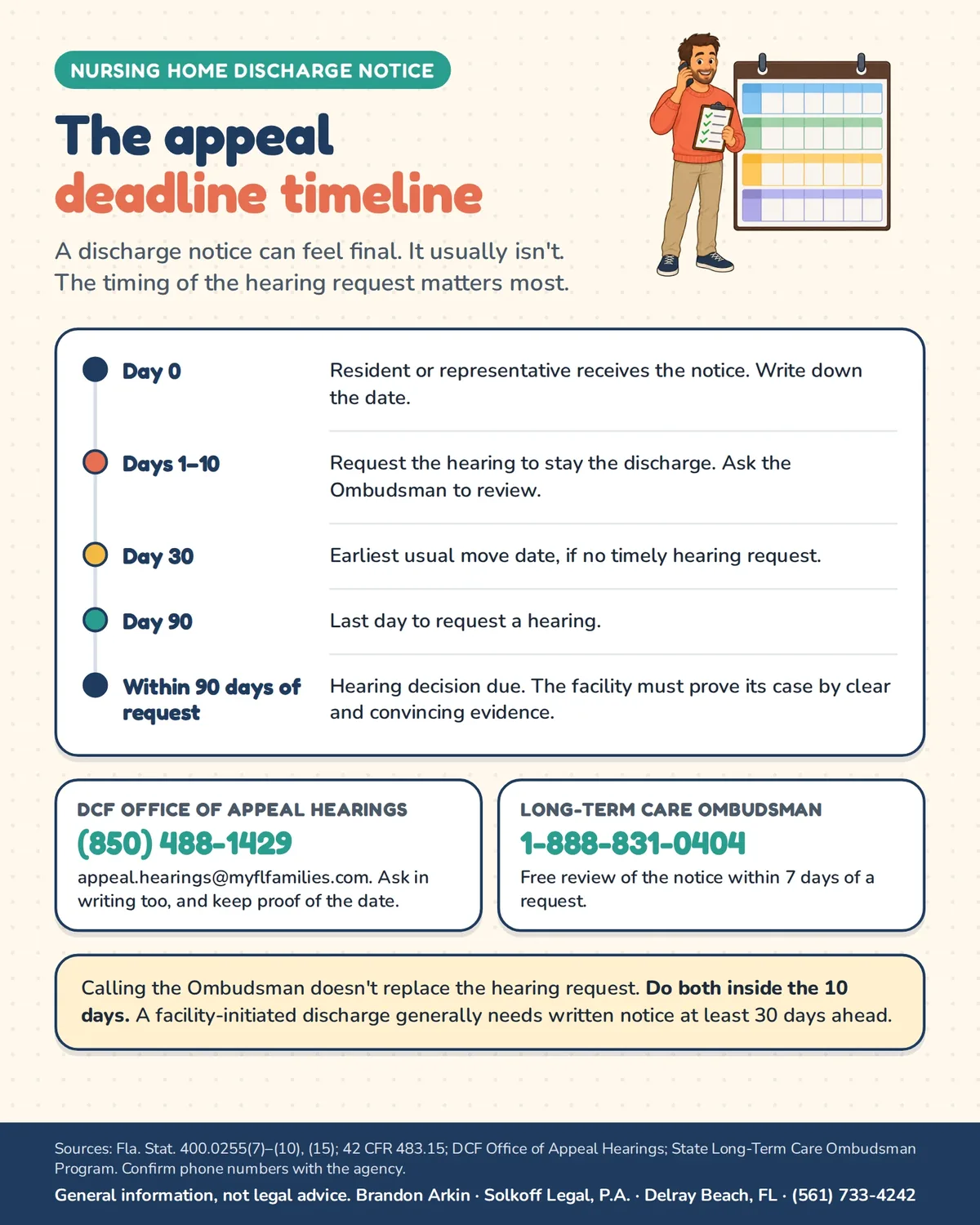
Deadline timeline
| When | What happens |
|---|---|
| Day 0 | Resident or representative receives the notice. Write down the date. |
| Days 1–10 | Request the hearing to stay the discharge. Ask the Ombudsman to review. |
| Day 30 | Earliest usual move date, if no timely hearing request. |
| Day 90 | Last day to request a hearing. |
| Within 90 days of request | Hearing decision due. |
When
Day 0
What happens
Resident or representative receives the notice. Write down the date.
When
Days 1–10
What happens
Request the hearing to stay the discharge. Ask the Ombudsman to review.
When
Day 30
What happens
Earliest usual move date, if no timely hearing request.
When
Day 90
What happens
Last day to request a hearing.
When
Within 90 days of request
What happens
Hearing decision due.
A script for families
Print this and keep it by the phone. Fill in the blanks before calling. Nothing is saved.
Tick boxes stay on this device. Nothing is saved or sent.
Common questions
How long do I have to appeal a nursing home discharge in Florida?
A resident, or their legal representative or designee, may request a fair hearing with DCF's Office of Appeal Hearings at any time within 90 days after receiving the facility's notice. The 10-day mark is the one that matters most. A request within 10 days generally stays the discharge, so the resident may remain in the facility until the hearing decision. After 10 days, the stay isn't automatic, and the facility may try to move the resident once the 30-day notice period ends, even though the hearing still goes forward. If day 10 has passed, get advice right away and request the hearing and a stay anyway. Emergency moves are handled differently.
Can a nursing home discharge my parent while Medicaid is pending?
It depends on the facts. Federal rules define nonpayment to include failing to submit the paperwork needed for Medicaid, or refusing to pay after Medicaid denies the claim. A complete, timely application being worked on in good faith is generally a strong response to a nonpayment notice. Florida also bars a Medicaid-certified facility from discharging a resident solely because the payment source changes. Keep proof of the application date, DCF's pending notice and every document sent, and keep paying any expected patient responsibility.
Can a nursing home refuse to take my parent back after a hospital stay?
Not without following the discharge rules. Federal regulations require a written policy letting residents return after a hospitalization, to their previous room if available or to the first available semi-private bed, if they still need the care and are eligible for Medicare or Medicaid coverage. If the facility decides a resident can't return, it must treat that as a discharge, with written notice, a lawful reason and appeal rights. A family facing this should call the Ombudsman and request a hearing quickly.
Who has to prove the discharge is justified?
The facility. Florida's statute sets the burden of proof at clear and convincing evidence for these hearings, a demanding standard. The hearing officer looks at whether the reason is one the law allows and whether the notice and documentation requirements were met. A decision must be issued within 90 days after the hearing request. If the resident wins after already being moved, the facility must readmit them to the first available bed.
If your family is facing one of these questions, you can reach Brandon Arkin at Solkoff Legal, P.A. at (561) 733-4242.
Related on this site
Talk through the next step
Bring your questions, a list of accounts and any papers a hospital, nursing home or Medicaid office has sent you. Call the Delray Beach office or request a consultation, and I can look at where things stand and what may come next. A phone call or an email does not by itself create an attorney-client relationship.
Solkoff Legal, P.A. · (561) 733-4242