Resources · Estate planning
Signing a will or power of attorney online in Florida: what remote online notarization allows, and where it stops
By Brandon Arkin, elder law attorney, Solkoff Legal, P.A. · Updated November 2026
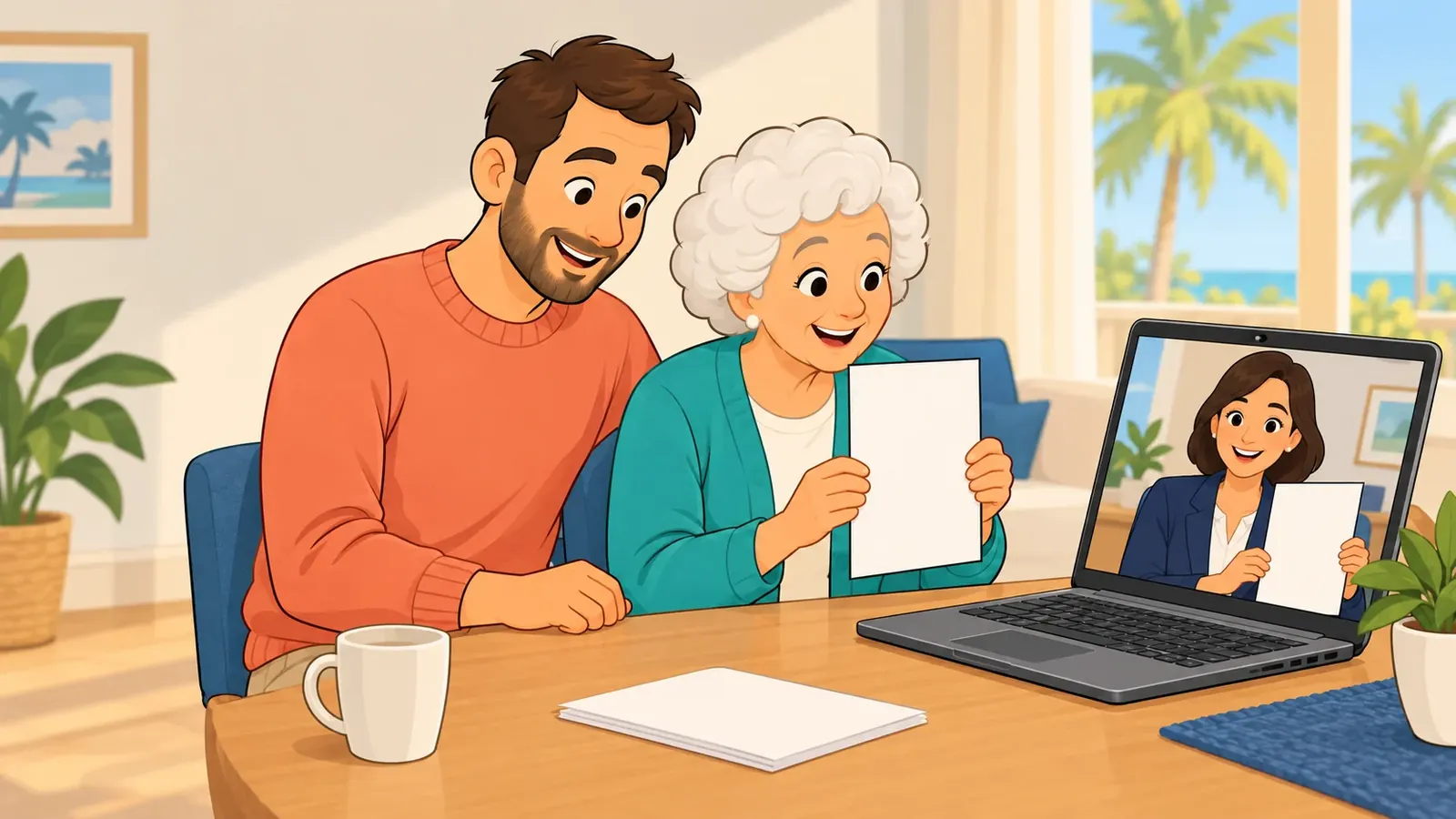
Florida allows remote online notarization under Chapter 117, Part II, and wills, revocable trusts, powers of attorney and health care advance directives can be signed with witnesses appearing by video if a registered Florida online notary supervises. But remote witnessing of those documents isn't effective for a "vulnerable adult," and it can't grant a power of attorney's gifting and trust powers, so many seniors are better served by a signing with witnesses physically in the room.
How online notarization works
In an online notarization, the signer and any witnesses appear before the notary by live, two-way audio-video technology instead of in the same room (Fla. Stat. 117.201). The notary must be physically in Florida, but the signer and witnesses may be elsewhere (117.209(3)). A signer outside Florida must confirm they want a Florida notary under Florida law (117.265(3)).
Identity is checked by personal knowledge or by three steps: an image of a government ID, an automated check of that ID, and identity proofing, often questions drawn from credit or public records (117.265(4)). If identity can't be confirmed, the notarization can't go ahead. The whole session is recorded (117.245(2)).
A remote witness must state on the recording that they're in the United States or a U.S. territory (117.285(4)). A signer can't serve as a witness to their own signature (117.265(2)).
The extra rules for estate documents
Florida singles out certain documents (Fla. Stat. 117.285(5)):
wills; revocable trusts with provisions that take effect at death; health care advance directives, such as a living will or surrogate designation; agreements and waivers of spousal rights under 732.701 and 732.702; and powers of attorney with the banking or investment powers in 709.2208, which most financial POAs include.
When fewer than two witnesses are physically with the signer, three steps apply.
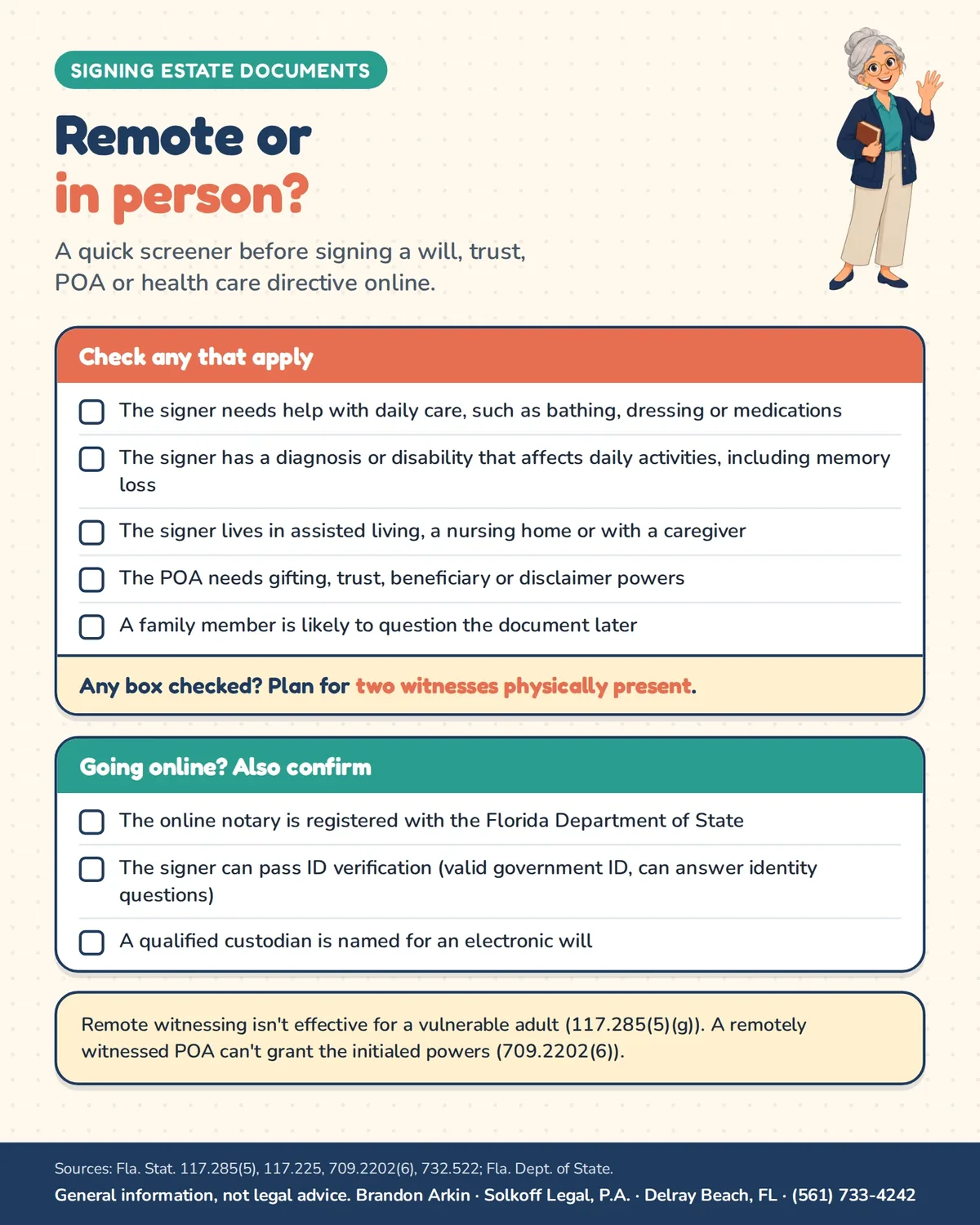
First, the online platform must ask whether the signer is impaired by drugs or alcohol, has a condition or long-term disability that impairs normal daily activities, or needs help with daily care. If any answer is yes, only witnesses physically present can validly witness the signature (117.285(5)(a)–(b)).
Second, the signer gets a written notice that documents signed by a vulnerable adult aren't valid if witnessed by video (117.285(5)(c)).
Third, the notary must ask, on the recording, whether the signer is married and to whom, who helped them get on the call, who helped prepare the documents, where they are and who is in the room (117.285(5)(d)). The answers can be evidence in a later challenge, but an incorrect answer alone can't void the document (117.285(5)(f)).
None of these steps apply if at least two witnesses are physically present with the signer, even if the notary is online (117.285(5)(k)).
The vulnerable adult problem
Remote witnessing "is not effective" for a principal who is a vulnerable adult (117.285(5)(g)). Florida defines a vulnerable adult as someone 18 or older whose ability to perform normal daily activities, or to provide for their own care or protection, is impaired by a mental, emotional, sensory, long-term physical or developmental disability, brain damage or "the infirmities of aging" (Fla. Stat. 415.102(28)).
That definition can reach many elder law clients: a parent with early dementia, someone recovering from a stroke, or a resident of assisted living. The person challenging the document must prove vulnerability (117.285(5)(g)). But a will or trust that might draw a contest is exactly the document you don't want to defend on that question. When there's any doubt, two witnesses in the room remove the issue.
Powers of attorney signed online
A Florida power of attorney needs two witnesses and a notary (Fla. Stat. 709.2105). It can be done online, but there's a significant limit. If a Florida resident's POA is witnessed by someone not physically present, it can't grant the powers that require the principal's initials next to each one (709.2202(6)). Those powers include creating or changing a trust, making gifts, changing beneficiary designations or survivorship rights, and disclaiming property (709.2202(1)).
Those are often the powers used in Medicaid and long-term care planning. A POA signed online may cover everyday banking and still leave the family unable to plan later. The statute preserves the rest of the POA's authority for real estate, commercial and consumer transactions (117.285(5)(h)).
Electronic wills and their limits
An electronic will is signed with an electronic signature. Witnesses may appear by video only in a supervised online notarization session that complies with 117.285 (Fla. Stat. 732.522). Otherwise, it's judged like any other will.
To be self-proved, an electronic will must name a "qualified custodian" and stay in that custodian's custody until it's offered for probate. The custodian then certifies under oath that it wasn't altered (732.523). A qualified custodian must be based in Florida, use a secure system, and carry a $250,000 bond or insurance (732.524; 732.525). It must deposit the will with the court on learning of the death (732.524(11)).
Other limits worth knowing:
If the session recording can't be produced, the electronic will is treated as lost or destroyed. Proving it then requires witness testimony (117.245(5); 733.207). A substantial failure to follow online notarization procedures can cost the will its self-proved status (733.201(1)). An electronic will can be revoked by deleting or rendering it unreadable with intent to revoke, proved by clear and convincing evidence (732.506).
The custody rules give an electronic will a longer chain of evidence than a paper original in a safe. For many families, a paper will remains the simpler choice.
Example (hypothetical)
Ruth, 88, lives in an assisted living facility in Jupiter. Her son in Ohio suggests signing a new will and POA online. On the platform's screening questions, Ruth truthfully answers that she needs help with bathing and medications. Under the statute, her signature can now be validly witnessed only by people physically present. Even if she had answered no, a POA witnessed by video couldn't grant the gifting and trust powers her family may later need for Medicaid planning. A signing at the facility with two witnesses in the room and a notary avoids both problems.
Which documents, and how
| Document | Remote witnesses allowed? | Main limit |
|---|---|---|
| Will or codicil | Yes, as an electronic will | Vulnerable-adult rule; qualified custodian needed for self-proof |
| Revocable trust (death provisions) | Yes | Vulnerable-adult rule applies to the death provisions (117.285(5)(h)) |
| Durable power of attorney | Yes | No gifting, trust or beneficiary powers (709.2202(6)) |
| Health care surrogate or living will | Yes | Vulnerable-adult rule |
| Prenuptial or spousal waiver | Yes | Vulnerable-adult rule |
| Affidavit or other document needing only a notary | Online notarization generally available (117.209) | Identity proofing; recording |
Document
Will or codicil
Remote witnesses allowed?
Yes, as an electronic will
Main limit
Vulnerable-adult rule; qualified custodian needed for self-proof
Document
Revocable trust (death provisions)
Remote witnesses allowed?
Yes
Main limit
Vulnerable-adult rule applies to the death provisions (117.285(5)(h))
Document
Durable power of attorney
Remote witnesses allowed?
Yes
Main limit
No gifting, trust or beneficiary powers (709.2202(6))
Document
Health care surrogate or living will
Remote witnesses allowed?
Yes
Main limit
Vulnerable-adult rule
Document
Prenuptial or spousal waiver
Remote witnesses allowed?
Yes
Main limit
Vulnerable-adult rule
Document
Affidavit or other document needing only a notary
Remote witnesses allowed?
Online notarization generally available (117.209)
Main limit
Identity proofing; recording
Remote or in person? A screener
If you check any of the first five, plan for two witnesses physically present. Nothing is saved.
Tick boxes stay on this device. Nothing is saved or sent.
Common questions
Can I sign my will online in Florida?
Yes, as an electronic will, if witnesses join through a supervised online notarization session with a Florida online notary that follows 117.285. You'll answer screening questions and, if fewer than two witnesses are physically with you, five questions on the recording about your marriage, who helped you and who is in the room. To be self-proved, an electronic will must name a qualified custodian that keeps it until probate. Remote witnessing isn't effective if you're a vulnerable adult, so many seniors sign with witnesses physically present.
What is a vulnerable adult for remote witnessing?
Florida uses its adult protective services definition: someone 18 or older whose ability to perform normal daily activities, or to provide for their own care or protection, is impaired by a mental, emotional, sensory, long-term physical or developmental disability, brain damage or the infirmities of aging. If the signer was a vulnerable adult, remote witnessing of a will, trust, advance directive, spousal waiver or covered POA isn't effective. Whoever challenges the document must prove it. Having two witnesses physically present avoids the question.
Is a power of attorney signed online valid in Florida?
It can be valid for many purposes, but with a gap. If a Florida resident's POA is witnessed by someone who isn't physically present, it can't grant the powers that require separate initials. These include making gifts, creating or changing a trust, changing beneficiary designations or survivorship rights and disclaiming property. Those powers often matter for Medicaid and long-term care planning. The rest of the POA, such as banking and real estate authority, can still work if the other requirements are met.
How much does a Florida online notary charge?
Florida caps the fee for an online notarial act at $25. That cap doesn't cover the separate fees a remote online notarization platform may charge for its technology, storage or other services, and it doesn't cover legal fees for preparing the documents. A qualified custodian for an electronic will may also charge for access and downloads. However, it can't charge for the first paper copy requested by the testator or for depositing the will with the court.
If your family is facing one of these questions, you can reach Brandon Arkin at Solkoff Legal, P.A. at (561) 733-4242.
Related on this site
Talk through the next step
Bring your questions, a list of accounts and any papers a hospital, nursing home or Medicaid office has sent you. Call the Delray Beach office or request a consultation, and I can look at where things stand and what may come next. A phone call or an email does not by itself create an attorney-client relationship.
Solkoff Legal, P.A. · (561) 733-4242