Resources · Estate planning
Living will vs. last will in Florida: two documents with similar names and very different jobs
By Brandon Arkin, elder law attorney, Solkoff Legal, P.A. · Updated November 2026
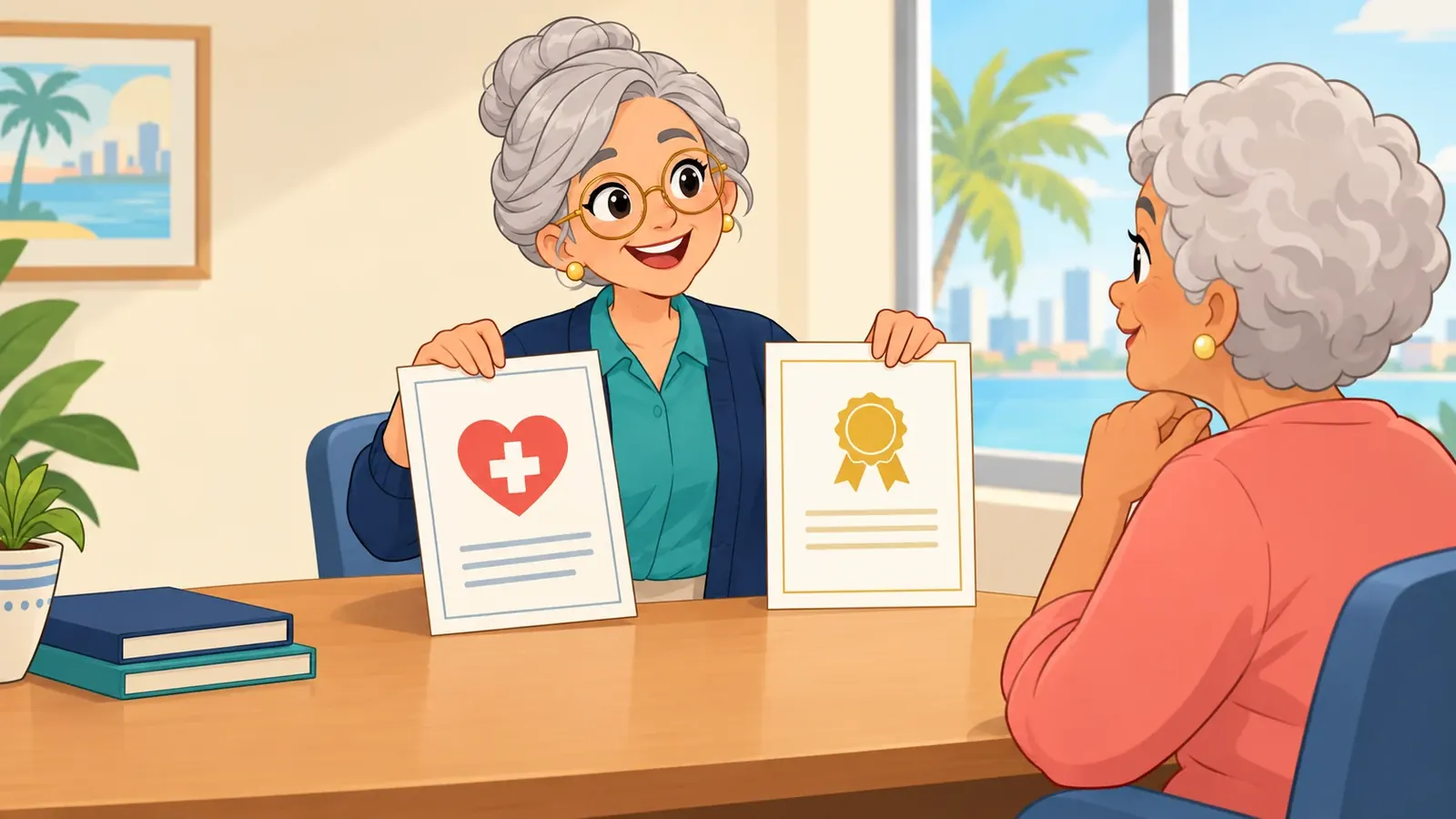
In Florida, a living will states your wishes about life-prolonging medical procedures and works only while you're alive, if you can't decide for yourself and have a terminal condition, an end-stage condition or a persistent vegetative state. A last will says who receives your property and who settles your estate, and it takes effect only at death.
Why the names confuse people
Both documents use the word "will" because both record what you want. That's where the similarity ends. Florida law calls the living will a "declaration" about life-prolonging procedures (Fla. Stat. 765.101(13)). The last will, sometimes called a "last will and testament," is a property document governed by the Florida Probate Code.
A third document adds to the confusion: the revocable "living trust." It's a property document, like a will, that can also work during your life. Florida revocable trusts explains it.
When a living will takes effect
A living will doesn't switch on just because you're in the hospital. While you can make your own decisions, your wishes control (Fla. Stat. 765.204(1)). Before life-prolonging procedures are withheld or withdrawn under a living will, it must be determined that (Fla. Stat. 765.304(2)):
you have no reasonable medical probability of recovering capacity; you have a terminal condition, an end-stage condition or a persistent vegetative state; and any limits you stated have been considered and met.
Two physicians must examine you separately and sign their findings in the record (765.306). Comfort care and pain relief aren't "life-prolonging procedures," so a living will doesn't refuse them (765.101(12)). A properly signed living will creates a rebuttable presumption of clear and convincing evidence of your wishes (765.302(3)).
When a last will takes effect
A last will has no legal effect during your life. You can change or revoke it at any time while you have capacity. At death, it generally goes through probate, the court process that confirms the will and gives the personal representative authority to act. Probate in Florida walks through that process.
A will also doesn't control everything. Accounts with a beneficiary form, payable-on-death accounts, jointly owned property with survivorship and assets in a trust pass outside the will. If the will says "my IRA goes to my son" but the IRA form names your daughter, the form usually wins.
Where the surrogate and POA fit
A living will says what you want. A health care surrogate designation names who speaks for you. It is signed before two adult witnesses, the surrogate can't be one of them, and at least one witness must not be your spouse or a blood relative (Fla. Stat. 765.202). The surrogate covers all health care decisions, not just end-of-life ones, and can be given authority right away rather than only after a finding of incapacity.
If there's no surrogate, decisions fall to a proxy from the statutory list: a guardian, then a spouse, then a majority of adult children who are reasonably available, then parents, siblings and others (765.401). "Majority of the children" is a hard standard in a family that disagrees.
A durable power of attorney covers money and property during life. It must be signed by you and two witnesses and acknowledged before a notary (Fla. Stat. 709.2105). It ends at death, which is when the will takes over (709.2109).
Question Document that answers it Who talks to my doctors if I can't? Health care surrogate designation Do I want a ventilator if I won't recover? Living will Who pays my bills if I have dementia? Durable power of attorney Who gets my house when I die? Last will, trust or deed Who raises my minor children? Last will
The 5 legal documents every Florida adult needs covers each one's signing basics.
Example (hypothetical)
Helen, 81, signed a will years ago and assumed it covered "everything." After a severe stroke she can't speak, and her doctors say she's unlikely to recover. Her will names her daughter as personal representative, but it says nothing about medical care and has no power until Helen dies. With no living will and no surrogate, the hospital turns to the proxy list. Helen's three adult children must reach a majority view on whether to continue tube feeding. Because a proxy's decision to withdraw life-prolonging care needs clear and convincing evidence of what Helen would have chosen, the family's memories of past conversations become the evidence. A living will and a surrogate designation, signed while she was well, would likely have answered that question for them.
Side by side
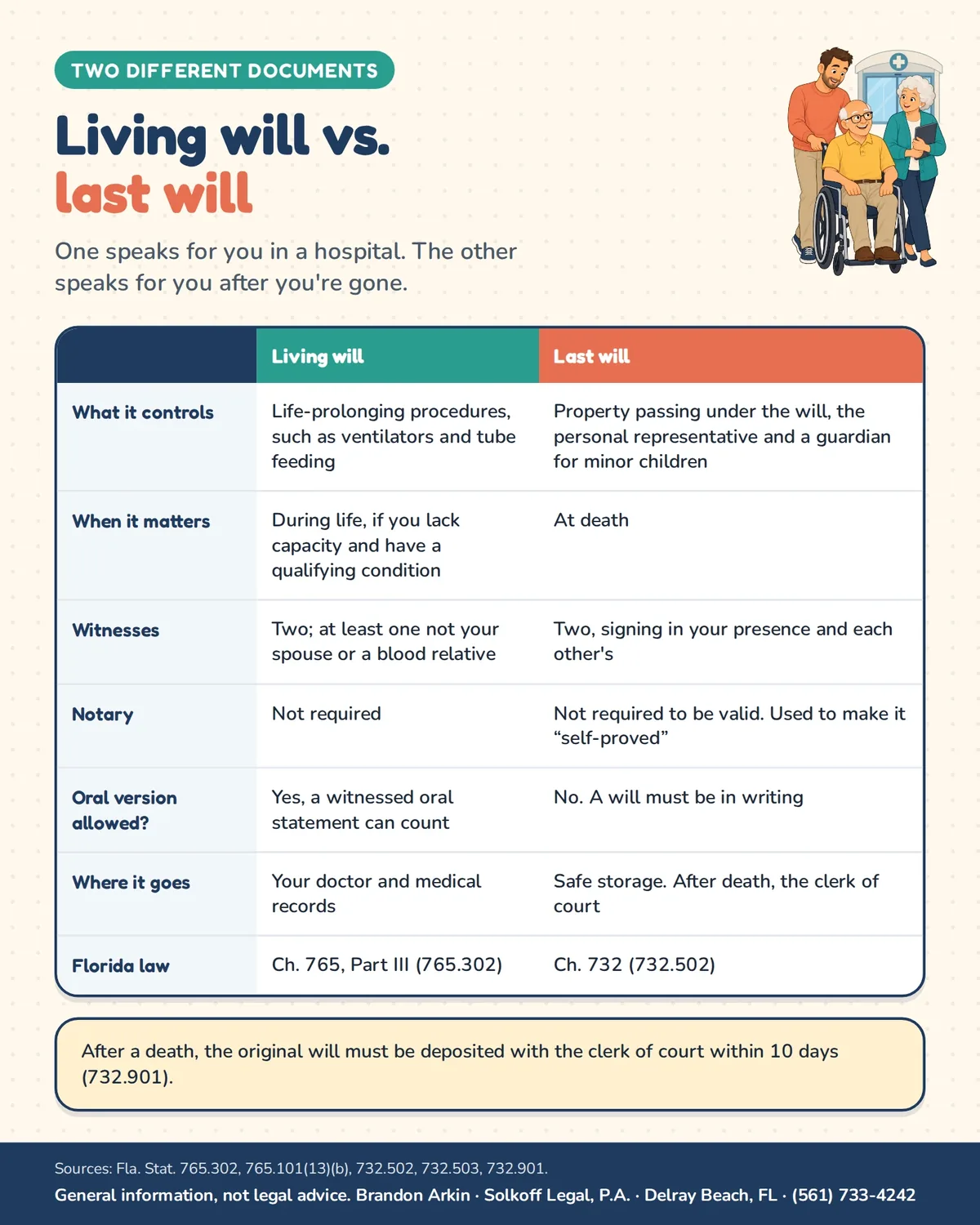
| Living will | Last will | |
|---|---|---|
| Florida law | Ch. 765, Part III (765.302) | Ch. 732 (732.502) |
| What it controls | Life-prolonging procedures, such as ventilators and tube feeding | Property passing under the will, the personal representative and a guardian for minor children |
| When it matters | During life, if you lack capacity and have a qualifying condition | At death |
| Who may sign | Any competent adult | A person of sound mind who is 18 or older, or an emancipated minor (732.501) |
| Witnesses | Two; at least one not your spouse or a blood relative | Two, signing in your presence and each other's |
| Notary | Not required | Not required to be valid. Used to make it "self-proved" (732.503) |
| Oral version allowed? | Yes, a witnessed oral statement can count (765.101(13)(b)) | No. A will must be in writing |
| Where it goes | Your doctor and medical records (765.302(2)) | Safe storage. After death, the clerk of court (732.901) |
| Signed in another state | Valid if it followed that state's law or Florida's (765.112) | Generally valid if valid where signed, except handwritten or oral wills (732.502(2)) |
| Changing it | A signed, dated writing, destruction, an oral statement or a new directive (765.104) | A new will or codicil signed with the same formalities, or revocation by act (732.506) |
Florida law
Living will
Ch. 765, Part III (765.302)
Last will
Ch. 732 (732.502)
What it controls
Living will
Life-prolonging procedures, such as ventilators and tube feeding
Last will
Property passing under the will, the personal representative and a guardian for minor children
When it matters
Living will
During life, if you lack capacity and have a qualifying condition
Last will
At death
Who may sign
Living will
Any competent adult
Last will
A person of sound mind who is 18 or older, or an emancipated minor (732.501)
Witnesses
Living will
Two; at least one not your spouse or a blood relative
Last will
Two, signing in your presence and each other's
Notary
Living will
Not required
Last will
Not required to be valid. Used to make it "self-proved" (732.503)
Oral version allowed?
Living will
Yes, a witnessed oral statement can count (765.101(13)(b))
Last will
No. A will must be in writing
Where it goes
Living will
Your doctor and medical records (765.302(2))
Last will
Safe storage. After death, the clerk of court (732.901)
Signed in another state
Living will
Valid if it followed that state's law or Florida's (765.112)
Last will
Generally valid if valid where signed, except handwritten or oral wills (732.502(2))
Changing it
Living will
A signed, dated writing, destruction, an oral statement or a new directive (765.104)
Last will
A new will or codicil signed with the same formalities, or revocation by act (732.506)
Which document answers this?
Check what you have, then note the gaps to discuss. Nothing is saved.
Tick boxes stay on this device. Nothing is saved or sent.
Common questions
What is the difference between a living will and a last will in Florida?
A living will is a medical document. It states whether you want life-prolonging procedures if you can't decide for yourself and have a terminal condition, an end-stage condition or a persistent vegetative state, and it works only while you're alive. A last will is a property document. It names who receives property passing under it, who serves as personal representative and who would raise minor children, and it takes effect only at death. Both need two witnesses in Florida, but the rules for who may witness differ.
Does a living will need to be notarized in Florida?
No. Florida requires a living will to be signed before two witnesses, at least one of whom is neither your spouse nor a blood relative. A notary isn't part of the statutory requirement. A last will also doesn't need a notary to be valid, but adding a notarized affidavit makes it "self-proved." The court can then admit it to probate without finding a witness. A durable power of attorney is different: Florida requires both two witnesses and a notary.
If I have a living will, do I still need a health care surrogate?
Usually it helps to have both. A living will covers one narrow situation: life-prolonging procedures when recovery isn't reasonably likely. A health care surrogate can make all kinds of medical decisions, such as consenting to surgery or choosing a rehab facility, and can apply for benefits to pay for care. Without a surrogate, Florida turns to a statutory list of proxies, which may require a majority of your adult children to agree. Naming a surrogate lets you choose the person and an alternate.
Can my power of attorney agent handle things after I die?
No. Under Florida law, a power of attorney terminates when the principal dies. After death, authority over probate property generally passes to the personal representative named in your will once the court appoints them. Assets with beneficiary forms or in a trust follow those documents instead. That's why a power of attorney and a will work as a pair: one covers your life, the other covers what happens after. Families are sometimes surprised that a bank freezes the agent's access on learning of a death.
If your family is facing one of these questions, you can reach Brandon Arkin at Solkoff Legal, P.A. at (561) 733-4242.
Related on this site
Talk through the next step
Bring your questions, a list of accounts and any papers a hospital, nursing home or Medicaid office has sent you. Call the Delray Beach office or request a consultation, and I can look at where things stand and what may come next. A phone call or an email does not by itself create an attorney-client relationship.
Solkoff Legal, P.A. · (561) 733-4242