
Resources · Estate planning
Revocable living trusts in Florida: what they do, how to sign and fund one, and what happens after
By Brandon Arkin, elder law attorney, Solkoff Legal, P.A. · Updated November 2026

A revocable living trust is a document you can change or cancel at any time, which holds property you transfer to it and names a successor trustee to manage that property if you become incapacitated and to distribute it at your death, generally without probate. In Florida, the parts that take effect at death are valid only if you sign the trust with the same formalities as a will, and it controls only property that has been retitled to it or that names it as beneficiary.
What it does, and what it doesn't
Our estate planning page introduces revocable trusts and how they fit with wills and powers of attorney. This guide goes into the mechanics.
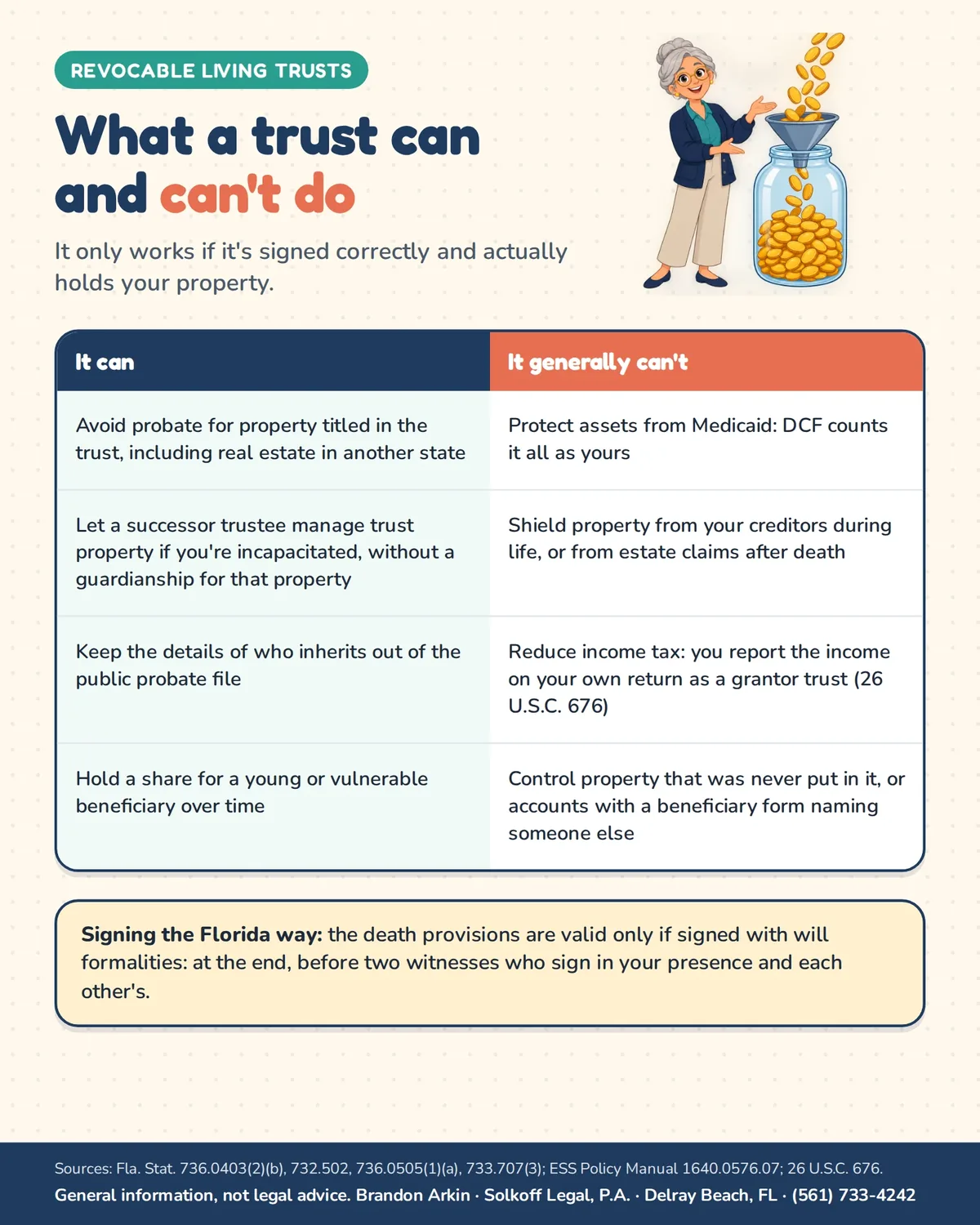
| It can | It generally can't |
|---|---|
| Avoid probate for property titled in the trust, including real estate in another state | Protect assets from Medicaid: DCF counts it all as yours |
| Let a successor trustee manage trust property if you're incapacitated, without a guardianship for that property | Shield property from your creditors during life, or from estate claims after death |
| Keep the details of who inherits out of the public probate file | Reduce income tax: you report the income on your own return as a grantor trust (26 U.S.C. 676) |
| Hold a share for a young or vulnerable beneficiary over time | Control property that was never put in it, or accounts with a beneficiary form naming someone else |
It can
Avoid probate for property titled in the trust, including real estate in another state
It generally can't
Protect assets from Medicaid: DCF counts it all as yours
It can
Let a successor trustee manage trust property if you're incapacitated, without a guardianship for that property
It generally can't
Shield property from your creditors during life, or from estate claims after death
It can
Keep the details of who inherits out of the public probate file
It generally can't
Reduce income tax: you report the income on your own return as a grantor trust (26 U.S.C. 676)
It can
Hold a share for a young or vulnerable beneficiary over time
It generally can't
Control property that was never put in it, or accounts with a beneficiary form naming someone else
Signing it the Florida way
Florida is stricter than many states. If you live in Florida when you sign, the "testamentary aspects" of the trust, meaning the provisions that dispose of property at or after your death, are invalid unless you sign with the formalities required for a will (Fla. Stat. 736.0403(2)(b)). That means you sign at the end, in front of at least two witnesses, and the witnesses sign in your presence and in each other's (Fla. Stat. 732.502). Most lawyers also have the trust notarized, since a notarized signature is needed for recording and is useful for banks.
A trust signed with only a notary, which may be fine elsewhere, can leave the death provisions open to challenge in Florida. If you moved here with a trust from another state, have it reviewed.
Unless the document says it's irrevocable, a Florida trust is revocable. You can amend or revoke it using the method it describes (Fla. Stat. 736.0602). Your agent under a power of attorney can do so only as allowed by Fla. Stat. 709.2202: that power must be specifically initialed, and amendment by an agent is allowed only if the trust itself expressly permits it.
Funding: the step most often missed
A trust controls only what it owns or what names it as beneficiary. "Funding" means moving property into it.
The home. You sign and record a new deed to yourself as trustee. Florida law gives a trustee named in a recorded deed the powers stated in it, and people who buy from the trustee don't need to look behind the deed (Fla. Stat. 689.073). The homestead tax exemption is available to a person with "beneficial title in equity" (Fla. Stat. 196.031); confirm with your property appraiser after recording. Federal law generally bars a lender from calling a mortgage due when you transfer a home to a living trust in which you remain a beneficiary (12 U.S.C. 1701j-3(d)(8)). Some people use a Lady Bird deed for the home instead.
One caution. If you're married or have a minor child, Florida's homestead restrictions may still apply to a home in a revocable trust, because you keep the power to take it back (Fla. Stat. 732.4017). Your spouse may need to sign the deed.
Bank and brokerage accounts. You retitle them in the trustee's name, or name the trust as payable-on-death or transfer-on-death beneficiary. Ask each institution what it needs; many want a certification of trust rather than the whole document.
Retirement accounts and life insurance. IRAs and 401(k)s generally can't be retitled during life without cashing out. Instead, you update the beneficiary form. Whether to name the trust, a person, or both has income tax effects, so it's worth discussing with your lawyer and CPA.
Out-of-state real estate. Deeding it to the trust can avoid a second probate where the property is located.
The pour-over will
A pour-over will leaves anything outside the trust to the trustee. Florida allows a will to leave property to the trustee of a trust that exists when the will is signed or is signed at the same time (Fla. Stat. 732.513). It's a safety net, not a substitute for funding. Property passing under the pour-over will generally still goes through probate first. Our guide to Florida probate explains what that involves.
What the successor trustee does after a death
When you die, the trust becomes irrevocable and your successor trustee takes over. A typical sequence:
Gather the trust documents, death certificates, and a list of trust property. File a notice of trust with the court in the county where you lived, listing your name, date of death, the trust's title and date, and the trustee's name and address (Fla. Stat. 736.05055). Within 60 days, notify the qualified beneficiaries that the trust exists, who created it, that they can request a copy, and their right to accountings (Fla. Stat. 736.0813). Get a tax ID number for the trust. The trustee and any personal representative may elect to treat the trust as part of the estate for income tax (26 U.S.C. 645). Pay expenses and valid claims. If a probate estate exists and is short, the personal representative can require the trustee to pay estate expenses and claims (Fla. Stat. 736.05053). In general, claims against a decedent are barred two years after death (Fla. Stat. 733.710); a probate case with a creditor notice may shorten that window. Keep records and provide trust accountings (Fla. Stat. 736.08135), then distribute under the trust's terms.
Throughout, the trustee must act solely in the beneficiaries' interests and avoid self-dealing (Fla. Stat. 736.0802). A trustee is entitled to reasonable compensation unless the trust says otherwise (Fla. Stat. 736.0708). A beneficiary generally has six months to challenge a matter adequately disclosed in a trust disclosure document once the required notice is given (Fla. Stat. 736.1008). Our after-a-death guide covers the first weeks more broadly.
A hypothetical
Assume a widower in Boynton Beach signs a trust in 2026, deeds his condo to himself as trustee and retitles his brokerage account. He forgets a $40,000 certificate of deposit in his own name. At his death, his daughter, as successor trustee, can sell the condo and manage the account without a court case. The certificate of deposit, though, goes through probate under his pour-over will, likely by summary administration, before it reaches the trust. One trip to the bank would have avoided that.
Funding checklist
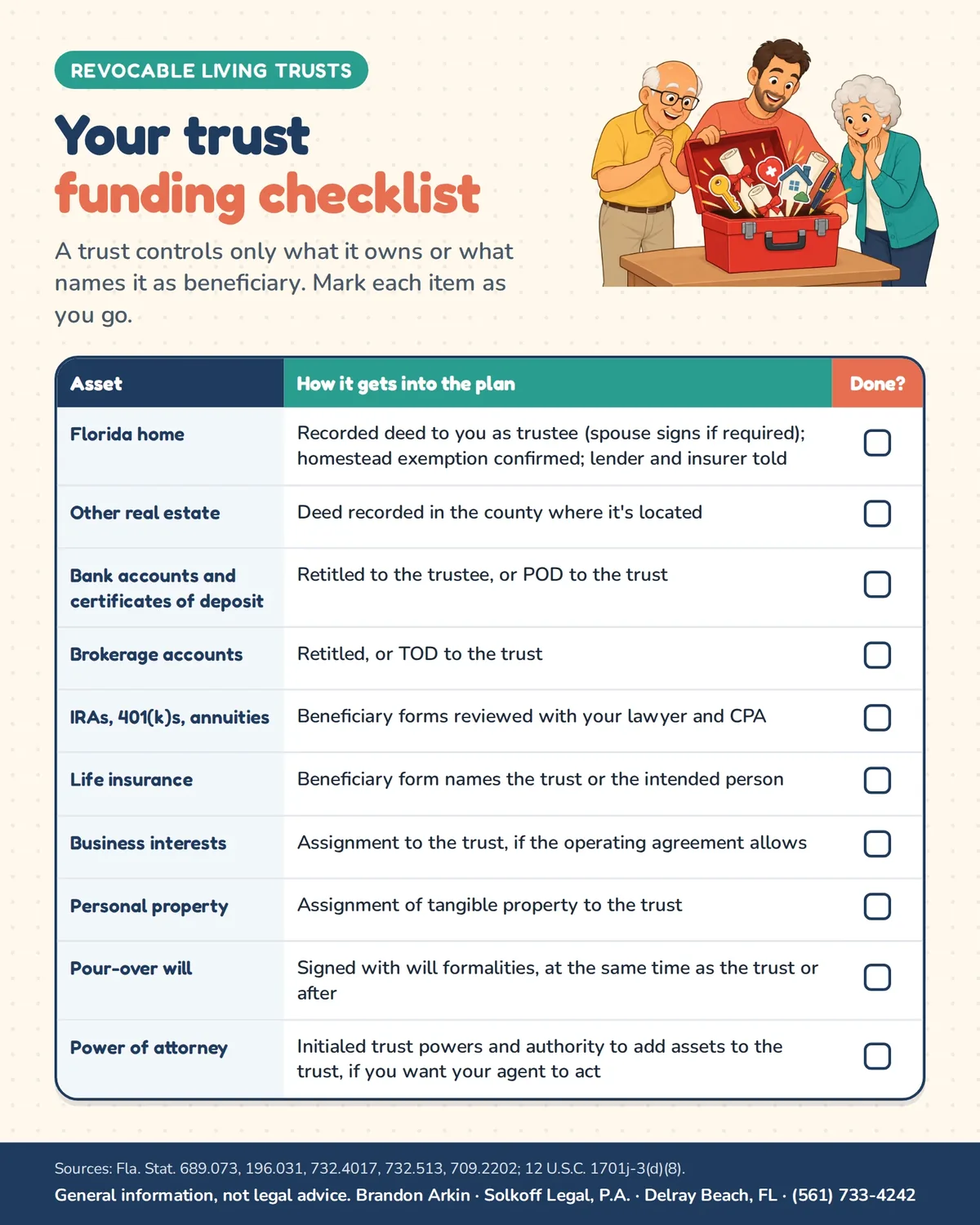
Mark each item as you go. Keep a copy with your trust.
| Asset | How it gets into the plan | Done? |
|---|---|---|
| Florida home | Recorded deed to you as trustee (spouse signs if required); homestead exemption confirmed; lender and insurer told | ☐ |
| Other real estate | Deed recorded in the county where it's located | ☐ |
| Bank accounts and certificates of deposit | Retitled to the trustee, or POD to the trust | ☐ |
| Brokerage accounts | Retitled, or TOD to the trust | ☐ |
| IRAs, 401(k)s, annuities | Beneficiary forms reviewed with your lawyer and CPA | ☐ |
| Life insurance | Beneficiary form names the trust or the intended person | ☐ |
| Business interests | Assignment to the trust, if the operating agreement allows | ☐ |
| Personal property | Assignment of tangible property to the trust | ☐ |
| Pour-over will | Signed with will formalities, at the same time as the trust or after | ☐ |
| Power of attorney | Initialed trust powers and authority to add assets to the trust, if you want your agent to act | ☐ |
Asset
Florida home
How it gets into the plan
Recorded deed to you as trustee (spouse signs if required); homestead exemption confirmed; lender and insurer told
Done?
☐
Asset
Other real estate
How it gets into the plan
Deed recorded in the county where it's located
Done?
☐
Asset
Bank accounts and certificates of deposit
How it gets into the plan
Retitled to the trustee, or POD to the trust
Done?
☐
Asset
Brokerage accounts
How it gets into the plan
Retitled, or TOD to the trust
Done?
☐
Asset
IRAs, 401(k)s, annuities
How it gets into the plan
Beneficiary forms reviewed with your lawyer and CPA
Done?
☐
Asset
Life insurance
How it gets into the plan
Beneficiary form names the trust or the intended person
Done?
☐
Asset
Business interests
How it gets into the plan
Assignment to the trust, if the operating agreement allows
Done?
☐
Asset
Personal property
How it gets into the plan
Assignment of tangible property to the trust
Done?
☐
Asset
Pour-over will
How it gets into the plan
Signed with will formalities, at the same time as the trust or after
Done?
☐
Asset
Power of attorney
How it gets into the plan
Initialed trust powers and authority to add assets to the trust, if you want your agent to act
Done?
☐
Tick boxes stay on this device. Nothing is saved or sent.
Common questions
Does a revocable living trust have to be witnessed in Florida?
Yes, for the parts that matter at death. If you live in Florida when you sign, the provisions that dispose of property at or after your death are invalid unless you sign with the formalities for a will (Fla. Stat. 736.0403(2)(b)). You sign at the end in front of two witnesses, who sign in your presence and each other's (Fla. Stat. 732.502). Notarization is also common and useful. A trust signed elsewhere, or with only a notary, should be reviewed by a Florida attorney.
Does a revocable trust protect my assets from Medicaid or nursing home costs?
No. Because you can revoke the trust and take the property back, Florida DCF counts the entire principal as your asset (ESS Policy Manual 1640.0576.07). For a single applicant, the 2026 asset limit is $2,000. A home in a revocable trust may still be excluded as your homestead under the usual rules. Medicaid asset protection uses different tools, such as an income-only trust or crisis planning. A revocable trust remains useful for probate and incapacity planning.
Do I still need a will if I have a revocable trust?
Generally yes. A pour-over will catches property you didn't move into the trust and leaves it to the trustee (Fla. Stat. 732.513). Without one, that property passes under Florida's intestacy rules, which may not match your trust. A will can also name a guardian for minor children. Keep in mind that property passing through a pour-over will usually goes through probate first, so careful funding during life is still the main way to avoid probate.
What does a successor trustee have to do after the person dies?
The main early steps are filing a notice of trust with the court (Fla. Stat. 736.05055) and notifying qualified beneficiaries within 60 days (Fla. Stat. 736.0813). After that, the trustee gets a tax ID, secures and values the property, pays valid expenses and claims, keeps records, gives accountings, and distributes under the trust. The trustee must act solely in the beneficiaries' interests (Fla. Stat. 736.0802). Many trustees work with a lawyer and CPA.
If your family is facing one of these questions, you can reach Brandon Arkin at Solkoff Legal, P.A. at (561) 733-4242.
Related on this site
Talk through the next step
Bring your questions, a list of accounts and any papers a hospital, nursing home or Medicaid office has sent you. Call the Delray Beach office or request a consultation, and I can look at where things stand and what may come next. A phone call or an email does not by itself create an attorney-client relationship.
Solkoff Legal, P.A. · (561) 733-4242