
Estate planning
How to Fund a Revocable Trust in Florida, Asset by Asset
By Brandon Arkin, elder law attorney, Solkoff Legal, P.A. · Updated November 2026
To fund a revocable trust in Florida, you move each asset into the trust's name or make the trust its death beneficiary. In practice, that means recording a new deed to yourself as trustee and retitling bank and brokerage accounts (or adding a payable-on-death or transfer-on-death designation to the trust). Retirement accounts, which stay in your name, get updated beneficiary forms instead. Anything left out generally passes through your pour-over will and probate before it reaches the trust (Fla. Stat. 732.513).
A revocable trust only controls what it owns or what names it as beneficiary. Our revocable trust guide explains what the trust does and what the successor trustee does later. This page covers the part that happens in the weeks after signing, when the binder goes home and the follow-through begins. A trust that isn't funded is mostly a well-drafted set of instructions with nothing to apply them to.
Start by listing every asset and how it's titled today.
The Florida home and other real estate
You sign a new deed from yourself, individually, to yourself as trustee of the trust by name and date. It's signed with two witnesses and a notary and recorded with the county clerk. A deed that names the trustee and states the trustee's powers lets a future buyer or lender deal with the trustee without examining the trust (Fla. Stat. 689.073). Because you keep the power to revoke, the transfer isn't subject to documentary stamp tax (Rule 12B-4.013).
After recording:
Property appraiser: confirm the homestead exemption carries over (the revocable trust guide covers the homestead rules and the spouse's signature). Homeowner's insurer: ask it to add the trustee as a named insured, so a claim isn't disputed over ownership. Title insurance: ask your title insurer whether your policy continues after the transfer. Many current forms address transfers to a revocable trust. Older ones may need an endorsement. Condo or HOA: check whether the association requires notice or approval of the transfer.
Bank accounts and CDs
There are two routes. You can retitle the account to "[Name], Trustee of the [Name] Revocable Trust dated [date]," or you can keep it in your name and add the trust as payable-on-death beneficiary. Retitling gives the successor trustee immediate access if you become incapacitated. A POD designation only works at death. During incapacity, your agent under a durable power of attorney would handle the account instead.
Banks usually ask for a certification of trust. That short document confirms the trust exists, names the trustee and states the trustee's powers, without revealing who inherits (Fla. Stat. 736.1017). CDs are easy to forget. Retitle them at renewal, or ask the bank whether it can change the title without breaking the CD.
Brokerage and investment accounts
Most firms open a new account in the trust's name and journal the holdings across. Within the same firm, that usually isn't a sale for tax purposes, because a revocable trust is generally ignored for income tax while you're living (26 U.S.C. 676). The trust uses your Social Security number. Alternatively, Florida's Uniform Transfer-on-Death Security Registration Act allows a TOD registration naming the trust (Fla. Stat. 711.50). It has the same trade-off as POD: it works at death but not during incapacity.
Stock certificates held in your own name and savings bonds each need their own transfer paperwork. Ask the transfer agent or TreasuryDirect.
Retirement accounts and annuities: don't retitle
IRAs, 401(k)s and 403(b)s are individual accounts by law (26 U.S.C. 408(a)). Moving one into a trust during life is generally treated as cashing it out, with income tax due. Instead, you decide whom to name on the beneficiary form:
A spouse or child directly: often simpler for income tax. The trust: useful for minors, a beneficiary with a disability, or someone who needs protection. The trust then has to meet federal "see-through" rules to use the longer payout periods (26 C.F.R. 1.401(a)(9)-4).
The choice turns on who inherits and their tax brackets, so it's a joint question for your lawyer and CPA. Annuities and life insurance follow the same idea. Keep the contract, and name the trustee as beneficiary if that fits the plan (Fla. Stat. 733.808).
Cars, boats and household goods
Many Florida families leave the car alone. If you're survived by a spouse or children, up to two regularly used vehicles and up to $20,000 of household furnishings can pass to them as "exempt property," protected from creditors (Fla. Stat. 732.402). A vehicle can also be transferred after death on proof of inheritance through Florida's motor vehicle agency (Fla. Stat. 319.28). Retitling a car to the trust also means updating the insurance. Boats and RVs worth more may be worth retitling.
For jewelry, art and other tangible property, a short written assignment of tangible personal property to the trust is common. It costs nothing and covers items with no title document.
LLCs and business interests
An LLC interest is moved with a written assignment to the trustee. Read the operating agreement first. Under Florida law, a transfer of a "transferable interest" carries the right to distributions, but on its own it doesn't make the transferee a member with management rights (Fla. Stat. 605.0502). The agreement may require the other members' consent, or allow transfers to a member's revocable trust. A properly documented assignment and admission keeps the successor trustee from inheriting money without a vote. Corporate stock in a family business uses a stock assignment and an update to the stock ledger.
Property in another state
A North Carolina cabin or an Ohio rental in your own name generally needs its own probate in that state, often called ancillary administration. Deeding it to your trustee under that state's rules usually avoids that. Use a lawyer licensed where the land is located, because deed forms, transfer taxes and homestead rules vary.
A sample funding letter
A short letter to each institution keeps funding moving. A typical letter reads:
"Re: Account no. ending 1234. I have created the [Name] Revocable Trust dated [date], of which I am trustee. Please retitle this account to '[Name], Trustee of the [Name] Revocable Trust dated [date],' using my Social Security number. A certification of trust is enclosed. Please send me any forms you require and written confirmation once the change is made."
Keep a copy and the confirmation with your trust binder. When the confirmation arrives, mark the asset as done on the tracker below.
What happens to assets you miss
Your pour-over will leaves them to the trustee, but they generally pass through probate first. The pour-over will guide explains how that works. If the probate assets, net of exempt property, are $150,000 or less, summary administration may be available (Fla. Stat. 735.201). If only exempt property and enough to cover funeral and final medical bills remain, no administration may be needed (Fla. Stat. 735.301).
Hypothetical: a widow in Delray Beach funds her condo and brokerage account. She forgets a $38,000 CD and a $9,000 checking account, and leaves her car in her own name. The car may go to her children as exempt property. The $47,000 in bank funds would likely need summary administration under her pour-over will before her successor trustee can use it.
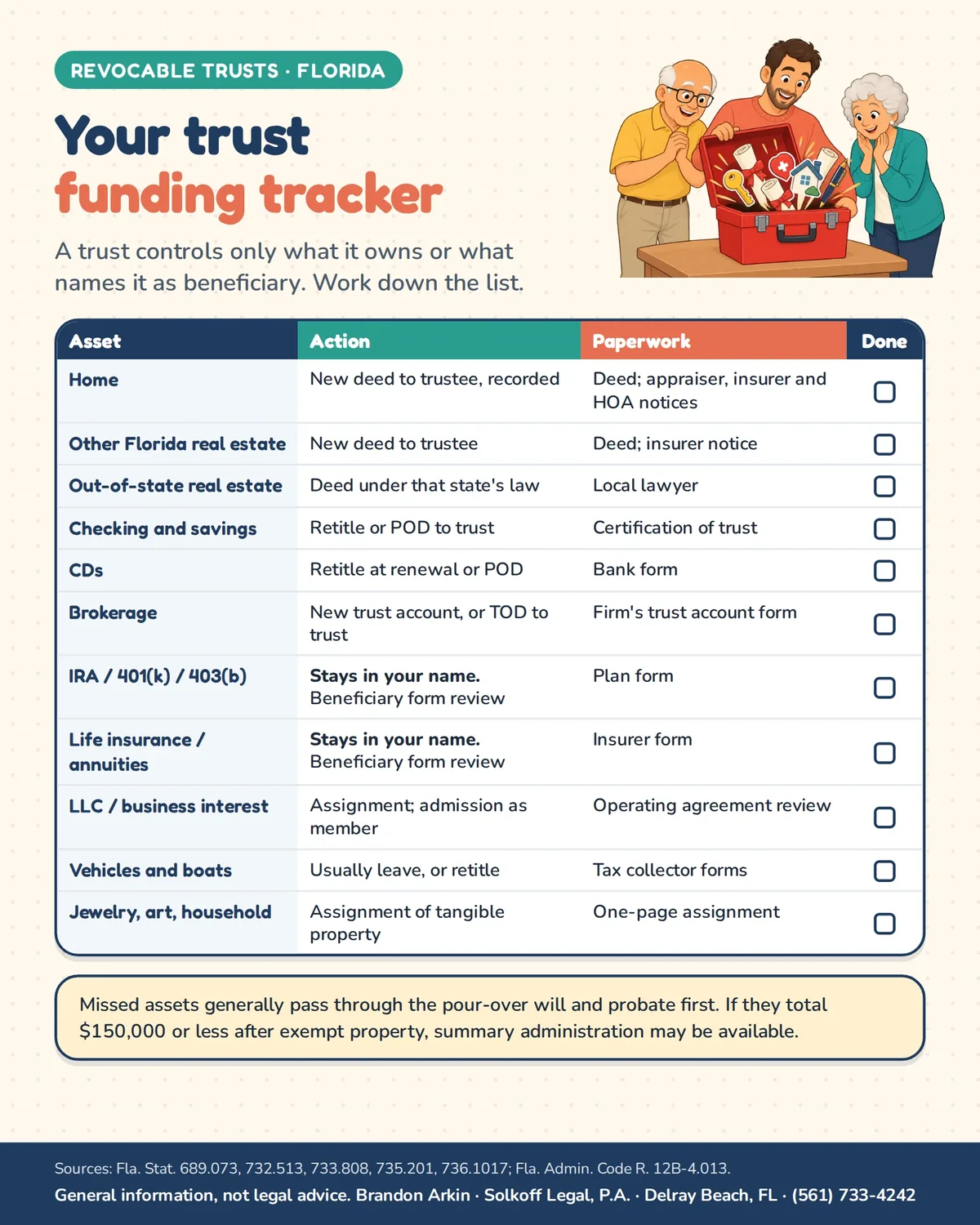
Trust funding tracker
List every asset, then work down the columns. Fill it in on screen or print it. Nothing is saved.
| Asset | Titled now | Action | Paperwork | Done |
|---|---|---|---|---|
| Home | Individually / jointly | New deed to trustee, recorded | Deed; appraiser, insurer and HOA notices | ☐ |
| Other Florida real estate | New deed to trustee | Deed; insurer notice | ☐ | |
| Out-of-state real estate | Deed under that state's law | Local lawyer | ☐ | |
| Checking and savings | Retitle or POD to trust | Certification of trust | ☐ | |
| CDs | Retitle at renewal or POD | Bank form | ☐ | |
| Brokerage | New trust account, or TOD to trust | Firm's trust account form | ☐ | |
| IRA / 401(k) / 403(b) | Stays in your name | Beneficiary form review | Plan form | ☐ |
| Life insurance / annuities | Stays in your name | Beneficiary form review | Insurer form | ☐ |
| LLC / business interest | Assignment; admission as member | Operating agreement review | ☐ | |
| Vehicles and boats | Usually leave, or retitle | Tax collector forms | ☐ | |
| Jewelry, art, household | Assignment of tangible property | One-page assignment | ☐ |
Asset
Home
Titled now
Individually / jointly
Action
New deed to trustee, recorded
Paperwork
Deed; appraiser, insurer and HOA notices
Done
☐
Asset
Other Florida real estate
Titled now
Action
New deed to trustee
Paperwork
Deed; insurer notice
Done
☐
Asset
Out-of-state real estate
Titled now
Action
Deed under that state's law
Paperwork
Local lawyer
Done
☐
Asset
Checking and savings
Titled now
Action
Retitle or POD to trust
Paperwork
Certification of trust
Done
☐
Asset
CDs
Titled now
Action
Retitle at renewal or POD
Paperwork
Bank form
Done
☐
Asset
Brokerage
Titled now
Action
New trust account, or TOD to trust
Paperwork
Firm's trust account form
Done
☐
Asset
IRA / 401(k) / 403(b)
Titled now
Stays in your name
Action
Beneficiary form review
Paperwork
Plan form
Done
☐
Asset
Life insurance / annuities
Titled now
Stays in your name
Action
Beneficiary form review
Paperwork
Insurer form
Done
☐
Asset
LLC / business interest
Titled now
Action
Assignment; admission as member
Paperwork
Operating agreement review
Done
☐
Asset
Vehicles and boats
Titled now
Action
Usually leave, or retitle
Paperwork
Tax collector forms
Done
☐
Asset
Jewelry, art, household
Titled now
Action
Assignment of tangible property
Paperwork
One-page assignment
Done
☐
Tick boxes stay on this device. Nothing is saved or sent.
Common questions
Do I have to put my car in my Florida trust?
Usually not. If you're survived by a spouse or children, up to two vehicles regularly used by you or your immediate family can pass to them as exempt property, outside the reach of creditors (Fla. Stat. 732.402). Florida also lets a vehicle's title be transferred after death on proof of inheritance (Fla. Stat. 319.28). Some people retitle boats, RVs or valuable vehicles, especially if no spouse or child will survive them. If you retitle, update the insurance at the same time.
Should my IRA go into my revocable trust?
Not by retitling it. IRAs are individual accounts, and moving one into a trust during life is generally treated as withdrawing it, with income tax due (26 U.S.C. 408(a)). You choose instead whom to name on the beneficiary form. Naming a spouse or adult child directly is often simpler. Naming the trust can make sense for minors, a beneficiary with a disability, or someone who needs protection, but the trust must meet federal see-through rules. Review it with your lawyer and CPA.
Is there a tax to deed my house to my revocable trust in Florida?
Generally no documentary stamp tax applies. Florida's rule says a deed to a trustee from a grantor who can revoke the trust, and a deed back on revocation, aren't transfers of ownership subject to the tax (Fla. Admin. Code R. 12B-4.013). There are recording fees. After recording, confirm with the property appraiser that the homestead exemption continues. Tell your homeowner's insurer and title insurer so your coverage stays matched to the new owner.
What happens if I forget to put an account in my trust?
Your pour-over will generally leaves it to the trustee, but it usually has to go through probate first (Fla. Stat. 732.513). If the probate assets, after exempt property, total $150,000 or less, the shorter summary administration may be available (Fla. Stat. 735.201). Without a pour-over will, the account would pass under Florida's intestacy rules, which may not match your trust. Reviewing your funding tracker once a year, and whenever you open an account, prevents most of this.
If your family is facing one of these questions, you can reach Brandon Arkin at Solkoff Legal, P.A. at (561) 733-4242.
Related on this site
Talk through the next step
Bring your questions, a list of accounts and any papers a hospital, nursing home or Medicaid office has sent you. Call the Delray Beach office or request a consultation, and I can look at where things stand and what may come next. A phone call or an email does not by itself create an attorney-client relationship.
Solkoff Legal, P.A. · (561) 733-4242