
Estate planning
Pour-Over Wills in Florida: The Safety Net Behind a Living Trust
By Brandon Arkin, elder law attorney, Solkoff Legal, P.A. · Updated November 2026

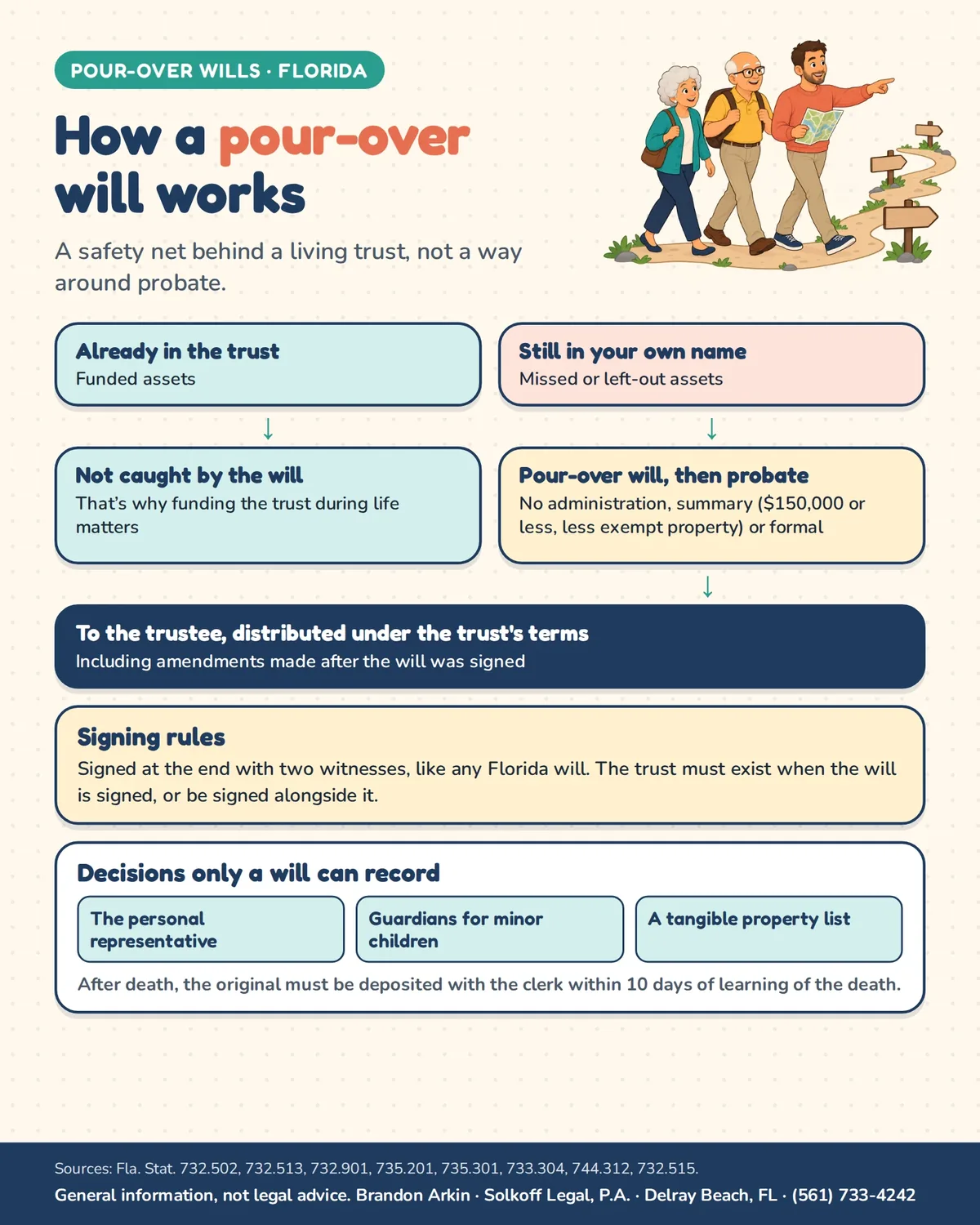
A pour-over will is a short will that leaves anything still in your own name at death to the trustee of your revocable trust, to be distributed under the trust's terms, including later amendments (Fla. Stat. 732.513). It's a safety net, not a way around probate: assets that pass under it generally go through probate first, though small estates may qualify for summary administration (Fla. Stat. 735.201).
People who sign a revocable trust are often surprised to sign a will at the same meeting. The trust is supposed to be the plan, so why both? Our revocable trust guide explains the trust. This page explains its partner document: what it catches, what it doesn't do, and the few decisions only a will can record.
What "pour-over" means in Florida law
Florida lets a will leave property "to the trustee of a trust" identified in the will, if the trust is in writing and exists when the will is signed or is signed alongside it (Fla. Stat. 732.513). Several rules follow from the statute:
Amendments still count. The gift isn't invalid because the trust can be amended or revoked, or was amended after the will. The property passes under the trust "as previously or subsequently amended." Revocation cancels the gift. If the whole trust is revoked in writing before death, the gift to it fails. No second trust. Unless the will says otherwise, the property becomes part of the existing trust. It isn't held in a separate testamentary trust under court supervision.
In practice, you can update the trust's distribution terms without re-signing the will. Changing the personal representative or the guardian nominations does require a new will or codicil.
Why it doesn't avoid probate
A will only takes effect through probate. Anything that passes under the pour-over will goes through the court process first, and then the personal representative transfers it to the trustee. That's why funding the trust during life matters. The trust funding guide walks through each asset.
The size of what's left over decides how heavy the probate is:
No administration: if the person left only exempt property (such as household goods up to $20,000 and two vehicles passing to a spouse or children) plus personal property worth no more than the funeral expenses and the last 60 days of medical bills, no administration may be needed (Fla. Stat. 735.301; Fla. Stat. 732.402). Summary administration: if the probate estate, less exempt property, is $150,000 or less (Fla. Stat. 735.201). Formal administration: for anything larger. The Florida probate guide explains the steps.
Hypothetical: a retired teacher in Boynton Beach funded her trust with her condo and investment account but kept a $62,000 savings account in her own name. Her pour-over will leaves it to her trustee. Her family would likely use summary administration for that one account. The rest of the plan works without court involvement.
Creditors, expenses and the trust
Avoiding probate doesn't put trust assets beyond the person's debts. In Florida, a revocable trust is liable for estate expenses and creditor claims to the extent the probate estate can't pay them. When the personal representative certifies in writing the amount needed, the trustee must pay it (Fla. Stat. 733.707(3); Fla. Stat. 736.05053).
Because the will and the trust are linked this way, opening a probate can sometimes help. It starts a creditor period that cuts off late claims. A small probate under the pour-over will is occasionally opened for that reason alone.
Medicaid matters here too. Florida's estate recovery claim for long-term care benefits is filed in probate (Fla. Stat. 409.9101). The estate recovery guide covers what it can and can't reach.
The homestead limit
A pour-over will can't override Florida's homestead rules. If the owner is survived by a spouse or a minor child, the homestead can't be freely left to others. The only exception is that it may be left to the spouse when there's no minor child. That limit applies to a home held in a revocable trust as well (Fla. Stat. 732.4015). If a married couple's plan needs the home to pass differently, the spouse may need to waive homestead rights in writing, which is addressed in the trust and deed planning.
Decisions only the will records
Most of the plan lives in the trust, but a will is where three things are usually written down.
The personal representative. This is the person the court appoints to handle any probate. It's often the same person as the successor trustee, for simplicity. A non-Florida resident can serve only if they're a close relative, such as a child, parent, sibling, niece, nephew or spouse (Fla. Stat. 733.304). A trusted friend in Ohio may qualify as successor trustee but not as personal representative.
Guardians for minor children. A court choosing a guardian must consider anyone designated in a will under which the child is a beneficiary (Fla. Stat. 744.312). Parents can also sign a separate preneed guardian declaration for a minor, with two witnesses present at the same time (Fla. Stat. 744.3046). Many families do both. The child's money is usually managed more easily in the trust, not by a court-supervised guardian of property.
Tangible personal property. A will can refer to a separate, signed list of who gets jewelry, art and keepsakes. That list can be updated later without re-signing the will (Fla. Stat. 732.515). It must describe the items and recipients with reasonable certainty.
Signing, storing and depositing the will
A pour-over will must meet Florida's will formalities. It's signed at the end in front of two witnesses, who sign in front of you and each other (Fla. Stat. 732.502). A self-proving affidavit before a notary avoids having to locate witnesses later.
Store the original somewhere your family can get to, and tell the successor trustee where it is. A copy usually isn't enough for probate. After death, whoever holds the original must deposit it with the clerk of court within 10 days of learning of the death, even if no probate is planned (Fla. Stat. 732.901).
Hypothetical: a son finds his father's trust binder after the funeral, with the will inside. Even though everything appears to be in the trust, he deposits the original will with the Palm Beach County clerk that week. If an asset turns up later, the will is already on file.
When the will and trust are out of sync
Common gaps include:
the will names a trust by a different date or name than the one actually signed; the trust was later revoked and replaced, but the will still names the old one; a will signed in another state names a personal representative who can't serve in Florida.
Each can usually be fixed with a short codicil or a new will. That's easier done during life than argued over in court. If the trust is restated rather than replaced, the original trust name and date usually stay the same, so the will still points to it. The trust amendment guide explains why that distinction matters.
Pour-over will review checklist
Use this with your will and trust side by side. Tick boxes on screen or on paper. Nothing is saved.
Tick boxes stay on this device. Nothing is saved or sent.
Common questions
Does a pour-over will avoid probate in Florida?
No. A pour-over will is still a will, and property that passes under it generally goes through probate before it reaches the trust. It's a safety net for assets that weren't moved into the trust during life. If the probate estate, less exempt property, is $150,000 or less, the shorter summary administration may be available (Fla. Stat. 735.201). If very little is left outside the trust, no administration may be needed. The surest way to keep probate small is to fund the trust fully while you're living.
Do I still need a will if my trust is fully funded?
Most people with a revocable trust still sign one. New assets appear: a refund check, an inheritance, a car, an account opened late in life. A pour-over will catches those and sends them to the trust (Fla. Stat. 732.513). The will is also where you nominate a personal representative and name guardians for minor children. It can also point to a signed list of who receives personal belongings. Without a will, anything left out passes under Florida's intestacy rules, which may not match the trust.
If I change my trust, do I have to sign a new pour-over will?
Usually not for changes to who inherits. Florida says property left to a trust passes under the trust's terms "as previously or subsequently amended" (Fla. Stat. 732.513). A restatement normally keeps the original trust name and date, so the will still matches. You would update the will if you revoke the trust and create a new one, or if you want a different personal representative or guardian. You might also update it if the will names the trust by the wrong date. A codicil or new will handles that.
Who should be the personal representative under my pour-over will?
Many people choose the same person as their successor trustee, so one person handles both the trust and any small probate. Check that the person can serve in Florida. A nonresident can serve only if they're a close relative, such as a child, parent, sibling, niece, nephew or spouse (Fla. Stat. 733.304). Name an alternate in case your first choice can't serve. Consider whether the person is organized, available and trusted by the rest of the family, since they'll deal with the court and creditors.
If your family is facing one of these questions, you can reach Brandon Arkin at Solkoff Legal, P.A. at (561) 733-4242.
Related on this site
Talk through the next step
Bring your questions, a list of accounts and any papers a hospital, nursing home or Medicaid office has sent you. Call the Delray Beach office or request a consultation, and I can look at where things stand and what may come next. A phone call or an email does not by itself create an attorney-client relationship.
Solkoff Legal, P.A. · (561) 733-4242