
Estate planning
Trust Decanting in Florida, and When to Amend or Restate Instead
By Brandon Arkin, elder law attorney, Solkoff Legal, P.A. · Updated November 2026

Trust decanting in Florida lets an independent trustee who has discretion over principal modify an irrevocable trust, or move its assets into a new trust with updated terms, after 60 days' written notice and within limits set by statute (Fla. Stat. 736.04117). Revocable trusts are simpler: you amend or restate them by the trust's own method, with two witnesses for any change to who inherits. Irrevocable trusts can also be changed by unanimous agreement after the settlor's death, or by a court (Fla. Stat. 736.0602; Fla. Stat. 736.0403; Fla. Stat. 736.0412).
Plans age: a grandchild is born with a disability, a trustee moves away, or the tax law shifts. Our revocable trust guide says a living trust can be changed. This page explains how, and what happens when the trust in question is irrevocable, perhaps one a parent left years ago.
Part one: changing a revocable trust
If the trust sets out a method for amending it, follow that method. Substantial compliance is enough. If it doesn't, Florida accepts either of these (Fla. Stat. 736.0602):
a later will or codicil that expressly refers to the trust; any other method that shows the settlor's intent by clear and convincing evidence.
A signed, written amendment avoids disputes.
The signing formalities matter. The "testamentary aspects" of a revocable trust, meaning the parts that say who receives what at death, are invalid unless signed with the same formalities as a will (Fla. Stat. 736.0403(2)(b)). That means signed at the end with two witnesses. A note in the margin or an unwitnessed letter changing a beneficiary generally won't work.
If a couple created a joint trust, each spouse can generally amend or revoke as to the property they contributed. The trustee must notify the other spouse (Fla. Stat. 736.0602(2)).
When someone else signs for the settlor
An agent under a power of attorney can amend, revoke or change distributions under a trust only if two things are true. The power of attorney must specifically grant that authority, with the principal's initials or signature next to it, and the trust document must also allow the settlor's agent to make that change (Fla. Stat. 709.2202(1)(b); 736.0602(5)). Powers of attorney signed before October 1, 2011 aren't covered by these rules (709.2202(7)). Even then, the agent remains a fiduciary who must try to preserve the principal's known estate plan.
A guardian of the property can act only as the guardianship statutes allow, which generally means with court approval (Fla. Stat. 736.0602(6)). For families planning ahead, the practical point is to review the trust while the settlor can still sign. The guide for agents covers the agent's role more broadly.
Amend or restate?
An amendment changes specific sections, such as "Article 5 is replaced as follows." A restatement replaces every term of the trust in one new document but keeps the original trust's name and date. A new trust is a different entity altogether. The difference has practical effects:
Funding stays put. After a restatement, the deed, accounts and beneficiary forms still name the same trust, so nothing needs retitling. A brand-new trust would require re-funding. The trust funding guide explains why that's a project. The will still matches. A pour-over will that names the trust by its original date still points to it (Fla. Stat. 732.513). Clarity for the successor trustee. After three or four amendments, a single restated document is easier to read and less likely to contain conflicting provisions.
Hypothetical: a couple in Delray Beach signed their trust in 2009 and amended it in 2014, 2018 and 2023. Their successor trustee would have to piece four documents together. They sign a restatement with the same name and 2009 date, and every account and the deed stay as they are.
Part two: changing an irrevocable trust by agreement
"Irrevocable" doesn't always mean frozen. After the settlor's death, a trust can be modified by unanimous agreement of the trustee and all qualified beneficiaries. A spendthrift clause or a no-amendment clause doesn't prevent it (Fla. Stat. 736.0412).
Exceptions:
trusts created before January 1, 2001; trusts that must vest within the traditional rule against perpetuities period, unless they expressly allow modification; charitable trusts while charitable interests remain.
Florida's common-law routes also remain available.
A modification under this section can change distribution or administration terms, end the trust in whole or part, or authorize acts the trust doesn't allow.
Hypothetical: a father's trust, created in 2012, requires that his daughter's share be invested only in certificates of deposit. After his death, the trustee and every qualified beneficiary sign an agreement allowing a diversified portfolio. No court is involved.
Changing an irrevocable trust through the court
A trustee or qualified beneficiary can ask a court to modify a trust that is no longer revocable in these situations:
Purpose problems: its purposes have been fulfilled, or have become illegal, impossible, wasteful or impracticable. Unforeseen circumstances: circumstances the settlor didn't anticipate would defeat a material purpose. No remaining purpose: a material purpose no longer exists (Fla. Stat. 736.04113). Beneficiaries' interests: even without those reasons, a court can modify a trust when following its terms doesn't serve the beneficiaries' interests. It must stay as close as possible to the settlor's intent (Fla. Stat. 736.04115).
Separately, if a trust's terms were affected by a mistake of fact or law, a court can reform them to match the settlor's intent. That's true even if the wording is unambiguous, so long as the mistake is proved by clear and convincing evidence (Fla. Stat. 736.0415). Court routes cost more time and money.
Decanting: pouring a trust into a new one
"Decanting" lets a trustee who has discretion to distribute principal use that power to modify the trust, or to move assets into a second trust with updated terms. Florida's statute sets the limits (Fla. Stat. 736.04117).
Who can decant. Only an "authorized trustee," meaning a trustee who isn't the settlor or a beneficiary. A child who is both trustee and beneficiary of a parent's trust generally can't decant it alone. An independent co-trustee may be able to.
How much change.
Absolute discretion (for example, distributions for a beneficiary's "welfare" or "happiness"): the second trust can include only beneficiaries of the first trust, and it can't reduce a vested interest. Limited discretion (for example, health, education, maintenance and support): the second trust must give each beneficiary substantially similar interests.
Supplemental needs trusts. A trustee who can distribute principal to a beneficiary with a disability may decant that share into a supplemental needs trust. The trustee must believe it will further the trust's purposes, and the other beneficiaries keep substantially similar interests. This can help when a beneficiary later qualifies, or may qualify, for SSI or Medicaid. The special needs guide explains why.
Process and limits.
The trustee signs a written instrument. At least 60 days before it takes effect, the trustee sends the proposed documents to the qualified beneficiaries, the other trustees and anyone who can remove the trustee. The notice period can be waived in writing. Decanting can't increase the trustee's pay, loosen the trustee's liability, or undo a tax benefit the original trust was built to obtain.
Hypothetical: a grandmother's irrevocable trust gives the independent trustee broad discretion over principal for her grandson. Years later, the grandson develops a disability and applies for SSI. Outright distributions could affect his benefits. After giving notice, the trustee decants his share into a supplemental needs trust for him.
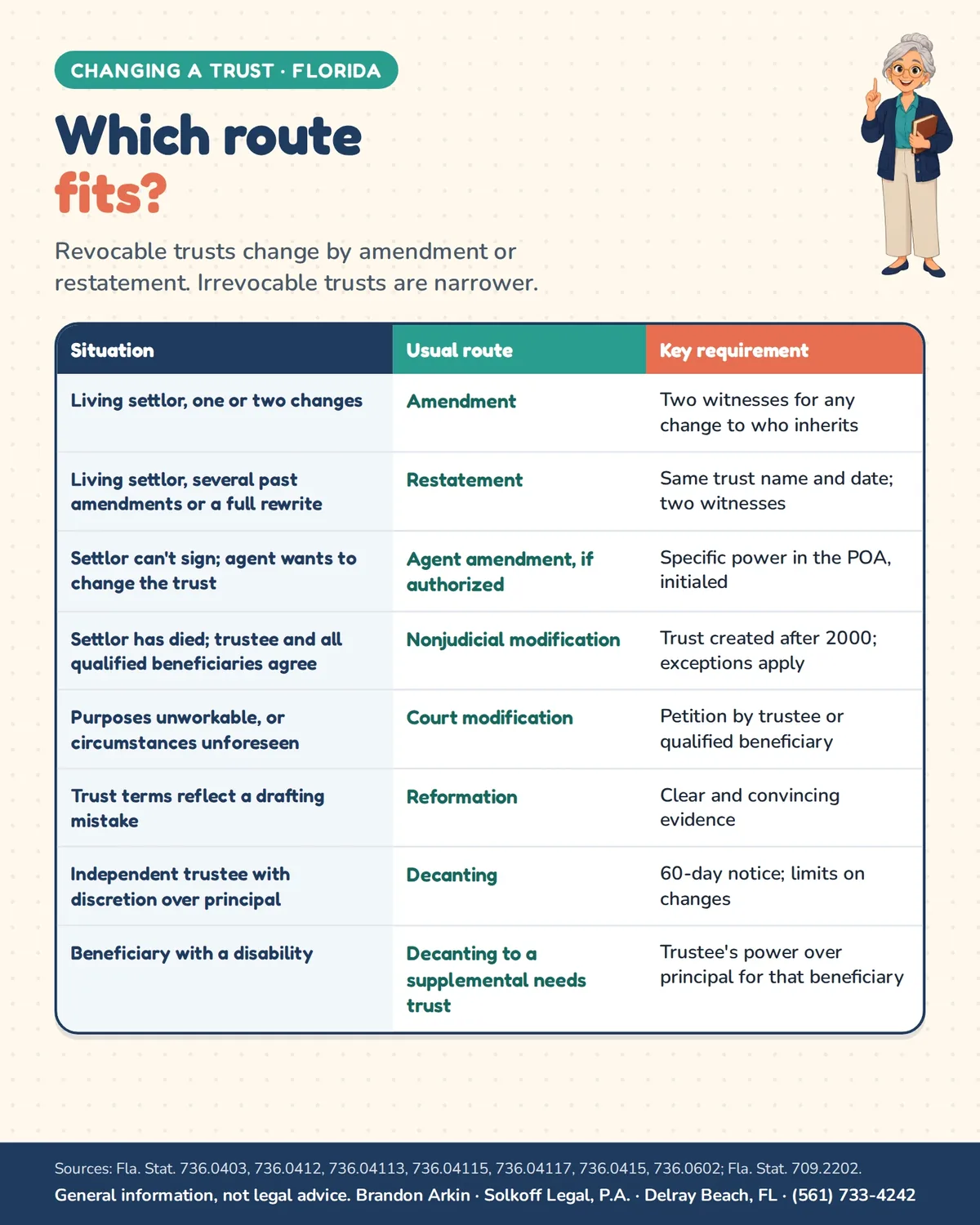
Which route fits?
Tick the row that describes your situation, then take it to your advisor. Fill it in on screen or on paper. Nothing is saved.
| Situation | Usual route | Key requirement |
|---|---|---|
| ☐ Living settlor, one or two changes | Amendment | Two witnesses for any change to who inherits |
| ☐ Living settlor, several past amendments or a full rewrite | Restatement | Same trust name and date; two witnesses |
| ☐ Settlor can't sign; agent wants to change the trust | Agent amendment, if authorized | Specific power in the POA, initialed, and the trust allows it |
| ☐ Settlor has died; trustee and all qualified beneficiaries agree | Nonjudicial modification | Trust created after 2000; exceptions apply |
| ☐ Purposes unworkable, or circumstances unforeseen | Court modification | Petition by trustee or qualified beneficiary |
| ☐ Trust terms reflect a drafting mistake | Reformation | Clear and convincing evidence |
| ☐ Independent trustee with discretion over principal | Decanting | 60-day notice; limits on changes |
| ☐ Beneficiary with a disability | Decanting to a supplemental needs trust | Trustee's power over principal for that beneficiary |
Situation
☐ Living settlor, one or two changes
Usual route
Amendment
Key requirement
Two witnesses for any change to who inherits
Situation
☐ Living settlor, several past amendments or a full rewrite
Usual route
Restatement
Key requirement
Same trust name and date; two witnesses
Situation
☐ Settlor can't sign; agent wants to change the trust
Usual route
Agent amendment, if authorized
Key requirement
Specific power in the POA, initialed, and the trust allows it
Situation
☐ Settlor has died; trustee and all qualified beneficiaries agree
Usual route
Nonjudicial modification
Key requirement
Trust created after 2000; exceptions apply
Situation
☐ Purposes unworkable, or circumstances unforeseen
Usual route
Court modification
Key requirement
Petition by trustee or qualified beneficiary
Situation
☐ Trust terms reflect a drafting mistake
Usual route
Reformation
Key requirement
Clear and convincing evidence
Situation
☐ Independent trustee with discretion over principal
Usual route
Decanting
Key requirement
60-day notice; limits on changes
Situation
☐ Beneficiary with a disability
Usual route
Decanting to a supplemental needs trust
Key requirement
Trustee's power over principal for that beneficiary
Tick boxes stay on this device. Nothing is saved or sent.
Common questions
Should I amend or restate my Florida trust?
An amendment works well for one or two targeted changes, such as a new successor trustee. A restatement replaces the entire document while keeping the original trust name and date. It's often chosen after several amendments, or when the changes are broad. Because the name and date stay the same, assets already titled to the trust stay put, and your pour-over will still matches. Either way, any change to who inherits must be signed with will formalities, meaning two witnesses (Fla. Stat. 736.0403).
Can my power of attorney agent change my trust?
Only if both documents allow it. Your power of attorney must specifically grant that power, with your separate initials or signature next to it, and your trust document must also allow your agent to make the change (Fla. Stat. 709.2202(1)(b); 736.0602(5)). Powers of attorney signed before October 1, 2011 aren't covered by these rules (709.2202(7)). Even with that power, the agent is a fiduciary who must act in good faith and try to preserve your known plan. A guardian of the property needs court approval.
What is trust decanting in Florida?
Decanting lets an independent trustee who has power to distribute principal modify the trust, or move assets into a new trust with updated terms (Fla. Stat. 736.04117). The trustee can't be the settlor or a beneficiary. With broad discretion, the new trust can include only existing beneficiaries and can't reduce vested interests. With limited discretion, beneficiaries' interests must stay substantially similar. A share can also be decanted into a supplemental needs trust for a beneficiary with a disability. The trustee must give 60 days' written notice unless it's waived.
Can an irrevocable trust be changed in Florida?
Often, yes, within limits. After the settlor's death, the trustee and all qualified beneficiaries can agree to modify many trusts created after 2000 (Fla. Stat. 736.0412). A court can modify a trust whose purposes have become unworkable, or when circumstances the settlor didn't foresee would defeat its purpose (Fla. Stat. 736.04113). A court can also reform it to fix a proven mistake. An independent trustee may be able to decant it. Which route works depends on the trust's terms, its date and who agrees.
If your family is facing one of these questions, you can reach Brandon Arkin at Solkoff Legal, P.A. at (561) 733-4242.
Related on this site
Talk through the next step
Bring your questions, a list of accounts and any papers a hospital, nursing home or Medicaid office has sent you. Call the Delray Beach office or request a consultation, and I can look at where things stand and what may come next. A phone call or an email does not by itself create an attorney-client relationship.
Solkoff Legal, P.A. · (561) 733-4242