
Resources · Medicaid planning
Medicaid asset protection trusts in Florida: how they work and who they may fit
By Brandon Arkin, elder law attorney, Solkoff Legal, P.A. · Updated November 2026

A Medicaid asset protection trust is an irrevocable trust that can pay you its income but can never return the principal to you or your spouse, so Florida Medicaid generally doesn't count the principal as yours. Funding it is a transfer, though, so it generally helps only if you won't need long-term care Medicaid for at least 60 months after you put the assets in.
What the trust is, in plain terms
You (the grantor) sign a trust agreement and transfer property to a trustee, often an adult child. The agreement says two things that matter most for Medicaid. First, you can't revoke it. Second, the trustee may pay you the trust's net income, such as interest and dividends, but may never pay principal to you or your spouse or use it for your benefit.
At your death, the trustee distributes what's left to the people you named, usually your children, without probate.
DCF's rule is what makes this work. For an irrevocable trust created on or after October 1, 1993, if any part of the principal could be paid to you or for your benefit under any circumstances, that part counts as your asset. If no payment could be made to you under any circumstances, the trust isn't counted, but the transfer rules apply to what you put in (ESS Policy Manual 1640.0576.07; 42 U.S.C. 1396p(d)(3)(B)). The same passage says these rules apply regardless of the trust's purpose or the trustee's discretion. Wording is everything. A trust labeled "asset protection" that lets the trustee pay principal to you "for health and support" generally fails.
The 60-month clock
When you apply for long-term care Medicaid, DCF looks back 60 months from the month of application for transfers for less than fair market value. Money or a home moved into an income-only trust is such a transfer.
If you apply within the 60 months, DCF divides the value transferred by the average private nursing home rate, $10,645 a month in 2026, to set a penalty period (ESS Policy Manual 1640.0618). Federal law starts that penalty only once you're otherwise eligible and in need of nursing-home-level care (42 U.S.C. 1396p(c)(1)(D)(ii)). In other words, the penalty runs at the worst possible time, when you're already spending down and need care.
If you apply after the 60 months have passed, the transfer generally isn't reviewed. That is why this trust is a "five years or more" tool. It's rarely the answer when someone is already in a nursing home; our Medicaid planning page explains crisis options.
Choosing the trustee
You generally shouldn't serve as your own trustee. If the trustee can use the funds for themselves, DCF treats the trust as the trustee's asset (ESS Policy Manual 1640.0312.02). In practice, the trustee is usually a child or other trusted person, with a named backup.
The trustee owes duties under the Florida Trust Code: loyalty, prudent investing, keeping records, and informing beneficiaries (Fla. Stat. 736.0802; 736.0813). The trust may allow principal to be paid to your children. That's legal, but if a child then hands the money back to you, the protection can unravel, and the gift back may be countable. A trust protector, or a limited power for you to change the remainder beneficiaries, may add flexibility without giving you access.
The home, homestead and property taxes
Many families put the home in the trust. These trusts are commonly drafted to give you the right to live in the home for life. Florida grants the homestead property tax exemption to a person with "beneficial title in equity" who makes the home a permanent residence (Fla. Stat. 196.031), and to a person whose right to live there comes from an instrument granting a beneficial interest for life (Fla. Stat. 196.041). Confirm with your county property appraiser after the deed is recorded.
Two points to weigh:
A home you live in is often already excluded for Medicaid during life, up to the $752,000 equity limit in 2026 (A-9). Moving it into the trust starts a new 60-month clock on its value. Some families use a Lady Bird deed instead, because DCF says signing one is not a transfer. If you're married or have a minor child, Florida's homestead rules may restrict who can receive the home and require your spouse to sign the deed (Art. X, s. 4, Fla. Const.).
If the trustee later sells the home, the proceeds stay in the trust and generally remain unavailable to you.
Income tax and basis
Because you keep the right to the income, the trust is generally a grantor trust for income tax, so you report its income on your own return (26 U.S.C. 677). Drafters often add another power so capital gains are also taxed to you. Grantor status can keep the $250,000 home sale exclusion available (Treas. Reg. 1.121-1(c)(3)).
Basis at death matters a great deal. The IRS has ruled that assets in an irrevocable grantor trust that are not included in the grantor's taxable estate don't get a step-up in basis at death (Rev. Rul. 2023-2). Income-only trusts are usually written so the assets are included in your estate, for example because you keep the income (26 U.S.C. 2036). That inclusion generally gives your children a basis equal to value at death (26 U.S.C. 1014). Your CPA should review the document; our guide for CPAs covers the technical side.
Who it may fit, and who it usually doesn't
It may fit someone who:
is in reasonable health and doesn't expect to need long-term care within five years; has more assets than they will need, and enough income and savings outside the trust to live on; trusts the person who will serve as trustee; wants a home or savings to pass to children.
It usually doesn't fit someone who:
already needs care, or likely will within five years; would need the principal for living expenses; holds savings mainly in IRAs or 401(k)s, which generally can't be retitled to a trust without cashing out and paying income tax; has a modest estate that other tools protect more simply; has a spouse who may need planning soon, since married couples have their own rules (see married couples and Medicaid).
How it compares
A revocable trust is useful for probate and incapacity planning, but DCF counts its entire principal as yours (ESS Policy Manual 1640.0576.07).
| Income-only trust | Lady Bird deed | Revocable trust | |
|---|---|---|---|
| Can you take assets back? | No | Yes | Yes |
| Medicaid transfer when signed or funded? | Yes, 60-month look-back | No, per DCF 1640.0613.01 | No, but all of it counts |
| Counted for Medicaid after 60 months? | Principal generally not counted | Home counted like any home (may be excluded as homestead) | Fully counted |
| Covers more than the home? | Yes | No | Yes |
| Avoids probate? | Yes | Generally, for the home | Yes, if funded |
Can you take assets back?
Income-only trust
No
Lady Bird deed
Yes
Revocable trust
Yes
Medicaid transfer when signed or funded?
Income-only trust
Yes, 60-month look-back
Lady Bird deed
No, per DCF 1640.0613.01
Revocable trust
No, but all of it counts
Counted for Medicaid after 60 months?
Income-only trust
Principal generally not counted
Lady Bird deed
Home counted like any home (may be excluded as homestead)
Revocable trust
Fully counted
Covers more than the home?
Income-only trust
Yes
Lady Bird deed
No
Revocable trust
Yes
Avoids probate?
Income-only trust
Yes
Lady Bird deed
Generally, for the home
Revocable trust
Yes, if funded
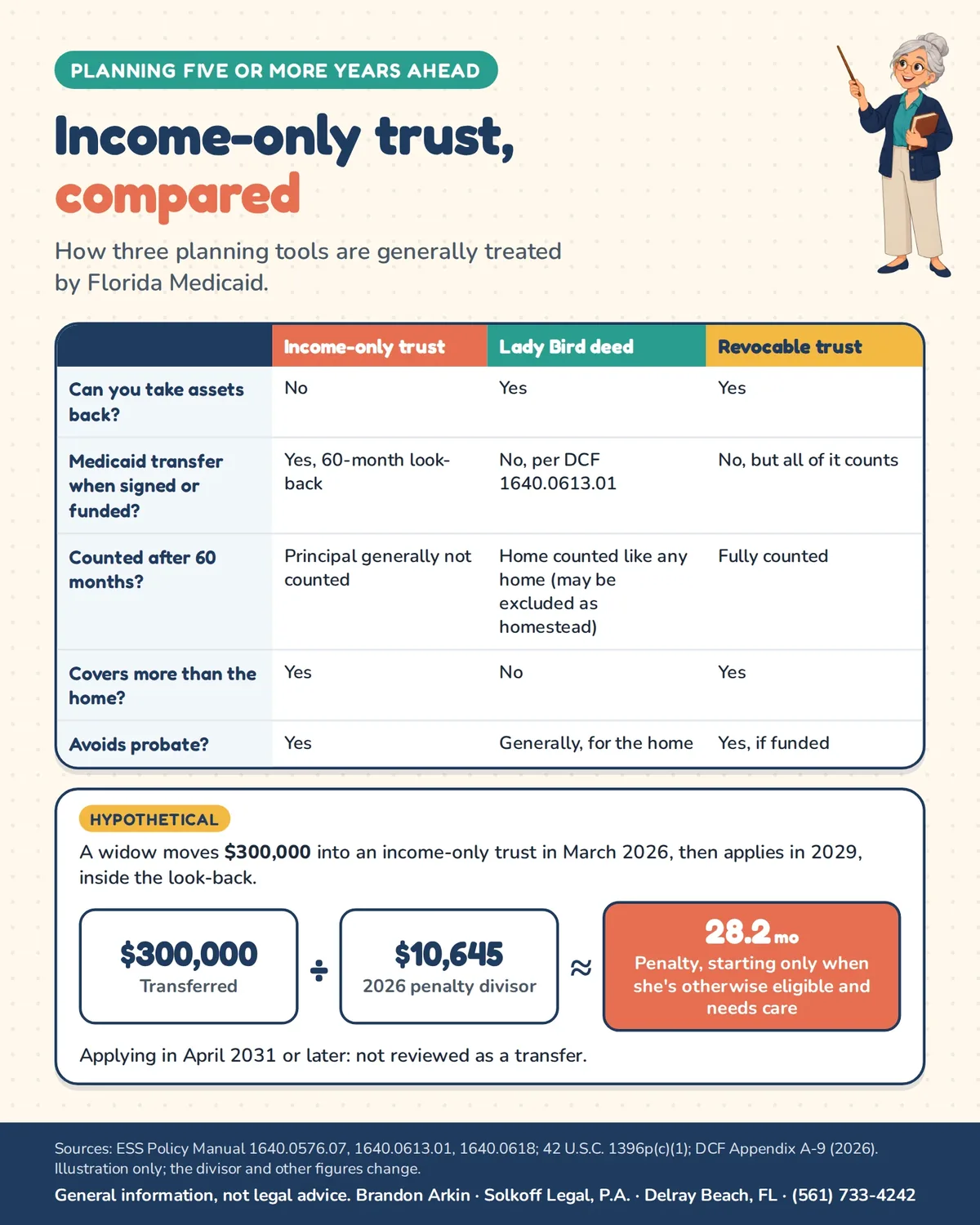
A hypothetical, in numbers
Assume a 71-year-old widow in Palm Beach County has a home and a $400,000 brokerage account. She keeps $100,000 in her own name for emergencies and moves $300,000 into an income-only trust in March 2026.
| If she applies for nursing home Medicaid... | What generally happens to the $300,000 |
|---|---|
| In April 2031 or later (more than 60 months) | Not reviewed as a transfer. The trust principal isn't counted. |
| In 2029 (inside the look-back) | A penalty of about 28 months: $300,000 ÷ $10,645 ≈ 28.2. It starts only when she's otherwise eligible and needs care. |
| Never | Children inherit the trust at her death outside probate. She received the income all along. |
If she applies for nursing home Medicaid...
In April 2031 or later (more than 60 months)
What generally happens to the $300,000
Not reviewed as a transfer. The trust principal isn't counted.
If she applies for nursing home Medicaid...
In 2029 (inside the look-back)
What generally happens to the $300,000
A penalty of about 28 months: $300,000 ÷ $10,645 ≈ 28.2. It starts only when she's otherwise eligible and needs care.
If she applies for nursing home Medicaid...
Never
What generally happens to the $300,000
Children inherit the trust at her death outside probate. She received the income all along.
The $100,000 she kept would still need to be spent or restructured before she could meet the $2,000 asset limit. Illustration only; actual figures change each year.
Decision checklist
Bring your answers to a planning meeting. A "no" doesn't rule the trust out, but it means the questions need closer review.
Tick boxes stay on this device. Nothing is saved or sent.
Common questions
What is a Medicaid asset protection trust in Florida?
It's an irrevocable trust, often called an income-only trust, that can pay you its income but never its principal. Under DCF policy, principal that can't be paid to you under any circumstances isn't counted as your asset for Medicaid (ESS Policy Manual 1640.0576.07). Putting assets in is a transfer, though, so it's subject to the 60-month look-back. It generally helps only if long-term care Medicaid won't be needed for five years or more. Florida doesn't have a special statutory form; the protection comes from the trust's wording.
Can I be the trustee of my own Medicaid trust?
Generally no. DCF treats a trust as the trustee's asset when the trustee can use the funds for personal benefit (ESS Policy Manual 1640.0312.02), and an income-only trust only works if you have no access to principal. Your spouse is usually a poor choice too, because the same rules look at payments for your spouse. Most families name an adult child or another trusted person, plus a backup. Some trusts let you keep limited powers, such as changing which children inherit, without giving you access. Those terms need careful drafting.
Will I keep my homestead exemption if my house goes into the trust?
Usually, if the trust is drafted for it. Florida grants the exemption to someone with beneficial title in equity who lives in the home permanently (Fla. Stat. 196.031), and to someone living there under an instrument granting a beneficial interest for life (Fla. Stat. 196.041). Income-only trusts commonly reserve your right to live in the home for life. After recording the deed, confirm the exemption with your county property appraiser, who may ask to see the trust.
Do my children lose the step-up in basis?
Not necessarily, but it depends on the wording. The IRS has ruled that assets in an irrevocable grantor trust that aren't included in the grantor's taxable estate don't get a step-up at death (Rev. Rul. 2023-2). Income-only trusts are usually written so the assets are included, for example because you keep the right to the income (26 U.S.C. 2036). If included, your children generally take a basis equal to value at death (26 U.S.C. 1014). Have your CPA review the draft.
If your family is facing one of these questions, you can reach Brandon Arkin at Solkoff Legal, P.A. at (561) 733-4242.
Related on this site
Talk through the next step
Bring your questions, a list of accounts and any papers a hospital, nursing home or Medicaid office has sent you. Call the Delray Beach office or request a consultation, and I can look at where things stand and what may come next. A phone call or an email does not by itself create an attorney-client relationship.
Solkoff Legal, P.A. · (561) 733-4242