
Resources · Estate planning
Is a handwritten will valid in Florida? Holographic wills, oral wills and what the law requires
By Brandon Arkin, elder law attorney, Solkoff Legal, P.A. · Updated November 2026

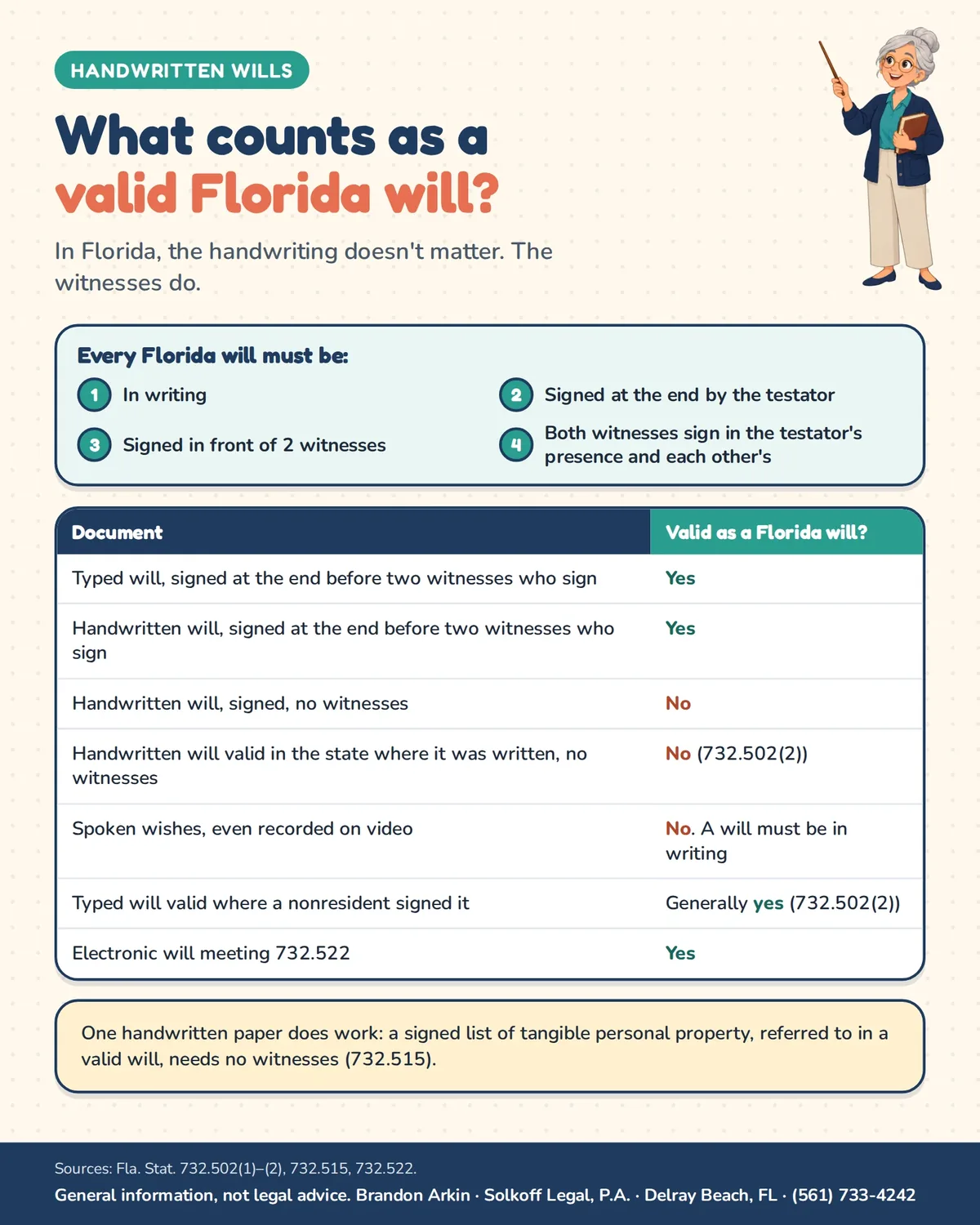
A handwritten will is valid in Florida only if it is signed at the end in front of two witnesses who also sign in the testator's presence and in each other's presence. Florida doesn't recognize unwitnessed handwritten ("holographic") wills or oral ("nuncupative") wills, even if they were valid in the state where they were made.
What Florida requires
Under Fla. Stat. 732.502(1), a will must:
be in writing; be signed at the end by the testator, meaning the person making the will, or by someone else in the testator's presence and at their direction; be signed, or the signature acknowledged, in the presence of at least two attesting witnesses; and be signed by both witnesses in the presence of the testator and of each other.
The person must also be of sound mind and 18 or older, or an emancipated minor (732.501). No special wording is required (732.502(4)).
So handwriting isn't the problem. A will written entirely by hand and signed before two witnesses, who then sign, meets the statute. The law says so directly: a handwritten will executed this way "shall not be considered a holographic will" (732.502(2)). What fails is the handwritten will with no witnesses, or with one.
Wills from other states
Many Palm Beach County residents signed their wills somewhere else. Florida generally accepts a will signed by a nonresident if it was valid where it was signed. The statute carves out two exceptions: holographic and nuncupative wills (732.502(2)). A handwritten, unwitnessed will that a court up north would have accepted is generally not a valid will in a Florida probate.
The out-of-state rule also only helps a will signed while the person was a nonresident. A will signed after moving to Florida must meet Florida's own formalities.
Oral wills
A nuncupative will is one spoken aloud, often near death, and never written down. Florida law opens its execution rules with "Every will must be in writing" (732.502), so an oral will has no effect on who inherits. A video of a parent describing their wishes isn't a will either, though it may matter in a dispute about capacity or undue influence.
Don't confuse this with health care documents. Florida does allow a witnessed oral statement to serve as a living will about life-prolonging procedures (Fla. Stat. 765.101(13)(b)). That rule covers medical care only, not property. Living will vs. last will explains the difference.
What happens if the will fails
If a document isn't a valid will, property that would have passed under it generally passes by intestacy, Florida's default inheritance rules. For example, a surviving spouse takes everything if all the decedent's descendants are also the spouse's and the spouse has no other descendants (Fla. Stat. 732.102). Different family structures produce different results. These rules may not match what the note said.
Accounts with beneficiary forms, joint accounts with survivorship and trust assets usually aren't affected, because they pass outside the will.
Handwritten changes to a typed will
A common version of this problem: someone writes "Give the boat to Mark" in the margin of a signed will, or crosses out a name. A codicil, meaning an amendment to a will, must be signed with the same formalities as a will (732.502(5)). An unwitnessed note in the margin generally doesn't change anything.
Worse, crossing out or defacing a will with the intent to revoke it can revoke it (Fla. Stat. 732.506). A pen can undo a plan.
One handwritten paper does work. A valid will may refer to a separate written list of tangible personal property, such as jewelry, art or furniture. The list must be signed and describe the items and recipients with reasonable certainty. It needs no witnesses and can be updated later (Fla. Stat. 732.515). It can't pass money, real estate or business property.
Self-proving and electronic wills
A self-proved will has an affidavit attached, in which the testator and both witnesses swear before a notary that the will was properly signed. The notary may be present in person or online (732.503). A self-proved will can be admitted to probate without further proof. Otherwise, the court generally needs the oath of a witness, and only if witnesses can't be found does it accept other oaths (733.201). Years later, finding a witness can be hard.
Florida also allows electronic wills, signed with an electronic signature. Witnesses may appear by audio-video technology, but only in an online notarization session supervised by a Florida online notary, with extra safeguards (732.522). An electronic will isn't a typed note on a phone. Signing estate documents online covers those rules.
Example (hypothetical)
Frank moved to Boynton Beach from a state that accepts handwritten wills. Before the move, he wrote and signed a two-page will by hand, leaving his condo to his longtime partner, Joan. No one witnessed it. After Frank dies, Joan offers it for probate in Palm Beach County. Because Florida excludes holographic wills, even ones valid where they were made, the court generally won't admit it. With no spouse, Frank's condo passes by intestacy to his two adult children (Fla. Stat. 732.103(1)), and Joan, who wasn't married to Frank, isn't an intestate heir. Had Frank signed the same pages before two witnesses, the handwriting wouldn't have mattered.
What counts and what doesn't
| Document | Valid as a Florida will? |
|---|---|
| Typed will, signed at the end before two witnesses who sign | Yes |
| Handwritten will, signed at the end before two witnesses who sign | Yes |
| Handwritten will, signed, no witnesses | No |
| Handwritten will valid in the state where it was written, no witnesses | No (732.502(2)) |
| Spoken wishes, even recorded on video | No. A will must be in writing |
| Typed will valid where a nonresident signed it | Generally yes (732.502(2)) |
| Military testamentary instrument under 10 U.S.C. 1044d | Yes (732.502(3)) |
| Electronic will meeting 732.522 | Yes (732.522) |
Document
Typed will, signed at the end before two witnesses who sign
Valid as a Florida will?
Yes
Document
Handwritten will, signed at the end before two witnesses who sign
Valid as a Florida will?
Yes
Document
Handwritten will, signed, no witnesses
Valid as a Florida will?
No
Document
Handwritten will valid in the state where it was written, no witnesses
Valid as a Florida will?
No (732.502(2))
Document
Spoken wishes, even recorded on video
Valid as a Florida will?
No. A will must be in writing
Document
Typed will valid where a nonresident signed it
Valid as a Florida will?
Generally yes (732.502(2))
Document
Military testamentary instrument under 10 U.S.C. 1044d
Valid as a Florida will?
Yes (732.502(3))
Document
Electronic will meeting 732.522
Valid as a Florida will?
Yes (732.522)
Will-signing check
Look at the original, not a copy, and check each line. Nothing is saved.
Tick boxes stay on this device. Nothing is saved or sent.
Common questions
Is a handwritten will legal in Florida?
It can be, if it's signed correctly. Florida doesn't care whether a will is handwritten or typed. It cares whether the will is signed at the end in front of two witnesses who also sign in the testator's presence and in each other's presence. A handwritten will signed that way isn't treated as a holographic will under Florida law. A handwritten will with no witnesses, or only one, generally isn't valid, even if it is dated, signed and clearly states the person's wishes.
My parent's handwritten will was valid in another state. Is it valid in Florida?
Generally not, if it was unwitnessed. Florida accepts most wills that were valid where a nonresident signed them. But the statute specifically excludes holographic and nuncupative wills from that rule. If the document wasn't signed before two witnesses, a Florida probate court generally won't admit it, and the property passing under a will goes by Florida's intestacy rules instead. Check whether there's an earlier, properly witnessed will, and whether the main assets pass by beneficiary form or trust anyway.
Does a Florida will have to be notarized?
No. A notary isn't required for a will to be valid. Two witnesses are. Many Florida wills add a self-proof affidavit, signed by the testator and both witnesses before a notary, in person or online. That makes the will "self-proved," so the court can admit it to probate without finding a witness to testify. Without it, the personal representative generally needs a witness's oath, which can be hard to get many years after signing.
Can I leave jewelry or furniture in a handwritten list?
Yes, if your valid will refers to the list. Florida allows a separate written statement or list to dispose of tangible personal property, such as jewelry, furniture, art or collectibles, that the will doesn't otherwise give away. The list must be signed and describe the items and recipients with reasonable certainty. It doesn't need witnesses and can be changed later; the most recent list controls where lists conflict. It can't be used for cash, real estate, accounts or business property.
If your family is facing one of these questions, you can reach Brandon Arkin at Solkoff Legal, P.A. at (561) 733-4242.
Related on this site
Talk through the next step
Bring your questions, a list of accounts and any papers a hospital, nursing home or Medicaid office has sent you. Call the Delray Beach office or request a consultation, and I can look at where things stand and what may come next. A phone call or an email does not by itself create an attorney-client relationship.
Solkoff Legal, P.A. · (561) 733-4242