Resources · Planning for incapacity
Alternatives to Guardianship in Florida: Less Restrictive Ways to Help a Parent Decide
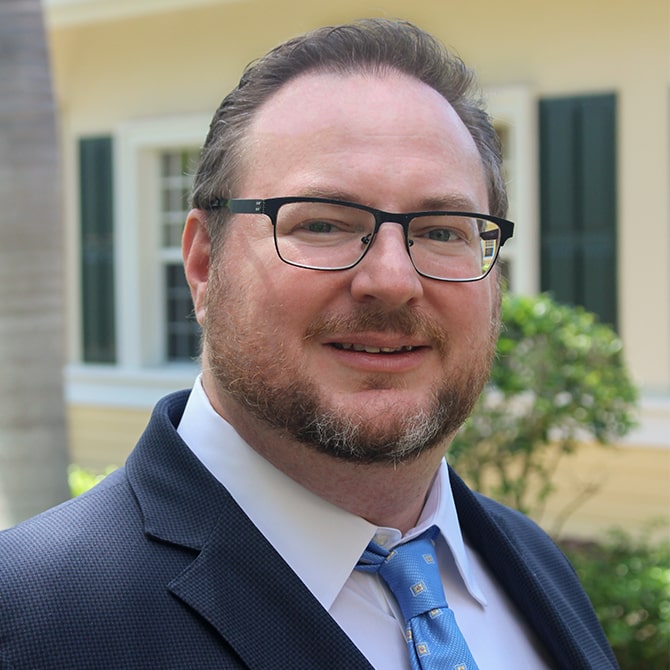
By Brandon Arkin, elder law attorney, Solkoff Legal, P.A. · Updated November 2026

The main alternatives to guardianship in Florida are a durable power of attorney for finances, a health care surrogate designation, the statutory health care proxy, a supported decision-making agreement, a trust, a Social Security representative payee, and, for adults with developmental disabilities, guardian advocacy. A Florida court may not appoint a guardian if it finds "an alternative to guardianship which will sufficiently address the problems" of the person (Fla. Stat. 744.331(6)(b)).
Guardianship isn't one of our practice areas. This page explains the options so your family can plan ahead and talk with the right professional.
Why guardianship is the last resort
A guardianship case starts with a petition to determine incapacity. Within 5 days, the court appoints an examining committee of three, one of them a psychiatrist or other physician. Each member examines the person and files a report within 15 days. The court also appoints an attorney to represent the person. If a majority of the committee finds no incapacity, the petition is dismissed. Otherwise, a hearing follows, generally 10 to 30 days after the last report (Fla. Stat. 744.331).
If the judge finds incapacity, the order can remove rights such as the right to contract, manage property, decide where to live, make health care decisions and apply for government benefits. Those rights pass to the guardian (Fla. Stat. 744.3215). After that, the guardian files an annual plan or accounting with the court (Fla. Stat. 744.367). The court must approve guardian and attorney fees, which are generally paid from the person's estate (Fla. Stat. 744.108).
The petition itself has to say whether the person already uses help, such as supported decision-making, and why it isn't enough (Fla. Stat. 744.3201). The court must then decide whether an alternative will sufficiently address the problem. If one will, no guardian may be appointed (Fla. Stat. 744.331(6)(b)).
Durable power of attorney for money and property
A durable power of attorney names an agent to handle finances, and it keeps working after the principal loses capacity. In Florida, it must be signed in front of two witnesses and a notary (Fla. Stat. 709.2105). It's the most important single document for avoiding a guardianship of the property. The catch is timing: the principal must have capacity to sign it.
Two points families miss:
If someone files a petition to determine incapacity, the agent's authority is generally suspended until the court rules. The exception is an agent who is the principal's parent, spouse, child or grandchild: that authority continues unless a verified motion is also filed (Fla. Stat. 709.2109(3)). A POA can be challenged. If an interested person files a verified statement with a good-faith, factual basis for believing it's invalid, the court won't treat it as an alternative (Fla. Stat. 744.331(6)(f)).
Our guide for agents explains the agent's day-to-day duties.
Health care surrogate and the statutory proxy
A health care surrogate designation names who makes medical decisions. It needs two adult witnesses. The surrogate can't be a witness, and at least one witness must be neither a spouse nor a blood relative. The document can make the surrogate's authority effective immediately, without waiting for an incapacity finding (Fla. Stat. 765.202).
If there's no surrogate, Florida's proxy statute steps in. The order is (Fla. Stat. 765.401):
a guardian already appointed; the spouse; an adult child, or a majority of the adult children reasonably available; a parent; an adult sibling, or a majority of the siblings; a close adult relative who has shown special care and concern; a close friend; a qualified clinical social worker chosen through a bioethics committee.
The statute says no guardian has to be appointed before a treatment decision can be made. For many families, the proxy list means a medical guardianship isn't needed at all. But a split among adult children can stall decisions, which is why a named surrogate is better.
Supported decision-making and guardian advocacy
Since 2024, Florida recognizes a supported decision-making agreement, a limited kind of power of attorney. The helper can obtain medical, education and other protected records and help the person communicate decisions, but has no authority to bind or act for them (Fla. Stat. 709.2209). Any language making it durable has no effect. It suits a parent with early memory loss who can still decide with help, for example someone who needs a daughter on the line with the doctor or the bank.
Guardian advocacy is a court process, but a lighter one, for a person with a developmental disability such as an intellectual disability or autism. It doesn't require a finding of incapacity, and the court delegates only the decisions the person can't make (Fla. Stat. 393.12). It isn't available for dementia that begins in later life. Our special needs guide covers it for younger adults.
Trusts, payees and a pre-need guardian
Revocable trust. Assets titled in a trust can be managed by a successor trustee if the creator becomes incapacitated, with no court involvement. See our revocable trust guide and trust funding guide. Representative payee. Social Security appoints a payee, usually a family member, to manage benefits for someone who can't. The payee must use the money for current needs and keep records. A POA, authorized-representative status or a joint account isn't the same thing (SSA). You can designate up to three people in advance (SSA Representative Payee Program). Pre-need guardian designation. This doesn't avoid guardianship, but it controls who serves if one is ever needed. A competent adult signs it in front of two witnesses present at the same time and may file it with the clerk. It creates a rebuttable presumption that the named person should serve (Fla. Stat. 744.3045).
When none of these is in place and there's an emergency, a court can appoint an emergency temporary guardian for up to 90 days, with one 90-day extension (Fla. Stat. 744.3031).
A worked example
Hypothetically, Ruth, 82, lives alone in Jupiter and was recently diagnosed with mild cognitive impairment. She has a will but no other documents. Her son lives in Ohio, and her daughter lives nearby.
Her doctor confirms she understands what she's signing. That month, she signs a durable power of attorney naming her daughter, with her son as successor. She also signs a health care surrogate designation with immediate authority and a pre-need guardian declaration naming her daughter. Her daughter applies to SSA to become Ruth's representative payee.
Two years later, Ruth can no longer manage money, but no court case is needed. The daughter pays bills under the POA, talks with doctors as surrogate and manages Social Security as payee. If a dispute ever led to a guardianship petition, the pre-need declaration would point the court to her.
Can we avoid guardianship? A self-check
Tick what's in place. Nothing is saved. Each unticked line is a gap to fill while the person can still sign.
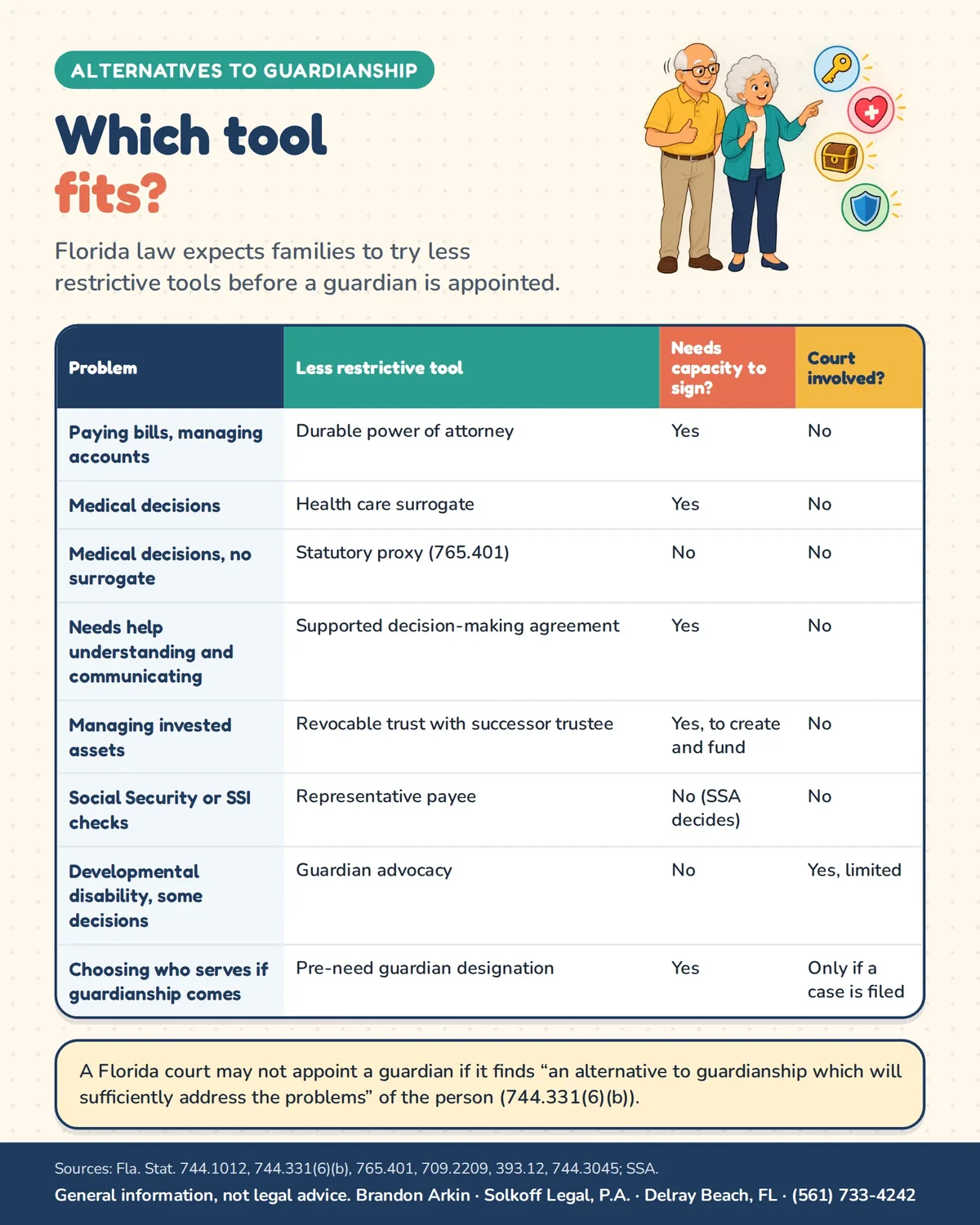
Which tool fits?
| Problem | Less restrictive tool | Needs capacity to sign? | Court involved? |
|---|---|---|---|
| Paying bills, managing accounts | Durable power of attorney | Yes | No |
| Medical decisions | Health care surrogate | Yes | No |
| Medical decisions, no surrogate | Statutory proxy (765.401) | No | No |
| Needs help understanding and communicating | Supported decision-making agreement | Yes | No |
| Managing invested assets | Revocable trust with successor trustee | Yes, to create and fund | No |
| Social Security or SSI checks | Representative payee | No (SSA decides) | No |
| Developmental disability, some decisions | Guardian advocacy | No | Yes, limited |
| Choosing who serves if guardianship comes | Pre-need guardian designation | Yes | Only if a case is filed |
Problem
Paying bills, managing accounts
Less restrictive tool
Durable power of attorney
Needs capacity to sign?
Yes
Court involved?
No
Problem
Medical decisions
Less restrictive tool
Health care surrogate
Needs capacity to sign?
Yes
Court involved?
No
Problem
Medical decisions, no surrogate
Less restrictive tool
Statutory proxy (765.401)
Needs capacity to sign?
No
Court involved?
No
Problem
Needs help understanding and communicating
Less restrictive tool
Supported decision-making agreement
Needs capacity to sign?
Yes
Court involved?
No
Problem
Managing invested assets
Less restrictive tool
Revocable trust with successor trustee
Needs capacity to sign?
Yes, to create and fund
Court involved?
No
Problem
Social Security or SSI checks
Less restrictive tool
Representative payee
Needs capacity to sign?
No (SSA decides)
Court involved?
No
Problem
Developmental disability, some decisions
Less restrictive tool
Guardian advocacy
Needs capacity to sign?
No
Court involved?
Yes, limited
Problem
Choosing who serves if guardianship comes
Less restrictive tool
Pre-need guardian designation
Needs capacity to sign?
Yes
Court involved?
Only if a case is filed
Common questions
What are the alternatives to guardianship in Florida?
They include a durable power of attorney, a health care surrogate, the statutory health care proxy, a supported decision-making agreement, a trust, a Social Security representative payee and, for developmental disabilities, guardian advocacy. A court may not appoint a guardian if an alternative will sufficiently address the person's problems (Fla. Stat. 744.331(6)(b)).
Can family make medical decisions in Florida without guardianship?
Often, yes. If there's no surrogate, Florida's proxy statute lets a spouse, then a majority of reasonably available adult children, then other relatives and close friends, make health care decisions. The statute doesn't require a guardian to be appointed first (Fla. Stat. 765.401).
Is it too late for a power of attorney if a parent has dementia?
Not necessarily. A dementia diagnosis doesn't by itself mean a person lacks capacity to sign. What matters is whether they understand the document when they sign it. Ask the doctor to document capacity near the signing date. If capacity is gone, the options narrow to the proxy, a representative payee and, if needed, the court.
How long does guardianship take in Florida?
The statute sets tight early steps: an examining committee within 5 days of the petition, reports within 15 days of appointment, and a hearing generally 10 to 30 days after the last report (Fla. Stat. 744.331). Contested cases take longer. Court supervision then continues for as long as the guardianship lasts.
If your family is facing one of these questions, you can reach Brandon Arkin at Solkoff Legal, P.A. at (561) 733-4242.
Related on this site
Talk through the next step
Bring your questions, a list of accounts and any papers a hospital, nursing home or Medicaid office has sent you. Call the Delray Beach office or request a consultation, and I can look at where things stand and what may come next. A phone call or an email does not by itself create an attorney-client relationship.
Solkoff Legal, P.A. · (561) 733-4242