Resources · Trusts
The HEMS standard: what "health, education, maintenance and support" means in a trust
By Brandon Arkin, elder law attorney, Solkoff Legal, P.A. · Updated November 2026

The HEMS standard lets a trustee pay income or principal for a beneficiary's health, education, maintenance and support, and federal tax law treats it as an "ascertainable standard," so a beneficiary who is also the trustee generally isn't treated as owning the trust for estate and gift tax. Florida uses the same standard as its default limit when a trustee is also a beneficiary, though it can be a poor fit for someone who receives SSI or Medicaid.
What each word usually covers
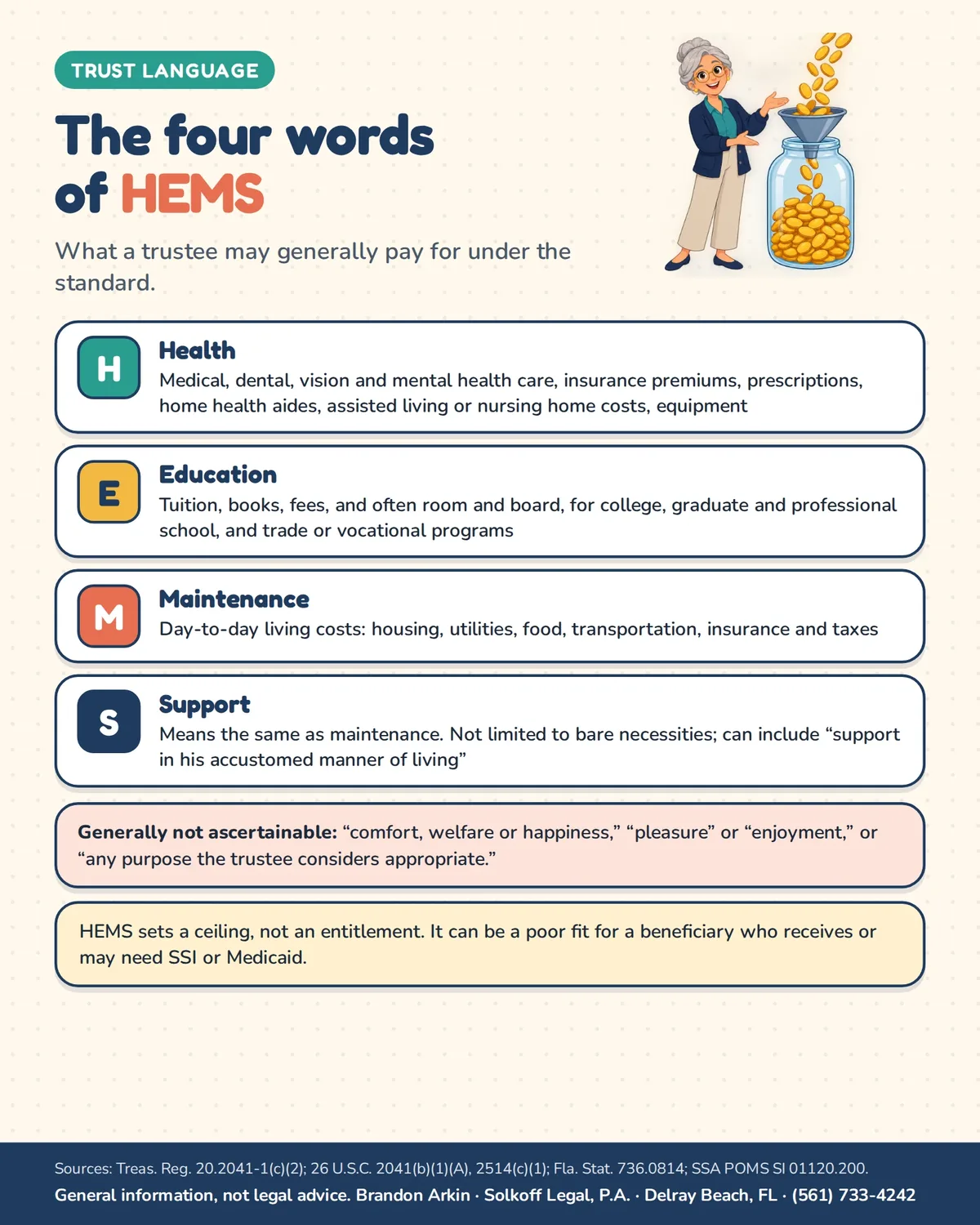
The trust document controls. Still, the four words carry common meanings:
Health: medical, dental, vision and mental health care, insurance premiums, prescriptions, home health aides, assisted living or nursing home costs, and equipment. The tax regulation lists "medical, dental, hospital and nursing expenses and expenses of invalidism" as an example. Education: tuition, books, fees, and often room and board, for college, graduate and professional school, and trade or vocational programs. The regulation's example is "education, including college and professional education." Maintenance and support: day-to-day living costs such as housing, utilities, food, transportation, insurance and taxes. The regulation treats the two words as synonyms and says they aren't limited to the "bare necessities of life," and it accepts "support in his accustomed manner of living" as ascertainable (Treas. Reg. 20.2041-1(c)(2)).
So a HEMS trust is not a "bare minimum" trust. It is measured against the beneficiary's needs, usually in light of the lifestyle they had.
| Generally treated as ascertainable | Generally not ascertainable |
|---|---|
| "Health, education, maintenance and support" | "Comfort, welfare or happiness" |
| "Support in reasonable comfort" | "Any purpose the trustee considers appropriate" |
| "Maintenance in health and reasonable comfort" | "Pleasure" or "enjoyment" |
| "Support in his accustomed manner of living" | "Emergencies," without more, may be uncertain; ask your lawyer |
Generally treated as ascertainable
"Health, education, maintenance and support"
Generally not ascertainable
"Comfort, welfare or happiness"
Generally treated as ascertainable
"Support in reasonable comfort"
Generally not ascertainable
"Any purpose the trustee considers appropriate"
Generally treated as ascertainable
"Maintenance in health and reasonable comfort"
Generally not ascertainable
"Pleasure" or "enjoyment"
Generally treated as ascertainable
"Support in his accustomed manner of living"
Generally not ascertainable
"Emergencies," without more, may be uncertain; ask your lawyer
Why tax law cares
If you hold a "general power of appointment," meaning a power you can use for yourself, your estate or your creditors, the property under that power is included in your taxable estate at death (26 U.S.C. 2041(a)(2)). Letting such a power lapse or releasing it can also be treated as a gift (2514).
The HEMS exception is what makes a common plan work. Picture a husband's trust that, at his death, holds assets for his wife for life and then for their children. If the wife is the trustee and can pay herself anything she wants, the trust may be taxed again in her estate. If her power is limited to HEMS, it generally isn't.
With a $15,000,000 per-person exclusion in 2026, most Florida families won't owe federal estate tax either way. HEMS still matters for families near that line, for trusts written years ago when the exclusion was much lower, and for the creditor and Florida trust rules below.
Florida's default rule for trustee-beneficiaries
Florida builds HEMS into its Trust Code. Unless the trust expressly says the rule doesn't apply, a person who is both a trustee and a beneficiary may not make discretionary distributions to themselves except for health, education, maintenance or support as described in sections 2041 and 2514. They also may not use trust money to meet their own legal support obligations, such as supporting their minor children (Fla. Stat. 736.0814(2)).
If the trust uses a broader standard, such as "happiness," the usual approach is to name an independent trustee or co-trustee to make those decisions. A family member can still serve for everything else.
How a trustee actually decides
HEMS sets a ceiling, not an entitlement. The trustee still has to use judgment:
Good faith. Florida requires the trustee to exercise discretion in good faith and in accordance with the trust's terms and purposes and the beneficiaries' interests. A court won't find abuse just because it would have decided differently (736.0814(1)). Fairness to everyone. When there are remainder beneficiaries, such as children who inherit after a surviving spouse, the trustee must act impartially, giving due regard to each beneficiary's interests (Fla. Stat. 736.0803). Other resources. Many trusts tell the trustee whether to consider the beneficiary's own income and assets. The tax regulation says that requirement doesn't affect whether the standard is ascertainable, but it changes the answer to many requests. Records. Keep each request, the reason, and what was paid, and pay providers directly when practical.
Creditor protection
A beneficiary's creditors generally can't force a discretionary distribution or reach the beneficiary's interest in one (Fla. Stat. 736.0504(2)). When the beneficiary is also the trustee and limited by an ascertainable standard, a creditor can reach the interest only to the extent it could if someone else were trustee (736.0504(3)). Most family trusts also include a spendthrift clause, which Florida enforces when it restrains both voluntary and involuntary transfers (Fla. Stat. 736.0502).
When HEMS conflicts with SSI and Medicaid
A support standard may be the wrong tool for a beneficiary who receives, or may someday need, SSI or Medicaid. SSA treats trust principal as the beneficiary's resource if the beneficiary can direct its use for their support and maintenance under the terms of the trust (SSA POMS SI 01120.200). A trust that requires support payments, or that a beneficiary can enforce for support, may be counted, and payments for shelter can reduce SSI.
For a beneficiary with a disability, a third-party special needs trust usually gives the trustee sole discretion and says the trust supplements, rather than replaces, public benefits. Our special needs planning guide and the trust section of our estate planning page explain how those trusts work. A spouse who may need Medicaid raises related issues; see when the healthy spouse dies first.
Applying HEMS: hypothetical requests
Assume a widow, 68, is trustee and lifetime beneficiary of her late husband's trust, with their two children as remainder beneficiaries. The trust uses a plain HEMS standard and says to consider her other resources.
| Request | Generally |
|---|---|
| Dental implants not covered by insurance | Health. Likely within the standard. |
| Monthly condo fees and property taxes | Maintenance and support. Likely within it. |
| A grandson's college tuition | Not her education. The trust would need to name descendants as beneficiaries. |
| Replacing a 12-year-old car she drives to doctors | Support, if reasonable for her circumstances |
| A cruise for her 70th birthday | Comfort or pleasure. Generally outside plain HEMS, though a long-standing travel habit might support an argument under "accustomed manner of living." |
| A large gift to one child | Not for her HEMS needs. Outside the standard. |
Request
Dental implants not covered by insurance
Generally
Health. Likely within the standard.
Request
Monthly condo fees and property taxes
Generally
Maintenance and support. Likely within it.
Request
A grandson's college tuition
Generally
Not her education. The trust would need to name descendants as beneficiaries.
Request
Replacing a 12-year-old car she drives to doctors
Generally
Support, if reasonable for her circumstances
Request
A cruise for her 70th birthday
Generally
Comfort or pleasure. Generally outside plain HEMS, though a long-standing travel habit might support an argument under "accustomed manner of living."
Request
A large gift to one child
Generally
Not for her HEMS needs. Outside the standard.
Distribution request worksheet
For trustees and beneficiaries. Fill one out for each significant request and keep it with the trust records.
Tick boxes stay on this device. Nothing is saved or sent.
Common questions
What does HEMS stand for in a trust?
HEMS stands for health, education, maintenance and support. It's a distribution standard that lets the trustee pay income or principal for those needs. Federal tax law treats it as an ascertainable standard, so a power limited to HEMS isn't a general power of appointment (26 U.S.C. 2041(b)(1)(A)). The IRS regulation says support and maintenance aren't limited to bare necessities and can reflect the beneficiary's accustomed manner of living (Treas. Reg. 20.2041-1(c)(2)). The trust document controls the details.
Can I be the trustee of a trust that benefits me?
Often yes, and HEMS is usually what makes that work. In Florida, unless the trust expressly says otherwise, a trustee who is also a beneficiary may make discretionary distributions to themselves only for health, education, maintenance or support (Fla. Stat. 736.0814(2)(a)). Staying within that standard generally keeps the trust out of the trustee's taxable estate. If the trust allows broader distributions, such as for happiness, an independent co-trustee usually makes those decisions instead.
Is a HEMS trust good for a child with a disability?
Usually not by itself. SSA counts trust principal as a resource if the beneficiary can direct its use for their support and maintenance under the trust's terms (SSA POMS SI 01120.200), and a support standard can invite that argument. Payments for shelter can also reduce SSI. A third-party special needs trust, with sole trustee discretion and language that supplements benefits, is the more common choice. Read our special needs planning guide and talk with an attorney before signing.
Does the trustee have to pay for anything that fits HEMS?
Not automatically. HEMS sets the outer limit of what may be paid, and many trusts make distributions discretionary within it. Florida requires the trustee to act in good faith and according to the trust's terms and purposes (Fla. Stat. 736.0814(1)), and to treat current and future beneficiaries impartially (Fla. Stat. 736.0803). If the trust says to consider other resources, the trustee may decline when the beneficiary can cover the cost. A beneficiary who disagrees can ask for the reasons and seek advice.
If your family is facing one of these questions, you can reach Brandon Arkin at Solkoff Legal, P.A. at (561) 733-4242.
Related on this site
Talk through the next step
Bring your questions, a list of accounts and any papers a hospital, nursing home or Medicaid office has sent you. Call the Delray Beach office or request a consultation, and I can look at where things stand and what may come next. A phone call or an email does not by itself create an attorney-client relationship.
Solkoff Legal, P.A. · (561) 733-4242