
Resources · Medicaid planning
When the healthy spouse dies first: protecting Medicaid in Florida
By Brandon Arkin, elder law attorney, Solkoff Legal, P.A. · Updated November 2026
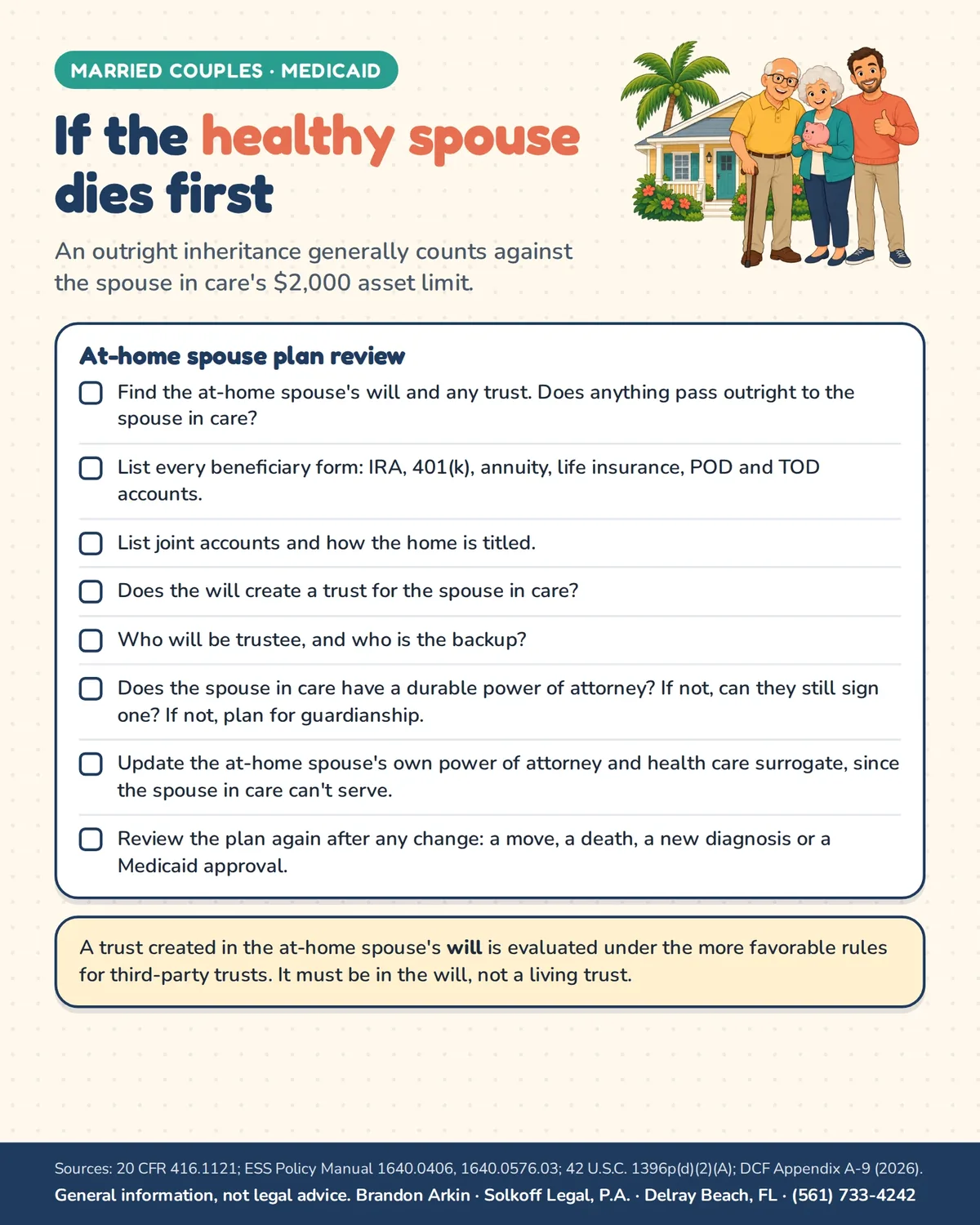
If the at-home spouse dies first and everything passes outright to the spouse on Medicaid, that inheritance generally counts against the $2,000 asset limit and can end their coverage until it is spent down. Florida also gives a surviving spouse a right to 30% of the elective estate, so the at-home spouse's will, trust and beneficiary forms should be reviewed together, often with a trust created by will for the spouse in care.
Why the at-home spouse's plan matters
When one spouse enters a nursing home, Florida Medicaid lets the spouse at home keep a protected share of the couple's assets, up to $162,660 in 2026, plus the home and other excluded property (A-9). Our guide to what happens when one spouse needs nursing home care explains how that works.
But many couples signed "I love you" wills years ago, leaving everything to each other, with beneficiary forms to match. Caregiving is hard on health, and the at-home spouse doesn't always outlive the spouse in care. If they die first, those old documents send the protected savings straight to the spouse on Medicaid.
What an outright inheritance does
For long-term care Medicaid, an inheritance counts as income in the month it is received (20 CFR 416.1121) and as an asset in every month after that (ESS 1640.0406). With a $2,000 asset limit, even a modest inheritance can end eligibility until the money is spent down.
Hypothetical: Harold and June live in Boynton Beach. Harold has advanced Parkinson's disease and is in a nursing home on Medicaid. June, 79, kept about $150,000 in savings plus the house, within the spousal allowance. Her 1998 will leaves everything to Harold. Her IRA names Harold as beneficiary. June dies suddenly after a stroke.
| Asset | Under June's old plan | Effect on Harold |
|---|---|---|
| $150,000 savings in June's name | Passes to Harold under the will after probate | Countable once received. He is over the $2,000 limit. |
| $90,000 IRA | Paid to Harold as beneficiary | Countable, subject to DCF's retirement account rules |
| The house | Florida homestead, passes to Harold as surviving spouse | Raises new questions about whether it stays excluded and about estate recovery after Harold's death |
| Result | Harold may lose Medicaid and pay privately until the money is spent. Little may be left for the children. | - |
Asset
$150,000 savings in June's name
Under June's old plan
Passes to Harold under the will after probate
Effect on Harold
Countable once received. He is over the $2,000 limit.
Asset
$90,000 IRA
Under June's old plan
Paid to Harold as beneficiary
Effect on Harold
Countable, subject to DCF's retirement account rules
Asset
The house
Under June's old plan
Florida homestead, passes to Harold as surviving spouse
Effect on Harold
Raises new questions about whether it stays excluded and about estate recovery after Harold's death
Asset
Result
Under June's old plan
Harold may lose Medicaid and pay privately until the money is spent. Little may be left for the children.
Effect on Harold
-
Why you can't simply leave the spouse out
Leaving everything to the children is harder than it looks.
The elective share. A surviving spouse of someone who dies in Florida has the right to take 30% of the "elective estate" (Fla. Stat. 732.201; 732.2065). The elective estate is broad. It includes the probate estate, the protected homestead, revocable trusts, joint and POD accounts, and pension and retirement accounts, among others (Fla. Stat. 732.2035). Who decides whether to elect. If the spouse in care can't decide, an agent under a power of attorney or a guardian may elect, but only with court approval. The court must find the election is in the surviving spouse's best interests during their probable lifetime (Fla. Stat. 732.2125). The election generally must be filed within 6 months after service of the notice of administration, and no later than 2 years after death (Fla. Stat. 732.2135). Not electing can also be a problem. Federal law treats income or assets that a person is entitled to but doesn't receive because of their own action, or the action of someone acting for them, as theirs for transfer purposes (42 U.S.C. 1396p(h)(1)). In Florida, a Medicaid spouse who doesn't elect the elective share is treated as making a transfer, just like a disclaimer, so the decision whether to elect needs advice before the deadline.
The answer is to leave their share in a form the law allows.
The testamentary trust for the spouse in care
Federal Medicaid law has strict rules for trusts a spouse creates with the couple's assets. Those rules apply to a trust established "other than by will" (42 U.S.C. 1396p(d)(2)(A)). A trust created in the at-home spouse's will is the exception.
Florida DCF evaluates a trust established by will under the SSI rules for trusts set up by others (ESS 1640.0576.03):
If the spouse in care can't revoke the trust or direct its use, it isn't counted as their asset. Cash paid directly to them is unearned income. Payments the trustee makes directly to others for their benefit, such as a private room upgrade, therapy, clothing, a phone or a companion, aren't income to them.
This is often called a testamentary supplemental needs trust. It must be in the will, not a living trust, so couples with living-trust plans need the two coordinated. See Probate in Florida.
The trust can also help with the elective share. Florida counts a "qualifying special needs trust" for an ill or disabled surviving spouse toward the elective share at the full value of its principal (Fla. Stat. 732.2095). To qualify, the trustees must have discretion to distribute to the spouse for life, no one else can receive distributions during the spouse's life, and fewer than half the trustees may be "ineligible family trustees", such as the decedent's siblings or children who aren't also the surviving spouse's descendants. Court approval is required unless the trusts total less than $100,000 (Fla. Stat. 732.2025). One trust drafted for both rules can satisfy the elective share and leave Medicaid in place.
The home
Florida's homestead rules add another layer. If the owner is survived by a spouse, the homestead generally can't be left by will to anyone but the spouse, and then only if there is no minor child (Fla. Stat. 732.4015). If it is left to the children anyway, the surviving spouse generally receives a life estate, the right to the home for life, or may elect a half interest within 6 months, with court approval if an agent or guardian elects (Fla. Stat. 732.401).
Spouses can waive homestead and elective share rights in a written agreement signed with two witnesses, and a waiver signed after marriage requires fair disclosure (Fla. Stat. 732.702). Both spouses need capacity to sign one. If the spouse in care can no longer sign, the options narrow. How the home is titled should be reviewed with the rest of the plan; see Lady bird deeds and Medicaid estate recovery.
Update the beneficiary forms
IRAs, annuities, life insurance, and POD and TOD accounts go to the person named on the form, and joint accounts go to the surviving owner, whatever the will says.
Common changes name the testamentary trust for the spouse's share and the children for the rest. Retirement accounts have tax rules for trusts as beneficiaries, so coordinate with a tax adviser. See IRAs, 401(k)s and Medicaid.
At-home spouse plan review checklist
Use this as soon as one spouse is likely to need long-term care.
Tick boxes stay on this device. Nothing is saved or sent.
Common questions
What happens to Medicaid if the healthy spouse dies first?
It depends on the at-home spouse's documents. If their will, beneficiary forms or joint accounts send money outright to the spouse on Medicaid, that inheritance counts as income in the month received and as an asset after that. With a $2,000 asset limit, the spouse in care may lose coverage and have to pay privately until the money is spent down. If the at-home spouse's will instead leaves the spouse's share in a properly drafted trust, the money can supplement care without counting against eligibility.
Can I leave everything to our children instead of my spouse in the nursing home?
Not without risk. Florida gives a surviving spouse the right to elect 30% of a broad elective estate that includes revocable trusts, joint and POD accounts and retirement accounts. A guardian or agent can make that election with court approval. Refusing an inheritance can also be treated as a transfer for Medicaid. Florida also limits leaving the homestead to anyone but a surviving spouse. The usual approach is to leave the spouse's share in a trust created by will that is drafted to count toward the elective share, with the rest going to the children.
Why does a trust for my spouse have to be in my will?
Because federal Medicaid law treats trusts differently depending on how they are created. The strict trust rules apply to a trust funded with a spouse's assets that is established "other than by will". A trust in your will is outside those rules. Florida evaluates it like a trust set up by someone else: if your spouse can't revoke it or direct its use, it isn't their asset, and payments the trustee makes directly for them aren't income. A living trust for your spouse generally doesn't get that treatment.
Can we fix this after my spouse is already on Medicaid?
Usually, yes, as long as the at-home spouse is alive and has capacity. The at-home spouse can sign a new will with a trust for the spouse in care and update beneficiary forms at any time. Adding the trust doesn't affect the current Medicaid approval, because the trust doesn't exist until death. What's harder is anything that needs the signature of the spouse in care, such as a spousal waiver, if they no longer have capacity. That's why reviewing both spouses' plans early matters.
If your family is facing one of these questions, you can reach Brandon Arkin at Solkoff Legal, P.A. at (561) 733-4242.
Related on this site
Talk through the next step
Bring your questions, a list of accounts and any papers a hospital, nursing home or Medicaid office has sent you. Call the Delray Beach office or request a consultation, and I can look at where things stand and what may come next. A phone call or an email does not by itself create an attorney-client relationship.
Solkoff Legal, P.A. · (561) 733-4242