Family planning
Hurricane Preparedness for Seniors in Palm Beach County
By Brandon Arkin, elder law attorney, Solkoff Legal, P.A. · Updated November 2026
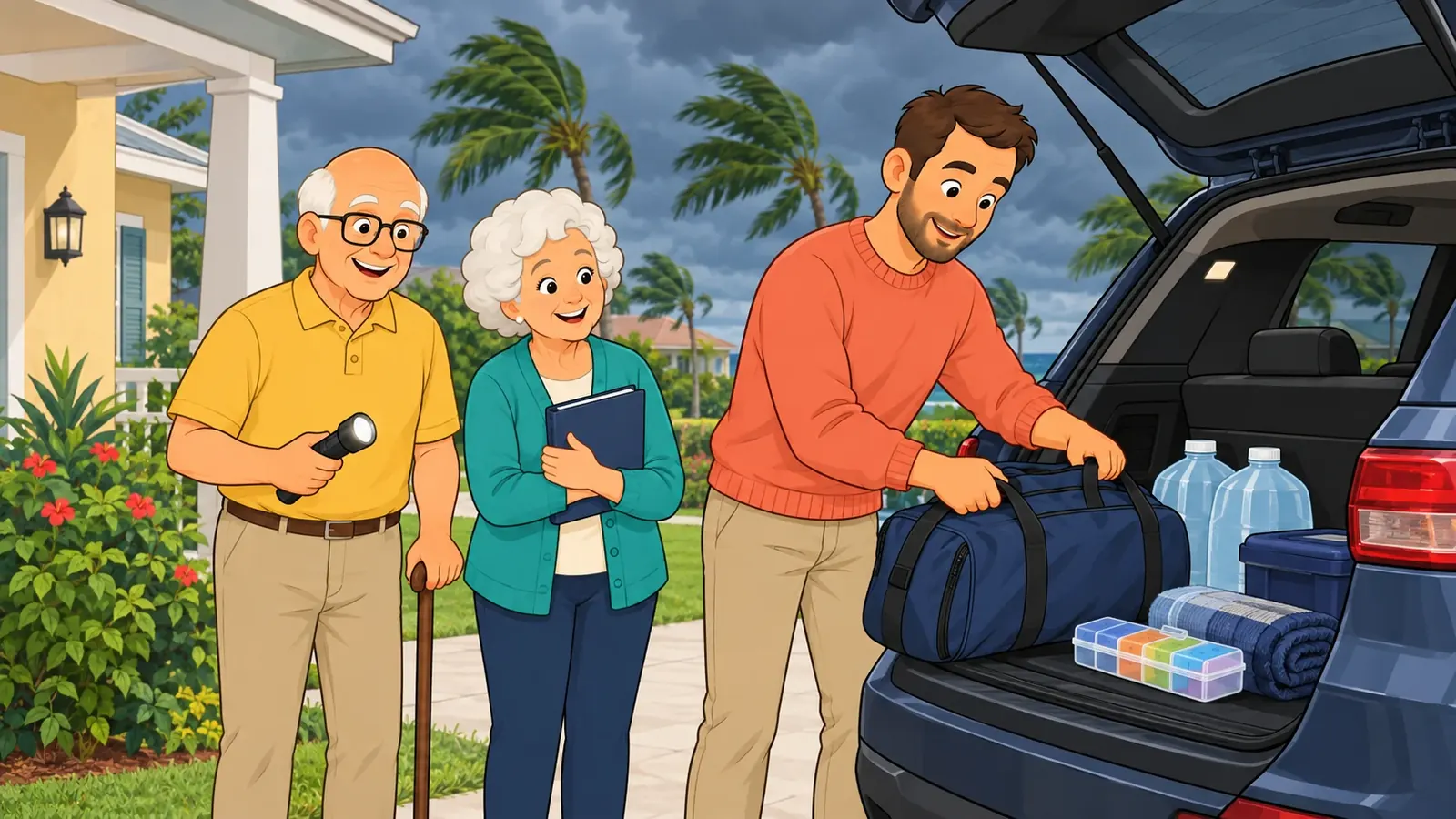
If an older parent in Palm Beach County uses oxygen or powered medical equipment, needs help with daily activities, or has progressing dementia, pre-register them with the county's Special Needs Shelter Program well before a storm, because admission requires pre-approval and space is limited (Palm Beach County OEM). Then pack the power of attorney, health care surrogate and insurance papers, and plan a 30-day medication supply, which Florida law lets insured patients refill early once a hurricane warning or emergency is declared (Fla. Stat. 252.358).
Last checked: The 2026 season ends November 30, 2026, and the 2027 season starts June 1, 2027 (National Hurricane Center). Before June 1, 2027, recheck the county's shelter registration details, renew FPL enrollment and check the facility rules (59A-4.1265 was amended effective January 25, 2026). Utilities send registration notices by May 31 each year (s. 252.355(2)(d)).
For older adults, the hardest part of a hurricane is often the days after: no power for oxygen or air conditioning, closed pharmacies, and papers nobody can find. Most of what helps has to happen before a storm has a name.
Decide where your parent will ride out a storm
Start with the address. Palm Beach County tells residents to "Know Your Zone," meaning their evacuation zone, and to know where they'll go if told to leave (Palm Beach County OEM preparedness). Pick a first choice and a backup:
home, if it's safe from surge and flooding and has a power plan family or friends outside the risk area a hotel inland a public shelter: general, or special needs for those who qualify
Write down who will drive, and when. A parent who no longer drives (see taking the car keys) needs a named driver or a registered county ride.
The Special Needs Shelter Program
Florida requires the state Division of Emergency Management and each county to keep a registry of people who would need help evacuating or sheltering because of a physical, mental, cognitive or sensory impairment (Fla. Stat. 252.355). In Palm Beach County, the Office of Emergency Management runs the Special Needs Shelter Program. Space is limited, and priority goes by need (Palm Beach County OEM).
As of November 2026, admission is limited to people who (SpNS information letter):
depend on electric medical devices (ventilator users aren't accepted) depend on supplemental oxygen get help with daily activities and evacuate with a caregiver have progressing Alzheimer's or dementia, with a caregiver along
Others are referred to a general shelter. Key points:
Apply early: online at ReadyPBC.com/SpNS, at (561) 712-6400, or by mail to the Special Needs Shelter Coordinator, 20 South Military Trail, West Palm Beach, FL 33415 (SpNS palm card). Incomplete applications are delayed. It's not a hospital. The county says it doesn't provide medication, dialysis, oxygen or concentrators (Palm Beach County OEM planning). Caregivers and service animals may stay, and the registration is confidential (Fla. Stat. 252.355). Need only a ride? A person with a disability in an evacuation zone or mobile home park with no transportation can register with Palm Tran at (561) 649-9838, option 3, for a free ride to a general shelter (SpNS information letter).
Medications and early refills
When the county is under a hurricane warning or a state of emergency, or has activated its emergency operations center, insurers licensed by the Office of Insurance Regulation must waive refill time limits and pay for at least a 30-day supply if refills remain. The window is 30 days and can be extended (Fla. Stat. 252.358).
Refills must remain. Get renewals from the doctor in May, not in a storm week. Not every plan is state-regulated. Medicare Part D and many employer plans follow federal rules instead. In a declared disaster or emergency, CMS expects Part D plans to lift "refill too soon" limits, allow out-of-network fills when a network pharmacy isn't reachable, and allow the maximum extended-day supply on request (CMS memo to Part D sponsors; Medicare.gov). Call the plan to confirm. Keep a printed list of every medication, dose, prescriber and pharmacy. Phones die.
Oxygen and power-dependent equipment
For an oxygen concentrator, CPAP, nebulizer or powered wheelchair, plan for days without power:
FPL Medically Essential Service. An FPL residential customer can enroll if a Florida-licensed physician certifies the need. The customer completes Part A, the physician Part B, and it must be renewed every year (FPL). FPL describes it as special notices and referrals (FPL assistance), not a promise that power stays on. The supplier. Ask for backup oxygen cylinders and how long they last. Generators run outdoors only, because of carbon monoxide. The shelter. Oxygen and electric-device users are among those the Special Needs Shelter accepts (SpNS information letter).
The documents to grab
Put copies in a waterproof bag, with scans a relative can reach from out of town:
Durable power of attorney, for insurers, banks and landlords Health care surrogate, living will and any HIPAA release (see our five documents guide) Insurance: homeowners, flood and windstorm policy numbers, plus room-by-room photos taken before the season Health coverage: Medicare, Medicaid and supplement cards, the medication list and doctors' numbers Identity and property: photo ID, the deed, any trust, and benefit award letters
If the POA or surrogate form is missing or very old, fix it before June 1.
Example (hypothetical): A mother, 79, lives alone in a Lake Worth Beach mobile home and uses an oxygen concentrator. In April her son applies for the Special Needs Shelter and enrolls her in FPL's program, with her doctor signing Part B. When a hurricane warning is issued in September, her pharmacy fills 30 days of medication, and he packs her medication list, POA and surrogate form. Her shelter and transport are already arranged.
If your parent lives in a nursing home or ALF
Since 2018, Florida has required backup power plans:
Nursing homes must keep an alternate power source onsite that holds resident areas at or below 81°F for at least 96 hours, with 30 net square feet per resident. They must store 72 hours of fuel and secure 96 hours in a declared emergency (Rule 59A-4.1265). Assisted living facilities must meet the same 81°F, 96-hour standard with 20 net square feet per resident. They store 48 hours of fuel (16 beds or fewer) or 72 hours (17 or more) (Rule 58A-5.036, ratified text).
AHCA says a compliant nursing home submits a "Consumer Friendly Summary" of its plan (AHCA guidance). Ask for it. Also ask whether the facility evacuates or shelters in place, how it contacts families, and how medications and records travel with residents. The rule was amended effective January 25, 2026, to align its emergency-plan language with s. 408.821 (flrules.org). Ask the facility to confirm its current plan meets the rule. When choosing a facility, add these questions to the tour (see nursing home admission).
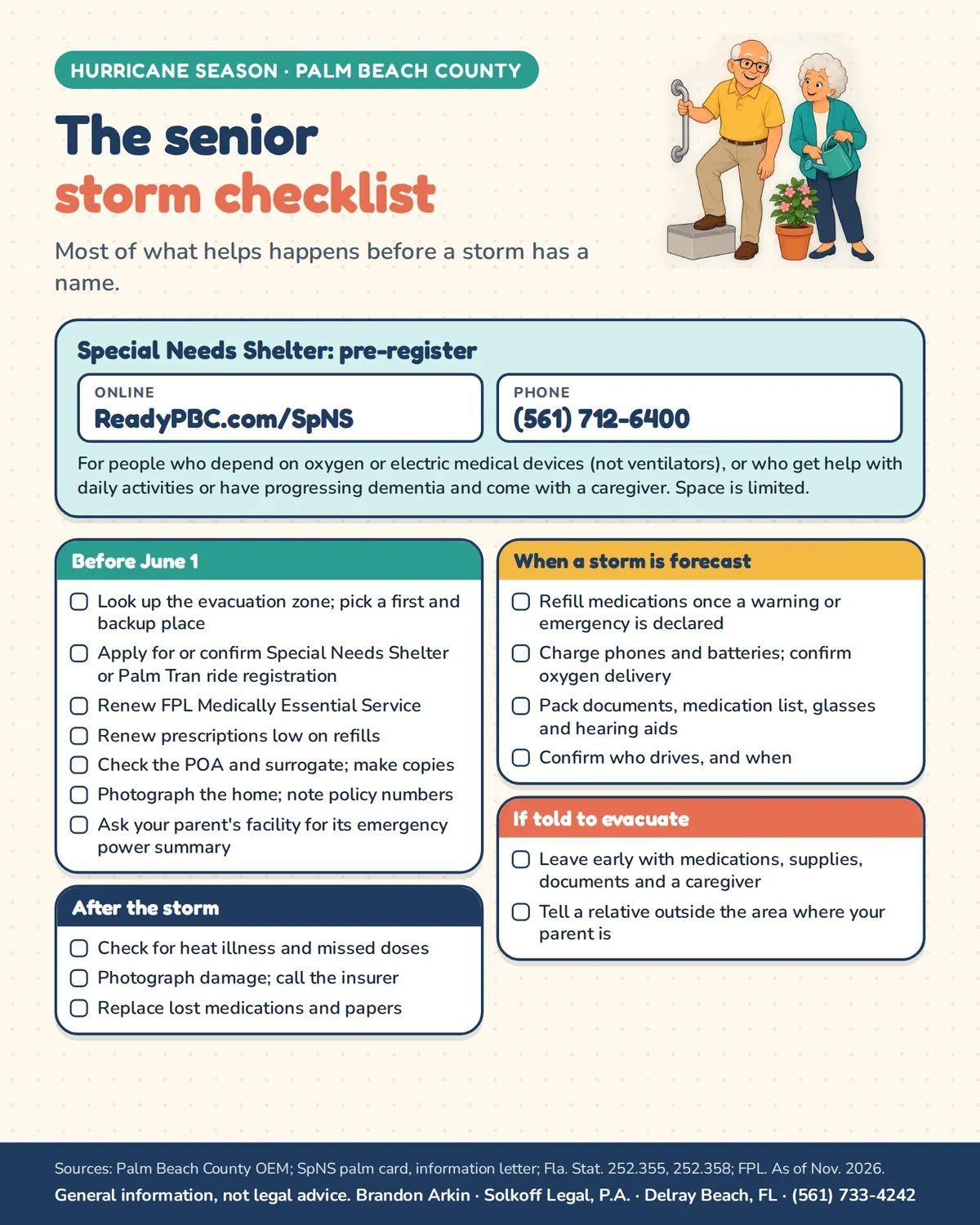
Tool: the senior storm checklist
Tick these off on your own device. Nothing is saved or sent anywhere.
Tick boxes stay on this device. Nothing is saved or sent.
Common questions
How do I register my parent for a special needs shelter in Palm Beach County?
As of November 2026, apply through Palm Beach County Emergency Management. You can apply online at ReadyPBC.com/SpNS, by phone at (561) 712-6400, or by mail to the Special Needs Shelter Coordinator at 20 South Military Trail, West Palm Beach, FL 33415 (SpNS palm card). Admission requires pre-approval and is based on need. Fill in every part of the application, because incomplete forms slow the review. Returning clients can confirm their registration at (561) 712-6362 (Palm Beach County OEM).
Can I go to the special needs shelter with my mother?
Yes. Florida law lets the caregiver of an eligible person shelter with them, along with anyone that caregiver is responsible for (Fla. Stat. 252.355(4)). For someone with progressing dementia, Palm Beach County requires a caregiver to come along (SpNS information letter). Bring her medications, oxygen and supplies, because the county says the shelter doesn't provide them. A service animal is also allowed.
Can my parent get medications refilled early before a hurricane?
Often, yes. Once the county is under a hurricane warning or a state of emergency, or has activated its emergency operations center, Florida-licensed insurers and managed care plans must waive "refill too soon" limits. They must pay for at least a 30-day supply if refills remain (Fla. Stat. 252.358). The rule doesn't create new refills, so renew low prescriptions ahead of time. Medicare Part D and some employer plans follow federal rules, so call the plan to confirm.
Does FPL's medical program mean my parent's power comes back first?
Don't plan on it. FPL's Medically Essential Service is for customers whose physician certifies that they depend on electric medical equipment. It has to be renewed every year with a new physician certificate (FPL). FPL describes it as providing special notices and referrals (FPL assistance). After a major storm, outages can last days. Keep backup oxygen and batteries, and consider the special needs shelter, which accepts people who depend on electric devices or oxygen.
If your family is facing one of these questions, you can reach Brandon Arkin at Solkoff Legal, P.A. at (561) 733-4242.
Related on this site
Talk through the next step
Bring your questions, a list of accounts and any papers a hospital, nursing home or Medicaid office has sent you. Call the Delray Beach office or request a consultation, and I can look at where things stand and what may come next. A phone call or an email does not by itself create an attorney-client relationship.
Solkoff Legal, P.A. · (561) 733-4242